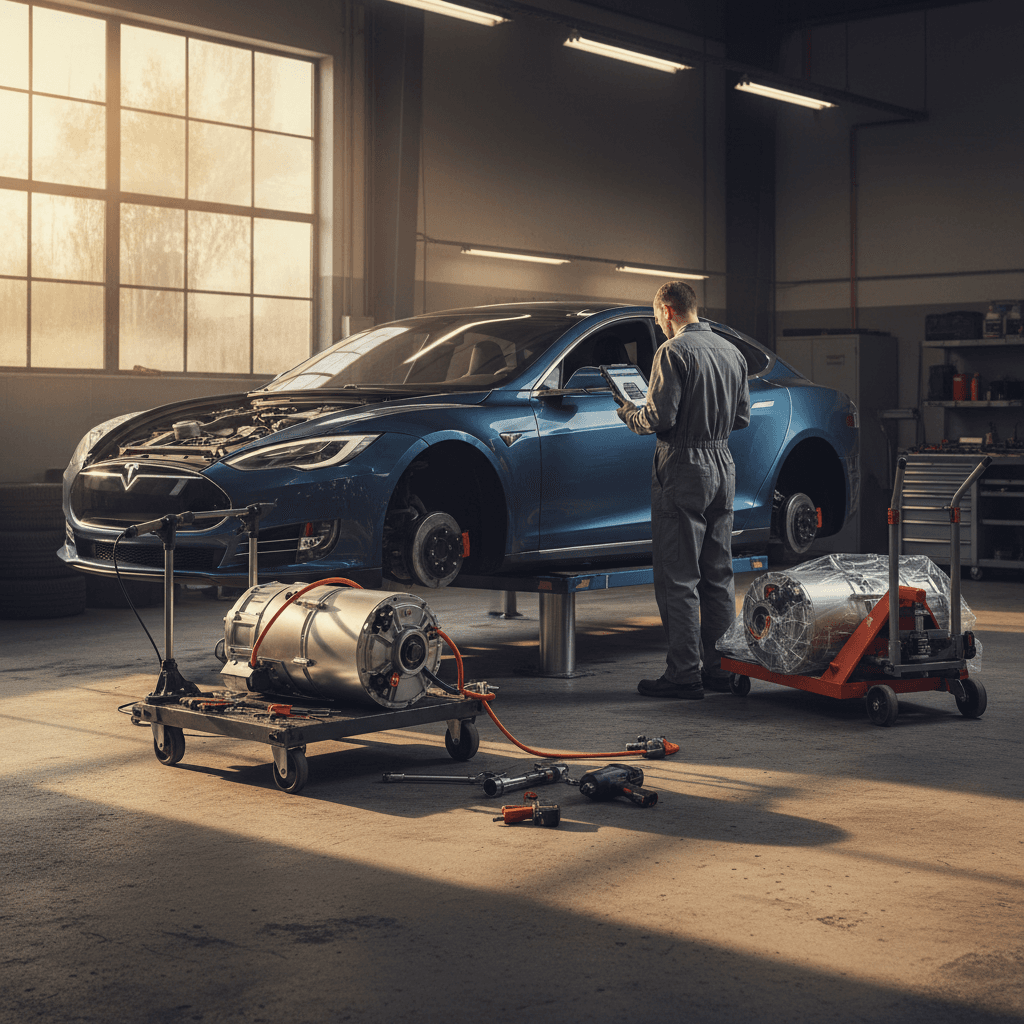
You don’t shop for a luxury EV expecting to budget for a new motor. Yet by 2025, enough Tesla Model S owners have faced drive‑unit replacements that “Model S motor replacement cost” has become its own search term. The good news: motors fail far less often than engines in gas cars. The bad news: when they do, the bill can look like a small used car.
Quick terminology check
Motor replacement cost, in plain English
Model S motor (drive unit) costs at a glance
Those numbers are broad benchmarks, not a menu. Final cost depends on model year, rear vs front motor, whether you’re AWD, labor rates in your region, and whether you go through Tesla or an independent EV specialist.
Sticker shock is common
What actually fails on a Model S motor / drive unit?
Unlike a gasoline engine, the Model S drive unit has very few moving parts. The weak links tend to be bearings, seals, and electronics, not pistons or valves. Early cars (especially some 2012–2015 builds) got a reputation for drive‑unit replacements; later units have been steadily improved.
- Rotor bearings developing play or noise (the infamous “milling” or whining sound that rises with speed).
- Output shaft or differential issues leading to vibration or clunks under load.
- Inverter or power electronics failures that trigger drive‑unit alerts and limp mode.
- Coolant leaks inside or around the drive unit that eventually damage internal components.
- Software or sensor issues that require drive‑unit replacement when components aren’t individually serviceable.
Battery vs motor failures
Real-world Tesla Model S motor replacement costs
Let’s talk numbers. Because Tesla doesn’t publish a fixed national price for drive‑unit replacement, what we have is a mosaic of service invoices and owner reports. They paint a fairly consistent picture.
Typical Model S motor / drive unit replacement pricing (U.S., 2025)
These are illustrative ranges gathered from owner experiences and EV repair specialists, not official quotes. Always confirm with your service provider.
| Scenario | What’s Included | Estimated Parts Cost | Estimated Labor | Typical Total |
|---|---|---|---|---|
| Rear drive unit, RWD Model S, out of warranty | Remanufactured rear drive unit from Tesla, fluids, seals | $6,000–$9,000 | $1,500–$2,500 | ≈ $8,000–$11,500 |
| Rear drive unit, dual‑motor AWD Model S | Rear drive unit assembly, programming, misc. hardware | $7,000–$10,000 | $2,000–$3,000 | ≈ $9,000–$13,000 |
| Front motor (AWD) only | Front drive unit assembly, alignment, programming | $4,000–$7,000 | $1,500–$2,500 | ≈ $5,500–$9,500 |
| Independent EV shop with refurbished unit | Refurbished or used drive unit, new fluids, labor | $3,000–$6,000 | $1,500–$3,000 | ≈ $4,500–$9,000 |
Rear‑motor, dual‑motor, and independent‑shop costs can differ significantly.
Why you sometimes hear “$15,000+”
Geography matters. A Bay Area Tesla Service Center with $250+/hr effective labor will not price the same as a smaller‑market shop. But the overall pattern is clear: if you’re outside the Battery and Drive Unit warranty, a full drive‑unit replacement is major‑surgery money.
When the motor replacement is free: warranty coverage
Here’s the best news in this entire discussion: on most Model S cars sold in the U.S., the Battery and Drive Unit Limited Warranty covers the motor for 8 years and up to roughly 150,000 miles, with a minimum battery‑capacity retention guarantee. If Tesla determines the drive unit has failed due to a covered defect within that window, the replacement is typically no‑charge.
- For many Model S model years, the Battery and Drive Unit warranty is 8 years / 150,000 miles (check your specific paperwork).
- The warranty is tied to the car, not the first owner, so it transfers when the vehicle is sold.
- Tesla has historically used remanufactured drive units for warranty replacements, similar to how engine swaps work in the ICE world.
Check your car’s actual warranty, not the internet’s
If you’re on the edge of warranty mileage, be cautious. Recent lawsuits have alleged that odometer readings on some Teslas may be inflated, which would cause warranties to expire sooner than expected. Whatever the legal outcome, it’s smart to treat your odometer reading as the hard limit and not something to “run right up against” before addressing symptoms.
Warranty claims aren’t automatic
Tesla service vs independent shop vs refurbished unit
Tesla Service Center
- Pros: OEM parts, software access, official procedures, easy app scheduling.
- Cons: Typically highest cost out of warranty; limited willingness to repair at component level.
- Best for: Cars still under Battery and Drive Unit warranty or complex electronic faults.
Independent EV Specialist
- Pros: Can source refurbished or used drive units; sometimes willing to repair specific components (bearings, seals).
- Cons: Coverage depends on shop warranty; quality varies; fewer locations.
- Best for: Older, out‑of‑warranty Model S where cost control matters.
Refurbished / Salvage Unit
- Pros: Lowest parts cost; can dramatically undercut Tesla’s list price.
- Cons: Unknown history, variable refurbishment quality, may complicate future warranty or resale.
- Best for: Budget builds and high‑mileage cars you plan to keep, not flip.
Component-level repairs are emerging
Early warning signs your Model S motor is in trouble
An EV doesn’t telegraph its pain the way a gas car does. There’s no misfire, no clouds of smoke. A failing drive unit can feel deceptively subtle, until it suddenly isn’t.
Common Model S drive-unit symptoms to watch for
Catching issues early can mean more options and less collateral damage.
New whining or “milling” noise
Shudder, vibration, or clunks
Drive-unit warnings
Sudden power loss or limp mode
Fluid leaks around the motor
Uneven feel at constant speed
Use your range as a health bar
How to reduce your risk of a big motor bill
Practical ways to protect your Model S drive unit
1. Don’t ignore new noises
A faint whine that appears out of nowhere and slowly gets louder is not “normal EV sound.” Document it, record a clip, and schedule service while you’re still under warranty if possible.
2. Keep software up to date
Drive‑unit control is all software. Updates can improve thermal management or diagnostics. Delaying them won’t save you from a hardware issue, but it can deprive you of important protections.
3. Avoid repeated hard launches when hot
The drive unit loves torque, but repeated full‑throttle launches on a hot day can still stress bearings and electronics over time. Enjoy the performance; don’t abuse it every stoplight.
4. Inspect underbody and seals periodically
During tire rotations or annual checkups, ask the tech to look for leaks, torn boots, or damaged mounts around the rear subframe and drive unit.
5. Log issues in the app
If you hear or feel something odd, note the <strong>time, speed, and conditions</strong> in the Tesla app. A paper trail helps if you later need to argue that a failure started under warranty.
6. Consider an extended plan, carefully
Some third‑party providers and legacy Tesla Extended Service Agreements can reduce financial risk, but read the fine print: many exclude wear items and certain failures.
Good news for typical owners
Buying a used Model S? How to judge motor risk
A used Model S can be one of the best performance‑per‑dollar deals in the EV world, if you go in with clear eyes about the battery and drive unit. The motor is not a consumable like brake pads; it’s a major capital component. You want as much visibility into its health as you can get.
Questions to ask before you buy
- Any past drive‑unit replacements? Ask for invoices or service history screenshots.
- Current odometer and in‑service date? You’re reverse‑engineering how much Battery and Drive Unit warranty remains.
- Any current noises or warnings? Take a highway test drive, windows up and down.
- How was the car used? High‑mileage highway commuter is usually easier on the drive unit than abusive stop‑light drag racing.
How Recharged fits into this
Every EV sold on Recharged comes with a Recharged Score Report that includes verified battery health diagnostics and a clear view of the vehicle’s history. While no one can promise a drive unit will never fail, transparent data about how the car has been used and charged is the next best thing.
Add in expert EV‑specialist support, fair‑market pricing, financing, trade‑in options, and nationwide delivery, and you avoid the blind‑date experience that too often comes with private‑party Teslas.
Look beyond Carfax
Tesla Model S motor replacement FAQs
Frequently asked questions about Model S motor replacement
Bottom line: how worried should you be?
If you own, or are eyeing, a Tesla Model S, a motor (drive‑unit) failure is one of the few items that can turn a smooth ownership story into a very expensive plot twist. The odds of it happening outside warranty are low, but the financial impact is high enough that you’re smart to think about it now, not later.
Treat strange noises and warning messages as early warning flares, not background scenery. Know your Battery and Drive Unit warranty dates. If you’re buying used, insist on transparency about battery health, past drive‑unit work, and remaining coverage, exactly the kind of data‑driven picture you get with a Recharged Score Report.
Do that, and the Model S is still one of the standout long‑range EVs you can own: quiet, devastatingly quick, and, when its major components are healthy, surprisingly low‑maintenance. The key is making sure the savings on fuel and oil changes aren’t erased by one unplanned line item with four zeros in it.