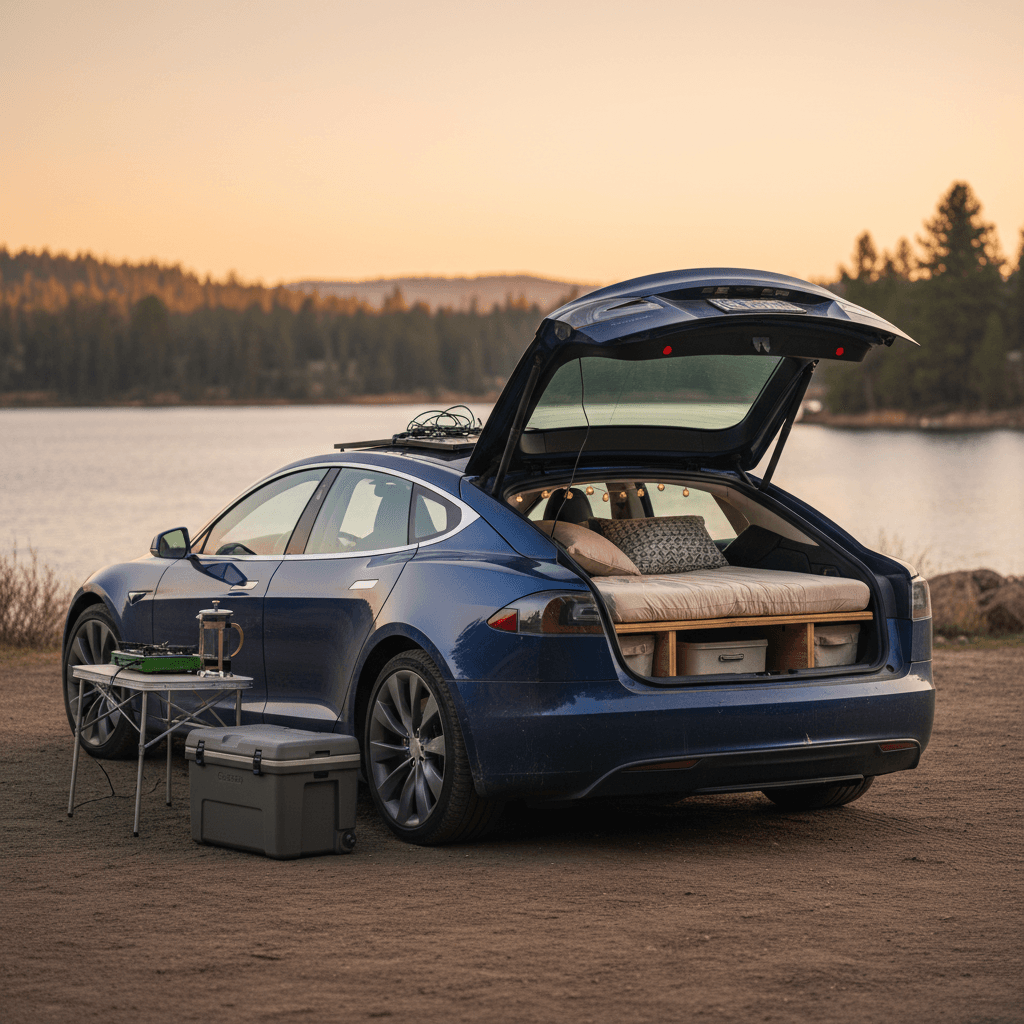
A Tesla Model S might not look like a traditional camper, but with the right setup it can be one of the most comfortable ways to sleep on the road. Thanks to a flat cargo area, generous storage, and built‑in Camp Mode, a well‑planned Tesla Model S camping setup gives you climate‑controlled sleep, quiet power and zero exhaust, no tent required.
Who this guide is for
Why camping in a Tesla Model S actually works
- Flat cargo area: With the rear seats folded, most Model S generations have roughly 73–76 inches of usable length diagonally, enough for most people to lie flat with a bit of creativity on pillow placement.
- Built‑in climate control: Camp Mode keeps the HVAC and 12V outlets running while the car is in Park, so you can sleep at a comfortable temperature without idling an engine.
- Low noise and vibration: No engine rumble or generator drone, just the faint whir of fans and a heat pump when they’re running.
- Tons of hidden storage: Frunk, deep trunk well, and side cubbies let you stash gear out of sight so the sleeping area can stay clean and simple.
- Digital entertainment: If you’re stuck in foul weather at a trailhead, Tesla Theater and Arcade turn the cabin into a tiny living room.
Model S vs. Model 3/Y for camping
Understanding Camp Mode and battery use
Before you start buying gear, you need to understand how Camp Mode works on the Model S and what it does to your usable range. That’s the difference between a great night’s sleep and waking up early to find a charger.
Camp Mode basics for Model S
What it does, and what it doesn’t
Keeps climate & power on
Camp Mode keeps HVAC running while the car is in Park and not in Low Power Mode. It also powers the USB ports and 12V outlet so you can charge phones or run low‑draw devices.
Screen stays awake
The touchscreen stays on with a Camp Mode message, and you can use music, Tesla Theater, and apps. Expect some portion of overnight energy use to show up as "screen" time in the energy graph.
Changes security behavior
While in Camp Mode, Sentry Mode, the alarm system, and walk‑away locking are disabled so you can move around without triggering alarms. You’ll need to lock the doors manually if desired.
Watch for Low Power Mode
Real‑world Camp Mode energy use
Dial in your temperature setpoint
Planning range and charging for Model S camping trips
Camping in a Model S is mainly a planning problem: you’re budgeting energy for both driving and "living." Here’s a simple way to structure trips so Camp Mode never becomes a liability.
Sample overnight energy budgets
Approximate planning numbers for a mid‑pack Model S (70–90 kWh usable), assuming you arrive with 60% state of charge.
| Scenario | Outside Temp | Arrival SOC | Planned Camp Duration | Expected SOC in Morning | Notes |
|---|---|---|---|---|---|
| Cool shoulder‑season night | 45–60°F | 60% | 8 hours | 50–54% | Low HVAC load; great for boondocking if next charger is close. |
| Summer night, warm but not brutal | 65–80°F | 60% | 8 hours | 45–50% | Plan conservatively and keep cabin at 70–72°F. |
| Heat wave or deep cold | >90°F or <20°F | 60% | 8 hours | 40–48% | Pre‑cool/heat while plugged in and arrive with extra buffer. |
Adjust these based on your pack size, weather, elevation and driving style.
Battery and charging planning checklist
1. Know your usable pack size
Different Model S trims have very different usable kWh. A 60 or 70 kWh pack gives you less overnight margin than a 90 or 100. A <strong>Recharged Score battery health report</strong> can help you understand how much usable capacity your specific used Model S still has.
2. Arrive with a buffer
Aim to reach your campsite or trailhead with at least <strong>50–60% state of charge</strong> if you aren’t plugged in. That gives you room for an overnight stay and a comfortable drive to the next charger or town in the morning.
3. Favor sites with power when you can
Even a standard 120V, 15A outlet (≈1.4 kW) at a campsite can almost offset Camp Mode usage, especially in mild weather. A 30A or 50A RV pedestal can easily add range while you sleep with climate control on.
4. Pre‑condition while plugged in
If you can plug in at the site or at a charger before parking for the night, run the cabin up or down to your ideal sleep temperature while connected. The pack becomes a thermal buffer, and overnight HVAC use drops.
5. Check terrain before boondocking
If you’re camping far from chargers, remember that long climbs, dirt roads and winter conditions can add 20–40% to your consumption compared to flat freeway driving. Build that into your pre‑camping SOC target.
Choosing a mattress and sleeping platform for your Model S
The most important part of your Tesla Model S camping setup is the sleep surface. The cargo floor is not perfectly flat, and the transition from trunk to folded seats needs to be bridged if you want a real‑bed feel.
Option 1: Inflatable camping mattress
An inflatable or self‑inflating camping pad is the simplest choice. Brands like Therm-a-Rest specialize in durable, packable pads long enough for a 6' sleeper.
- Pros: Packs small; weight is low; easy to adjust firmness.
- Cons: Can feel bouncy; doesn’t fully smooth out height steps; vulnerable to punctures from debris in the cargo area.
Option 2: Foldable foam mattress
Folding memory‑foam or high‑density foam mattresses (often sold for guests or van builds) are extremely popular for EV camping.
- Pros: More “bed‑like” feel; bridges seat/trunk gap well; quiet when you move.
- Cons: Bulkier to store; model‑specific versions for Model S are harder to find than for Model 3/Y, so you may need to trim or fold creatively.
Know your interior dimensions
Sizing a mattress for Tesla Model S
A good starting point for mattress selection. Always confirm against your specific year and interior.
| Area | Recommended Width | Recommended Length | Notes |
|---|---|---|---|
| Shoulders/torso | 36–40 in | 70–72 in | Aim for nearly full cargo width; too narrow and you’ll roll off the edge. |
| Hips | 34–38 in | 70–72 in | Narrower is okay if you sleep on your side. |
| Feet | 30–34 in | 65–70 in | Tapered mattresses can save space and make hatch closure easier. |
| Thickness | 3–4 in | , | Thinner pads pack better; thicker foam evens out bumps. 3–4" is a good Model S compromise. |
For tall sleepers, prioritize diagonal length and consider placing pillows slightly between the front seats.
Do you need a hard platform?
Step-by-step: How to set up your sleeping area
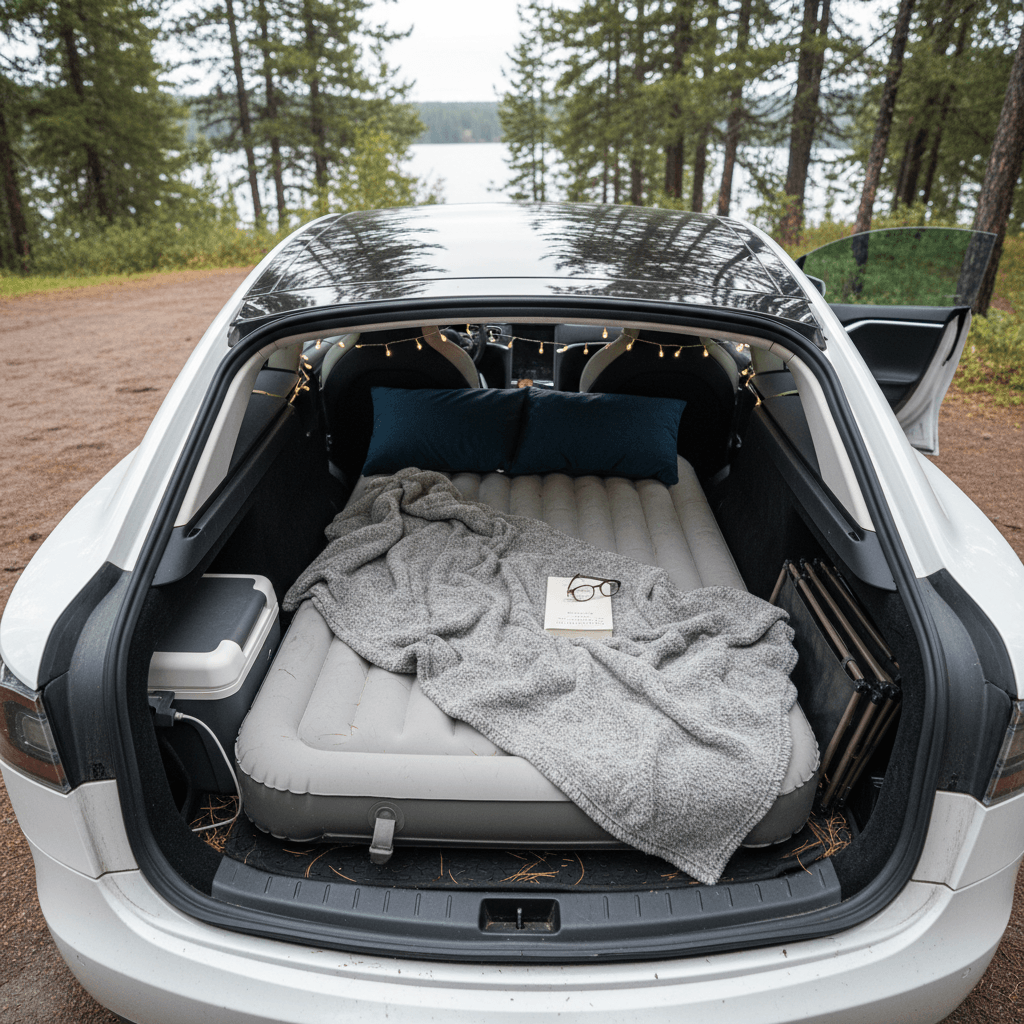
Model S camping setup in 10 steps
1. Choose your parking orientation
If possible, park so the car is level or with a slight head‑up incline. This makes sleep more comfortable and keeps doors and hatch from slamming shut unexpectedly.
2. Move the front seats forward
Slide both front seats forward and tilt the backs upright enough to maximize rear cargo length. On older Model S seats, avoid pushing so far forward that your knees jam into the dash when you later drive away half‑asleep.
3. Fold the rear seats flat
Lower the split rear backrests. Check for any seatbelt buckles or hard objects that could poke through your mattress and reposition or cover them as needed.
4. Lay down a protective base
If you’re using a foam or inflatable mattress, start with a tarp, yoga mat or thin closed‑cell foam pad. It protects the mattress and helps hide small steps between seatbacks and trunk floor.
5. Position the mattress
Place your mattress so your head is towards the front seats and your feet towards the hatch. This gives you the most usable length and prevents cold drafts directly at your face when you open the hatch at night.
6. Add bedding and pillows
A fitted sheet keeps foam mattresses from grabbing clothing, and a light duvet or sleeping bag lets you turn Camp Mode up a few degrees to save energy.
7. Stash your gear around the edges
Use soft duffel bags or packing cubes along the sides and at the foot of the bed to keep important items close without crowding your sleeping space.
8. Set up window shades and privacy curtains
Install reflective or fabric shades on side windows and pano roof if you have one. A simple tension rod behind the front seats with a curtain or blanket creates a "bedroom" area in back.
9. Engage Camp Mode
With the car in Park, tap the fan icon, set your desired temperature and select <strong>Camp</strong>. Confirm that Sentry Mode is off and that the car shows Camp Mode active before locking the doors.
10. Dim interior lights and screen
Lower display brightness and disable dome lights on door open if you’ll be in and out. Some owners throw a light scarf or T‑shirt over the screen for a darker cabin while still leaving it on for Camp Mode.
Organizing gear and using Model S storage well
One advantage the Model S has over smaller EVs is sheer storage volume. The key is using that space intelligently so you aren’t climbing over gear every time you change clothes or grab a snack.
Smart storage zones in a Model S camper
Keep the sleeping area for sleeping, and stash everything else strategically.
Frunk: clean, dry storage
Great for items you don’t need constantly: camp chairs, spare shoes, extra water, tools, tire repair kits. Use soft bags so they don’t rattle.
Rear under‑floor well
Use the deep well in the trunk for heavy items: cooking gear, food bins, recovery gear, power strips, and bulky clothing. A small organizer keeps this from becoming a junk pit.
Cabin & rear footwells
Store daily‑use items (toiletry kit, electronics, snacks) in small bags that tuck into the rear footwells or beside the mattress. They’re easy to reach from bed, but don’t crowd your sleeping surface.
Packing principle: modular, not massive
Privacy, light and climate control tips
Nothing ruins a good night of EV camping faster than bright parking‑lot lights or strangers peering in. Model S glass is expansive, so plan for both light and privacy before you leave home.
Managing privacy & light
- Window shades: Custom‑fit or DIY Reflectix panels for side windows and hatch glass block light and add insulation.
- Roof shade: If you have a panoramic roof, a reflective shade dramatically reduces solar load in summer and keeps warmth in during shoulder season.
- Cabin divider: A spring‑loaded curtain rod behind the front seats with a dark curtain creates a separate sleeping area and hides pillows and bedding when parked in town.
Tuning climate for comfort and efficiency
- Use your bedding: Sleep with a light blanket or quilt so you can run Camp Mode 2–3°F warmer in summer and a few degrees cooler in winter.
- Vent a crack if needed: In temperate weather you can crack a rear window slightly for fresh air; keep bug screens or mesh inserts handy for buggy areas.
- Watch condensation: Two people breathing in a sealed car will fog glass. Running HVAC on auto usually manages this, but bring a small microfiber towel just in case.
Never sleep without ventilation or climate control in extreme conditions
Safety and etiquette when camping in a Tesla
EV camping comes with a different set of safety and etiquette expectations than tent or RV camping. The Model S gives you quiet, fume‑free shelter, but it’s still a vehicle in a shared space.
- Respect campground rules: Not all parks or private campgrounds allow sleeping in vehicles outside designated areas. Check terms ahead of time and be transparent at check‑in, "I sleep in my vehicle" is increasingly common and often accepted.
- Be a good Supercharger citizen: Sleeping at a Supercharger stall should be a last resort, not the default. If you must, move the car once your session completes so others can charge.
- Use dark‑mode lighting: Keep exterior lights off and interior lighting low in quiet campgrounds. Avoid loud door slams and music late at night.
- Keep a basic safety kit: Pack a headlamp, reflective triangle, compact first‑aid kit and a charged portable battery pack, just in case.
- Know how to exit quickly: Practice unlocking and opening doors and the hatch from inside in the dark before your first trip, especially if you’re using curtains or shades that might get in the way.
Battery and fire safety
Example Model S camping loadout
To make this concrete, here are two example packing lists: one for casual weekend trips and one for longer, more self‑supported adventures. Adjust for your climate and hobbies, but keep the principle the same, everything has a home and a purpose.
Two Model S camping setups to copy
Weekend warrior (campground + hookups)
Foldable 3–4" foam mattress cut or folded to roughly 38" × 72".
Two pillows, light duvet, and a fitted sheet that stays on the mattress full‑time.
Reflectix or fabric shades for rear side windows and hatch glass.
Compact duffel with clothes stowed in rear footwell.
Small tote with toiletries and chargers beside mattress.
Camp chairs and small folding table in frunk.
Compact induction or single‑burner stove and kitchen kit in rear under‑floor well (used outside the car).
12V or USB lantern and a headlamp for walks to restrooms.
Long‑haul road trip (mixed campgrounds + boondocking)
Custom or modular platform over folded seats with 3" foam mattress on top.
Thicker bedding and extra blanket for shoulder‑season or mountain nights.
Full window shade set including pano‑roof shade.
Soft storage cubes for clothing and food, stacked in the rear well and along sides of mattress.
Compact cooler or 12V fridge (secured in trunk well or behind front seats).
Small shovel, traction boards and basic recovery kit if exploring rough forest roads.
Extra water (at least 2–3 gallons) and simple dry‑food reserves.
120V extension cord and adapters for different campground outlets, plus a slim power strip for devices.
FAQ: Tesla Model S camping setup
Common questions about camping in a Model S
Is a used Model S a good EV for camping?
If you’re looking at EVs through a camping and road‑trip lens, a well‑sorted used Tesla Model S is a compelling option. You get a long wheelbase, real hatchback practicality, and an integrated Camp Mode experience that no gas car can really match. The catch is that range and comfort depend heavily on pack health and how previous owners treated the car.
That’s where buying from a specialist matters. At Recharged, every used EV comes with a Recharged Score Report that quantifies battery health, charging history and fair‑market pricing, so you know exactly how much real‑world range you can count on before you start building out your Tesla Model S camping setup. Add in flexible financing, trade‑in options, and nationwide delivery, and you can go from browsing to your first overnight at a trailhead without ever setting foot in a traditional dealership.