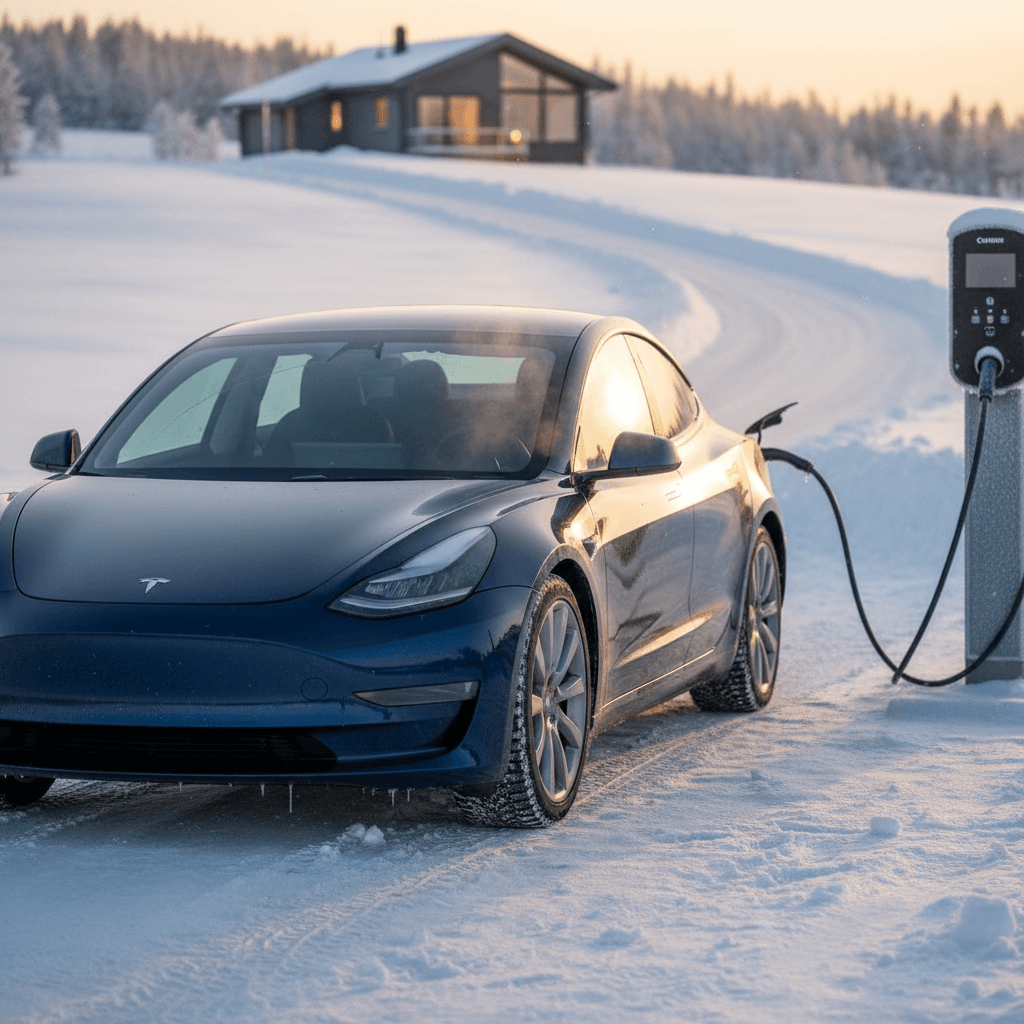
If you’ve driven a Tesla Model 3 in cold weather, you already know the story: the thermometer drops, the blue snowflake shows up, and your rated miles melt faster than the snow on the hood. The good news is that most of that loss is predictable, manageable, and, for road trips, plan‑around‑able once you understand what’s really happening.
Quick answer: how much range do you lose?
Why cold weather hits Model 3 range so hard
Cold weather doesn’t just make your Model 3 feel sluggish, it changes how the battery chemistry works. Lithium‑ion cells are happiest in a mild temperature window. Drop below freezing and the battery’s internal resistance rises, so it can’t deliver or accept energy as efficiently. At the same time, you’re asking it to heat the cabin, the battery pack, and your cold-soaked seats and glass.
- Battery chemistry slows down: At low temps, the pack can’t access its full usable capacity and needs energy to warm itself up before it performs normally.
- Cabin heat is paid for in miles: Unlike a gas car, there’s no “free” waste heat from an engine. Your Model 3 runs a heat pump or resistive heater from the high‑voltage battery to warm the cabin.
- Short trips are the worst: Warming up a cold pack and cabin is a big fixed cost. If you only drive a few miles, that overhead is spread over very little distance, so your effective miles per kWh tank.
- Higher rolling resistance and drag: Cold air is denser and winter tires are stickier, so it takes more energy just to push the car through the air and over the road.
About that blue snowflake icon…
Tesla Model 3 EPA range vs real winter range
To talk about Model 3 range in cold weather, we need a baseline. EPA ratings are measured in controlled, mild conditions, not in a January crosswind on I‑94. Recent Model 3 trims cluster roughly in the low‑to‑mid‑300‑mile EPA range for the long‑range variants, and just over or under 300 miles for standard‑range versions. Exact numbers vary by year and battery, but the pattern is consistent: superb efficiency in mild temps, and still better-than-average behavior in the cold, just not magic.
Recent Tesla Model 3 trims: EPA vs typical winter range
Approximate real‑world winter range estimates assume steady highway driving around freezing temperatures, starting with a warm battery and cabin.
| Trim (recent years) | EPA rated range* | Mild weather real‑world | Typical winter (around 32°F) | Harsh winter (single digits°F) |
|---|---|---|---|---|
| Model 3 RWD / Standard | ~300–320 mi | ~260–280 mi | ~190–230 mi | ~170–200 mi |
| Model 3 Long Range AWD | ~330–360 mi | ~280–310 mi | ~210–250 mi | ~190–220 mi |
| Model 3 Performance AWD | ~290–310 mi | ~240–260 mi | ~180–210 mi | ~160–190 mi |
These aren’t lab numbers; they’re realistic ballparks to help you plan your winter drives.
About the numbers
How much range you’ll lose by temperature
Different studies and fleet data sets converge on the same big picture: as the thermometer drops, EVs generally lose 20–45% of their range compared with mild weather, depending on temperature and use case. The Model 3 usually sits on the better side of that spectrum thanks to its efficient drivetrain and good thermal management, but physics still wins.
Typical Tesla Model 3 winter range loss
Remember that percentage loss isn’t the whole story. On a long highway leg with a warmed‑up battery, your Model 3 might do far better than a series of five‑mile errands in town at the same temperature. That’s why two owners in the same city can report wildly different winter range experiences.
A simple way to sanity‑check your winter range
City vs highway winter driving: which kills range faster?
Short‑trip city driving
From the car’s point of view, this is the worst‑case scenario in winter:
- Battery and cabin start cold every time.
- Preheating energy is spread over just a few miles.
- You stop often, so there’s less airflow to help warm the pack and drivetrain.
If your life is a loop of school drop‑off, grocery runs, and errands, don’t be surprised if your indicated consumption climbs 30–40% or more on the coldest days.
Steady highway driving
Once the battery and cabin are warmed up, your Model 3 actually settles into a more predictable groove:
- Thermal systems don’t have to work as hard to maintain temperature.
- Most of the loss is from denser cold air and tire drag.
- On a long leg, you might see only 20–25% range hit around freezing.
So the paradox is this: long winter trips are often easier to manage than lots of short ones, as long as you plan charging stops well.
Highway trap: speed still matters
Charging your Model 3 in cold weather
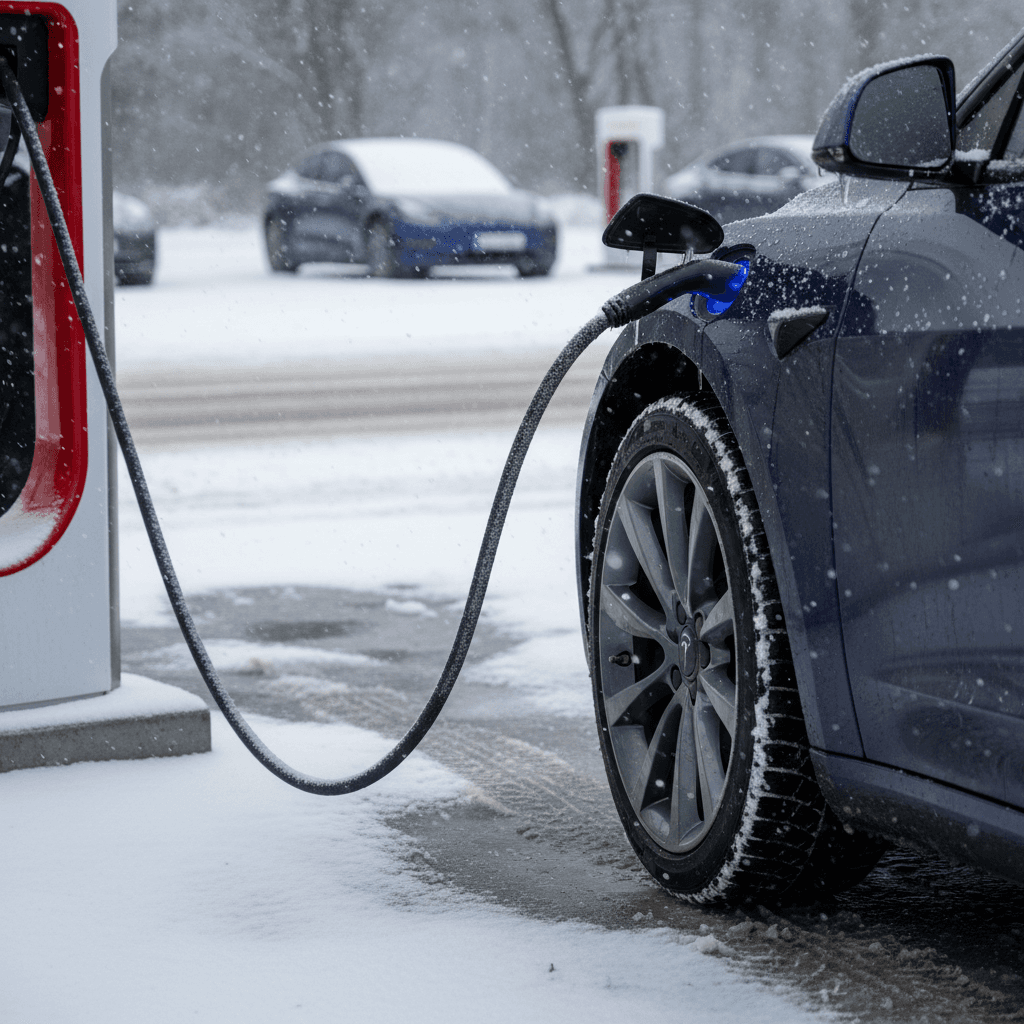
Range is only half the cold‑weather story. The other half is how your Model 3 charges when it’s cold. A cold battery resists fast charging, so the car will limit power until the pack warms up. That’s why you might see painfully low Supercharger speeds on a frigid morning if you just hop in and drive straight to the station.
Cold‑weather charging basics for Tesla Model 3
Use your car’s software to do the hard work for you.
1. Always navigate to the Supercharger
When you set a Tesla Supercharger as your destination, your Model 3 automatically preconditions the battery. It uses drive time to gently heat the pack so it can accept high power as soon as you plug in.
2. Precondition before you leave
For home or Level 2 charging in the cold, use the Scheduled Departure feature. The car will warm the pack and cabin so you can unplug and leave with a warm battery and full regen.
3. Keep it plugged in
In real cold, think of your Model 3 like a smartphone: leave it plugged in overnight. That lets the car maintain battery temperature without depleting your driving range.
Don’t judge the car by its first 5 minutes at a charger
Winter driving tips to protect your range
7 practical ways to stretch Model 3 range in the cold
1. Preheat while plugged in
Use the app or Scheduled Departure to warm the cabin and battery while you’re still connected to home power. That shifts the energy cost from your battery to the grid and preserves more driving range.
2. Use seat and wheel heaters first
Seat and steering‑wheel heaters sip power compared with blasting cabin air at max. Set the cabin a couple degrees lower than you would in a gas car and let the contact heat keep you comfortable.
3. Knock snow and ice off the car
Brushing snow off the roof, hood, and wheel wells isn’t just polite, it reduces weight and drag. Packed snow around tires also increases rolling resistance and hurts efficiency.
4. Check your tire pressure
Cold temps drop tire pressure. Under‑inflated tires add drag and sap range. Check pressures when temperatures swing, and set them to Tesla’s recommended values for your wheels.
5. Drive smoother and a bit slower
Aggressive acceleration and high speeds are range killers, especially in the cold. Use Chill mode if you like, and aim for steady speeds where traffic allows.
6. Plan a bit more buffer
In winter, don’t plan to roll into a charger with 3% state of charge. Give yourself 10–20% buffer, especially in unfamiliar areas or when wind or snow is in the forecast.
7. Use Eco routes when it makes sense
If your nav suggests a slightly slower but shorter route, it may save energy. Avoid long detours or big climbs if range is tight, elevation and headwinds stack onto winter losses.
Realistic winter goal: consistency, not perfection
Planning winter road trips with a Model 3
A lot of would‑be EV owners worry about taking a Model 3 on a ski trip or a long holiday drive in January. The reality: with a little planning, the car is usually ready before you are. The key is to assume 20–35% less effective range than your summer road‑trip numbers and to use Tesla’s routing tools to your advantage.
Example: planning a 230‑mile winter leg in a Model 3 Long Range
How the same drive looks in October vs January with smart planning.
| Scenario | Assumed efficiency | Usable range estimate | Trip result |
|---|---|---|---|
| Mild weather, 65 mph, light heat | 250 Wh/mi | ~300 miles | One 230‑mile leg is comfortable with buffer. |
| Winter, 25°F, 70 mph, normal heat | 320 Wh/mi | ~235 miles | Same 230‑mile leg is tight, plan a short top‑up or slow down. |
| Winter, 25°F, 65 mph, careful heat, preconditioned | 290 Wh/mi | ~260 miles | 230‑mile leg is comfortable again with planning. |
Numbers are approximate but give you a feel for how to think about winter range and charging stops.
Let the car do the math
Does cold-weather driving hurt your battery long term?
It’s natural to worry that every cold snap is shaving life off your battery. The encouraging news is that most of winter’s impact is temporary performance loss, not permanent degradation. In fact, very high heat is generally tougher on lithium‑ion batteries over the long haul than the cold.
- Cold temperatures temporarily reduce usable capacity and power, but that capacity comes back when the pack warms up.
- Tesla’s thermal management system actively warms the battery when needed, protecting it from the harshest conditions.
- Long‑term degradation is driven more by high average state of charge, frequent DC fast charging, and high temperatures than by reasonable winter use.
The real winter battery risk isn’t driving
Used Model 3 buyers: what to know about winter range
If you’re shopping for a used Tesla Model 3 in a cold‑weather state, it pays to think about winter up front. A car that feels generous in July can feel merely adequate in January, especially if you take a lot of short hops or carry a full load of passengers and gear.
Winter questions to ask when buying a used Model 3
You’re not just buying a car, you’re buying its cold‑weather habits.
How healthy is the battery?
Ask for a battery health report or, on a test drive, reset a trip meter and log Wh/mi over 20–30 minutes. Healthy packs mean more cushion when winter drains your miles.
Every Model 3 on Recharged includes a Recharged Score battery health report, so you know exactly what you’re getting before the first snow flies.
How will you actually use it in winter?
Long highway commutes to a ski town? School‑run stop‑and‑go? Be honest about your worst‑case days. If your typical winter drive pattern is demanding, you might prefer a Long Range trim over Standard, even if the latter looks fine on paper.
Where Recharged fits in
Ready to find your next EV?
Browse VehiclesFAQ: Tesla Model 3 range in cold weather
Common questions about Model 3 winter range
Bottom line on Model 3 range in winter
Cold weather is tough on every electric vehicle, and the Tesla Model 3 is no exception. But once you understand that you’ll typically see 20–35% less range in real winter conditions, and that much of that loss can be managed with preconditioning, smart climate use, and modest speeds, the mystery goes away. What’s left is a car that still does the daily grind and the big winter road trip with very little drama.
If you’re living with a Model 3 already, think of winter as a season to tweak your habits, not a reason to panic. And if you’re shopping for a used Model 3, especially through a marketplace like Recharged, lean on tools like the Recharged Score battery health report and EV‑specialist guidance to make sure the range that looks good on paper will still feel good on a frosty January morning where you live.