You’d be forgiven for assuming that dropping thousands of dollars on Tesla Full Self‑Driving (FSD) would make your car a resale gold mine. After all, software is where the magic is, right? In 2026, though, the answer to “Is Tesla FSD worth it for resale?” is a lot more complicated, and, for most owners, leaning toward **no**.
Key takeaway up front
Overview: Is Tesla FSD Worth It for Resale?
FSD & Resale at a Glance (2026 Snapshot)
Put simply: **FSD used to be a clearer resale win than it is today**. When FSD was a $10,000–$15,000 option permanently tied to the car, used buyers *knew* they were inheriting a pricey piece of software. That justified real premiums on certain VINs. Now, between Tesla’s move toward subscriptions, limited‑time transfer programs, and new rules that strip FSD from certain package cars when they’re sold, the value story is murkier.
So instead of asking, “Does FSD add resale value?” a better question in 2026 is: “Under what specific conditions does FSD actually help me at resale, and by how much?” The rest of this guide breaks that down in plain English, whether you’re selling your Tesla or shopping for a used one on a marketplace like Recharged.
How Tesla FSD Is Sold in 2026
To understand resale, you first need to understand how FSD is being sold today, because that’s what shapes buyer expectations.
Two Main Ways FSD Shows Up on a Tesla Today
The way FSD was acquired originally matters more than most sellers realize.
1. Legacy one‑time purchase (older cars)
On earlier Model 3, Y, S, and X builds, owners could pay a single lump sum for FSD, at various points priced up to $15,000. That license was typically tied to the VIN, not the person, which meant early on it usually stayed with the car when sold.
These are the cars that historically commanded real resale premiums when FSD was included.
2. Subscription or non‑transferable perks (newer cars)
As of early 2026, Tesla is phasing out the option to buy FSD outright for new vehicles and pushing a $99/month subscription model instead. Some higher‑end packages include FSD as a perk for the original buyer, but that access can be wiped when the car changes hands.
In this newer world, a used Tesla’s sticker price says far less about what FSD will actually cost the next owner.
Watch the fine print
Does FSD Stay With the Car When You Sell?
Once upon a time, the folk wisdom was simple: “If the car shows FSD, the next owner gets FSD.” In 2026, that’s no longer a safe assumption. The answer now depends on when the FSD was bought and how it was attached.
Older cars with paid FSD (pre‑subscription era)
If you bought FSD outright on a 2017–2024‑ish Tesla, before the subscription push, it has generally behaved like a permanent, VIN‑tied option. Sell the car, and the next owner keeps FSD. These are the VINs that used car buyers still actively hunt for.
On these cars, FSD is the closest thing Tesla offers to a traditional, transferable option like air suspension or a premium audio package.
Newer cars, Luxe packages, and FSD perks
On newer vehicles, especially high‑end "Luxe" or bundled packages, Tesla has started treating FSD access more like a non‑transferable benefit. The original buyer enjoys FSD, but once the title changes hands and Tesla updates the account, the car can lose FSD entirely. The new owner is then steered into a $99/month subscription.
That shift is hugely important: it means what you "see" on the screen today may not be what the next owner actually gets.
Critical resale risk
There’s also a middle category: Tesla’s limited‑time FSD transfer programs, currently scheduled to end March 31, 2026. If you use one of these to move your paid FSD license from an older car to a new one, the old car loses FSD and the new one gains it. When that new car is eventually sold, FSD typically stays with it, unless it’s part of a package that explicitly says otherwise.
How Much Do Buyers Actually Pay Extra for FSD?
Scroll through used‑Tesla listings and you’ll see a pattern: plenty of sellers trying to recoup every last dollar of FSD, and plenty of buyers quietly ignoring that markup. The spread between those two realities is where things get interesting.
- On older Model 3 and Y with **permanently attached FSD**, sellers often ask $3,000–$6,000 more than comparable cars without it, but final sale prices usually tell a more modest story.
- On premium S and X, especially performance trims, FSD can help the car stand out in a crowded, price‑sensitive market, but it’s rarely a full‑value multiplier. Many buyers see it as a nice‑to‑have, not a must‑have.
- On newer cars where buyers know FSD is a **subscription anyway**, they tend to discount the seller’s FSD price claims heavily. Why overpay upfront when you can just turn it on for $99 a month when you actually want to use it?
Think in buyer psychology, not MSRP
In practice, most private‑party sellers who succeed at baking FSD into their price treat it as a **partial premium**, not a full reimbursement. Think of FSD more like an expensive wheel package than a second powertrain: attractive, but not something every used buyer is willing to fund at retail.
FSD Purchase vs Subscription: Which Helps Resale?
With Tesla phasing out new upfront FSD purchases and pushing the $99/month subscription, the resale calculus looks different depending on where you sit in the timeline.
FSD Purchase vs Subscription for Resale Value
How today’s two FSD models affect you as a seller and your future buyer.
| Scenario | What You Pay | What Buyer Sees | Resale Impact |
|---|---|---|---|
| Legacy paid FSD (older VIN) | One‑time $5k–$15k sunk cost | Permanent FSD on the car, no monthly bill | Can support a meaningful premium if priced realistically; strongest resale case for FSD. |
| Newer car, no FSD purchased | $0 upfront, buyer can add $99/month | No baked‑in FSD value today | Neutral: car competes on miles, condition, and options, not autonomy. |
| Newer car where you added FSD before Feb 14, 2026 | Several thousand upfront | Permanent FSD (unless limited by package fine print) | Moderate upside: helps differentiate your car, but buyers know subscription was cheaper, so premium is capped. |
| Cars with non‑transferable FSD perks | You essentially pre‑paid for your own access | Buyer loses FSD at transfer, must subscribe | Potential downside: if misunderstood, can cause buyer frustration and offer pressure when FSD disappears. |
Use this as a mental model, not a precise pricing table, local market conditions and trim levels still matter.
From a pure resale standpoint, **the best position to be in is owning an older Tesla with truly VIN‑tied FSD**. You already ate the cost; now you can market it as a lifetime feature that saves the next owner years of subscription fees. In contrast, adding FSD late in 2025 or early 2026 purely for resale is much harder to justify on math alone.
When FSD strengthens your listing
When Paying for FSD Can Still Make Sense
So, is there any universe where it’s rational in 2026 to buy FSD with one eye on resale? Yes, but it’s a narrow one, and resale should still be **secondary** to your own use and enjoyment.
Situations Where FSD Can Help Resale
You already own an older Tesla with FSD
If you bought into FSD years ago on a Model 3 or S and the car clearly shows “Full Self‑Driving (Supervised)” as included, you’re in good shape. Keep the car well‑maintained, document that FSD is active, and you’ll likely enjoy a modest resale edge versus similar cars without it.
You use FSD heavily during ownership
If you’re racking up miles on long commutes or road trips and value the driver‑assistance, FSD can pay off in <em>day‑to‑day quality of life</em>, not just dollars. Any resale bump is then icing on the cake, not the whole cake.
You list the car where software is visible and verified
On platforms that surface software and battery data, like a <strong>Recharged Score Report</strong>, FSD has a better chance of being understood and valued correctly. Buyers can see that the feature is truly present, not just promised in the description.
You plan to sell privately to a tech‑savvy buyer
There’s a subset of buyers who specifically filter for FSD‑equipped cars because they want to experiment with autonomy. If your local market skews toward EV‑literate shoppers, your chances of recouping more of FSD’s cost improve.
Optimize for your entire ownership cycle
When FSD Is Probably Not Worth It for Resale
Here’s the uncomfortable bit: for a lot of owners in 2026, FSD is a **poor financial play** if you’re buying it primarily to boost your car’s resale. In several scenarios, it can even backfire.
Red‑Flag Scenarios for Buying FSD for Resale
If these sound like you, think twice before writing a big FSD check.
Short ownership window
If you’re likely to sell the car within 12–24 months, buyers will correctly point out that they could just rent FSD for those same months instead of paying your big premium. Your odds of recovering a large upfront FSD cost are low.
Non‑transferable FSD terms
If the fine print on your package says FSD access is only for the original owner, then it’s literally worthless at resale. Don’t pay for what you can’t pass on, unless you’re purely buying it for your own stint with the car.
Highly price‑sensitive market
In regions where used EV buyers are laser‑focused on monthly payment and battery health, autonomy bells and whistles tend to be the first thing they’re willing to live without. Here, FSD can make your car sit rather than sell.
The subscription shadow
How to Price a Used Tesla With FSD
If you do have a car where FSD is legitimately staying with the VIN, the next challenge is turning that into a **realistic asking price**, not a fantasy number driven by what you once saw on a Tesla options list.
Practical Pricing Playbook for FSD‑Equipped Teslas
1. Start with non‑FSD comparables
Filter recent sales or listings to find cars with the same year, trim, mileage, and condition, but <strong>without</strong> FSD. This gives you a baseline that reflects what the metal and the battery are worth on their own.
2. Estimate FSD’s realistic premium, not its MSRP
Instead of trying to recoup the full original FSD price, aim for a **fraction** that makes sense against the subscription alternative. Many sellers successfully land in the ballpark of 30–60% of what FSD cost them, depending on how rare the configuration is.
3. Show, don’t just tell, that FSD is present
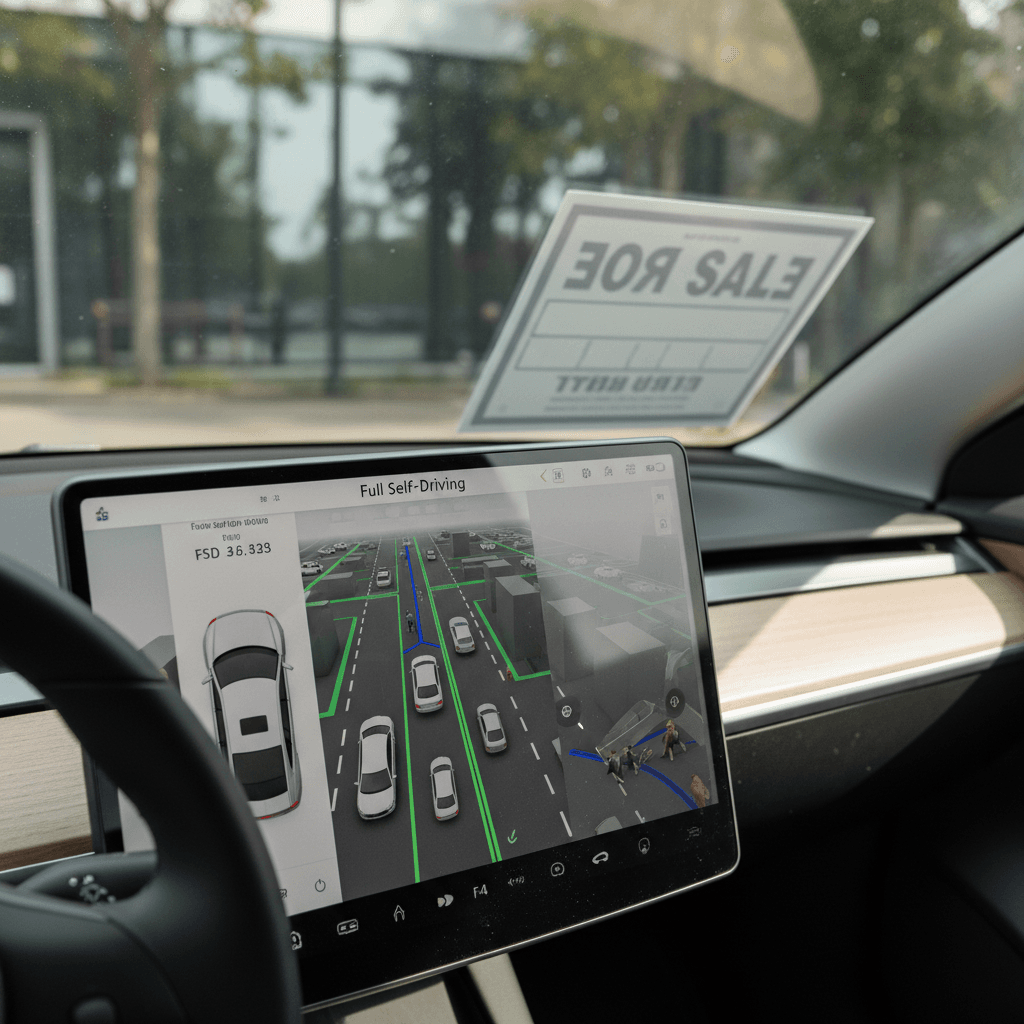
Photograph the car’s center screen clearly showing “Full Self‑Driving (Supervised)” in the software menu. If you’re selling through a platform like <strong>Recharged</strong>, make sure that detail appears in the digital feature list as part of the <strong>Recharged Score Report</strong>.
4. Be transparent about transfer risks
If there’s any doubt about whether FSD will remain after Tesla processes the ownership change, spell that out. Savvy buyers will respect the honesty, and you’ll avoid angry texts when a subscription paywall suddenly appears on their driveway.
5. Expect more pushback as FSD evolves
Tesla is still iterating on FSD’s capabilities and pricing. Don’t assume that what you read on an owners’ forum three years ago still reflects buyer sentiment today. Be prepared to adjust your ask if the market shrugs at your FSD premium.
What Buyers Should Watch For on Used Teslas
If you’re the one shopping for a used Tesla and trying to decide whether a car with FSD is worth the extra money, flip the script: you’re not paying for the seller’s past decision, you’re paying for your own future experience.
Questions to ask before paying a premium
- Is FSD truly active today? Have the seller show it on the screen, and ideally take a short drive where you see the features in action.
- Will it stay after transfer? Ask the seller for any documentation on how their FSD was acquired and whether it’s VIN‑tied or a non‑transferable perk.
- How much will you really use it? If your driving is mostly short city hops, Enhanced Autopilot or basic Autopilot might be enough.
How Recharged helps de‑mystify software
On Recharged, every vehicle comes with a Recharged Score Report that doesn’t just tell you about battery health and pricing, it also verifies key software and hardware features. That means fewer surprises about what’s actually included when you take delivery, whether you’re buying in Richmond or having a car shipped to your driveway.
If FSD or other paid software features are part of the story, they’ll be documented, not just promised in fine print.

FAQ: Tesla FSD and Resale Value
Frequently Asked Questions About FSD & Resale
Bottom Line: Should You Buy FSD for Resale?
If you strip away the hype and look at how real buyers behave, the picture is clear: **Tesla FSD is no longer a reliable lever for maximizing resale value.** It can absolutely make your car more appealing, and in some cases it can justify a modest premium, especially on older VINs with truly permanent licenses. But as Tesla marches toward subscriptions and non‑transferable perks, FSD behaves less like an investment and more like a personal luxury.
If you’re an owner, the smart move in 2026 is to treat FSD as something you buy for your own driving experience. If you’re a buyer, focus first on battery health, condition, and fair market pricing, things a platform like Recharged surfaces clearly through its Recharged Score, then decide whether FSD, at a given premium, makes sense for how you actually drive.
In other words, don’t let FSD be the tail that wags the dog. Buy the right Tesla first. Then decide whether the idea of your car driving itself, under your watchful eye, is worth what it costs you, not what it once cost someone else.