If you’re eyeing a Tesla Cybertruck for work or weekend toys, the big question isn’t just **“Can it tow?”**, it’s **“What’s the Cybertruck’s real-world range while towing?”** On paper, Tesla advertises 300+ miles of range and up to 11,000 pounds of towing, but hitch a trailer and those numbers change fast.
Quick takeaway
Why Cybertruck towing range matters
Traditional truck shoppers are used to watching fuel economy drop when they hook up a trailer. With electric pickups like the **Tesla Cybertruck**, the tradeoff feels bigger because the range number is front and center on the screen, and charging stops take more planning than a quick gas fill-up. If you’re pulling a camper, boat, or equipment trailer, knowing your **real-world towing range** ahead of time is the difference between a relaxed trip and white‑knuckle range anxiety.
- You may need to **double your charging stops** compared with driving empty.
- Some Supercharger sites aren’t easy to access with a trailer, so **unhitching may be required**.
- Cold weather, headwinds, and high speeds can turn a marginal plan into a **“call-a-flatbed” day**.
- If you’re buying a **used Cybertruck**, past heavy towing can affect battery health and thus future range.
Tesla’s own manual is blunt
Cybertruck towing specs and trims at a glance
Before you get into **towing range**, you need the basics: how much each Cybertruck variant can tow and what its claimed range is without a trailer.
Tesla Cybertruck trims, rated range, and towing
Key Cybertruck configurations and how their paper specs set expectations before you hook up a trailer.
| Trim (2025 MY) | Drive / Motors | Tesla-estimated range (unloaded) | Max tow rating | Notes |
|---|---|---|---|---|
| Dual Motor AWD (Premium) | Dual motor AWD | ~340 miles | 11,000 lbs | Air suspension, higher feature content |
| Dual Motor AWD (Base) | Dual motor AWD | ~325 miles | 7,500 lbs | Lower-cost work-focused variant, simplified hardware |
| Cyberbeast | Tri motor AWD | ~300–320 miles | 11,000 lbs | Highest performance, heaviest, most energy-hungry |
| Future RWD / lower trims | Single motor RWD | ~250+ miles (target) | 7,500 lbs (expected) | Lower price, lower tow rating |
Real-world towing range will be far lower than these unloaded estimates, especially at highway speeds.
Towing capacity vs. towing range
Why towing crushes EV range (including the Cybertruck)
Gas trucks lose mpg when towing; EV trucks lose **miles of range**. The physics are the same, but you see the impact more clearly on an EV’s screen. With the Cybertruck, there are three main culprits:
The three big range killers when towing
Understanding these helps you interpret any Cybertruck towing test you see online.
Aerodynamic drag
Mass to move
Weather & climate
Don’t obsess over the badge number
Real-world Tesla Cybertruck towing range: What tests show
Independent testers and early owners have put real miles on Cybertrucks with trailers attached. The patterns line up with what we’ve seen from other electric pickups like Ford’s F‑150 Lightning and the Rivian R1T: figure on **roughly half of your rated range** when towing at highway speeds, sometimes less.
Key Cybertruck towing range data points
Those numbers might feel shocking next to a 300‑mile range figure, but they’re consistent with other EV trucks. Once you bolt a big sail to the back of any pickup, electric or gas, you pay for it at the pump or the plug.
Light to moderate trailer (2,500–4,000 lbs)
Think small campers, utility trailers, single-axle cargo trailers. With a relatively low, aero-friendly profile and reasonable speeds (60–65 mph), many owners report **40–50% range loss**. On a Dual Motor truck rated around 325–340 miles, that means **160–200 miles** of real‑world towing range in good weather.
Heavy or tall trailer (6,000–11,000 lbs)
Large campers, car haulers, wake boats, and enclosed trailers can push range loss closer to **55–65% or more**, especially at 70–75 mph or in winter. That drops a similar Cybertruck to **110–160 miles**, and max‑weight tests in freezing temps have already shown **~90 miles** is possible at the extreme end.
Don’t build a tow plan off perfect numbers
How to estimate your own Cybertruck towing range
You don’t need a lab test to get a conservative towing estimate. Use your **unloaded highway range** as a baseline, then apply realistic percentage hits based on your trailer, speed, and weather.
5‑step method to ballpark your towing range
1. Start with your realistic highway range
Ignore the brochure number. Use what you actually see on road trips at 65–75 mph without a trailer, maybe **220–260 miles** on a Dual Motor, a bit less on a Cyberbeast.
2. Adjust for trailer type and weight
For a low, streamlined trailer under ~3,500 lbs, assume **40–45% loss**. For tall campers or loads above ~6,000 lbs, start at **50–60% loss** and get more conservative from there.
3. Factor in speed and terrain
Running 75 mph into a headwind on rolling terrain can turn a 50% loss into **60–65%**. If you can keep it to 60–65 mph on flatter roads, you may save 10–20 miles per charge.
4. Account for weather and HVAC
In cold weather (around 20°F) with cabin heat on, expect **another 10–20% hit** on top of the trailer penalty. Extreme heat with heavy A/C use can also nibble away at your margin.
5. Leave a big safety buffer
After all of that, don’t plan to use more than **60–70% of the battery** between fast charges. That way you’re not arriving at chargers with single‑digit state of charge and sweaty palms.
A rule-of-thumb you can remember
Charging and route planning with a trailer
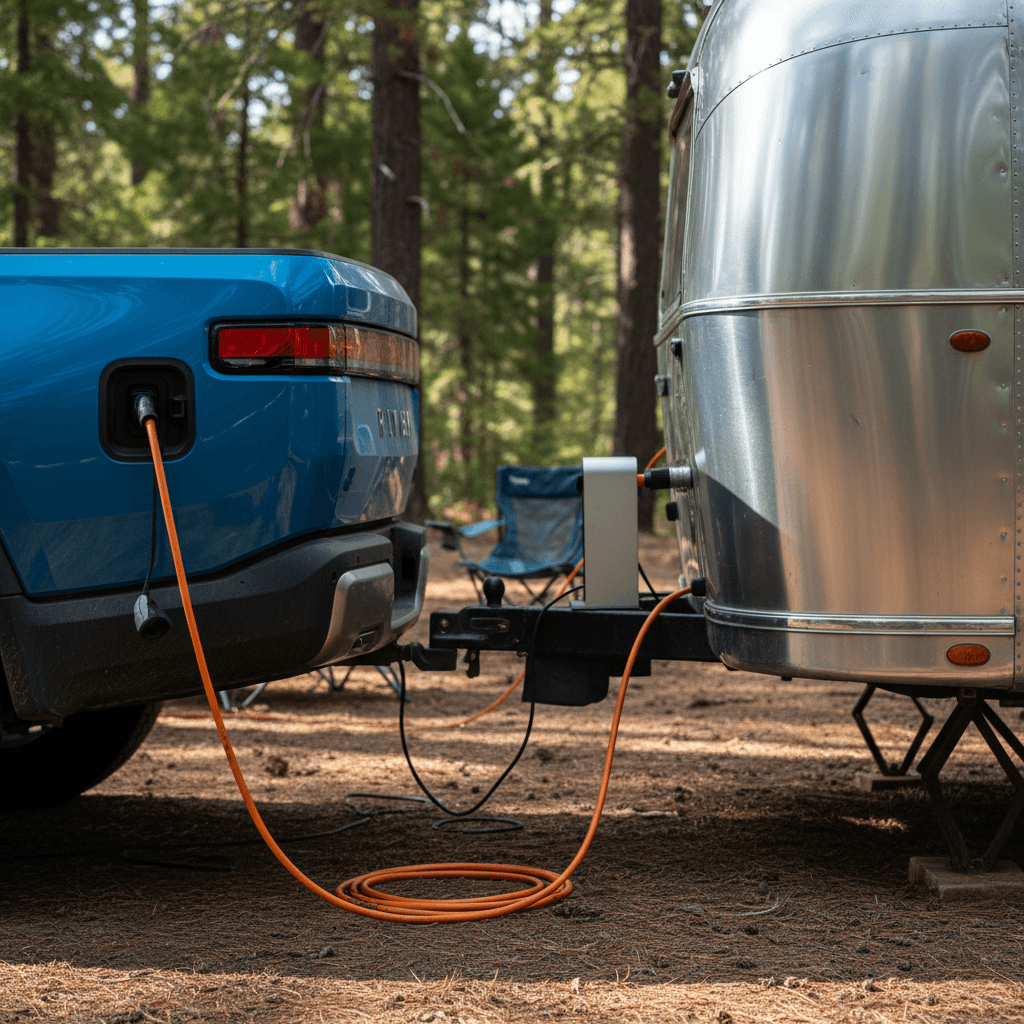
Range is only half the towing story. The other half is **how easy it is to charge while hitched up**. Here the Cybertruck has a big advantage: the Supercharger network is dense and reliable, but some sites still weren’t designed with trailers in mind.
Smart charging strategies when towing
Keep the trip moving, not spent re‑parking your rig.
Target pull‑through sites
Charge more often, not fuller
Always have a bailout plan
Use the truck’s tow mode & energy graph
Cybertruck’s **Trailer Mode** and trip prediction tools adjust estimated range based on weight and recent consumption. Watch the live energy graph with your trailer on; if it trends worse than predicted for the first 30–40 miles, shorten your planned hops.
Complement with third‑party apps
Apps like ABetterRoutePlanner (ABRP) let you plug in **trailer weight, speed, and temperature assumptions**. They won’t be perfect, but they help you visualize how much towing trims your day’s progress compared with running empty.
Mind charger access with long trailers
Is the Tesla Cybertruck actually good for towing?
The short answer: **Yes, if your towing is regional and well‑planned. No, if you expect cross‑country, non‑stop hauls like a diesel.**
Where the Cybertruck shines
- Strong, instant torque makes merging and climbing grades smooth even near max tow rating.
- Low center of gravity from the battery pack helps stability, especially with heavy loads.
- Excellent regen braking reduces brake fade on long descents and can feel more controlled than engine braking in a gas truck.
- The **Supercharger network** means quick, predictable charging compared with many public DC fast chargers.
Where it struggles
- Real‑world towing range can fall into the **90–170‑mile window**, forcing more frequent stops than a gas HD pickup.
- Charger layouts aren’t always trailer‑friendly, adding time to hitch/unhitch or maneuver in tight lots.
- Heavy towing in cold climates demands **careful planning** and flexible schedules; you can’t just “push on” when stations are far apart.
Best use case: Close‑to‑home work and weekend toys
Pre-trip Cybertruck towing checklist
Before you hitch up, run through this quick checklist to protect your range and your sanity.
Cybertruck towing prep
Confirm weights and tongue load
Make sure your trailer’s **gross weight** and tongue weight are within the Cybertruck’s limits and your hitch rating. Overloading will hurt range and safety.
Choose the most aero‑friendly option
If you have choices, pick the **lower, smoother trailer**. A small Airstream‑style camper will usually beat a tall box trailer at the same weight for range.
Set appropriate speed targets
Decide beforehand to keep it around **60–65 mph** when possible. Ten mph slower on the highway can mean **tens of extra miles** between charges.
Pre‑heat or pre‑cool while plugged in
If it’s very hot or cold, condition the cabin and battery **before leaving** while still on shore power or at home charging to preserve on‑road range.
Plan chargers you can actually access
Use satellite view to verify how you’ll pull in and out with a trailer. Favor **pull‑through** or edge stalls when you can.
Set conservative energy margins
On tow days, aim to arrive at chargers with **15–25% state of charge**, not 3–5%. That buffer is your insurance policy against wind, traffic, or detours.
Buying a used Cybertruck? What towing means for range and value
If you’re shopping the **used Cybertruck market**, towing should be part of your due‑diligence checklist. Two trucks with the same odometer reading can have very different **battery health** depending on how they were used.
- A truck that frequently towed near its **11,000‑lb limit**, fast‑charged hard, and lived in extreme temps may see more battery wear.
- A lightly used Cybertruck that mostly commuted unladen and slow‑charged at home is likely to retain more of its original range.
- Real‑world towing history can explain why one truck’s highway range is **20–40 miles lower** than another’s on the same route.
How Recharged helps you sort the good from the abused
You can also browse other used electric trucks, like Ford F‑150 Lightning and Rivian R1T, on Recharged to see how their **towing range tradeoffs** compare if you’re still deciding which EV pickup fits your use case best.
Frequently asked questions about Cybertruck towing range
Cybertruck towing range FAQ
Bottom line: What to expect from Cybertruck towing range
If you’re considering a Tesla Cybertruck for towing, the headline is simple: it tows **very well**, but not **very far**. Real‑world testing shows that once you hitch up a camper, boat, or equipment trailer, your practical range can land anywhere from **90 to 180 miles per charge**, depending on how heavy and how tall that trailer is, and how aggressive you are with speed and weather.
For regional hauling and weekend adventures inside a **150‑mile radius**, a Cybertruck can be an outstanding tow partner, especially with the Supercharger network backing you up. For long‑distance, time‑sensitive towing, you’ll need patience and a flexible mindset. If you’re exploring **used Cybertrucks and other electric trucks**, tools like Recharged’s **battery‑health diagnostics and pricing transparency** can help you match the right EV truck, and its real‑world towing range, to the way you actually use a pickup.