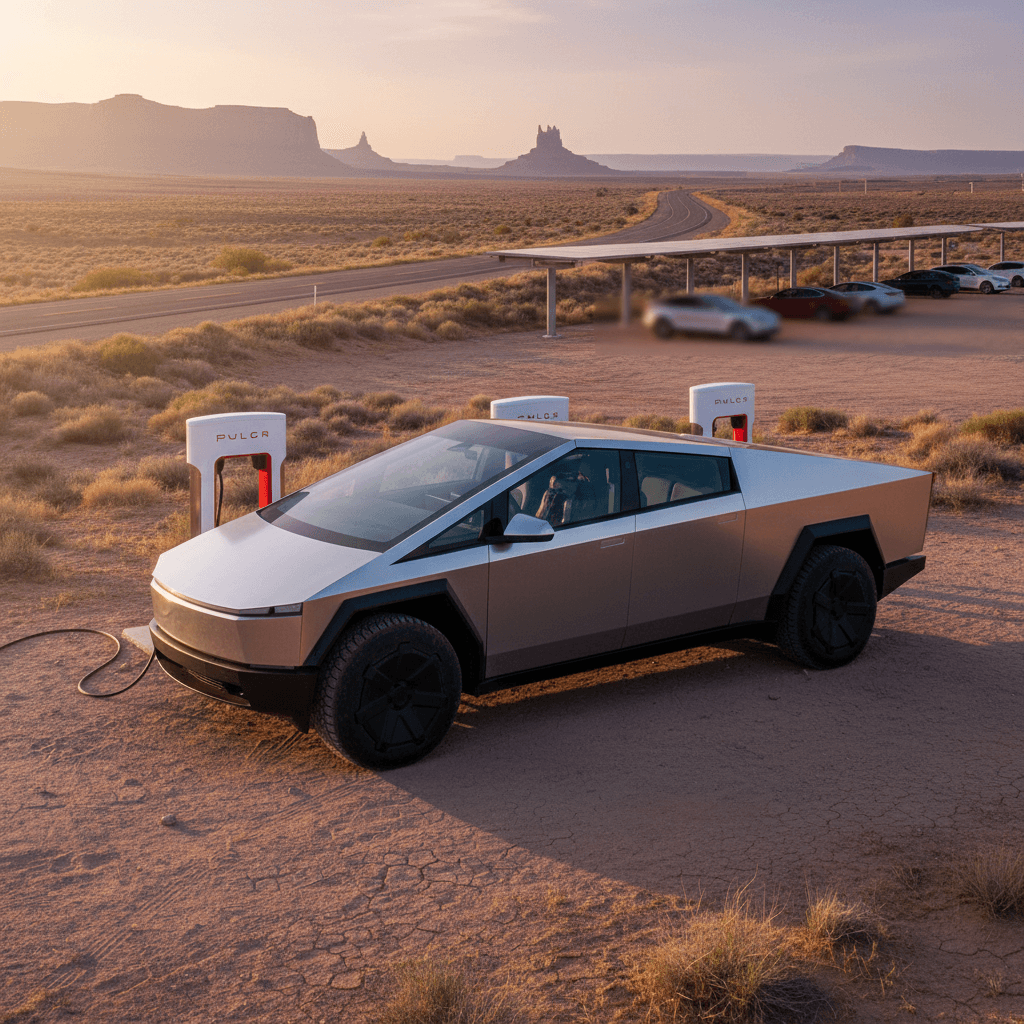
If you’re eyeing a Tesla Cybertruck road trip, you’re probably wondering how its wild looks, big battery, and 800‑volt platform translate into real-world travel. The answer is nuanced: the Cybertruck can be a fantastic long‑distance machine in the right conditions, but it also exposes the weaknesses that all electric trucks share, especially at highway speeds and when towing.
Quick takeaway
Cybertruck road trip overview: who this truck really suits
Best for
- Drivers who regularly use Tesla’s Supercharger network along major interstates.
- Families or couples doing 200–300 mile legs between stops.
- Owners who want pickup utility at home but mostly road-trip without heavy trailers.
- Tech‑focused drivers who value Autopilot and in‑car apps over traditional truck feel.
Challenging for
- Long‑distance towing at highway speeds (range can be cut nearly in half).
- Travel in remote regions with sparse DC fast charging.
- Drivers sensitive to cabin noise and firm ride quality.
- Anyone expecting the 300+ mile rated range to hold at 75–80 mph with a full load.
Expectation check
Real-world Cybertruck road trip range & efficiency
On paper, current Cybertruck trims advertise roughly 300+ miles of range. In reality, highway testing paints a more conservative picture, especially at American interstate speeds and with the truck’s blocky profile working against it.
What independent tests and owners see on the highway
That data lines up with what we’ve seen across all electric trucks: once you’re driving a big, heavy, bluff‑front pickup at 70–80 mph, drag and mass dominate the equation. The Cybertruck’s efficient 800‑volt powertrain helps early in each charge, but physics still wins over long legs.
- At a steady 75 mph, plan on roughly 65–80% of the EPA‑style range, depending on wind and terrain.
- Expect consumption around 380–450 Wh/mile on typical interstate trips without towing.
- Climbing into mountains increases Wh/mile, but long descents let the truck claw some of that energy back via regen.
- If you want to arrive with a 15–20% buffer, your practical leg length is usually 180–230 miles, not the full rated figure.
Range planning rule of thumb
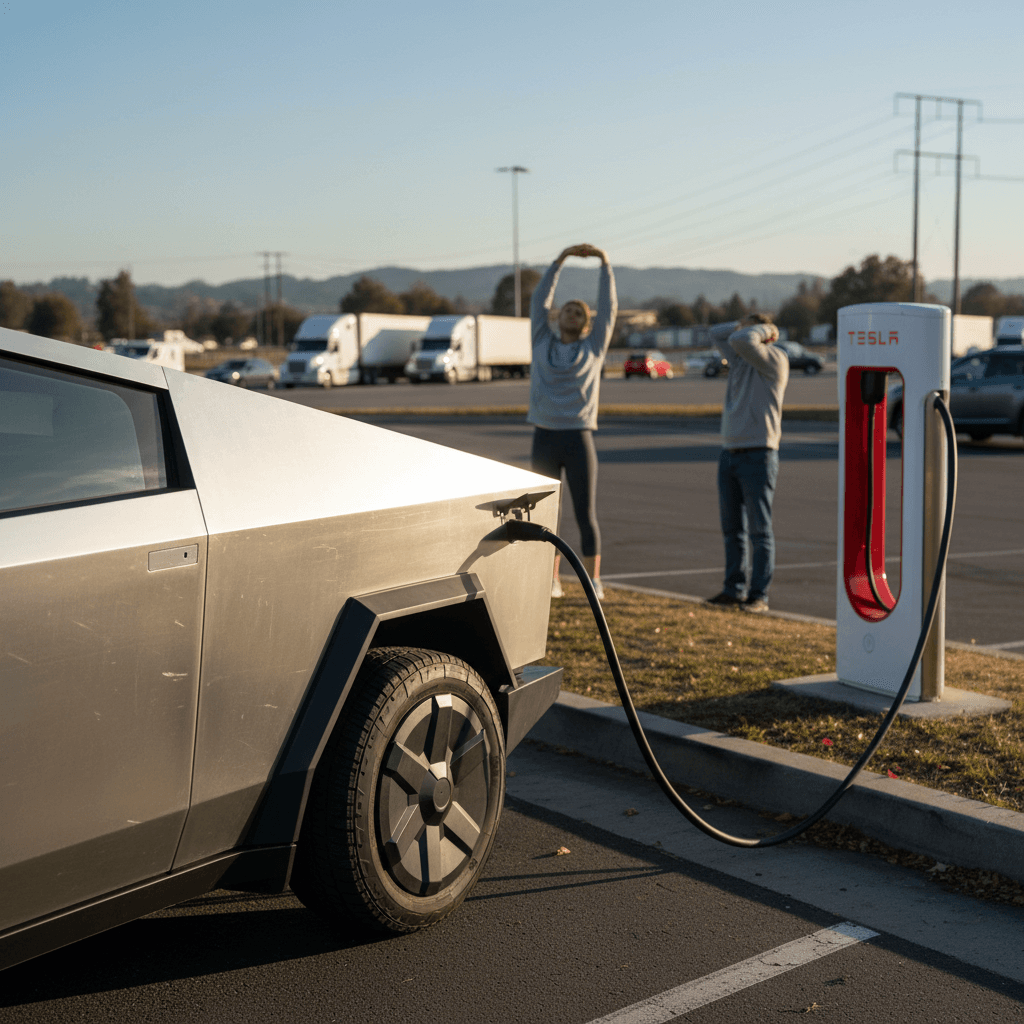
Charging on the road: speed, stops and Supercharger quirks
The Cybertruck leans heavily on Tesla’s Supercharger network, and that’s mostly a good thing. The 800‑volt electrical architecture lets it take advantage of newer 325 kW‑capable sites, and early real‑world tests show strong, but not class‑leading, fast‑charge performance.
What Cybertruck road-trip charging really feels like
Fast peaks, but average session times still matter
Peak power
On upgraded sites, Cybertruck can briefly hit 300+ kW, especially from 10–20% state of charge (SOC). On more common V3 sites, expect ~250 kW peaks.
10–80% time
Independent testing and owner logs point to about 35–40 minutes for a 10–80% DC fast‑charge session when conditions are ideal.
Best strategy
You’ll make the fastest progress with more frequent, shorter stops, charging 10–60%, instead of pushing all the way to 90%+ at each station.
Compared with smaller Tesla models, you’ll simply spend more minutes per mile of added range. Tesla advertises roughly 130–140 miles in 15 minutes under ideal conditions, but that assumes a low starting SOC, a strong charger, and mild temperatures.
Charging curve reality check
Road-trip charging tips specific to Cybertruck
1. Aim for low arrival SOC
Try to hit Superchargers with 10–20% remaining. The lower your battery when you arrive, the more time you’ll spend at the higher, more efficient charge rates.
2. Use built‑in navigation to precondition
Always route to a Supercharger in the Tesla navigation so the truck can preheat or precool the battery. That can cut meaningful minutes from each stop.
3. Stop a bit earlier when towing
If you’re pulling a trailer, plan shorter legs and start charges around 20–30% SOC. The extra buffer leaves room for headwinds or elevation changes.
4. Avoid overfilling
Try not to charge beyond 80% unless the next stretch is truly remote. The last 20% is slow on any EV, and especially noticeable on a big truck.
5. Scout backup sites
In less‑dense parts of the country, identify a backup DC fast charger or Level 2 option in case your target Supercharger is down or congested.
Highway comfort, noise and driving experience
From the driver’s seat, the Cybertruck feels more like a futuristic luxury SUV than a traditional half‑ton pickup, until the noise creeps in. Road tests point to a firm but controlled ride, excellent body control, and surprisingly agile handling thanks to rear‑wheel steering and steer‑by‑wire. But the same reports also mention more cabin noise than you’ll find in most modern EVs.
What feels great on a long drive
- Stability and body control: The rigid exoskeleton and air suspension keep the truck composed at speed and in crosswinds.
- Instant torque: Passing is effortless; even the dual‑motor model has quick, confidence‑inspiring acceleration.
- Steer‑by‑wire agility: Rear‑wheel steering shrinks the truck in tight parking lots and helps with quick lane changes.
- Flat floor and roomy cabin: Plenty of stretch‑out space for five; rear passengers enjoy good legroom.
What gets tiring over hundreds of miles
- Higher cabin noise: Large, aggressive tires and square profile mean more road and wind noise above ~70 mph.
- Non‑linear steering feel: Some testers find the quick ratio unpredictable at low speeds until you adjust.
- Firm ride: Well‑controlled but not plush; rough concrete slabs can feel busy over time.
- Ergonomics learning curve: Touch‑screen‑heavy controls and unusual door releases can frustrate new passengers.
Comfort upgrades that help
“The Cybertruck’s unified structure makes it feel very solid on the road… even though the ride is firm, it is controlled and composed.”
Towing and hauling on a Cybertruck road trip
If your vision of a Tesla Cybertruck road trip involves an Airstream or toy hauler, you’ll want to temper expectations. The truck offers impressive tow ratings and stout torque, but like every EV truck tested so far, towing slashes usable range.
How towing changes Cybertruck road-trip behavior
Use this as a ballpark guide for planning, not a promise, actual results vary with terrain and weather.
| Scenario | Example Setup | Typical Highway Consumption | Usable Trip Range (Start ~90%, Stop ~15%) |
|---|---|---|---|
| No trailer, light load | Family of 4, luggage in bed | ~380–420 Wh/mi | ~190–230 mi |
| Mid-size camper (~3,000–3,500 lb) | Single-axle travel trailer | ~480–550 Wh/mi | ~130–170 mi |
| Tall cargo trailer | Enclosed moto/ATV trailer | 550+ Wh/mi possible | Often under 150 mi |
Approximate effects of moderate trailers on Cybertruck road-trip range.
Tests with ~3,200‑lb trailers show range dropping to roughly 160 miles despite some slower mixed driving, and owner anecdotes put heavier or boxier trailers in the same ballpark. That’s not a Cybertruck problem so much as an aerodynamics and weight problem that hits every EV truck on the market.
Don’t plan by EPA range when towing
Software, navigation and trip-planning behavior
One of the Cybertruck’s biggest road‑trip advantages is Tesla’s software. The truck automatically builds a charging plan for long routes, shows real‑time Supercharger occupancy, and preconditions the pack on approach. But as at least one high‑profile 2,500‑mile trip highlighted, its calculations can be too optimistic if you treat them as gospel.
- Navigation assumes relatively ideal conditions for speed, temperature, and wind, which can understate energy use.
- On long legs, the system may plan arrivals near 5–10% SOC; that’s fine in perfect weather, but it leaves little room for detours or headwinds.
- A well‑documented trip nearly stranded five passengers when they trusted a 10% arrival buffer and discovered the estimate hadn’t accounted for all real‑world losses.
- The software shines when you treat its plan as a baseline and adjust buffers manually based on experience and the in‑car consumption graph.
How to use Tesla’s planner the smart way
What a Cybertruck road trip actually costs
On electricity alone, a Cybertruck is usually cheaper to road‑trip than a comparable gas truck, but not by the same margin you’d see around town. Big EV trucks are energy‑hungry at 75 mph, and many high‑power Superchargers are now priced more like premium gasoline per mile than like home electricity.
Back-of-the-envelope cost comparison
- Assume 400 Wh/mi on the highway without towing.
- Over 1,000 miles, that’s about 400 kWh total energy use.
- If you average $0.35/kWh at DC fast chargers, that’s roughly $140 in energy.
- A similar gas truck getting 20 mpg at $3.75/gal burns about $188 in fuel over the same distance.
When costs tighten up
- Higher DC rates (some urban Superchargers exceed $0.45/kWh) shrink the advantage.
- Towing at 500+ Wh/mi pushes usage toward 500 kWh per 1,000 miles, which can erase most savings.
- Home charging before and after the trip helps; road‑trip only analysis is the worst‑case scenario.
Financial angle for used buyers
Cybertruck road trip pros and cons at a glance
Road-trip strengths and weaknesses
Where the Cybertruck shines, and where it still feels first‑generation
Cybertruck road-trip pros
- Excellent charging network: Native access to Superchargers simplifies route planning vs. many rival trucks.
- Strong straight‑line performance: Effortless passing and on‑ramp merges even when loaded.
- Solid, confidence‑inspiring chassis: Rigid structure and air suspension feel planted at high speed.
- Spacious, tech‑forward cabin: Roomy for families, large touchscreen and software ecosystem for long days.
- Regenerative braking: Makes mountain descents easier on your nerves and your brakes.
Cybertruck road-trip cons
- Range falls quickly at speed: Real‑world 75‑mph range is well below the highest marketing numbers.
- Charging still takes time: 35–40 minute stop cadence adds hours over a multi‑day trip.
- Cabin noise: Louder than many EVs, especially on rough pavement.
- Towing cuts range deeply: 120–170‑mile legs with a trailer demand meticulous planning.
- User‑interface quirks: Learning curve for door operation and touch‑screen‑based basics for new passengers.
Is the Tesla Cybertruck a good road trip truck for you?
Whether the Cybertruck is a “good” road trip truck depends a lot on your routes, your expectations, and how much you tow. For many owners who mainly shuttle between major metros on interstate corridors, it can be a compelling alternative to a big gas pickup, quicker, quieter than an ICE at low speeds, and cheaper to run if you mix in home charging.
Who should road-trip a Cybertruck, and who might want something else
Great fit
You mostly travel along dense Supercharger corridors (I‑5, I‑95, cross‑country interstates).
You’re comfortable planning around <strong>180–230‑mile legs</strong> and 30–40 minute breaks.
You rarely tow long distance, or your trailer is low and aerodynamic.
You enjoy Tesla’s tech ecosystem and are willing to adapt to its quirks.
Think twice
Your usual trips involve <strong>remote regions</strong> with sparse DC fast charging.
You tow a tall camper or cargo trailer several times a year for hundreds of miles at a time.
You’re extremely sensitive to cabin noise and want a traditional luxury‑truck feel.
You expect EPA‑style range at 75–80 mph year‑round.
How Recharged can help
Ready to find your next EV?
Browse VehiclesPre-trip checklist for Cybertruck owners
Cybertruck road trip checklist
1. Update software and maps
Make sure your truck is on the latest software so you get the newest navigation logic, charging site data, and bug fixes for trip planning and charging behavior.
2. Check tires and alignment
Inspect tread, correct pressures (higher pressures can improve efficiency), and confirm alignment is in spec. Aggressive mud‑terrain tires will hurt range significantly at highway speeds.
3. Benchmark your consumption
Before a big trip, run a 50–100 mile test at your planned highway speed on a familiar route. Note the Wh/mile and use that as your reference instead of default assumptions.
4. Build a conservative first‑day plan
For your first long trip, plan shorter legs and higher arrival buffers than you think you need. You can always stretch distances on later days once you see real‑world numbers.
5. Save backup chargers
Use tools like A Better Routeplanner and PlugShare alongside Tesla’s nav to bookmark backup fast chargers and key Level 2s near your planned stops.
6. Pack charging essentials
Bring your Mobile Connector (if equipped), any NEMA adapters you own, and a quality extension cord rated for the load if you expect to use RV parks or friends’ outlets.
Tesla Cybertruck road trip FAQ
Frequently asked questions about Cybertruck road trips
Taken as a whole, the Tesla Cybertruck road trip experience is exactly what its styling suggests: bold, capable, and occasionally rough around the edges. It rewards drivers who understand EV road‑tripping basics, planning conservative legs, embracing regular breaks, and respecting the impact of speed and towing on range. If that sounds like you, and your routes align with Superchargers, the Cybertruck can be a genuinely compelling long‑distance companion. And if you’re weighing it against other used EV trucks, a transparent marketplace like Recharged can help you compare real‑world range, charging behavior, and ownership costs before you commit to your next adventure rig.