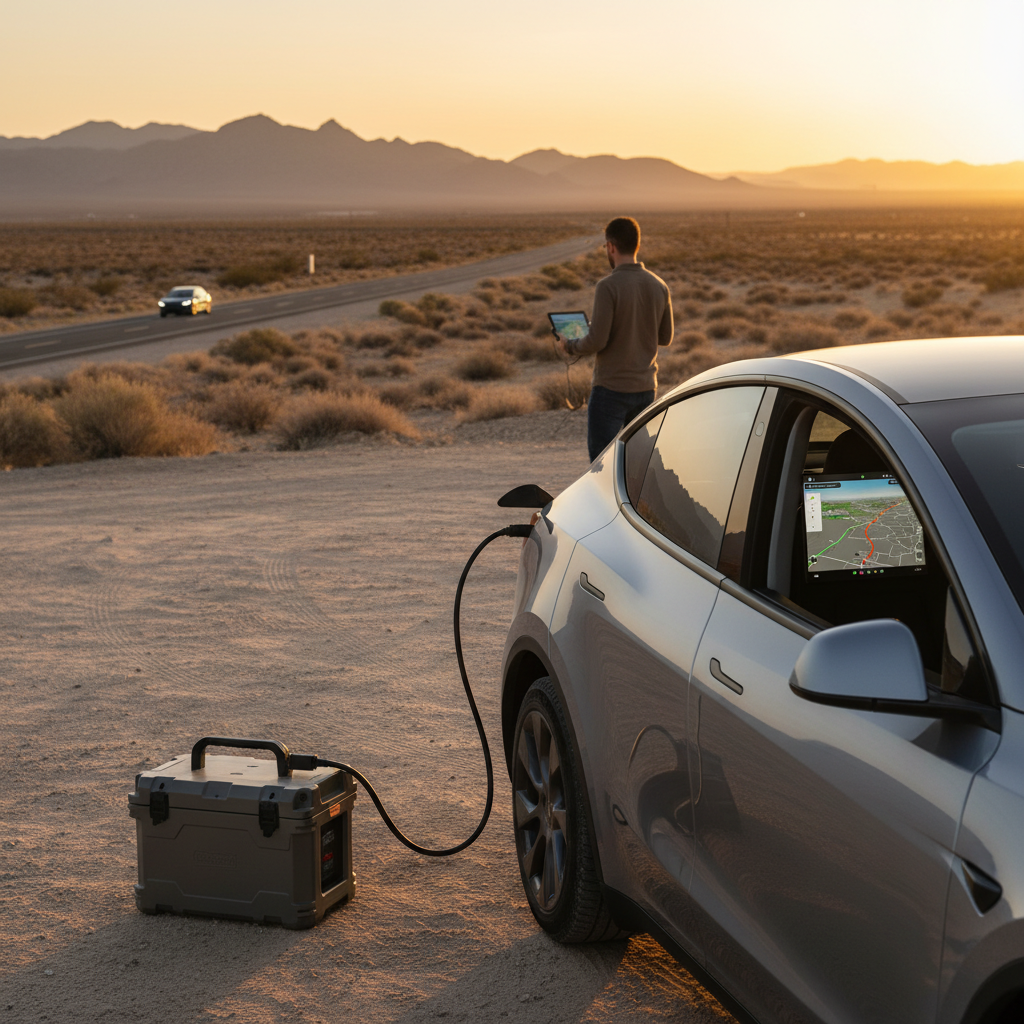
Yes, the Tesla Cybertruck can tow a trailer, and on paper it can tow a lot of trailer. But the real question isn’t just “can the Tesla Cybertruck tow a trailer,” it’s *what kind of trailer, how far, and with what trade-offs in range, payload, and safety*. If you’re thinking about towing a camper, car hauler, or utility trailer with a Cybertruck, you need to understand more than that headline 11,000‑pound rating.
Key takeaway up front
Short answer: Can the Tesla Cybertruck tow a trailer?
- Yes, every currently sold Cybertruck (AWD and Cyberbeast) comes with a factory tow hitch and is rated to tow a trailer.
- Maximum advertised tow rating is **11,000 lbs** with a properly equipped truck and trailer.
- Real‑world use is constrained by **tongue‑weight limits**, **payload**, and **range**, especially at highway speeds.
- For most owners, the sweet spot is **3,000–7,000 lbs** of trailer weight for a manageable mix of performance and charging stops.
So if your basic question is whether you can hook a trailer to a Tesla Cybertruck and tow it, the answer is clearly **yes**. The nuance is in how close you should actually get to that 11,000‑lb number and what it does to your day‑to‑day usability and trip planning.
Cybertruck towing ratings by trim and what they really mean
Tesla has already revised Cybertruck trims since launch, but if you’re looking at trucks available in 2025–2026, you’re effectively looking at **All‑Wheel‑Drive** and **Cyberbeast** variants. Both share the same headline tow rating.
Tesla Cybertruck towing and payload specs (current trims)
High‑level factory ratings. Always verify exact numbers on the door jamb sticker and in the owner’s manual for a specific VIN.
| Cybertruck trim | Max tow rating | Estimated max tongue weight | Estimated payload (approx.) | Best‑case EPA range (unladen) |
|---|---|---|---|---|
| AWD | 11,000 lbs | ~1,100 lbs | ~2,500 lbs | ~340–350 miles |
| Cyberbeast | 11,000 lbs | ~1,100 lbs | ~2,500 lbs | ~320–340 miles |
Cybertruck’s tow rating is only part of the story, payload and tongue weight matter just as much.
Ratings are not guarantees
Tesla’s documentation also distinguishes between **tow rating** and **vertical load** or **tongue weight** at the hitch. That’s where a lot of confusion, and some of the early controversy, has come from. If you care about towing a trailer safely, tongue weight and payload matter more than the big number in the marketing slide.
What kinds of trailers can a Tesla Cybertruck tow?
Common trailer types Cybertruck can tow
Rough guidance assumes a properly equipped truck, correct hitch setup, and conservative loading.
Utility & landscape trailers
Typical weight: 1,000–3,000 lbs loaded
Ideal use case for a Cybertruck. Hauling tools, lumber, yard waste, small equipment, or bikes is well within the truck’s comfort zone, and range impact is noticeable but manageable.
Car haulers
Typical weight: 5,000–8,000 lbs loaded
Open car haulers with a light vehicle on board fit the Cybertruck’s spec sheet, but expect substantial range loss. Enclosed car haulers push more frontal area and drag, cutting range even further.
Travel trailers & campers
Typical weight: 3,500–8,000+ lbs loaded
Single‑axle and compact dual‑axle campers are workable. Large, boxy travel trailers are where you run into severe range penalties and stability considerations.
From a pure rating standpoint, the Cybertruck competes directly with trucks like the Rivian R1T or Ford F‑150 Lightning: open utility trailers, small boats, snowmobiles, dirt bikes, compact campers, and car haulers are all fair game, as long as you stay within the truck’s **weight** and **tongue‑load** limits and accept shorter legs between charges.
Tongue weight, payload, and why most people get this wrong
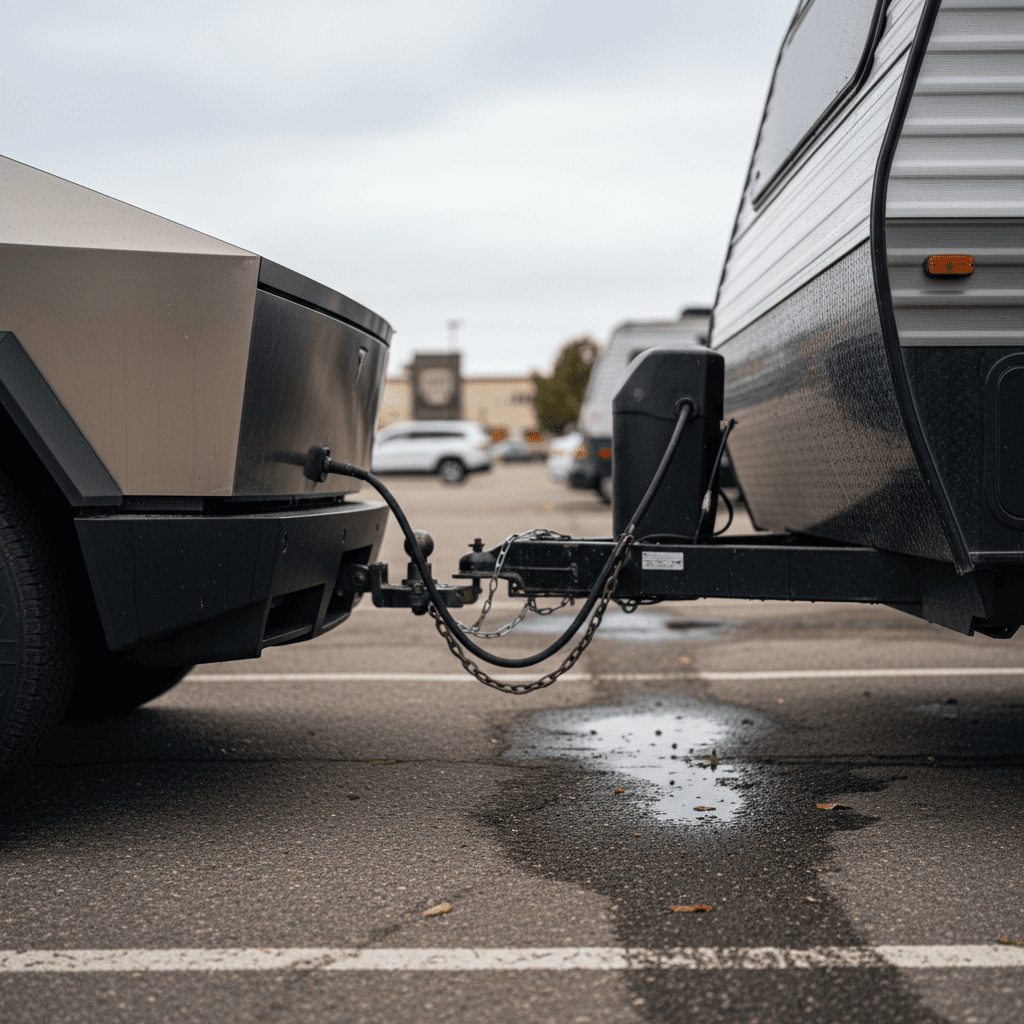
Here’s where towing with an EV, especially something as hyped as the Cybertruck, gets more complicated. It’s easy to obsess over the 11,000‑lb tow number and forget the basic physics at the hitch and over the rear axle.
- Tongue weight is the downward force the trailer puts on the hitch, usually **10–15%** of the trailer’s total weight for a conventional bumper‑pull trailer.
- Payload is everything the truck carries: passengers, cargo in the bed, plus the trailer’s tongue weight.
- If you overload tongue weight or payload, you can overload the rear axle or hitch long before you reach the advertised max tow rating.
A concrete example
Tesla’s owner’s manual calls out a maximum tongue weight figure (roughly 10% of the rated trailer capacity) *and* warns that passengers and cargo reduce how much tongue weight you can safely carry. If you’ve seen screenshots floating around showing very low vertical‑load numbers, those usually refer to **bike racks or non‑towing loads** on the hitch, not a properly hitched trailer with weight distribution.
Quick sanity check before towing with your Cybertruck
1. Find your truck’s actual payload rating
Look at the sticker on the driver’s door jamb. That payload number is specific to your Cybertruck’s equipment and wheels and includes passengers, cargo, and trailer tongue weight.
2. Estimate realistic trailer weight
Don’t assume brochure numbers. A 6,000‑lb “dry” trailer can easily be **7,000+ lbs** once you add water, propane, batteries, and gear.
3. Check tongue weight target
Aim for roughly 10–15% of loaded trailer weight as tongue weight. If your trailer is 7,000 lbs loaded, that’s roughly 700–1,050 lbs on the hitch.
4. Add people and cargo
Add up estimated tongue weight, passenger weights, and cargo in the cab and bed. That total must stay **below the payload rating**, with some margin.
5. Consider a weight‑distributing hitch
For heavier trailers, a properly set up weight‑distributing hitch can shift some tongue load off the Cybertruck’s rear axle and stabilize handling.
Don’t ignore the fine print
How far can a Cybertruck tow? Range in the real world
This is the part most buyers underestimate. An unloaded Cybertruck might claim ~320–350 miles of range depending on trim and wheel choice. Hook a trailer to it and that number drops fast.
Rule‑of‑thumb Cybertruck towing range impacts
Early independent tests with Cybertruck towing around 6,000 lbs have shown real‑world legs in the **130–170‑mile** range before you’re looking for a DC fast charger. That lines up with what we’ve seen across electric pickups in general: plan on **roughly half your solo‑driving range** when towing a sizable trailer, then add more margin for winter, mountains, or headwinds.
Plan charging legs, not total trip distance
Safely setting up a trailer on your Cybertruck
Towing safely with a Cybertruck is less about its stainless‑steel body and more about doing the basic truck things right, hitch setup, wiring, brake controller configuration, and using the truck’s software correctly.
Cybertruck trailer setup: step‑by‑step
1. Match the hitch and ball to the trailer
Use the correct ball size and ball mount rated above your expected trailer weight. Check that the hitch and ball are torqued properly before every long tow.
2. Level the trailer
With the Cybertruck at your normal suspension height, the trailer should sit close to level. Tesla recommends a lower suspension setting for stability when towing; confirm this in the owner’s manual and in‑car menus.
3. Connect safety chains and breakaway cable
Cross chains under the coupler so they can catch the tongue if it comes off the ball. Attach the breakaway cable to a solid point on the truck, not the hitch ball mount.
4. Plug in lights and test
Connect the trailer wiring harness and test running lights, turn signals, and brake lights. Cybertruck can detect a connected trailer, verify the dash confirms it.
5. Enable or configure trailer brakes
For anything above ~1,000 lbs, you should be using trailer brakes. Make sure the brake controller is configured and the gain is appropriate for the trailer’s weight.
6. Use Tow/Haul or Trailer mode
Set the Cybertruck to the correct towing mode so it can adjust throttle mapping, stability control, and range estimates for the extra weight and drag.
A properly set up rig feels boring, in a good way
Charging and route planning when towing with a Cybertruck
The other half of the equation is infrastructure. A Cybertruck can tow a trailer, but can you realistically keep it charged while doing so, especially on long trips?
1. Superchargers and high‑power DC fast chargers
Crowded, urban Superchargers with tight parking aren’t ideal for a long truck and trailer combo. Look for **pull‑through, edge, or back‑in spots** where you can either stay hitched or drop the trailer quickly without blocking others.
Many owners plan their routes around **larger highway‑side sites** or third‑party DC fast chargers with room for trailers rather than relying on whatever’s closest to the map pin.
2. Slower chargers at campgrounds and destinations
Campgrounds with 50‑amp RV pedestals (NEMA 14‑50 outlets) can function as **Level 2 charging** for a Cybertruck. It’s slower than DC fast charging, but if you’re parked overnight at a campsite anyway, waking up to a mostly full battery can make towing days much easier.
An overnight Level 2 session can easily add **150+ miles of towing range**, depending on conditions, often enough for the following day’s legs between DC fast chargers.
Use EV‑aware trip planning tools
If you’re new to EV towing, start with a **shorter shakedown trip** within a few hours of home. Learn how fast the battery drains at 55–65 mph with your specific trailer, in your climate, with your driving style. That data point is more valuable than any generic towing chart.
When a Cybertruck isn’t the right tool for the trailer job
No matter how wild the marketing is, the Cybertruck is still subject to the same physics and regulatory test procedures as any other truck. There are towing scenarios where an electric pickup simply isn’t the right answer yet.
- Regularly towing **near the 11,000‑lb limit** through mountains or in high winds.
- Dragging a **tall, heavy fifth‑wheel or toy hauler** that pushes well beyond typical bumper‑pull dynamics (the Cybertruck is not equipped for fifth‑wheel hitches).
- Long‑distance commercial towing where **downtime kills productivity** and frequent DC fast‑charging stops are a real cost.
- Situations where you can’t count on **reliable fast‑charging infrastructure** and overnight Level 2 isn’t available.
Big, boxy trailers are the worst case
Used Cybertruck and EV towing: what to watch for
If you’re considering a **used Cybertruck** or another used EV truck for towing, you’re not just shopping for cool styling or 0–60 times. You’re buying whatever towing habits the previous owner had, good or bad.
Key towing questions for a used Cybertruck
Exactly the kind of thing Recharged’s battery and vehicle health checks are built to surface.
1. Battery health and fast‑charging history
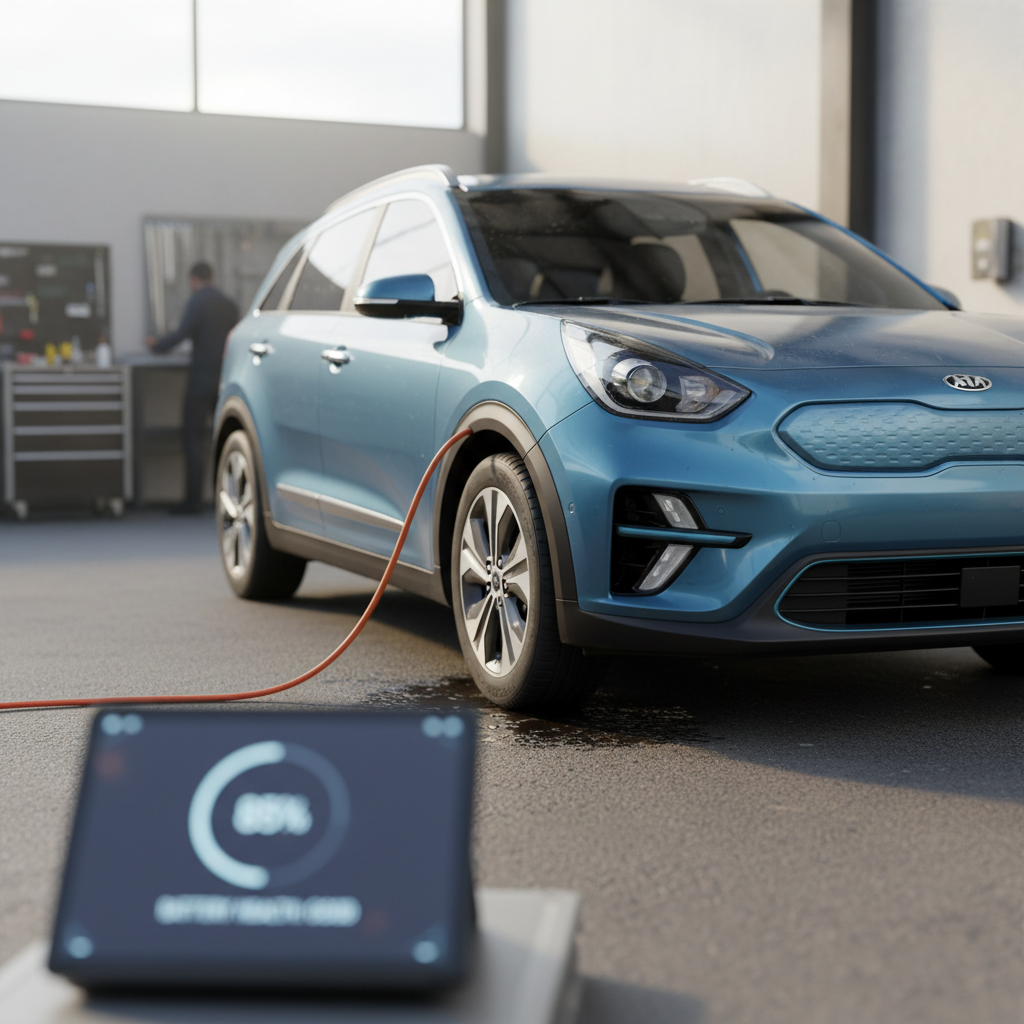
Frequent towing means more fast‑charging, more heat, and more cycles. A **battery health diagnostic**, like the Recharged Score Report, helps you understand how much usable capacity is left compared with new.
2. Hitch, suspension, and brakes
Inspect the hitch receiver and mounting points for damage, rust, or obvious overloading. Look for uneven tire wear or suspension sag that could hint at heavy, repeated towing beyond the truck’s comfort zone.
3. Software settings and logs
If you have access to service records, look for notes about trailer wiring faults, ABS or stability control events while towing, and any hitch‑related repairs.
4. Transparent history
At Recharged, every used EV we sell comes with a **Recharged Score Report** that covers battery health, charging history signals, and a detailed mechanical inspection, exactly the information you want if you’re planning to tow.
If towing is part of your plan, tell the seller or platform that up front. You want real, specific answers, not “yeah, it can tow 11,000 lbs” and a shrug. That’s where a marketplace that actually understands EVs, their batteries, and their use cases earns its keep.
FAQ: Cybertruck towing and trailers
Frequently asked questions about Cybertruck towing
Bottom line: Can a Tesla Cybertruck tow a trailer?
If all you want to know is **“can a Tesla Cybertruck tow a trailer?”**, the answer is absolutely yes, up to **11,000 lbs** on paper, with enough torque to make a conventional gas truck feel old. The more useful answer is that a Cybertruck is best at towing **light to mid‑weight, reasonably aerodynamic trailers** over thoughtfully planned routes, with plenty of charging stops built into your day.
If you’re considering a Cybertruck or another used EV as a tow vehicle, you’re really shopping for **battery health, realistic range under load, and a truck that hasn’t been abused at the hitch**. That’s exactly the kind of nuance Recharged bakes into every **Recharged Score Report**, so you can see beyond the marketing numbers and decide if a given EV actually fits your towing life, trailer, range, trade‑offs and all.