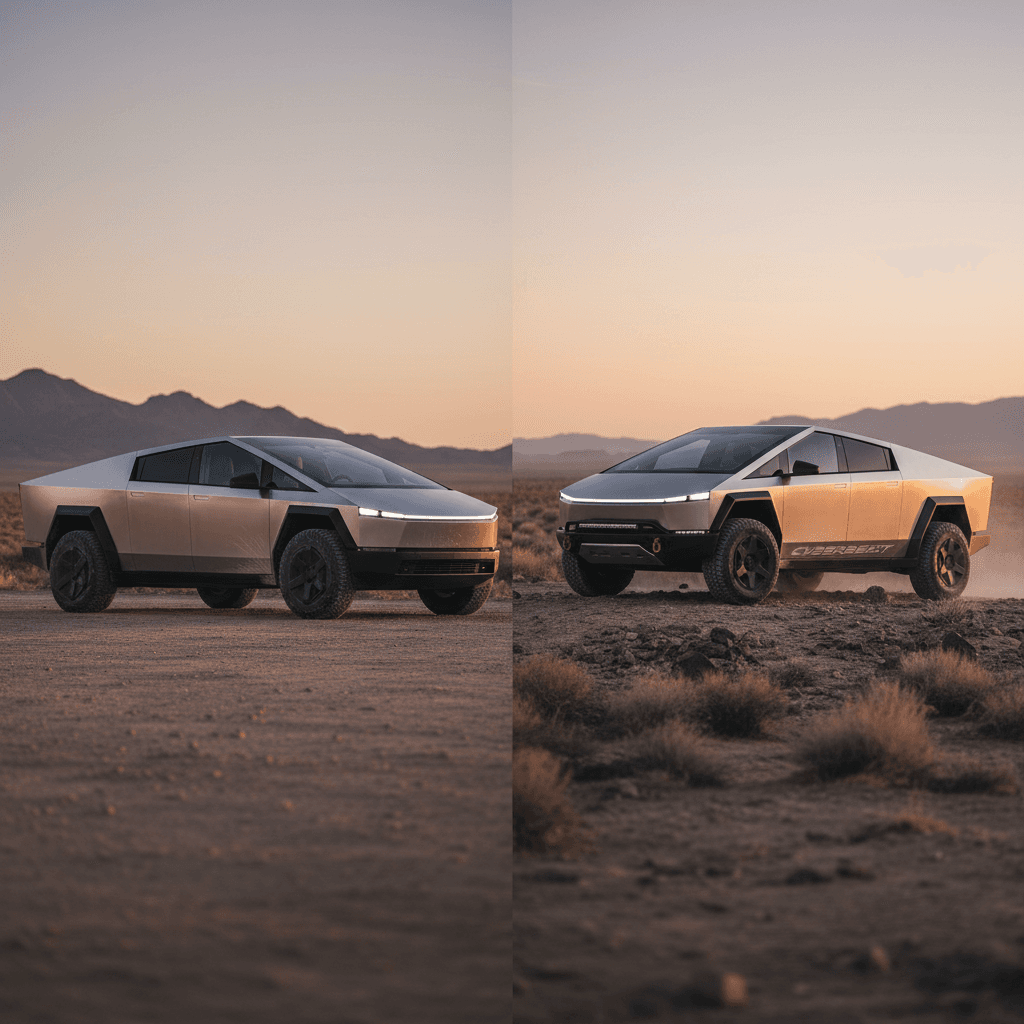
You don’t buy a Tesla Cybertruck because you’re shy. But even among stainless-steel pyramids on wheels, there’s a choice to make: the more accessible Cybertruck All-Wheel Drive (AWD) or the full-send Cyberbeast. If you’re trying to decide between Tesla’s two main Cybertruck trims, this guide breaks down Tesla Cybertruck AWD vs Cyberbeast in the only terms that matter: speed, range, towing, livability, and long‑term cost.
2026 lineup snapshot
Cybertruck AWD vs Cyberbeast: Who Each Truck Is For
Cybertruck AWD: The sane choice
- Best for: Daily drivers, commuters, light towing, road‑trip duty.
- Why it exists: Delivers the Cybertruck experience, wild design, big battery, fast charging, without the eye‑watering price and overkill performance.
- How it feels: Still very quick by full‑size truck standards, more efficient, and easier to live with.
Cyberbeast: The spectacle
- Best for: Performance junkies, brand loyalists, early adopters who want the “halo” version.
- Why it exists: To prove a 3‑ton stainless wedge can outrun sports cars and drag entire neighborhoods off the line.
- How it feels: Brutally quick, more theatrical, arguably less rational, yet undeniably entertaining.
Quick rule of thumb
Key Specs: Cybertruck AWD vs Cyberbeast
Cybertruck AWD vs Cyberbeast: Core Specs
Factory‑quoted or widely reported specs as of early 2026. Exact numbers can vary slightly with wheel/tire choices and software revisions.
| Spec | Cybertruck AWD | Cybertruck Cyberbeast |
|---|---|---|
| Drivetrain | Dual‑motor all‑wheel drive | Tri‑motor all‑wheel drive |
| 0–60 mph | ~4.1 seconds | ~2.6 seconds (with rollout) |
| Estimated range | ~325 miles | ~320 miles |
| Top speed | ~112 mph | ~130 mph |
| Max towing | Up to 11,000 lbs (on higher‑spec AWD) | Up to 11,000 lbs |
| Max charging power | Up to ~325 kW DC | Up to ~325 kW DC |
| Battery architecture | ~800V structural pack | ~800V structural pack |
| Base MSRP (new, early 2026)* | ~$60k–$80k depending on trim content | Around ~$100k after recent price cuts |
| Seats | 5 adults | 5 adults |
Both Cybertruck trims are quick; the Cyberbeast is simply absurd.
About those prices

Performance & Driving Feel
On paper, the Cybertruck AWD vs Cyberbeast debate looks like a simple power question. In reality, it’s a question of how often you actually use supercar performance in a 7,000‑pound pickup.
How They Drive: AWD vs Cyberbeast
Both are fast. One is physics‑defying.
Launch & acceleration
Cybertruck AWD does 0–60 mph in a claimed ~4.1 seconds. That’s already Raptor‑quick and faster than many performance sedans.
Cyberbeast drops that to about 2.6 seconds with rollout, supercar territory. The experience is more roller coaster than pickup.
Passing & real‑world speed
Above 40 mph, both trucks have more than enough shove for highway passing and on‑ramps. The Cyberbeast feels more urgent, but in daily use you’re limited more by traffic and tires than horsepower.
Ride & handling
Higher‑spec AWD and Cyberbeast share advanced suspension and rear‑steer hardware, which makes this angular refrigerator oddly agile. The new lower‑cost AWD trims dial back the air suspension and some refinement, but the basic character, firm, heavy, surprisingly composed, remains.
Traction vs spectacle
Range, Efficiency & Charging
Tesla quotes similar headline range figures for the Cybertruck AWD (~325 miles) and Cyberbeast (~320 miles). In the real world, how you drive matters more than which trim you picked, especially when you’ve bolted 35‑inch all‑terrains to a stainless steel brick.
Range & Charging: What To Expect
- In gentle commuting, the AWD will generally be slightly more efficient than Cyberbeast.
- At 75–80 mph, expect both trucks to use energy quickly; they’re heavy and not exactly slippery.
- Big off‑road tires and roof racks can cost you tens of miles of real‑world range, regardless of trim.
- Both trucks enjoy deep integration with the Supercharger network and NACS standard, no dongle drama.
Range sanity check
Towing, Hauling & Real Truck Duty
On towing specs, Tesla Cybertruck AWD vs Cyberbeast is less a battle and more a mirror: both can be configured to tow up to about 11,000 pounds. The differences show up in how they behave with a load and which AWD variant you’re actually looking at.
Work Truck Reality Check
What the spec sheet doesn’t tell you.
Max numbers vs usable numbers
Yes, both AWD (in its higher‑spec forms) and Cyberbeast can tow up to 11,000 lbs. But at those weights, range falls off a cliff. Plan for roughly half your unloaded range when towing a tall, heavy trailer at highway speeds.
Lower‑cost AWD trims
The new budget‑oriented AWD variants drop rated towing to around 7,500 lbs to save cost and complexity. If you only occasionally tow a small camper or utility trailer, that’s still plenty, and easier on your consumption.
Questions To Ask Before You Buy for Towing
1. How heavy is your trailer, honestly?
Weigh the actual trailer or read the placard, then add a margin for cargo and water. If you’re under 7,500 lbs, the cheaper AWD trims are probably enough.
2. How far do you tow in one shot?
Short weekend hauls are manageable in any Cybertruck. If you’re crossing states with a big trailer, the more efficient AWD trims offer a real-world advantage.
3. Do you tow in mountains or heat?
High grades and hot weather hit range hard. Cyberbeast can haul, but its extra power doesn’t change battery physics. Expect more frequent stops regardless of trim.
4. Do you need bed power & Powershare?
Higher‑spec AWD and Cyberbeast offer bed outlets and bidirectional power. If you use your truck as a mobile generator for tools or camping, prioritize those options.
Don’t ignore payload
Interior, Features & Tech Differences
From the driver’s seat, Cybertruck AWD and Cyberbeast share the same basic vibe: minimalist slab interior, huge center display, rear screen on higher trims, and the usual Tesla software theater. Where they diverge is in materials, seats, sound, and suspension hardware, especially now that Tesla has introduced a lower‑content AWD.
AWD: From work truck to luxo‑wedge
- New lower‑price AWD variants substitute textile seats for full premium upholstery and may skip rear seat ventilation and rear display.
- Audio drops from a 15‑speaker premium system with active noise cancellation to a simpler 7‑speaker setup on cheaper trims.
- Suspension hardware is simplified: coil springs with adaptive damping instead of full adaptive air suspension with variable ride height.
Cyberbeast: Turn it up to 11
- Tri‑motor Cyberbeast keeps the full premium interior feel: richer materials, more complete seat heating/ventilation packages, and the full audio suite.
- Off‑road light bar, cosmetic add‑ons, and software‑unlocked performance modes lean into the halo‑truck persona.
- Suspension, steering, and braking calibrations skew sportier, helping tame the extra power.
Where AWD hits the sweet spot
Pricing, Value & Total Cost of Ownership
At launch, the gulf between Cybertruck AWD and Cyberbeast pricing was enormous, with early Foundation Series trucks flirting with supercar money. By early 2026, Tesla has walked prices down: a new lower‑content AWD around $60,000, higher‑spec AWD trims in the $70k–$80k band, and Cyberbeast hovering around $100,000 after a recent $15,000 price cut.
Money Talk: AWD vs Cyberbeast
Think payment, not just MSRP
If you’re cross‑shopping new vs used, remember that early‑build 2024 AWD and Cyberbeast trucks are already appearing on the secondary market at meaningful discounts from original MSRP. That’s where a platform like Recharged becomes compelling: you can compare prices and see a Recharged Score battery health report before you gamble on a stainless status symbol.
Buying Used: Cybertruck AWD vs Cyberbeast
Used Cybertrucks are still rare compared with F‑150s or Silverados, but they’re out there, and the AWD vs Cyberbeast decision looks a little different once someone else has eaten the first owner’s depreciation.
Used Cybertruck Pros & Cons by Trim
What changes once miles and years get involved?
Battery & degradation
Both trims share the same underlying battery architecture. What matters is how the truck was driven and charged, not just which badge is on the tailgate. Frequent hard launches and towing can accelerate wear on either model.
AWD on the used market
Dual‑motor AWD trucks will likely be the volume seller. Expect more selection, saner pricing, and an easier time finding a spec that matches your actual needs.
Cyberbeast on the used market
Cyberbeast will attract enthusiasts, but demand is narrower. Prices can be all over the map depending on mileage, options, and how much the seller values that 2.6‑second bragging right.
Checklist: Inspecting a Used Cybertruck
Check battery health, not just range estimate
A proper battery diagnostic, like the <strong>Recharged Score</strong> you get on every truck listed on Recharged, tells you how much capacity has actually been lost over time.
Ask how often it towed or fast‑charged
Hard use isn’t a dealbreaker, but a Cybertruck that lived on Superchargers while towing at max weight will age differently than a commuter truck.
Inspect wheels, tires, and suspension
Aggressive off‑road tires, curb rash, or leaky dampers are clues about how the truck was driven. On Cyberbeast, also look for uneven tire wear from frequent launches.
Verify software features and subscriptions
Performance modes, Autopilot/FSD, and connectivity features can be worth thousands. Confirm what’s actually active on the VIN, not just what a badge suggests.
Look for panel gaps and corrosion
Stainless exoskeleton or not, panel alignment, seals, and underbody condition still matter, especially in snow‑belt states that use road salt.
Why shop used Cybertruck on Recharged?
Which Cybertruck Should You Choose?
You should pick Cybertruck AWD if…
- You want a truck that’s still brutally quick but easier on your budget.
- Your towing is occasional and under 7,500–8,000 lbs most of the time.
- You care more about range, comfort, and daily efficiency than quarter‑mile times.
- You’re planning to keep the truck for a long time and want stronger resale odds.
You should pick Cyberbeast if…
- You actively want the fastest, wildest version and are comfortable paying for it.
- You love performance trucks and will actually use launch mode more than once.
- You don’t mind higher insurance, tire, and energy costs.
- You see the truck as a toy and a statement piece as much as a tool.
Or… skip both, for now
- If you just need an electric work truck, a more conventional used EV pickup (F‑150 Lightning, Rivian R1T) may be cheaper and easier to live with.
- If you’re on the fence about Cybertruck at all, a used Model Y or other EV SUV may do 95% of what you need for far less.
In the end, Tesla Cybertruck AWD vs Cyberbeast isn’t really a contest. It’s a lifestyle question. The AWD is the better truck for most people most of the time: fast, capable, slightly more efficient, and kinder to your wallet. The Cyberbeast is a spectacle, a rolling meme, a physics experiment for people who like to leave rubber in their wake. Whichever way you lean, treat it like any other big purchase: focus on how you’ll use it 300 days a year, not just what it can do in a 10‑second clip, and if you’re going used, let an objective battery and pricing report, like the Recharged Score, keep your stainless‑steel fantasy grounded in reality.