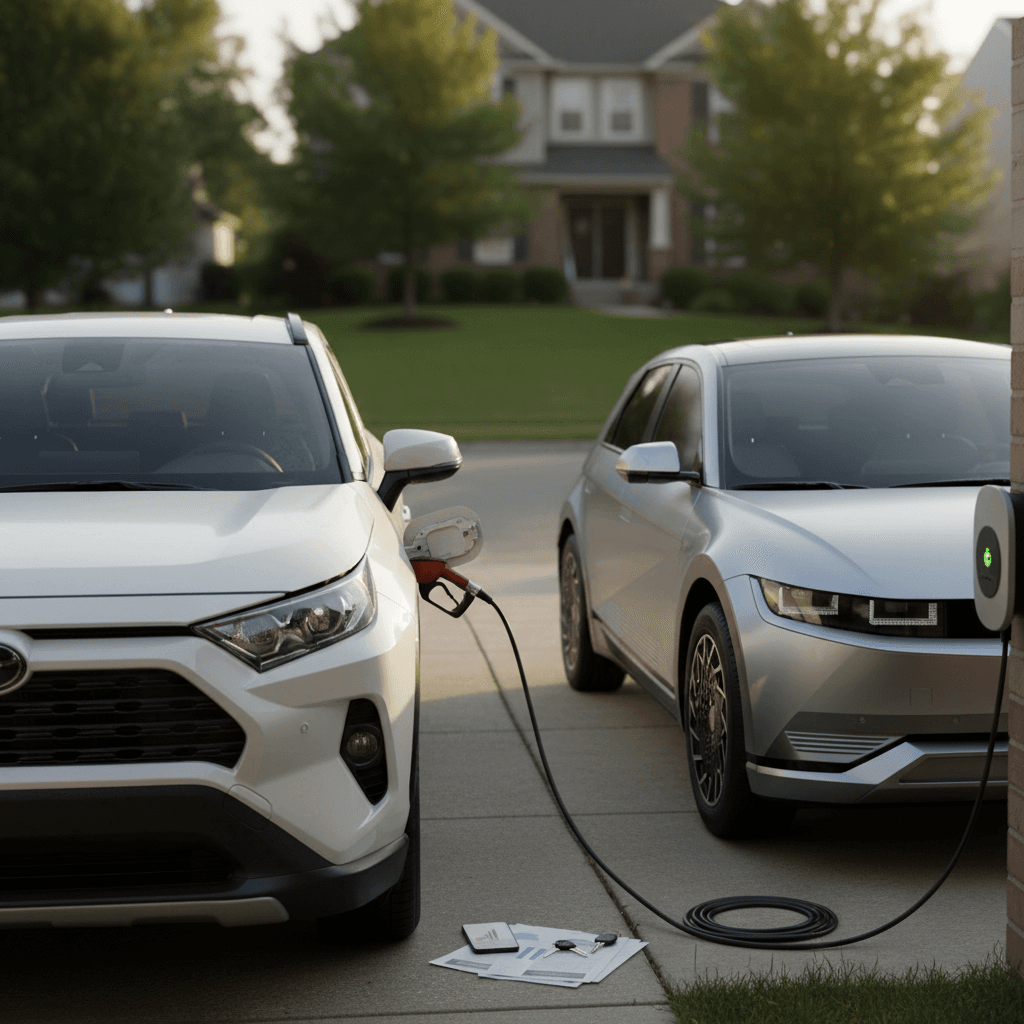
If you’re eyeing a switch from a Toyota RAV4 to a Hyundai Ioniq 5, the big question is simple: how much will you actually save? Between lower “fuel” costs, less maintenance and available EV incentives, the Hyundai Ioniq 5 can undercut a gas RAV4’s ownership costs by thousands of dollars over a few years, if you set things up right.
At a glance
Why drivers are switching from RAV4 to Ioniq 5
The Toyota RAV4 has long been the default choice for shoppers who want a practical, efficient SUV. The Hyundai Ioniq 5 targets the same territory, but as a fully electric crossover, it trades gasoline fill-ups for electrons, and a traditional engine for a battery pack and motors. The overlap in size, practicality and price means a lot of shoppers are actively comparing RAV4 vs. Ioniq 5 and trying to understand total cost of ownership, not just the sticker price.
Toyota RAV4 vs. Hyundai Ioniq 5: quick snapshot
Think of them as cousins targeting the same driveway
Toyota RAV4 (gas)
- Compact SUV with gasoline engine
- Popular for reliability and resale value
- Regular fuel and oil-change schedule
- Available in FWD and AWD, plus hybrid variants
Hyundai Ioniq 5 (EV)
- All-electric compact crossover
- Uses electricity instead of gas
- Fewer moving parts, less routine maintenance
- Fast charging and strong tech feature set
Include the hybrid in your mental math
Key assumptions for our cost-savings math
To keep things grounded, we’ll walk through a realistic example for a U.S. driver. Your exact numbers will vary, but the relative gap between a RAV4 and a Hyundai Ioniq 5 will look similar.
- Annual miles driven: 15,000 miles
- Gasoline price: $3.50 per gallon (national-blend assumption)
- Home electricity price: $0.15 per kWh (rough U.S. residential average)
- Toyota RAV4 fuel economy: ~30 mpg combined (gas model)
- Hyundai Ioniq 5 efficiency: ~3.0 miles per kWh (typical real-world mix)
- Ownership window: 5 years
- Charging mix: mostly home charging, limited DC fast charging on road trips
Your rates may be very different
Fuel vs. electricity costs: RAV4 vs. Ioniq 5
Annual “fuel” costs: gas vs. electrons
Here’s how we get there. A gas Toyota RAV4 at 30 mpg burns about 500 gallons a year at 15,000 miles. At $3.50 per gallon, that’s roughly $1,750 a year in fuel. The Hyundai Ioniq 5, at about 3.0 miles per kWh in mixed driving, needs about 5,000 kWh per year to cover the same distance. At $0.15 per kWh, that’s about $750. You’re pocketing around $1,000 per year on energy alone under these assumptions.
Public fast charging can eat into savings

Maintenance and repairs: where EVs pull ahead
RAV4 (gas): more routine items
- Oil and filter changes multiple times a year
- Spark plugs, belts, exhaust components over time
- Transmission and engine fluids
- More complex engine-related diagnostics as the vehicle ages
Ioniq 5 (EV): fewer moving parts
- No oil changes, spark plugs or exhaust system
- Simple single-speed reduction gear instead of multi-gear transmission
- Regenerative braking reduces brake wear
- Still needs tires, cabin filters and brake fluid over time
Typical maintenance savings
The gap often widens as vehicles age. A higher-mileage RAV4 may need more engine- or transmission-related attention, while an Ioniq 5’s biggest long-term question is battery health. That’s where tools like a Recharged Score Report come in, providing verified battery diagnostics on a used Hyundai Ioniq 5 so you’re not guessing about future range or degradation.
Insurance, taxes and credits
Insurance and registration costs vary by state and insurer, but EVs like the Hyundai Ioniq 5 typically land in the same general ballpark as a comparably priced compact SUV. Some insurers charge a little more for EV repairs; others discount for advanced safety tech. Plan for a small plus or minus rather than a huge swing either way.
- Some states offer reduced registration fees or additional rebates for EVs.
- Federal and state tax credits may be available on new Ioniq 5s, and in some cases on qualifying used EVs purchased from a dealer.
- Local utilities may offer bill credits or reduced off-peak charging rates, further trimming electricity costs.
Don’t forget used-EV incentives
5-year total cost comparison: RAV4 vs. Ioniq 5
Let’s pull the big pieces together. Here’s a simplified five-year comparison focused on operating costs, not including your purchase price, interest or depreciation. That’s because shoppers will cross-shop new vs. used, different trims, cash vs. financing, and so on.
Estimated 5-year operating costs (15,000 miles/year)
Illustrative example comparing a gas Toyota RAV4 to a Hyundai Ioniq 5 under common U.S. fuel and electricity assumptions.
| Category (5 years) | Toyota RAV4 (gas) | Hyundai Ioniq 5 (EV) | Difference |
|---|---|---|---|
| Fuel / Electricity | $8,750 | $3,750 | Ioniq 5 saves ~$5,000 |
| Maintenance & minor repairs | $4,000 | $1,500 | Ioniq 5 saves ~$2,500 |
| Total operating costs | $12,750 | $5,250 | ~$7,500 in favor of Ioniq 5 |
| Potential incentives | N/A | Up to several thousand (if eligible) | Improves Ioniq 5 economics further |
These figures are directional, not guarantees. Always plug in your own gas price, power rate and mileage for a personalized view.
What this table really says
Used Ioniq 5 vs. new: how to boost savings
New-vehicle pricing for a Toyota RAV4 and Hyundai Ioniq 5 can feel similar, depending on trim and options. But where many shoppers unlock real savings is by buying a used Ioniq 5 that’s already taken its first-year depreciation hit, then stacking those lower operating costs on top.
Why a used Ioniq 5 often wins on total cost
Depreciation plus lower operating costs is a powerful combo
Lower upfront price
Battery health transparency
Faster break-even point
Don’t skip battery diagnostics
Charging practicalities if you’re coming from a RAV4
Moving from a RAV4 to an Ioniq 5 changes how you “fuel” the vehicle. Instead of gas stations, your main “fill-up” is usually your driveway or garage. That’s part of where the savings come from, but you’ll want a basic charging plan before you make the switch.
Charging readiness checklist for RAV4 owners
1. Confirm home charging options
If you have access to a driveway, garage, or dedicated parking spot near an outlet, you’re in a great position. Even a standard 120V outlet can work for low daily mileage, although 240V Level 2 is much more convenient.
2. Evaluate your daily miles
If you routinely drive under 60–80 miles per day, an Ioniq 5 plus overnight home charging will feel seamless. Higher daily mileage may justify installing faster Level 2 charging at home.
3. Check electrical capacity
For Level 2 charging, you’ll typically need a 240V circuit. Have a licensed electrician (not a DIY job) confirm capacity and install the right outlet or wall unit safely.
4. Map nearby public chargers
Use charging apps to find DC fast chargers on your common routes. The Ioniq 5 can charge very quickly on compatible high-power stations, which helps on longer trips.
5. Learn your utility’s rate plan
Many utilities offer cheaper overnight rates. Time-of-use plans can make your electricity costs even lower than the $0.15 per kWh we used in our example.
6. Factor charging into your routine
Think of charging more like charging your phone and less like refueling your RAV4. Plug in when you get home, wake up with the “tank” full, and use public fast charging when you really need it.
Safety first with home charging
How Recharged helps make the switch smoother
If you’re selling or trading your Toyota RAV4 and stepping into a used Hyundai Ioniq 5, you’re juggling resale value, tax credits, battery health questions and financing, all at once. Recharged is built to simplify that transition for EV shoppers.
What Recharged brings to a RAV4 → Ioniq 5 switch
Support from trade-in to battery health to delivery
Trade-in & selling options
Recharged Score battery diagnostics
Financing and delivery
Ready to find your next EV?
Browse VehiclesMake total cost part of your shopping flow
FAQ: RAV4 to Ioniq 5 cost savings
Frequently asked questions
Is switching from RAV4 to Ioniq 5 worth it?
If you can charge at home or at work and you drive at least a typical 12,000–15,000 miles per year, switching from a Toyota RAV4 to a Hyundai Ioniq 5 can deliver thousands of dollars in savings over a five-year window, mostly through cheaper “fuel” and lower maintenance. Stack in potential tax credits and a smart used-EV purchase price, and the financial case gets even stronger.
The key to making the switch work is doing the math with your own gas price, electricity rate and mileage, then buying the right Ioniq 5 at the right price with clear insight into battery health. That’s where a transparent used-EV marketplace like Recharged, with its Recharged Score Report, financing help, trade-in options and nationwide delivery, can turn a spreadsheet win into a real-world upgrade from gas SUV to electric crossover.