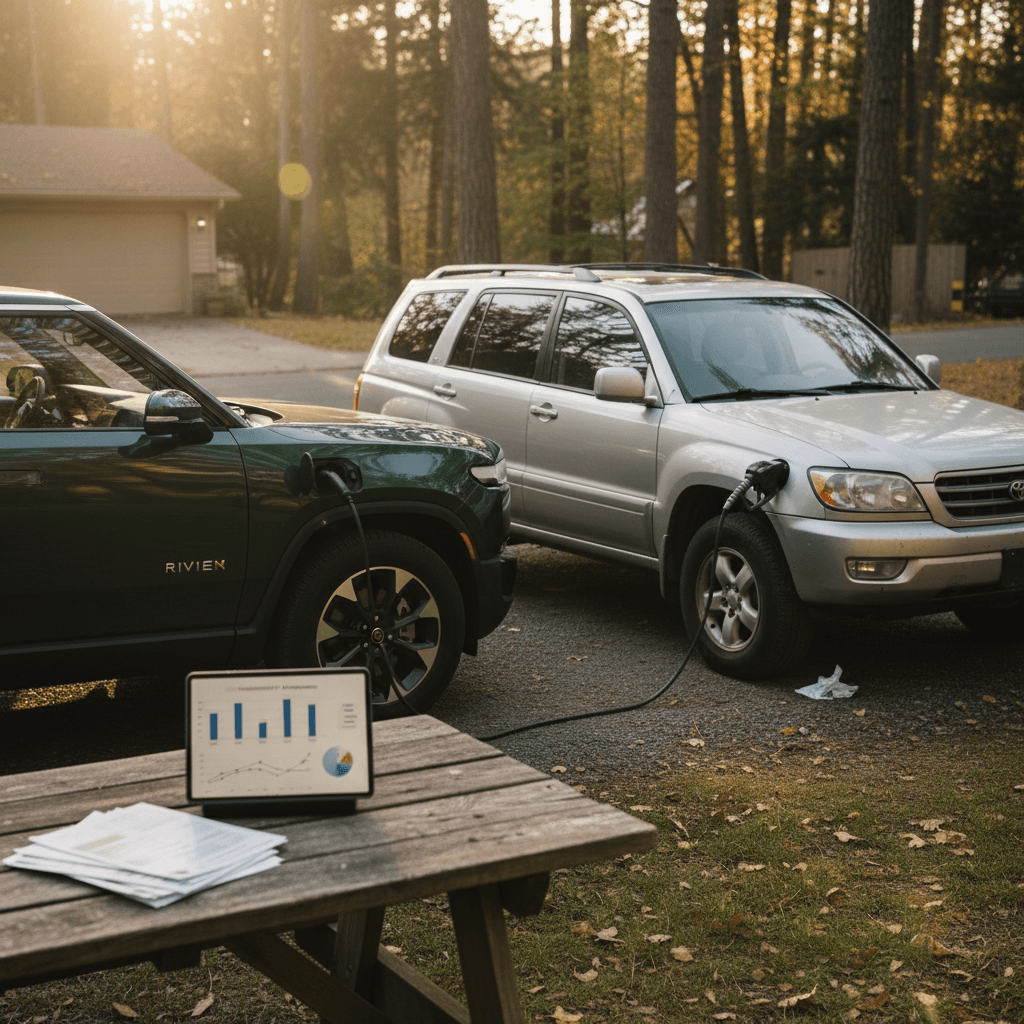
You don’t wake up one morning and casually swap a trusty Toyota Highlander for a Rivian R1S. This is a big, emotional move: same three-row, family-hauling mission, very different drivetrain, purchase price, and ownership story. If you’re wondering what the real cost savings of switching from a Toyota Highlander to a Rivian R1S look like, this guide walks through the numbers in plain English.
How we’ll compare costs
Why Drivers Are Trading Highlanders for Rivian R1S
On paper, a gas Highlander and a Rivian R1S solve the same problem: three rows, kid gear, road trips, foul-weather security. In practice, they attack it very differently. The Highlander leans on Toyota’s reputation for durability and simplicity; the R1S leans on instant torque, over-the-air updates, and the quiet satisfaction of skipping gas stations.
Highlander to R1S: What’s Driving the Switch?
Money matters, but it’s not the only reason
Fuel & energy costs
Gas bills on a midsize SUV add up. When you replace 24 mpg on gasoline with an efficient electric drivetrain, you turn every commute into a savings play, especially if you can charge at home.
Future-proofing
Many families are thinking beyond today’s pump price to future regulations, low‑emission zones, and resale demand for gas vs. EV SUVs a decade from now.
Driving experience upgrade
The R1S feels more like a modern luxury flagship than a family bus, quicker, quieter, and packed with tech. For a lot of people, that makes the cost question worth digging into.
Highlander vs Rivian R1S: 5‑Year Cost Snapshot (Typical U.S. Driver)
Highlander vs Rivian R1S: Cost Summary at a Glance
5‑Year Cost Snapshot: Gas Highlander vs Rivian R1S
Estimates for a typical U.S. driver at 12,000 miles per year. These are directional, not promises, your local prices and driving mix will shift the totals.
| Category | Toyota Highlander (Gas) | Rivian R1S (New) | What This Means |
|---|---|---|---|
| Fuel / Electricity | ≈$8,750 | ≈$4,300 | R1S can save around $900 per year if you charge mostly at home. |
| Routine maintenance | ≈$3,000 | ≈$1,500 | EVs skip oil changes, exhaust repairs, and many engine‑related services. |
| Repairs out of warranty | Low–moderate | Moderate–unknown | Toyota parts and labor tend to be cheaper and more predictable today. |
| Insurance | Baseline | +10–25% | R1S is a pricier, heavier luxury EV; premiums often run higher. |
| Depreciation | Gentle | Steeper (new), improving (used) | Highlander is a safe bet; R1S is newer to market and still finding its curve. |
| Total 5‑yr running costs (fuel + basic maintenance) | ≈$11,750 | ≈$5,800 | The R1S can easily cut running costs in half, before insurance and depreciation. |
Assumes purchase price financed over 5–6 years, mostly home charging for the R1S, and routine maintenance only.
These are averages, not guarantees

Fuel vs Electricity: Where Most Savings Come From
Let’s start with the one bill you see every week: energy. A gas Highlander sip‑sips its way through your checking account. An R1S gulps electricity instead. The good news is that each gulp is cheap.
Gasoline in a Toyota Highlander
- Realistic mixed mpg: about 24 mpg for a non‑hybrid Highlander in real‑world driving.
- Annual miles: 12,000.
- Gallons per year: 12,000 ÷ 24 = 500 gallons.
- At $3.50/gal: 500 × $3.50 = $1,750 per year in fuel.
Electricity in a Rivian R1S
- Typical efficiency: about 2.3 mi/kWh for mixed driving on all‑terrain tires.
- Annual miles: 12,000.
- kWh per year: 12,000 ÷ 2.3 ≈ 5,220 kWh.
- At 16.5¢/kWh: 5,220 × $0.165 ≈ $862 per year in electricity.
Check your own energy reality
- If you drive more than 12,000 miles a year, the R1S pulls away further on energy savings.
- If you drive less, the fuel savings shrink, but so does the environmental case for a big EV.
- If you’re mostly on highway at 75–80 mph, the R1S efficiency may dip closer to 2.0 mi/kWh, trimming the savings.
Maintenance and Repairs: Highlander vs R1S
Toyota has built its reputation on making SUVs that seem to run forever on oil changes and brake pads. EVs play a different game: far fewer moving parts in the drivetrain, and powerful regenerative braking that saves the friction brakes for emergencies and low‑speed stops.
Where the R1S Saves, and Where the Highlander Still Wins
Not all costs disappear when you go electric
Maintenance the Highlander needs, R1S doesn’t
- Oil and filter changes every 5–10k miles.
- Transmission fluid service.
- Spark plugs, belts, exhaust system over time.
- More frequent brake jobs without strong regen.
Over five years, those routine items can easily add up to $2,000–$3,000 on a gas SUV.
Maintenance both vehicles still need
- Tires and rotations (the R1S is heavy and loves good rubber).
- Cabin air filters, wiper blades, brake fluid.
- Suspension wear if you live on rough roads.
The R1S may go through tires faster, partly offsetting its savings on oil and engine work.
Warranty safety net
Insurance, Taxes, and Incentives
Here’s where the R1S reminds you it’s a premium, heavy EV. It can save you at the pump and in the shop, then hand some of that money back to your insurer.
Owning Costs Beyond Fuel and Maintenance
These factors don’t show up at the pump but matter to your monthly budget.
| Line Item | Highlander (Gas) | Rivian R1S | Cost Impact |
|---|---|---|---|
| Insurance | Moderate | Higher | Many owners see 10–25% higher premiums because of vehicle value and repair complexity. |
| Registration & taxes | Standard SUV | Sometimes higher | Some states base fees on weight or vehicle value; check your DMV’s EV specifics. |
| Federal EV tax credit | No | Depends on year and configuration | New EV incentives are in flux; used EVs up to a price cap may qualify for a tax credit if they meet IRS rules. |
| State/local incentives | Rare for gas SUVs | Possible for EVs | HOV lane access, sales tax breaks, or home charging rebates can tilt the math toward the R1S. |
Run the tax credit and rebate numbers
Depreciation and Resale Value
If the Highlander is the sensible pair of jeans in your closet, the R1S is that sharp new jacket, gorgeous, pricey, and you’re not quite sure how it’ll age. Toyota’s three‑row SUV has a long, proven resale track record. The Rivian R1S is still carving its path, and that affects your long‑term cost.
How Each SUV Handles Time and Miles
Toyota Highlander
- Historically slow, predictable depreciation.
- Huge used‑buyer pool; easy to sell locally.
- Buy new, keep 8–10 years, and cost per mile looks fantastic.
Rivian R1S
- Early EV luxury SUVs often see steeper first‑owner depreciation.
- Used prices have started normalizing as more inventory hits the market.
- Buying used instead of new moves you past the steepest part of the curve, and can unlock the biggest cost savings.
Where Recharged fits in
Ready to find your next EV?
Browse VehiclesCharging at Home vs Public Fast Charging
All the pretty savings charts assume you charge mostly at home, where electricity is cheapest. The closer your R1S behaves to a gas car, filling up at public stations when you’re empty, the more those savings leak away.
What You’ll Pay to Charge a Rivian R1S
Approximate costs for adding 250 miles of range to an R1S under different charging scenarios.
| Charging Scenario | Cost for ~250 Miles | Rough Cost per ‘Tank’ | Notes |
|---|---|---|---|
| Home Level 2, standard residential rate | ≈108 kWh × 16.5¢ ≈ $18 | About $18 | Cheapest, most convenient for most owners. |
| Home Level 2, off‑peak EV rate | ≈108 kWh × 10–12¢ ≈ $11–13 | As low as $11 | Some utilities offer special night‑time EV rates. |
| Public DC fast charging | Often 40–60¢/kWh | $43–$65 | Great for trips; too expensive for daily use. |
| Gas Highlander (24 mpg, $3.50/gal) | 250 ÷ 24 = 10.4 gal → ≈ $36 | About $36 | Twice the cost of home charging, similar to some fast‑charging sessions. |
Fast‑charging all the time? Savings evaporate
5‑Year Ownership Scenarios: Mild, Typical, and Heavy Drivers
To really feel the numbers, let’s look at three driving patterns. In each case we’ll focus on fuel vs electricity plus basic maintenance, things you can actually forecast, using the same gas and electricity prices as before.
5‑Year Running Costs: Toyota Highlander vs Rivian R1S
Fuel/electricity plus routine maintenance only. All figures rounded.
| Driver Type | Miles per Year | Highlander: Fuel + Basic Maintenance (5 yrs) | R1S: Electricity + Basic Maintenance (5 yrs) | R1S Advantage |
|---|---|---|---|---|
| Mild commuter | 8,000 | Fuel ≈ $5,835 | Maint ≈ $2,000 → $7,835 | Electric ≈ $2,875 | Maint ≈ $1,200 → $4,075 | Saves ≈ $3,760 |
| Typical family | 12,000 | Fuel ≈ $8,750 | Maint ≈ $3,000 → $11,750 | Electric ≈ $4,312 | Maint ≈ $1,500 → $5,812 | Saves ≈ $5,940 |
| Road‑trip warriors | 18,000 | Fuel ≈ $13,125 | Maint ≈ $4,000 → $17,125 | Electric ≈ $6,470 | Maint ≈ $2,000 → $8,470 | Saves ≈ $8,655 |
More miles, more benefit
How a Used Rivian R1S Changes the Math
New‑car math is one thing. Used‑car math is where the Rivian R1S can get very interesting for a Highlander owner. You’re stepping out of a vehicle famous for long‑term value. To make a switch pencil out, you want three things: a fair price, a healthy battery, and some confidence about the SUV’s history.
Why Many Highlander Owners Look for a Used R1S
Depreciation already paid
The first owner usually takes the steepest hit. Buying used moves you into a lower monthly payment territory while keeping the fuel and maintenance advantages.
Battery health transparency
This is the EV wild card. A used R1S with a documented, healthy pack is a very different proposition than one with question marks.
Third‑party validation
Recharged’s Score Report gives you verified battery diagnostics, pricing benchmarks, and a clear-eyed look at a used R1S’s condition before you ever sign.
How Recharged can help you run the numbers
Checklist: What to Think Through Before You Switch
Highlander → Rivian R1S: Decision Checklist
1. Be honest about your mileage
Look at the last year of driving, not just your commute. High annual miles make the R1S’s lower energy and maintenance costs far more compelling.
2. Audit your home charging situation
Do you have a garage or driveway near a usable 240V circuit? If not, what will it take, permits, panel upgrades, electrician labor, to install a Level 2 charger?
3. Check your electricity and gas prices
Pull real numbers off your bills. If your gas is low but electricity is unusually high, savings will be thinner. In parts of the country with cheap power, they’ll be much better.
4. Get insurance quotes before you shop
Ask your insurer (and one competitor) for quotes on a Rivian R1S with your actual driving record. Don’t wait to be surprised after you’ve fallen in love with a truck.
5. Compare used vs new R1S
If saving money is the goal, short‑list used R1S models with strong battery health and good histories. New is lovely; used is where the spreadsheets start smiling.
6. Put a number on your Highlander
Use trade‑in tools, instant offers, or consignment estimates to know what your Highlander is really worth. Recharged can provide an <strong>instant offer</strong> or help you consign to maximize value.
7. Think about how long you’ll keep the R1S
If you tend to keep vehicles 8–10 years, the R1S’s running‑cost advantage and improving resale picture start to offset its higher upfront price in a big way.
FAQ: Switching From Toyota Highlander to Rivian R1S
Common Questions About Highlander to Rivian R1S Cost Savings
Bottom Line: Is the R1S Cheaper to Own Than a Highlander?
If you strip away emotion and just stare at the math, a Rivian R1S can absolutely undercut a gas Toyota Highlander on day‑to‑day running costs. For a typical American family doing around 12,000 miles a year with home charging, it’s not hard to find $5,000–$8,000 in fuel and maintenance savings over five years. Drive more, or charge at lower off‑peak rates, and the gap widens.
But you don’t live on a spreadsheet. Insurance, charging access, how long you keep vehicles, and whether you buy new or used all matter. A brand‑new R1S will feel like a rocket‑ship upgrade from your Highlander, but the cleanest cost story usually belongs to a well‑vetted used R1S with a healthy battery and a fair purchase price.
If you’re ready to see how the numbers look for your specific situation, you don’t have to do this alone. Recharged can help you value your Highlander, evaluate used R1S options, and compare total ownership costs, with the kind of battery health data and pricing transparency that make a big switch feel less like a leap of faith and more like a smart, informed decision.