If you’ve been living with a Jeep Grand Cherokee and find yourself eyeing a Rivian R1S, you’re probably not just chasing cool factor. You want to know, in plain English and real numbers, what the cost savings look like when switching from a Jeep Grand Cherokee to a Rivian R1S. Does the big electric SUV actually save you money once you add up fuel, maintenance, insurance, and purchase price?
Assumptions up front
Why Jeep Grand Cherokee Owners Are Eyeing the Rivian R1S
On paper, a Jeep Grand Cherokee and a Rivian R1S appeal to the same kind of driver: you want space, towing ability, real off-road chops, and a sense that your SUV can take on more than a mall parking lot. The big difference is what’s happening under the floor. Jeep burns gasoline; Rivian burns electrons. That swap changes your monthly bills in three big ways: fuel, maintenance, and depreciation.
Top reasons Jeep Grand Cherokee drivers consider a Rivian R1S
It’s not just about going electric for the sake of it.
Fuel cost shock
Maintenance fatigue
Capability without compromise
Think in total cost, not monthly payment
Key Specs & Efficiency: Jeep Grand Cherokee vs. Rivian R1S
Grand Cherokee vs. Rivian R1S: Snapshot
Representative trims and real-world efficiency assumptions for a fair cost comparison.
| Model | Powertrain example | EPA/real-world efficiency | Fuel/energy type | Seating |
|---|---|---|---|---|
| Jeep Grand Cherokee (gas) | 3.6L V6 4x4 | 21 mpg combined (real-world ~20) | Gasoline | 5 |
| Rivian R1S (Dual Motor Large pack) | Dual-motor AWD | ~2.3–2.5 mi/kWh (we’ll use 2.4) | Electricity | 7 |
Exact numbers vary by engine, wheels, and climate, but this gives a realistic baseline.
If you own a V8 or spend most of your time in stop‑and‑go traffic, your Grand Cherokee’s real‑world mpg may be in the high teens. For the R1S, owners commonly report between about 2.2 and 2.6 mi/kWh over thousands of miles, depending on wheels, climate, and how heavy your right foot is. For clean math, we’ll assume 20 mpg for the Jeep and 2.4 mi/kWh for the Rivian, both realistic, not best‑case brochure numbers.
What those efficiencies mean on your utility bill
Your numbers may be better… or worse
Fuel vs. Electricity: What Each Mile Really Costs
Jeep Grand Cherokee fuel cost per mile
- Assumed real‑world fuel economy: 20 mpg
- Assumed gas price: $4.00 per gallon
Cost per mile = $4.00 ÷ 20 mpg = $0.20/mile
Drive 15,000 miles per year and you’re spending about $3,000 a year just on fuel.
Rivian R1S electricity cost per mile
- Assumed efficiency: 2.4 mi/kWh
- Assumed electricity price: $0.18–$0.20/kWh
At $0.18/kWh:
Cost per mile = ($0.18 ÷ 2.4) ≈ $0.075/mile
At $0.20/kWh, round it to $0.08/mile. At 15,000 miles, that’s about $1,125–$1,200 a year.
Annual fuel/energy savings at 15,000 miles
Five-Year Ownership Cost Comparison
Upfront, a Rivian R1S is a more expensive vehicle than most Jeep Grand Cherokee trims. Where it claws money back is running costs and depreciation behavior. To get a clear picture, let’s compare a typical five‑year ownership window for a reasonably new Jeep versus a used R1S bought through a marketplace like Recharged.
Example 5‑year cost of ownership: Jeep Grand Cherokee vs. used Rivian R1S
Assumes 15,000 miles per year, U.S. averages for fuel and electricity, and typical maintenance/repair patterns.
| Cost category (5 years) | Jeep Grand Cherokee (late-model gas) | Rivian R1S (used, dual-motor) |
|---|---|---|
| Starting vehicle price | $32,000 (lightly used) | $60,000 (used via EV marketplace) |
| Estimated 5‑year depreciation | -$12,000 | -$22,000 |
| Net value lost to depreciation | $12,000 | $22,000 |
| Fuel / electricity (75,000 miles) | ~$15,000 (75,000 x $0.20) | ~$6,000 (75,000 x $0.08) |
| Maintenance & repairs | ~$6,000 (brakes, fluids, wear items, occasional repairs) | ~$3,000 (tires, brakes, minimal service) |
| Total 5‑year running costs (fuel + maint.) | $21,000 | $9,000 |
| Total 5‑year cost (depr. + running) | ~$33,000 | ~$31,000 |
These are ballpark, illustrative numbers to show the size and direction of the savings, not a personalized quote.
In this example, even though the Rivian started life with a much higher sticker price, the total 5‑year cost ends up in the same ballpark as a cheaper gas Jeep. Push the miles higher, or start adding expensive gas‑SUV repairs in years 6–10, and the R1S starts to pull ahead.
What about if your Jeep is already paid off?
How Your Driving Patterns Change the Savings
Annual fuel/energy savings by mileage
Same assumptions as before: 20 mpg Jeep, 2.4 mi/kWh R1S, $4.00/gallon gas, $0.18–$0.20/kWh electricity.
10,000 miles/year
- Jeep fuel: ~$2,000/year
- R1S energy: ~$750–$800/year
- Savings: ≈ $1,200/year
15,000 miles/year
- Jeep fuel: ~$3,000/year
- R1S energy: ~$1,100–$1,200/year
- Savings: ≈ $1,800–$1,900/year
20,000 miles/year
- Jeep fuel: ~$4,000/year
- R1S energy: ~$1,500–$1,600/year
- Savings: ≈ $2,400–$2,500/year
High‑milers see payback sooner
On the flip side, if your Grand Cherokee mostly sits in the driveway and you drive 6,000–8,000 miles a year, fuel savings alone probably won’t justify a jump to a premium‑priced EV. You’d still benefit from lower maintenance, smoother driving, and zero tailpipe emissions, but the spreadsheet won’t shout “bargain.”
Insurance, Taxes, and Other "Hidden" Costs
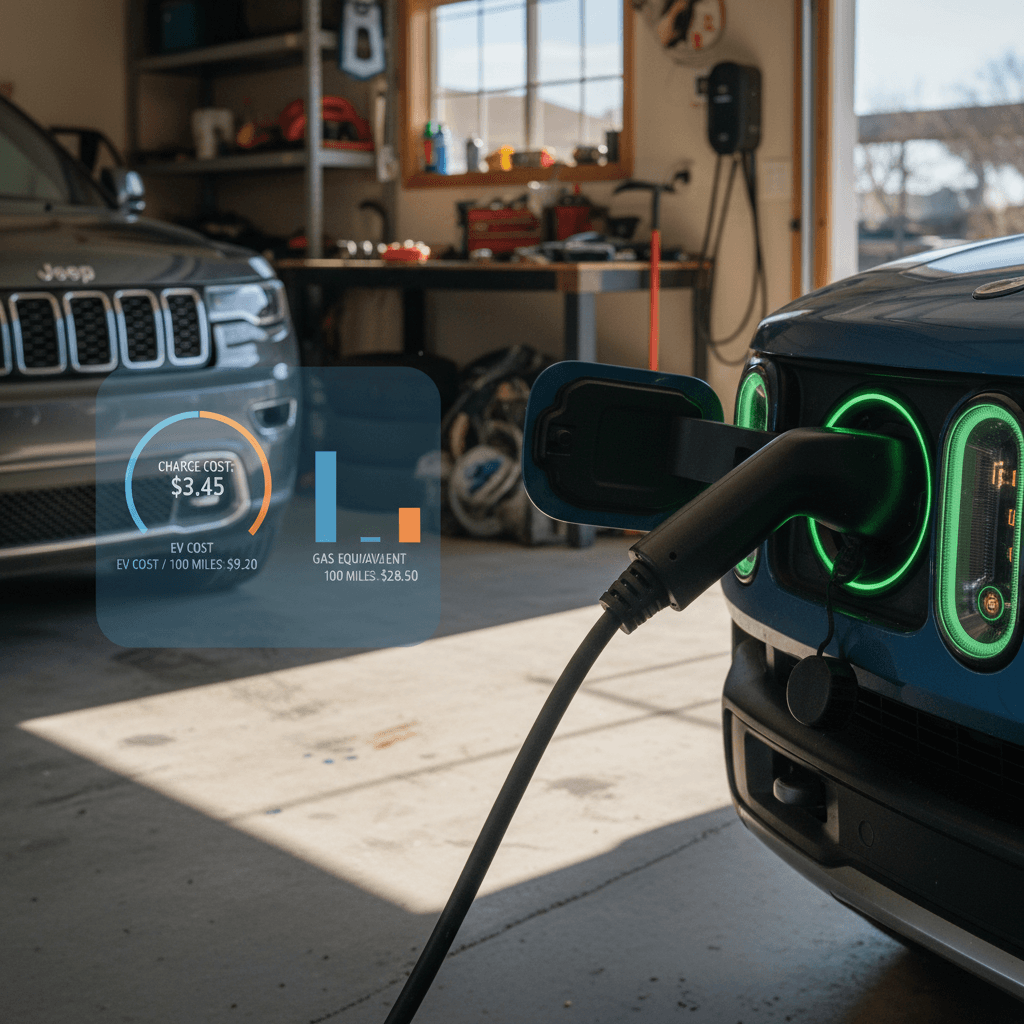
Don’t forget home charging costs
Buying New vs. Used Rivian R1S: How Recharged Changes the Math
The quickest way to make the Rivian look “too expensive” is to compare a brand‑new R1S to an older, already‑depreciated Grand Cherokee. The smarter move is to look at the growing used Rivian R1S market. Early‑build trucks have already taken the steep first‑owner depreciation hit, exactly where a platform like Recharged comes in.
How buying a used R1S through Recharged can tilt the scales
You’re not just gambling on a random used EV.
Verified battery health
Fair pricing & financing
Trade‑in & delivery
Ready to find your next EV?
Browse VehiclesWhere used R1S deals tend to shine
Checklist: Is Switching from Jeep to Rivian Worth It for You?
Run through these questions before you list your Jeep
1. How many miles do you actually drive each year?
Pull fuel receipts or your service records instead of guessing. If you’re under 8,000 miles a year, the financial case is softer; above 15,000, the R1S’s fuel savings get compelling fast.
2. What’s your real Jeep mpg?
Use the trip computer over a few tanks or track miles vs. gallons. If your V6 or V8 lives in city traffic or tows often, you may be closer to 16–18 mpg than 22 mpg.
3. Can you charge at home overnight?
Home charging is the backbone of the savings story. If you can plug in overnight at a predictable residential rate, the R1S will beat public fast‑charging your way through life, both in cost and convenience.
4. What would a 240V install cost you?
Get at least one quote from a licensed electrician. Ask about panel capacity, permit requirements, and whether utility rebates might offset the cost of a Level 2 charger.
5. How long do you plan to keep your next SUV?
If you’re a 2‑ to 3‑year flipper, rapid EV price moves can be unpredictable. If you’re planning to keep the R1S for 5–8+ years, lower operating costs and fewer major repairs start to dominate the equation.
6. What’s your Jeep worth today?
Check instant‑offer tools or get a trade‑in estimate. Rolling that equity into a used R1S on Recharged can shrink the payment gap more than you might expect.
Frequently Asked Questions
Jeep Grand Cherokee to Rivian R1S: Common Questions
Bottom Line: When a Rivian R1S Beats a Jeep Grand Cherokee
If your Grand Cherokee is your daily workhorse and you’re piling on 15,000–20,000 miles a year, the math is squarely in the Rivian’s favor. Fuel alone can save you $1,500–$2,500 per year, and maintenance trims a few hundred more off the top. Over a five‑ to seven‑year window, a well‑chosen used Rivian R1S can match or undercut the total cost of owning a newer gas‑powered Jeep while giving you more performance, quieter miles, and zero tailpipe emissions.
If you’re a low‑mileage driver with a paid‑off Jeep that’s still in good shape, switching is more about what you value: the driving experience, the environmental upside, and the satisfaction of skipping gas stations. In that case, the spreadsheet might whisper “maybe,” while your heart shouts, “Do it.”
Either way, treat this as a starting framework. Pull your real mpg and fuel receipts, check your electric bill, and then browse used EV buying guides and EV charging basics to fine‑tune the numbers. And when you’re ready to see what a used Rivian R1S with a verified battery and fair market pricing looks like, a marketplace like Recharged can turn your Jeep’s hard‑earned miles into your next electric adventure.