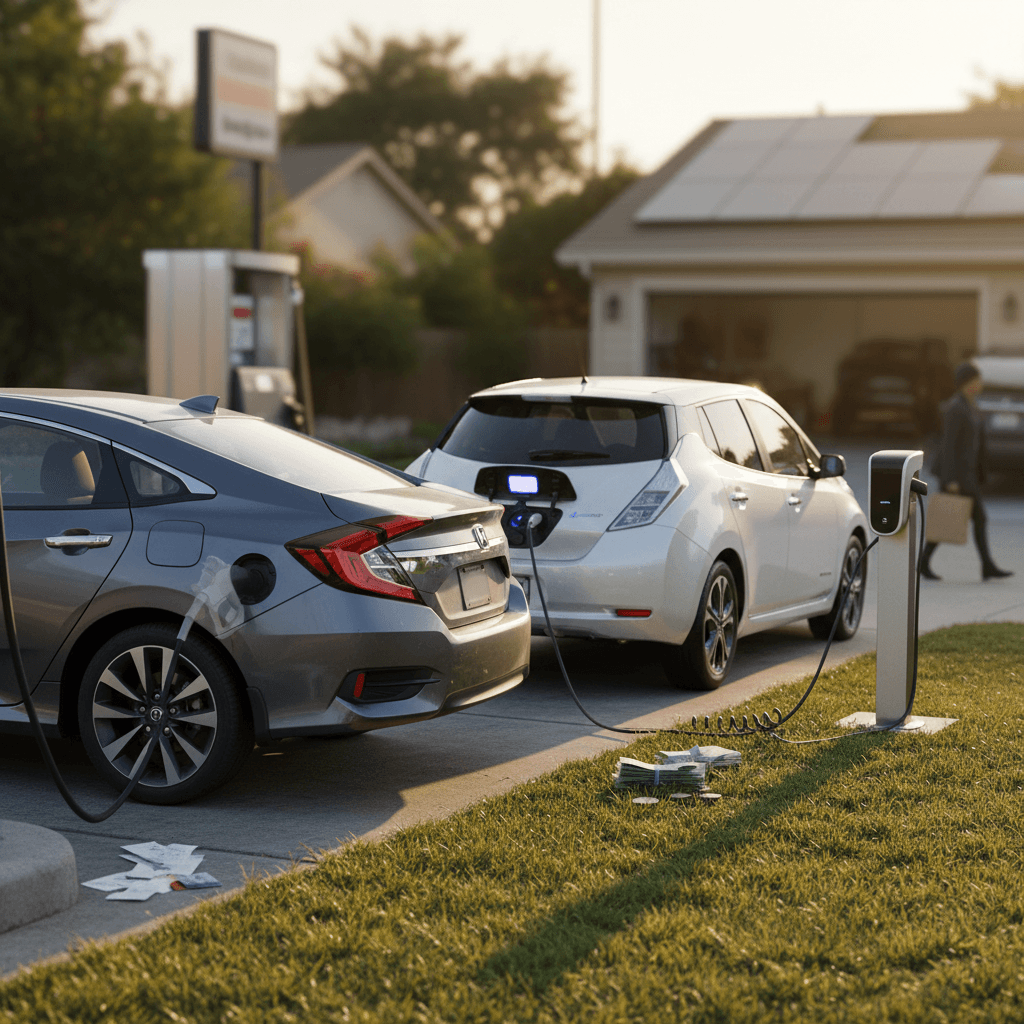
If you’re driving a Honda Civic today and eyeing a Nissan Leaf, you’re probably asking a simple question: will this actually save me money? The short answer for most U.S. commuters is yes, especially if you buy a used Leaf and keep it a few years, but the details depend on how much you drive, what you pay for gas and electricity, and the specific models you compare.
Key takeaway in one line
Why Compare a Honda Civic and a Nissan Leaf?
The Honda Civic and Nissan Leaf occupy a similar spot in a lot of driveways: practical, compact, and focused on everyday commuting rather than luxury. The Civic is a benchmark gas compact, while the Leaf was one of the first mass‑market EVs. That makes switching from a Honda Civic to a Nissan Leaf a very common upgrade path for drivers who want lower running costs without giving up usability.
- Both are compact hatchback/sedan‑style vehicles aimed at commuters and small families.
- Civics are known for reliability and low operating costs on the gas side.
- Leafs bring the benefits of all‑electric driving: no gas, fewer moving parts, quiet operation.
- Used examples of both models are widely available and relatively affordable.
Choose comparable trims
Headline Numbers: How Much Can You Save?
Typical Annual Savings: Civic vs. Leaf
Those numbers won’t match every driver, but they illustrate the scale: even if your local gas or electricity prices are different, you’re generally trading hundreds of dollars in fuel and oil changes for a modest bump in your electric bill and much lower routine maintenance.
Fuel Costs: Gas vs. Electricity
Let’s break fuel down step by step so you can plug in your own numbers. We’ll assume a modern Civic (around 30 mpg combined) and a Leaf using roughly 30 kWh per 100 miles in mixed driving. We’ll also assume you do most of your Leaf charging at home, which is where the big savings show up.
Typical Annual Fuel Cost: Civic vs. Leaf (12,000 miles/year)
Use this as a framework, you can substitute your local gas and electricity prices to get a more precise estimate.
| Vehicle | Efficiency | Energy Price (example) | Annual Energy Use | Estimated Annual Fuel Cost |
|---|---|---|---|---|
| Honda Civic (gas) | 30 mpg | $3.50 / gallon | 400 gallons | ≈ $1,400 |
| Nissan Leaf (electric) | 30 kWh / 100 miles | $0.15 / kWh | 3,600 kWh | ≈ $540 |
| Difference | , | , | , | ≈ $860 saved by Leaf |
Comparison assumes 12,000 miles of driving per year, mainly home charging for the Leaf.
Public fast charging can change the math
If gas prices spike
When gas climbs above $4.00/gal, the Civic’s annual fuel bill jumps fast. At $4.50/gal, that same 12,000 miles costs roughly $1,800/year, widening the gap vs. an electric Leaf charged at home.
If electricity is expensive
If you pay closer to $0.25/kWh, the Leaf’s annual electricity cost in our example rises to around $900/year. You still typically save money vs. the Civic, but the gap narrows, especially if your Civic is a newer, more efficient model.
Maintenance and Repairs: Where EVs Really Pull Ahead
The Leaf doesn’t just save at the pump, it also has far fewer moving parts than a Civic. No engine oil, spark plugs, timing belts, or exhaust system. Over a 5‑year span, that can meaningfully change your budget.
Typical Maintenance Differences: Civic vs. Leaf
Exact costs vary by shop and region, but the pattern is consistent.
Oil & filters
Honda Civic: 2–3 oil changes per year plus filters.
Nissan Leaf: No engine oil at all, just cabin filters.
Transmission & engine
Civic: Transmission fluid services, potential engine repairs as it ages.
Leaf: Single‑speed reduction gear, far fewer serviceable parts.
Brakes & wear items
Civic: Standard pad and rotor wear.
Leaf: Regenerative braking often means longer brake life, though tires can wear faster on heavier EVs.
Rough 5‑year maintenance picture
The big wild card for a Leaf is battery health. Unlike a Civic engine, you can’t rebuild a degraded battery cheaply. That’s why it’s critical to buy a Leaf with documented battery condition, not just a clean interior and low miles. Every used EV listed on Recharged includes a Recharged Score battery health report, so you’re not guessing about pack condition.
Insurance, Registration, and Fees
Insurance is one of the least predictable parts of the Civic‑to‑Leaf equation because it’s driven by driver profile, location, and insurer. However, a few trends are worth knowing about.
- In some markets, EVs like the Leaf can cost slightly more to insure than an equivalent Civic because of higher vehicle values or pricier collision repairs.
- In others, Leafs and Civics land in a similar premium band; driving record and ZIP code matter more than the gas vs. electric difference.
- A few U.S. states add annual EV registration fees to make up for lost gas‑tax revenue. These typically range from tens of dollars to a bit over $200 per year.
Get quotes before you switch
Purchase Price and Depreciation: New vs. Used
On day one, a new Nissan Leaf has usually carried a higher sticker price than a new Honda Civic. But by the time you’re looking at the used market, a few years and tens of thousands of miles later, the story often flips, especially for earlier‑generation Leafs with shorter range.
Used Civic pricing patterns
Late‑model Civics tend to hold value well. That’s great if you’re selling, but it means a relatively high buy‑in as a used buyer. A clean, mid‑trim Civic with moderate miles often costs a noticeable premium over older Leafs in similar age brackets.
Used Leaf pricing patterns
The Leaf’s faster depreciation, driven largely by concerns about battery life and shorter range on early models, means you can often buy a used Leaf for thousands less than a comparable‑year Civic. That lower entry price can offset future battery‑related risk, especially if you plan to keep the car only a few years.
Battery replacement risk is real, but manageable
Illustrative Used Pricing: Civic vs. Leaf
These are example ranges only; actual prices depend on trim, mileage, market, and condition.
| Vehicle example | Age & mileage (example) | Typical asking price range |
|---|---|---|
| Honda Civic EX | 5–7 years, ~70,000 miles | Often high-teens to low‑$20Ks |
| Nissan Leaf SV (24–40 kWh) | 5–7 years, ~60,000 miles | Often low‑ to mid‑teens |
| Nissan Leaf Plus (62 kWh) | 4–6 years, ~50,000 miles | Often mid‑ to high‑teens |
How depreciation can make a used Leaf cheaper to buy than a similar‑age Civic.
The upshot: you might sell your Civic for strong money, pick up a used Leaf for less, and pocket the difference, while also cutting fuel and maintenance bills. That’s the scenario where Civic‑to‑Leaf switching delivers the biggest financial win.

Range, Charging, and Practical Ownership Trade‑offs
Cost is only one side of the ledger. A Civic can be fueled anywhere in minutes, while a Leaf’s range and charging access will shape how you use the car. Ignoring this is how some buyers end up disappointed.
Practical Pros and Cons: Civic vs. Leaf
Think about how and where you drive before chasing savings.
Where the Civic still wins
- Long highway trips: Easy 400–500‑mile days with fast refueling.
- Rural fueling: Gas stations are ubiquitous, even where public charging is thin.
- Towing / heavy loads: Certain Civic trims may handle occasional loads better than a compact EV.
Where the Leaf shines
- Daily commuting: Quiet, smooth, no gas stops; you leave home with a "full tank."
- Stop‑and‑go traffic: Regenerative braking recovers energy instead of wasting it as heat.
- Short urban/suburban trips: Most errands and workplace commutes fit easily within Leaf range.
Range matters more than you think
Step-by-Step: Should You Switch From Civic to Leaf?
6-Step Civic-to-Leaf Decision Checklist
1. Map your real driving pattern
Look at the last few months of driving. How many miles do you typically drive in a day? How often do you take 150+ mile trips? If nearly all your days are under 60–80 miles, a Leaf can fit easily.
2. Check home or workplace charging
Do you have a driveway or garage where you can install Level 2 charging, or consistent access to workplace chargers? If yes, your fuel savings will be strongest. If you rely solely on public fast charging, savings shrink and convenience falls.
3. Estimate your energy costs
Pull a recent utility bill and find your <strong>all‑in price per kWh</strong>. Compare it to local gas prices using the fuel cost framework above so you know how your personal numbers look, not just national averages.
4. Get insurance quotes for both cars
Use identical coverage levels to compare Civic vs. Leaf premiums. If the Leaf quote is substantially higher, subtract that extra cost from your expected fuel and maintenance savings.
5. Compare real used prices and trade-in value
Look up what your Civic is realistically worth, then shop used Leafs at similar age and mileage. Platforms like <strong>Recharged</strong> can show you transparent pricing, battery health, and financing in one place.
6. Decide your ownership horizon
If you tend to keep cars 3–5 years, total cost of ownership and depreciation matter more than sticker price. If you trade frequently, focus on models and trims that hold value better, such as newer Leaf Plus versions with longer range.
How Recharged Helps If You Go Electric
If this math is pushing you toward the Leaf side of the ledger, the next step is finding the right car at the right price point, and making sure you’re not inheriting someone else’s battery problem. That’s where Recharged comes in.
What You Get When You Shop a Used Leaf at Recharged
Designed specifically to make used EV ownership simpler and more transparent.
Recharged Score battery report
Financing & trade-in support
Nationwide delivery & EV experts
Ready to find your next EV?
Browse VehiclesConsider pre-qualifying
FAQ: Switching From a Honda Civic to a Nissan Leaf
Frequently Asked Questions
Bottom Line: Is Switching to a Leaf Worth It?
If you’re driving a reliable Honda Civic today, switching to a Nissan Leaf only makes sense if the overall ownership picture adds up. For a typical commuter with access to home or workplace charging, the combination of lower fuel costs, reduced maintenance, and attractive used Leaf pricing can easily beat the Civic’s otherwise strong value story, especially over a 3–5‑year ownership window.
Run your own numbers using your real mileage, utility rate, and local gas price. Then look at what your Civic is worth and what a healthy‑battery used Leaf actually costs in your market. If the savings pencil out and the range fits your life, a Civic‑to‑Leaf switch can be a smart financial move that also cuts your tailpipe emissions to zero. And if you want help finding a vetted used Leaf, with verified battery health, fair pricing, and EV‑savvy support, Recharged is built to make that transition as simple as clicking “pre‑qualify” and browsing from your couch.