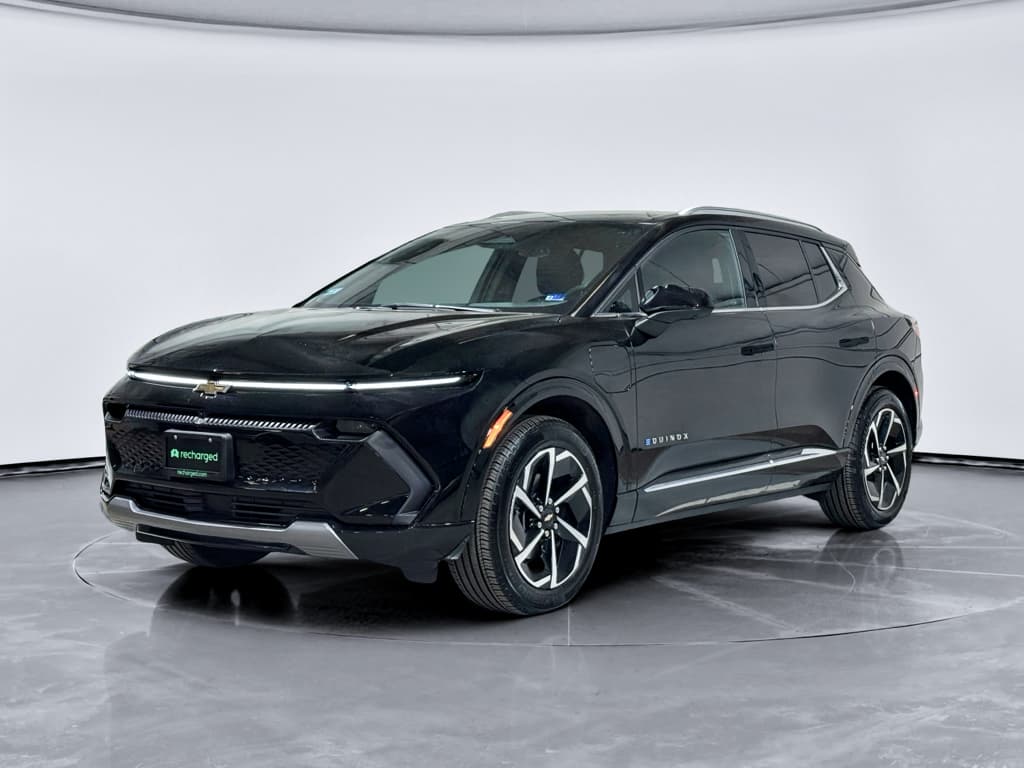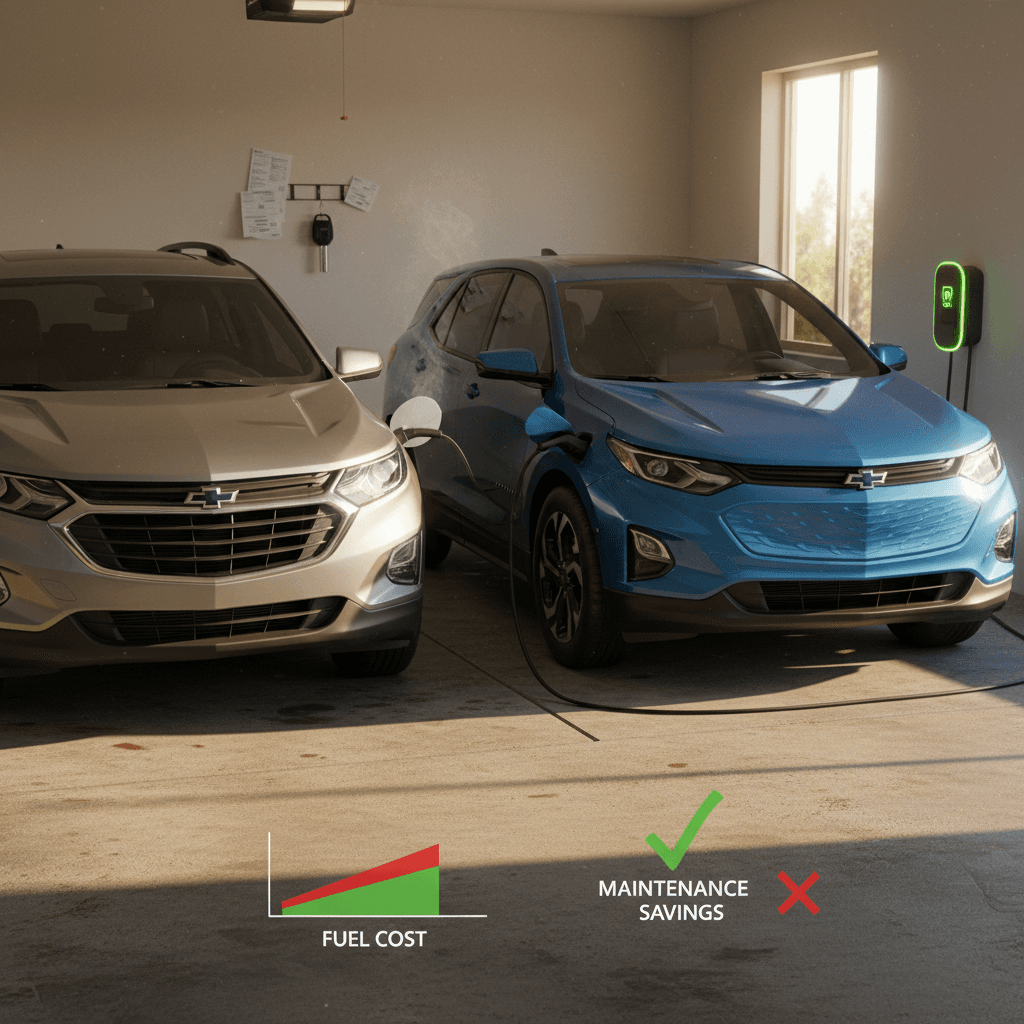
If you’re driving a gasoline Chevrolet Equinox and looking at the new Chevrolet Equinox EV, the big question is simple: will switching actually save you money, or is it just about driving electric? Let’s walk through real-world fuel, maintenance, and incentive math so you can see what switching from a Chevrolet Equinox to a Chevrolet Equinox EV could mean for your monthly budget, and how long it might take to come out ahead.
What this guide covers
Why Equinox owners are eyeing the Equinox EV
The gasoline Chevy Equinox has earned its spot as a go-to family crossover: comfortable, practical, and reasonably efficient for a compact SUV. Recent all-wheel-drive models are rated around 26–27 mpg combined, with front-wheel drive a touch better. The new Equinox EV takes that familiar package and swaps the gas engine for a battery and electric motors, delivering EPA efficiency over 100 MPGe and 300+ miles of range on many trims.
From a cost standpoint, the Equinox EV promises three big advantages over your current gas Equinox: - Much lower energy cost per mile when you can charge at home - Lower routine maintenance (no oil changes, spark plugs, or exhaust work) - The potential to stack federal and state incentives on the purchase price, especially on newer models The flip side: the Equinox EV typically has a higher sticker price than a comparable new gas Equinox, and public fast charging can get expensive if you rely on it heavily. That’s why it’s crucial to look at the full ownership picture, not just the window sticker.
Equinox vs. Equinox EV: headline numbers for a typical U.S. driver
Quick answer: how much can you actually save?
Before we dive into the detailed math, here’s the short version for a typical U.S. driver doing about 15,000 miles per year, charging mostly at home at average residential electricity rates and driving a reasonably efficient gas Equinox today.
Typical annual savings switching to an Equinox EV
Assuming 15,000 miles/year, mostly home charging, average U.S. energy prices
Fuel vs. electricity
≈$1,000 per year saved on energy alone when you go from buying gasoline for a 26–27 mpg Equinox to home charging an Equinox EV at around 3–4¢ per mile.
Maintenance
Hundreds per year saved by eliminating oil changes, transmission service, exhaust work, and many engine-related repairs, EVs have fewer moving parts.
Long-term totals
Over a 10-year ownership window, it’s realistic for many drivers to see $10,000–$15,000 in total savings vs. sticking with a gas Equinox, especially if they drive more than average.
Use these numbers as a template
Purchase price, incentives, and financing
The first thing most shoppers notice is that an Equinox EV generally costs more than a gas Equinox on paper. Recent model years of the gas Equinox commonly advertise in the high‑$20,000s to low‑$30,000s new, depending on trim and discounts. Many 2025 Equinox EV trims have MSRPs in the low‑ to mid‑$30,000s and up when new, with higher trims pushing into the low‑$40,000s.
New purchase: what to expect
- Gas Equinox: Often stickers slightly lower than an equivalent Equinox EV, but incentives are limited to standard rebates and dealer discounts.
- Equinox EV: Many trims have been eligible for up to a $7,500 federal clean-vehicle credit on new purchases when bought within the current incentive window, plus possible state or utility rebates.
- Dealer programs: Some dealers bundle home charger installation or offer low-APR financing to sweeten EV deals.
Used market: where Recharged shines
- As early Equinox EVs hit the used market, you may find significant upfront savings vs. buying new, especially once initial depreciation has set in.
- A used Equinox EV may qualify for up to a $4,000 used EV federal credit if bought from a dealer and you meet income and price caps.
- With Recharged, every used Equinox EV listing includes a Recharged Score battery health report, fair market pricing, and expert EV guidance.
Incentives are time-sensitive
From a cost-savings standpoint, the key question isn’t just, “Is the Equinox EV more expensive to buy?” It’s, “After incentives and lower running costs, how many years until I’m ahead?” For many Equinox owners, the answer lands somewhere in the 5–8 year range if they drive average or above‑average miles and don’t overpay for DC fast charging.
Fuel vs. electricity: cost per mile comparison
Let’s put some simple numbers to what you’re paying to move your gas Equinox down the road today versus what you’d pay in an Equinox EV, using realistic 2025–2026 U.S. averages. You can adjust the assumptions later to match your own situation.
Gas Equinox vs. Equinox EV: example energy cost per mile
Illustrative numbers using typical U.S. prices and EPA efficiency ratings
| Vehicle | Key assumptions | Cost per mile | Annual energy cost (15,000 mi) |
|---|---|---|---|
| Gas Chevrolet Equinox | 26 mpg combined, gas at $3.50/gal | ≈$0.135/mi | ≈$2,025 |
| Equinox EV (home charging) | 108–110 MPGe, electricity at $0.16/kWh (~3.5 mi/kWh) | ≈$0.045/mi | ≈$675 |
| Equinox EV (mixed use) | 70% home at 4.5¢/mi, 30% DC fast at ~15–18¢/mi | ≈$0.07–$0.08/mi | ≈$1,050–$1,200 |
You can replace the fuel price, electricity rate, or efficiency assumptions here with your own to get a more personalized answer.
How the math works
Even if your local gas prices are relatively low, home‑charged electricity still tends to be roughly one‑third to one‑half the cost per mile of gasoline for a compact SUV like the Equinox. At 15,000 miles per year, that difference alone can be in the neighborhood of $800–$1,300 annually in your favor with the Equinox EV, as long as you’re not living on DC fast charging.
The public fast-charging caveat
Maintenance and repairs: where EVs quietly win
The Equinox EV’s other big advantage is simplicity. An EV powertrain has far fewer moving parts than a turbocharged gas engine, automatic transmission, and traditional exhaust system. No oil changes, no spark plugs, no timing belt, no exhaust or emissions system maintenance.
Typical maintenance differences: gas Equinox vs. Equinox EV
You still have wear items on both, but EVs lose many routine services
Gas Chevy Equinox
- Oil and filter changes several times per year
- Transmission fluid service on schedule
- Spark plugs, ignition components, possible exhaust repairs over time
- More frequent brake wear if you do a lot of city driving without significant engine braking
Chevy Equinox EV
- No engine oil, spark plugs, or exhaust system to service
- Simple single‑speed drivetrain with fewer wear parts
- Brake pads often last longer thanks to regenerative braking
- Focus on tires, cabin air filter, brake fluid, coolant checks, and software updates
Industry‑wide data and real‑world service histories suggest EVs often cut routine maintenance and repair spending by about one‑third to one‑half versus comparable gas vehicles over time. For an Equinox‑class crossover, that could mean saving a few hundred dollars per year once you average in the bigger service items you’re avoiding later in life.
Budget for tires and alignment
Insurance, registration fees, and other costs
Fuel and maintenance are the big levers, but they’re not the only ones. When you swap a gas Equinox for an Equinox EV, a few secondary costs come into play.
- Insurance: Newer EVs can sometimes carry slightly higher collision premiums than older gas SUVs because of repair costs and technology content. The difference often amounts to tens of dollars per month, not hundreds, and varies widely by state and insurer.
- Registration fees: Many states add an extra EV registration fee to make up for lost gasoline tax revenue. On the flip side, some states reduce or waive certain fees for EVs. It’s worth a quick check with your DMV before you buy.
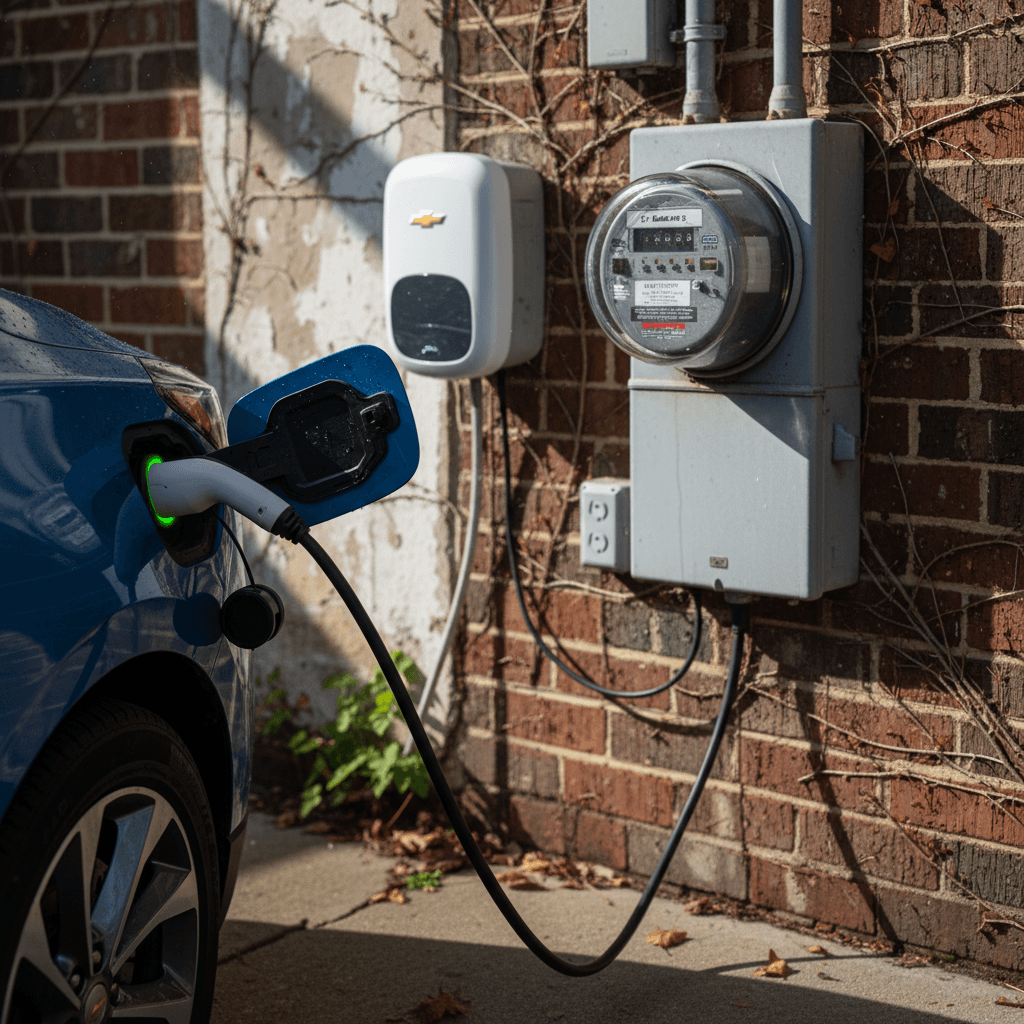
- Home charging installation: If you don’t already have a 240‑volt outlet in your garage, you may spend a few hundred to a couple thousand dollars to install a dedicated Level 2 circuit. Some utilities and dealers offer rebates that reduce or even cover this cost.
- Depreciation and resale: EV values have been evolving quickly. In the near term, strong incentives and fast‑moving technology can make new EVs depreciate faster. On the other hand, a used Equinox EV that shows strong battery health can be very attractive to second owners.
Don’t ignore your local policy landscape
5-year and 10-year savings scenarios
To make this concrete, let’s run through two simplified scenarios for a driver moving from a late‑model gas Equinox into an Equinox EV. These are not promises, think of them as ballpark frameworks you can adapt with your own numbers.
Illustrative ownership-cost scenarios: gas Equinox vs. Equinox EV
Simplified estimates for a driver doing 15,000 miles per year, mostly home charging, average U.S. prices. Figures rounded for clarity.
| Scenario | Ownership window | Gas Equinox (fuel + maint.) | Equinox EV (energy + maint.) | Estimated difference |
|---|---|---|---|---|
| A: Keep 5 years | 5 years / 75,000 mi | ≈$16,000 | ≈$9,000–$10,000 | Save ≈$6,000–$7,000 with Equinox EV |
| B: Keep 10 years | 10 years / 150,000 mi | ≈$32,000 | ≈$18,000–$20,000 | Save ≈$12,000–$14,000 with Equinox EV |
Purchase prices are net of incentives where noted. These scenarios ignore financing interest and major unexpected repairs to keep the comparison straightforward.
In these rough sketches, we’re assuming: - Gas Equinox at ≈26–27 mpg with average gas prices in the mid‑$3 range - Equinox EV charged primarily at home at around 4–5¢ per mile - EV maintenance coming in roughly 30–50% cheaper over the long run If your local gas prices are higher than the national average, or if you drive more than 15,000 miles per year, the Equinox EV’s advantage typically grows. If you drive very little, or electricity is unusually expensive where you live, the payback stretches out.
Where the real win shows up
When the Equinox EV makes the most, and least, sense
Is an Equinox EV a good financial fit for you?
The closer your situation looks to the left column, the more likely you are to come out ahead.
Great financial fit
- You drive 12,000–20,000 miles per year or more.
- You can charge at home overnight on a reasonably priced residential rate.
- You plan to keep the vehicle at least 5–10 years.
- You can capture a meaningful new or used EV tax credit or strong local incentives.
- You’re coming out of an older gas Equinox that’s starting to need more frequent repairs.
Weaker financial fit
- You drive under 8,000 miles per year most years.
- You have no access to home or workplace charging and must rely on public fast chargers.
- Your state piles on high EV registration fees without offering incentives.
- You tend to replace vehicles every 3–4 years, so you may never fully harvest the EV’s long‑term savings.
Think like an accountant, not a car nut
Step-by-step checklist for switching from Equinox to Equinox EV
Your Equinox → Equinox EV game plan
1. Gather your current numbers
Pull a recent year of gas receipts or credit‑card statements and estimate how much fuel your Equinox really uses. Grab your annual mileage from service records or your odometer. Note your current insurance premium and any recent repair bills.
2. Estimate your EV energy cost
Check your utility bill for your per‑kWh rate and estimate how many kWh you’d need for your annual miles (divide miles by roughly 3–4 mi/kWh). Multiply to get a ballpark annual charging cost at home. Add a cushion if you expect to use some public fast charging.
3. Factor in incentives and fees
Verify whether a new or used Equinox EV would qualify for federal and state incentives in your situation, and whether your state adds extra EV registration fees. Subtract confirmed incentives from your target price; add any known recurring fees to your annual cost.
4. Compare 5- and 10-year totals
Build a simple side‑by‑side: gas Equinox vs. Equinox EV over 5 and 10 years with your own fuel, electricity, maintenance, and insurance estimates. Look for the year in which the EV crosses over and starts saving you money overall.
5. Decide how you’ll charge
Confirm whether you can install a Level 2 charger at home or at least charge regularly on a 120‑volt outlet. If you rent or live in a condo, ask your landlord or HOA about EV‑ready parking. The easier it is to charge at home, the faster your savings add up.
6. Test-drive and price actual vehicles
Once the math looks promising, it’s time to drive an Equinox EV and see real numbers. On Recharged, you can compare used Equinox EV listings, review Recharged Score battery health reports, and explore financing, trade‑in, or instant‑offer options side by side.
How Recharged helps you run the numbers on a used Equinox EV
If you’re leaning toward an Equinox EV but want to avoid first‑owner depreciation, the used market can be your sweet spot. This is where a transparent marketplace like Recharged is built to help.
Shopping an Equinox EV on Recharged
What you get beyond a typical listing site
Verified battery health
Fair pricing and financing
EV-specialist support
Ready to find your next EV?
Browse VehiclesTry before you commit
FAQ: Equinox vs. Equinox EV cost savings
Frequently asked questions
Bottom line: is switching to the Equinox EV worth it?
If you’re in a typical U.S. driving pattern, say 12,000–15,000 miles per year, and can charge at home, switching from a gas Chevrolet Equinox to the Chevrolet Equinox EV is very likely to save you real money over the long haul. The Equinox EV usually costs more up front, but lower energy and maintenance bills can erase that difference in about 5–8 years, with total lifetime savings often landing in the five‑figure range if you keep the vehicle 10 years or more.
On the other hand, if you drive very little, can’t install home charging, or live somewhere with steep EV fees and extremely high electricity rates, the math becomes tighter and you may decide to switch for reasons other than pure dollars, quiet, instant torque, or cutting tailpipe emissions.
The key is to run your numbers, not just national averages. When you’re ready to see how the math plays out on actual vehicles, Recharged makes it easy to compare used Equinox EVs, review battery health with the Recharged Score, line up financing, and trade or sell your current Equinox, all with EV‑savvy guidance at each step.