You buy an electric car, you bring it home, and then the realization hits: you don’t just need electrons, you need a plan. The first big decision is usually **smart EV charger vs dumb charger**, do you pay extra for Wi‑Fi, apps, load management and data, or stick with a brutally simple box that just shoves power into the car? The right answer depends far less on the car and far more on *you*, your home, your utility, and your tolerance for fiddling with software.
Quick definitions
What “smart” and “dumb” EV chargers actually are
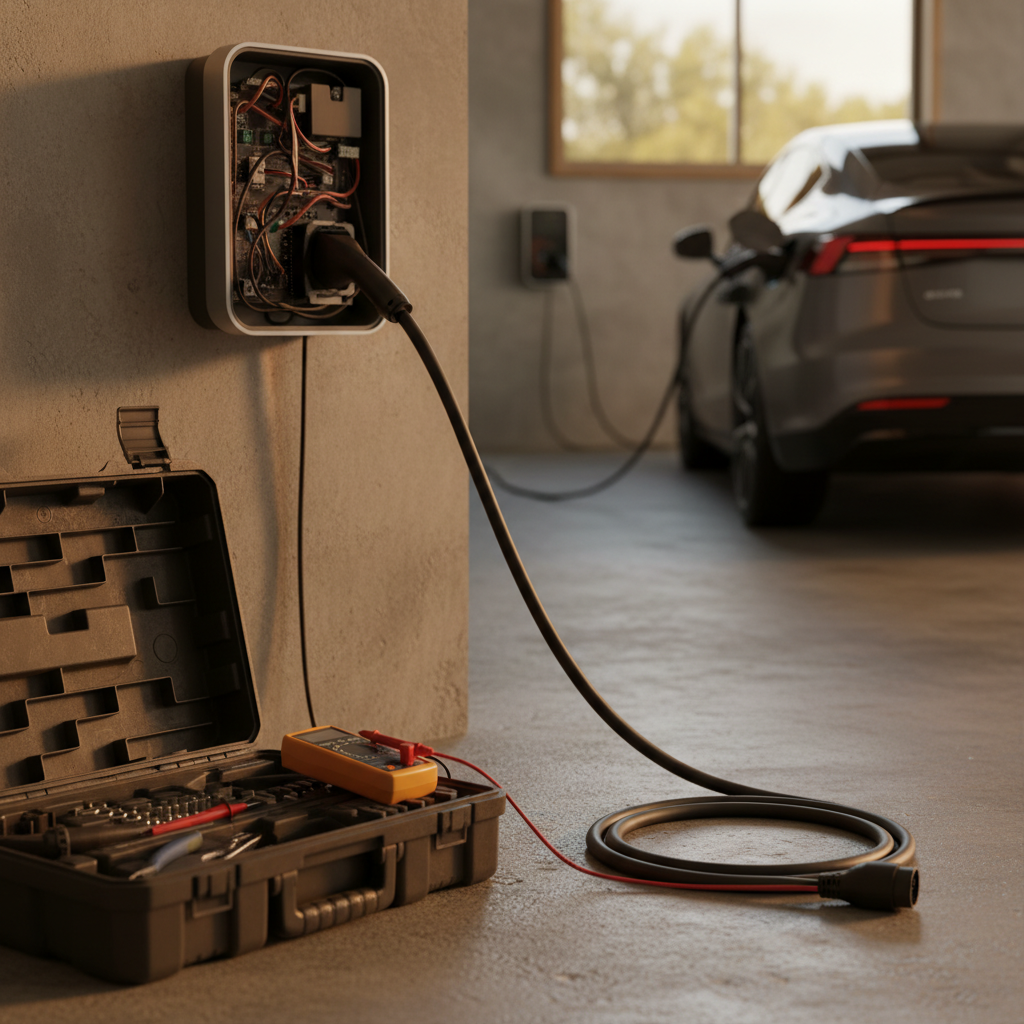
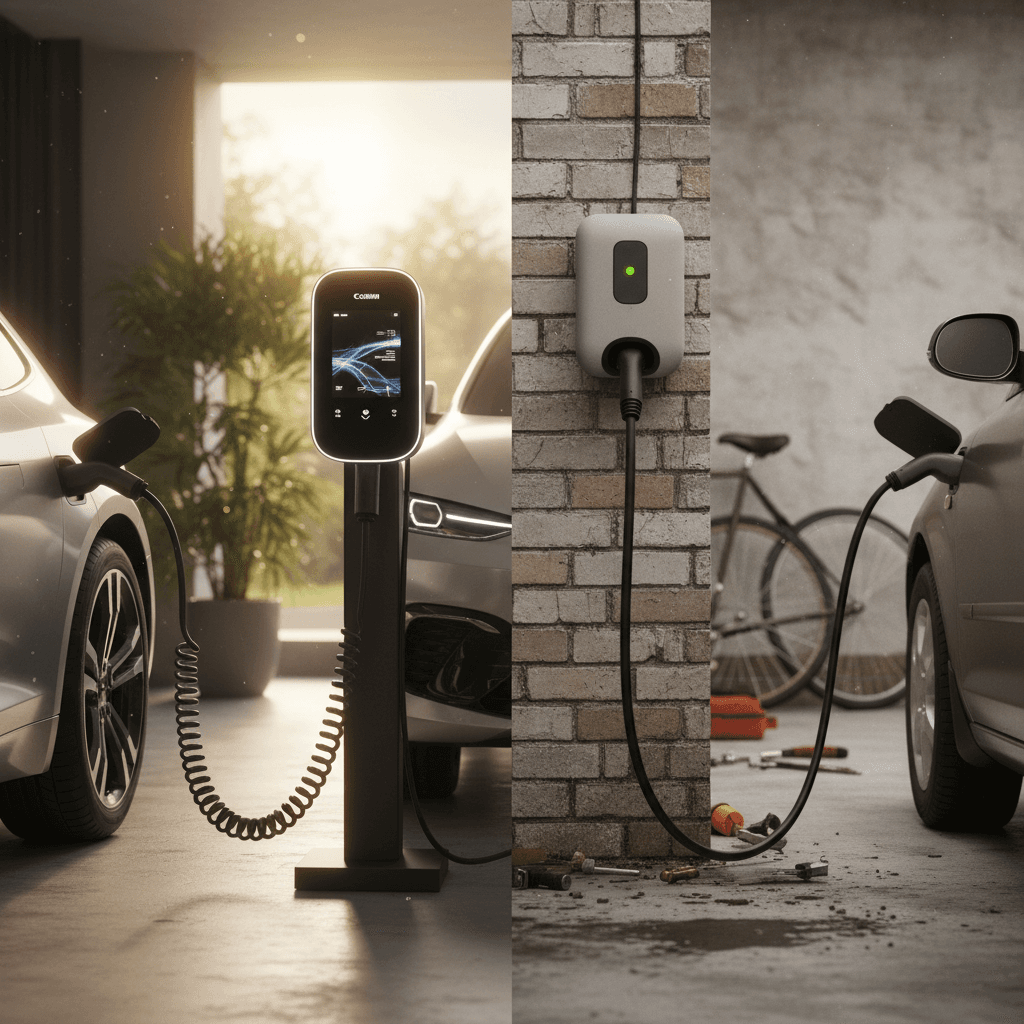
A **dumb charger** is the EV equivalent of an old-school wall outlet with good manners. It provides the required safety checks, ground fault protection, temperature monitoring, communication with the car over the standard J1772 or NACS pilot signal, but nothing else. No app, no Wi‑Fi, no usage history. You plug in, it charges at the set amperage until the car says, “I’m full,” or you unplug.
A **smart EV charger** adds a layer of brains on top of that basic safety hardware. Through Wi‑Fi, Bluetooth, Ethernet, or even cellular, it talks to an app or cloud service so you can schedule charging, see how many kWh you used last month, limit current to protect your panel, or share a charger across multiple vehicles with automatic load balancing. Some newer models are edging into **bidirectional** capability and home-energy integration, turning your car into part of your home power system rather than just a load.
- Dumb charger: hardware only – safe power delivery, no connectivity, usually cheaper and simpler.
- Smart charger: hardware + software + connectivity – adds control, data, and coordination with your home, your utility, and sometimes the grid.
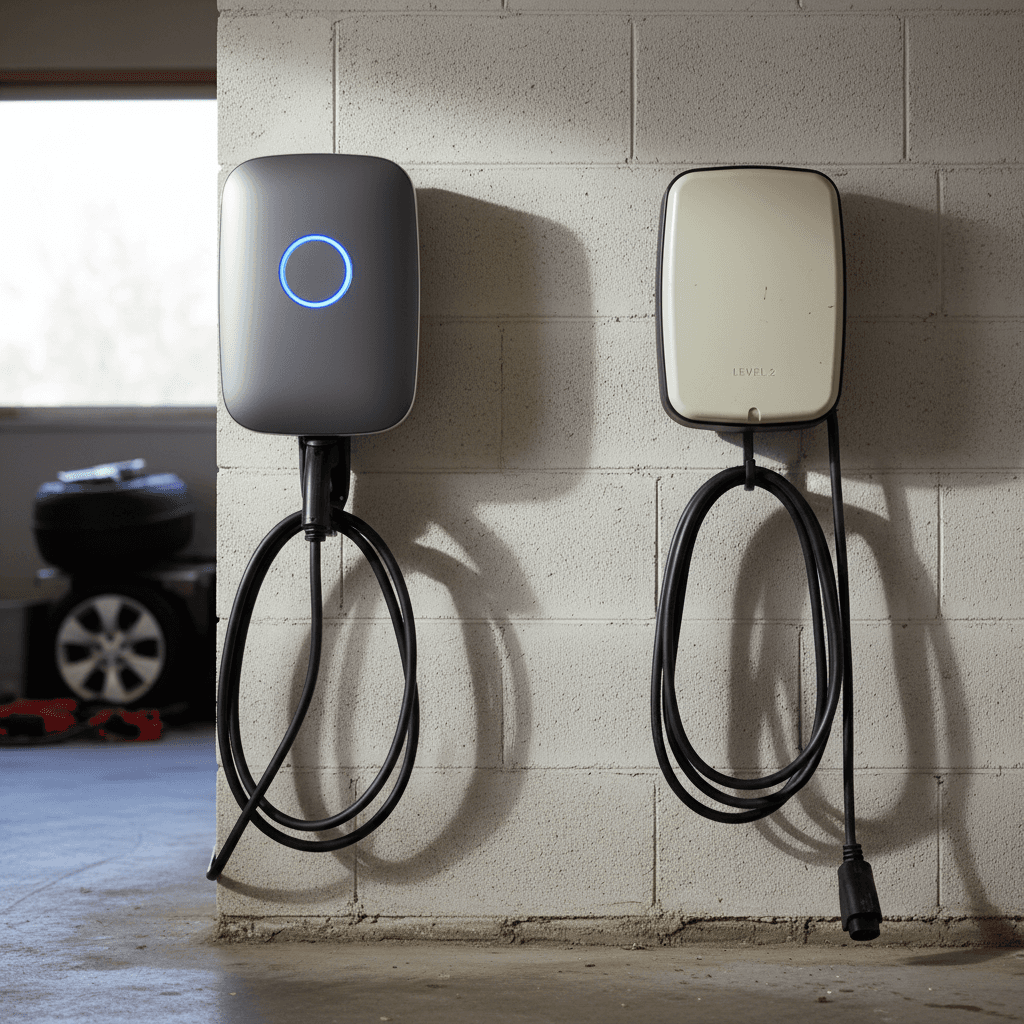
Key differences: smart EV charger vs dumb charger
Smart vs dumb EV chargers at a glance
How smart and dumb home EV chargers compare across the features that matter most to owners.
| Feature | Dumb charger | Smart charger |
|---|---|---|
| Typical price (hardware) | ~$300–$500 | ~$500–$900+ |
| Connectivity | None | Wi‑Fi/Bluetooth/Ethernet, sometimes cellular |
| App control & scheduling | Not available | Standard feature |
| Data & reporting | Not available | kWh, cost estimates, session history |
| Utility or demand-response programs | Rarely supported | Common on newer models |
| Dynamic load sharing (multiple EVs) | Usually not | Common in multi‑port or networked setups |
| Over‑the‑air updates | No | Yes, for new features and security patches |
| Cloud dependency | None | Varies by brand; some require cloud to unlock full features |
| Failure modes | If relay & safety circuits work, it charges | If app or cloud fails, hardware may still work, but some brands tie basics to the app |
Both types can safely charge your EV; the question is how much control and visibility you want over the process.
The most important similarity
Cost comparison: hardware, installation, and ongoing
In the U.S., the **home EV charger market is growing fast**, with residential equipment representing the largest slice of charger deployments as of 2025. That growth has driven prices down, but there’s still a meaningful spread between a solid dumb EVSE and a feature-rich smart unit.
Where the money actually goes
It’s not just the price tag on the box, your panel and wiring matter just as much.
1. Hardware price
Dumb Level 2 chargers from reputable brands typically land in the $300–$500 range for 32–40 amps, often with a NEMA 14‑50 plug or hardwire option.
Smart chargers with Wi‑Fi, apps, and utility integration usually cost $500–$900+, and high‑end or bidirectional units can go well north of that.
2. Installation costs
If you already have a suitable 240V circuit near your parking spot, install can be a few hundred dollars. If your panel is full or undersized, expect quotes that rival or exceed the cost of the charger.
Smart vs dumb doesn’t change conduit, wire, or panel labor, the **amp rating and distance** do.
3. Ongoing costs & savings
A smart charger can help you chase cheaper off‑peak rates automatically and participate in utility programs that pay you small incentives to shift load.
A dumb charger saves on upfront cost but can’t optimize time-of-use rates without you manually plugging and unplugging on schedule.
Don’t cheap out on safety
When a dumb charger is all you need
There’s a strong case for the humble, non‑networked EVSE, especially if you’re the kind of driver who regards apps as necessary evils rather than lifestyle accessories.
You’re a great fit for a dumb charger if…
You have a predictable schedule
If you plug in around the same time every evening and your utility doesn’t have aggressive time‑of‑use swings, you don’t *need* automated scheduling. The car’s built‑in departure‑time or off‑peak charging settings may be enough.
You value simplicity over features
No servers, no log‑ins, no firmware updates. A basic unit from a reputable maker can chug along for years with almost nothing to break except the relay and cable.
You’re wary of cloud lock‑in
Some smart chargers lose features, or their entire app, when a company folds or sunsets a platform. A dumb charger that never depended on the cloud can’t be bricked by a boardroom decision.
You don’t share the charger
If it’s just you and one EV, with plenty of panel capacity, you likely don’t need sophisticated load sharing or per‑user access controls.
You’re budget‑constrained today
It’s often better to install a safe, modest dumb charger **now** than to wait years for the “perfect” smart unit while fast‑charging in public for much higher energy prices.
Classic example: the workhorse dumb charger
When a smart EV charger is worth the money
For a growing share of owners, the charger is becoming less like an appliance and more like a node in a home‑energy network. If that’s you, or will be soon, a smart EV charger can pay for itself in flexibility and avoided headaches.
Who actually benefits from smart chargers?
These are the use cases where the extra brains really earn their keep.
Time-of-use rates & high power prices
If your utility charges dramatically different rates by time of day, a smart charger that automatically schedules sessions in the cheapest window can shave noticeable money off your monthly bill, especially with larger battery packs.
Yes, many cars have their own scheduling, but the charger often has better data on real power draw and can coordinate multiple vehicles or appliances.
Multi‑EV households and shared parking
Two EVs, one circuit, limited panel capacity, that’s a smart charger’s natural habitat. Features like intelligent load sharing let multiple EVSEs dynamically share a circuit without overloading it, avoiding or delaying a costly panel upgrade.
In apartments or workplaces, app‑based access control and usage tracking make it possible to bill fairly for shared infrastructure.
Solar, batteries, and home energy nerds
If you have rooftop solar or a home battery, a smart charger that can prioritize excess solar generation, or throttle charging during peak household loads, turns your EV into a flexible part of your energy system instead of a blunt instrument.
Some high‑end units and OEM systems are already tiptoeing toward vehicle‑to‑home (V2H), where your car can help power the house.
Data, control, and peace of mind
If you like to know exactly how many kWh your car drank last month, what it cost, and whether your teenager actually plugged in, a smart charger’s app will make you happier than any spreadsheet hack.
Push notifications, remote start/stop, and usage reports sound trivial until the first time you’re out to dinner and wonder if you remembered to plug in.
Check your EV’s built‑in features first
Reliability, security, and the JuiceBox lesson
The dirty little secret of the smart‑charger boom is that the “smart” part often ages faster and less gracefully than the hardware. Over the last few years we’ve seen entire app ecosystems shuttered or sold, leaving owners with wallboxes that technically still charge, but have lost most of the features they paid for.
Dumb charger reliability
Because dumb chargers have no cloud dependency, their failure modes are beautifully boring: if the relay, sensors, and cable are healthy, they charge; if not, they trip or stop. There’s no login, no server outage, no forced firmware push that introduces a new bug.
That’s why you’ll still find basic Level 2 units from years ago quietly doing their jobs in garages across North America.
Smart charger risks & rewards
Smart chargers live on multiple timelines at once: the physical hardware (usually robust), the firmware, the cloud backend, and the mobile app. Any of those can change without your consent.
On the upside, this also means bugs can be fixed and security improved over the air. High‑quality smart chargers now emphasize secure, signed updates and local fallback modes so that if the internet goes out, you can still charge normally.
Security is no longer optional
Future-proofing, load management, and your electric panel
By 2030, analysts expect tens of millions of EVs on U.S. roads and a corresponding wave of home charging. Residential charging is already the dominant segment of the charger market, and utilities are paying much closer attention to when and how those cars charge. That’s where smart chargers start to look less like luxuries and more like **infrastructure**.
Why smarter home charging keeps coming up
For you, the homeowner, the key friction point is often not the charger itself but the **electrical panel** feeding it. Many older U.S. homes have 100‑amp service, and a 40‑ or 48‑amp EV circuit looks like a mastiff asking to move in with a family of pugs.
How smart load management helps
How to choose the right charger for your garage
So which side of the **smart EV charger vs dumb charger** divide should you land on? Instead of starting with the product, start with your life: how you drive, where you park, what your panel can handle, and how long you plan to stay in the home.
Step-by-step: picking the right home charger
1. Confirm your charging need
Look at your daily mileage and your EV’s onboard charger limit. If you’re driving 30–40 miles a day and your car tops out at 7.2 kW AC, virtually any 32–40 amp Level 2 unit, smart or dumb, will refill you overnight.
2. Check panel capacity and outlet options
Have an electrician (ideally one with EV experience) assess whether your panel can support a new 240V circuit and at what amperage. This will often dictate whether **load‑sharing features** on a smart charger are worth paying for.
3. Map your utility’s rate structure
If your utility has time‑of‑use or EV‑specific rates, a smart charger that automates off‑peak charging can be a quiet money saver. If your rates are flat all day, that benefit largely disappears.
4. Decide how much you care about data and control
If you love dashboards, usage history, and push notifications, a smart charger’s app will probably delight you. If your eyes glaze over at another password, a dumb EVSE plus your car’s own scheduling might be a better match.
5. Think about resale and your next EV
A quality, name‑brand charger, smart or dumb, can make your home more attractive to future buyers. If you think your next EV or future buyer will expect app control and integrations, leaning smart may be the more future‑proof choice.
6. Don’t forget the car itself
Some OEM wall connectors play especially nicely with their own vehicles, unlocking extra features like automatic plug‑and‑charge, integrated load management, or V2H. If you’re in one ecosystem (Tesla, Ford, Hyundai, etc.), compare the automaker’s solution to third‑party options.
Buying used? Plan your charger with the car
Smart EV charger vs dumb charger: FAQ
Frequently asked questions
The bottom line: smart vs dumb EV chargers
The real distinction in the **smart EV charger vs dumb charger** debate isn’t “good vs bad.” It’s “appliance vs instrument.” A dumb charger is a sturdy toaster: flip it on and it does one thing reliably for years. A smart charger is closer to a good induction range, more ways to cook, more precise control, and more that depends on the software behind the glass.
If your life is simple, one EV, predictable miles, forgiving electric rates, a well‑built dumb Level 2 charger is still an entirely defensible choice. You’ll save money up front, dodge cloud drama, and likely never think about it again. If your life is more complex, multiple EVs, a tight panel, aggressive time‑of‑use pricing, solar, or just a strong taste for data, a smart charger quickly stops feeling like a splurge and starts feeling like the right tool for the job.
Either way, pairing the right charger with the right car matters more than any spec sheet arms race. If you’re shopping for a used EV, Recharged can help you evaluate not just the battery and price, but how that car will fit into your home‑charging reality, so the only drama in your driveway is the design of the car, not whether it’ll be full by morning.