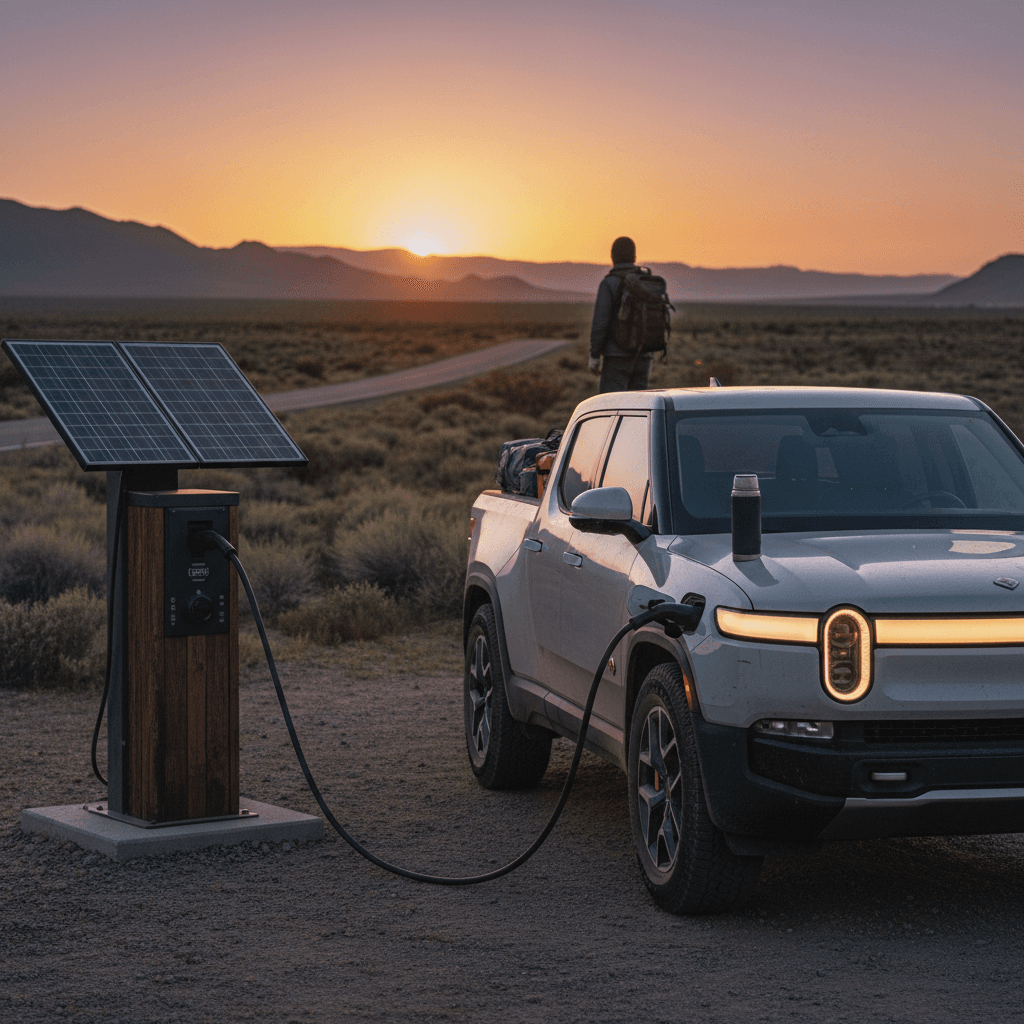
If you’re shopping for an electric truck that can shrug off blizzards and black ice, a Rivian R1T winter driving review is more useful than any spec sheet. On paper the R1T looks like an ideal four-season rig: all-wheel drive, fast-reacting traction control, adaptive air suspension, and plenty of ground clearance. But cold weather is brutal on EV range, and “great on paper” doesn’t always survive a February cold snap.
Winter test context
Who this Rivian R1T winter review is for
- Drivers in northern U.S. states or Canada deciding if an R1T can replace a gas 4x4 as a year-round daily and ski-trip hauler.
- Shoppers comparing the R1T with trucks like the F‑150 Lightning, Silverado EV, or gas half‑tons for winter duty.
- Current EV owners wondering how much more winter‑capable a purpose-built electric truck can feel compared with a crossover or sedan.
- Used‑EV buyers evaluating whether a pre-owned R1T is a smart choice for harsh winters and how to protect battery health.
We’ll look at snow and ice traction, cold-weather range loss, the impact of tires and wheel choices, and what it’s actually like to charge and road-trip an R1T when temps plunge into the teens and single digits. Along the way, you’ll see where the R1T shines, where it stumbles, and what you can do to make ownership in winter easier.
Quick take: Rivian R1T in winter conditions
Rivian R1T winter driving at a glance
High-level verdict
Snow and ice traction: how the R1T really handles
The Rivian R1T’s calling card in winter is traction. Every R1T, regardless of drivetrain, has sophisticated traction and stability control and a full-time all-wheel-drive system that can meter torque far more quickly than a gas truck’s mechanical 4WD. With the air suspension lifted and proper winter or all‑terrain tires, the R1T feels almost overqualified for plowed but slick roads, and it’s shockingly composed on unplowed side streets.
R1T snow & ice strengths vs. weaknesses
Why it feels like a snow beast, and where physics still wins
Where the R1T excels
- Ultra-fast traction control: Electric motors can cut or add torque in milliseconds, so wheelspin is brief and controlled.
- Adjustable ride height: Up to roughly 14–15 inches of ground clearance in Off-Road or deep snow, far more than most EVs and crossovers.
- Excellent weight distribution: The heavy battery low in the chassis stabilizes the truck on slick surfaces.
- Fine throttle control: Snow mode softens pedal response, making it easier to avoid spinning the tires when setting off.
Where you still need to be careful
- Stopping distance: The R1T is heavy. Great ABS and stability control can’t change basic physics on ice.
- Tall on 22s: The big 22‑inch road wheels with summer‑ish rubber are the weak link in winter. They’re range-friendly, not snow‑friendly.
- Deep, wet snow: The truck can plow snow with its belly if you rely solely on ground clearance and ignore conditions.
- Black ice: No drivetrain can fully compensate for sheet ice; the R1T is no exception.
Don’t underestimate weight
Drive modes, suspension, and the best winter settings
Rivian doesn’t just rely on raw traction; it also gives you software-defined drive modes tailored to conditions. For winter driving you’ll mainly use All-Purpose, Snow, and occasionally Off‑Road modes, along with the adjustable ride height and regen braking settings.
Best Rivian R1T modes for winter driving
How the core modes behave and when to use them in cold weather.
| Mode | Use it when… | Ride Height | Regen feel | Winter notes |
|---|---|---|---|---|
| Snow | City and highway in active snow, slush, or patchy ice | Standard or High | Low | Softened throttle and low regen help avoid sudden weight transfer on slick roads. |
| All-Purpose | Dry cold pavement or light winter use | Standard | Normal | Good default in winter when roads are mostly clear but temps are below freezing. |
| Off-Road All-Terrain | Unplowed roads, deep snow, cabin/backroad access | High or Very High | Variable | Maximizes clearance and traction for chunky snow, but hurts efficiency. |
| Conserve (dual/tri/quad) | Cold but dry highways, light snow, range-focused driving | Lowest practical | Normal or High | Front-biased drive for efficiency. Avoid in really slick conditions; the truck may prompt you to switch if it detects slip. |
Exact names and options can vary slightly by model year, but the winter playbook is consistent.
A simple winter setup that works
Regenerative braking in winter
On dry pavement, strong regeneration is great for efficiency. In winter, though, it can introduce sudden weight transfer or wheel lock if you lift off the accelerator mid-corner on ice. That’s why Rivian’s Snow mode uses a unique Low regen setting that you can’t select in other modes, so you decelerate more like a conventional truck with gentle engine braking.
Suspension height and stability
Cranking the R1T up to its highest ride settings looks cool and adds clearance for snow ruts, but it also raises the center of gravity slightly. Use High or Very High only when you need them. For mostly plowed roads with some slush or packed snow, Standard height usually offers the best blend of stability and clearance.
Cold-weather range: what to actually expect
The single biggest adjustment when running an R1T through winter is range expectations. All EVs lose efficiency in the cold as the battery and cabin heating demands soak up energy, and the R1T is no exception. Owner reports from 2023–2025 show a wide spread, but a pattern emerges once you separate city vs. highway driving and “mild cold” from “brutal cold.”
Typical winter range scenarios for the R1T
How ambient temperature and trip type change efficiency
Cool, not brutal (25–40°F)
- Highway trips on All-Purpose or Conserve modes often see ~15–25% range loss vs. EPA estimates.
- Efficiency around 2.0–2.4 mi/kWh is common with large or Max packs on all-season tires.
- Preconditioning while plugged in keeps losses more manageable.
Real winter (0–25°F)
- Most reports cluster around 20–35% range loss, especially on mixed city/highway trips.
- Owners often see 1.6–2.0 mi/kWh at these temps, depending on wheel/tire setup and speed.
- Short errands are hardest on efficiency, since the pack never fully warms up.
Deep freeze (below 0°F)
- Range losses of 35–45% or more are common, especially with outdoor parking and no preconditioning.
- Some R1T drivers have reported ~1.3 mi/kWh on short, cold city runs in the teens or single digits.
- Planning conservatively and charging more often is essential on road trips.
Don’t trust summer range in winter
How to preserve range in a Rivian R1T winter
1. Precondition while plugged in
Use the app to warm the cabin and battery before you leave, especially if the truck is parked outside. This shifts much of the initial energy demand to the grid rather than your battery.
2. Bundle short errands
Back‑to‑back trips keep the pack warm. Isolated 5–10 minute drives in deep cold are the worst-case scenario for efficiency.
3. Use seat and steering wheel heaters
They consume less energy than blasting cabin heat. You can stay comfortable at a slightly lower cabin temperature, which helps preserve range.
4. Slow down a little
Highway aero drag plus cold air is a range killer. Dropping from 75 to 65 mph can claw back a chunk of efficiency in winter.
5. Check tire pressures
Cold air can drop tire pressures significantly. Running far below spec increases rolling resistance and harms traction; check and adjust pressures on cold days.
6. Avoid unnecessary weight up high
Roof racks, boxes, and tall loads increase drag and raise the center of gravity. If you need them for a trip, budget extra range.
Winter tires and wheel packages that make the biggest difference
More than any software tweak, tires determine how your R1T behaves in winter. Rivian offers both all‑terrain and road‑biased wheel/tire packages from the factory, and many owners in snow belts add dedicated winter tires. The pattern is clear: range drops a bit on aggressive tires, but control and confidence improve dramatically.
R1T winter behavior by wheel and tire type
General patterns owners report; specific brands and sizes vary.
| Setup | Winter grip | Typical range hit vs. 21/22" road tires | Best for |
|---|---|---|---|
| 21" or 22" road-focused all-season tires | Adequate on plowed roads, weak in deep or icy conditions | Baseline (best range) | Mild winters, mostly dry cold highways. |
| 20" all-terrain tires (factory or aftermarket) | Noticeably better bite in snow, better self-cleaning tread | ~5–10% less range | Mixed city/highway with frequent snow or slush. |
| Dedicated 20" winter tires (Hakkapeliitta, Blizzak, etc.) | Outstanding grip on snow and ice, best braking and steering feel | ~10–15% less range | Harsh-winter states and provinces, frequent mountain trips. |
If you live where roads stay white for months, tires are your most important winter upgrade.
If you can afford only one winter upgrade…
Charging a Rivian R1T in the cold
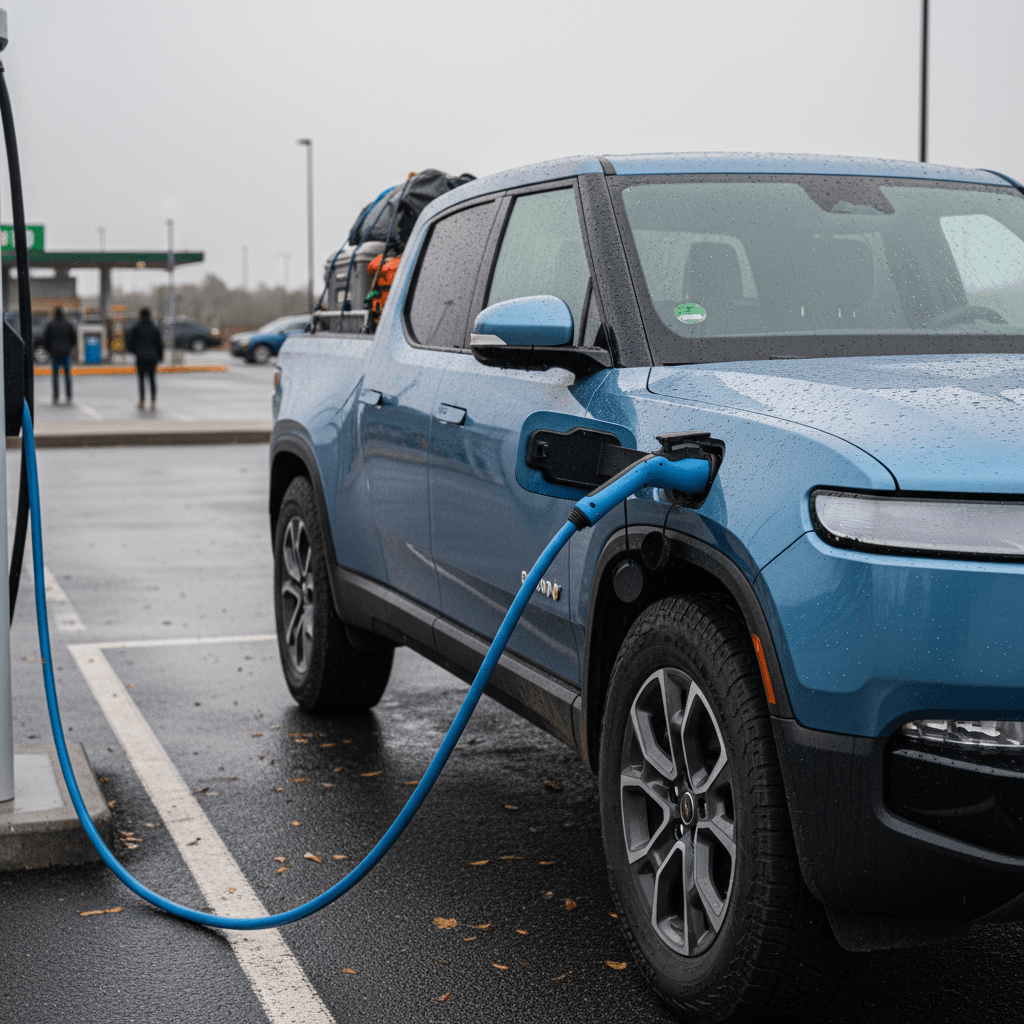
Cold weather doesn’t just affect driving efficiency, it also slows down DC fast charging. The R1T can pull serious power from capable stations in ideal conditions, but in winter you’ll often see lower peak speeds and longer sessions, especially if you arrive with a cold-soaked battery.
DC fast charging in winter
- Arrive with a warm battery: If possible, fast charge after a stint of highway driving rather than from a cold parking lot.
- Use built-in navigation to chargers: When you route to a DC fast charger, the R1T can precondition the pack on the way, improving charging speed.
- Expect lower peaks: It’s normal to see reduced peak kW and a longer ramp‑up when the pack is cold. Don’t panic if you’re not hitting summer numbers.
Home and workplace charging
- Level 2 at home is a winter superpower: Plugging in every night lets the truck manage pack temperature more effectively and saves you from hunting for public charging in storms.
- Schedule charging close to departure: If your utility plan allows, set charging to finish near the time you typically leave so the pack is naturally warm.
- Use cabin preheat: Warm the truck from shore power so you’re not burning range to scrape ice and defog windows.
Beware of relying only on Level 1
Which Rivian R1T configuration works best in winter?
By 2025–2026, the R1T lineup includes Dual Motor, Performance Dual, Tri Motor, and updated Quad Motor variants, with Large and Max battery options. On paper, the Tri and Quad are rocket sleds, with over 850–1,000 hp and sports‑car acceleration. But for winter use, outright power is less important than range, control, and tire choice.
How different R1T powertrains behave in winter
What matters more than 0–60 times when roads turn white
Dual Motor (Standard & Performance)
- Plenty of power: Even standard Dual Motor trucks are quick; Performance Dual is legitimately fast.
- Good efficiency: Dual Motor trucks can be slightly more efficient, which helps offset winter losses.
- Best value for winter: For most buyers in snow country, a Dual or Performance Dual with Large or Max pack is the sweet spot.
Tri Motor
- Extreme performance: Over 850 hp and supercar acceleration, even in winter.
- Max pack standard: The big battery helps preserve useful winter range despite the extra power.
- Overkill for many: If your main concern is traction on snowy commutes, Tri Motor is more about fun than necessity.
Quad Motor (2nd gen)
- Wild torque vectoring: The most adjustable, playful setup for mixed on/off‑road use.
- Massive power: Over 1,000 hp in recent models, spectacular, but not a requirement for winter commuting.
- Price and efficiency hit: Great if you want the flagship; not required to have a fantastic winter R1T.
Range vs. performance trade-off
Used Rivian R1T winter ownership tips
If you’re considering a used Rivian R1T as your primary winter vehicle, you’ve got two extra variables to think about: battery health and how the previous owner treated the truck through earlier winters. This is exactly where a transparent used‑EV buying process matters.
Battery health and cold-weather performance
Cold weather exaggerates any loss of usable battery capacity. A truck that originally delivered 320+ miles of EPA range but has significant degradation will feel much more constrained when temperatures take another 20–40% off the top. That’s why a verified battery health report is more than a nice-to-have, it’s central to knowing what winter range you can realistically expect.
With Recharged, every used EV comes with a Recharged Score battery health report that measures state of health, fast‑charging history, and how the pack has been treated. That gives you a data-backed view of how the truck is likely to behave on a February ski trip, not just on a mild test drive.
Spec, tires, and accessories to look for
- Wheel/tire setup: Prioritize trucks on 20" wheels or those sold with a dedicated winter wheelset. That’s hundreds of dollars you won’t need to spend immediately.
- Battery pack: In snow country, Large or Max packs offer noticeably more margin for cold-weather trips than Standard packs.
- Charging hardware: Confirm that the truck includes its portable charge cable and that you have a realistic plan for installing Level 2 at home or using one at work.
- Owner usage patterns: Vehicles used primarily in mild climates typically show less winter wear from road salt and fewer extreme cold cycles.
How Recharged can help
Ready to find your next EV?
Browse VehiclesFAQ: Rivian R1T winter driving
Common Rivian R1T winter questions
Bottom line: Is the Rivian R1T a good winter truck?
If you judge trucks purely on how calmly they claw their way through snow and how sure‑footed they feel on ice, the Rivian R1T is one of the best winter vehicles on sale today. Its combination of quick-reacting electric torque, smart drive modes, and generous ground clearance makes it feel like a luxury snow machine when the weather turns ugly.
The trade-offs are clear: you’ll give up a meaningful chunk of range in sustained cold, you’ll want to invest in proper winter tires, and you need a realistic plan for home or workplace charging. If you accept those realities, the R1T delivers winter capability that rivals or beats traditional 4x4 pickups, without the noise, emissions, or sluggish cold‑start behavior.
For new and used shoppers alike, the key is buying the right configuration and seeing real battery data. That’s where a platform like Recharged can simplify things: from verified battery health and fair pricing to EV‑savvy guidance and delivery to your driveway, you can choose an R1T that’s truly ready for the winters you actually drive in, not just the ones in the brochure.