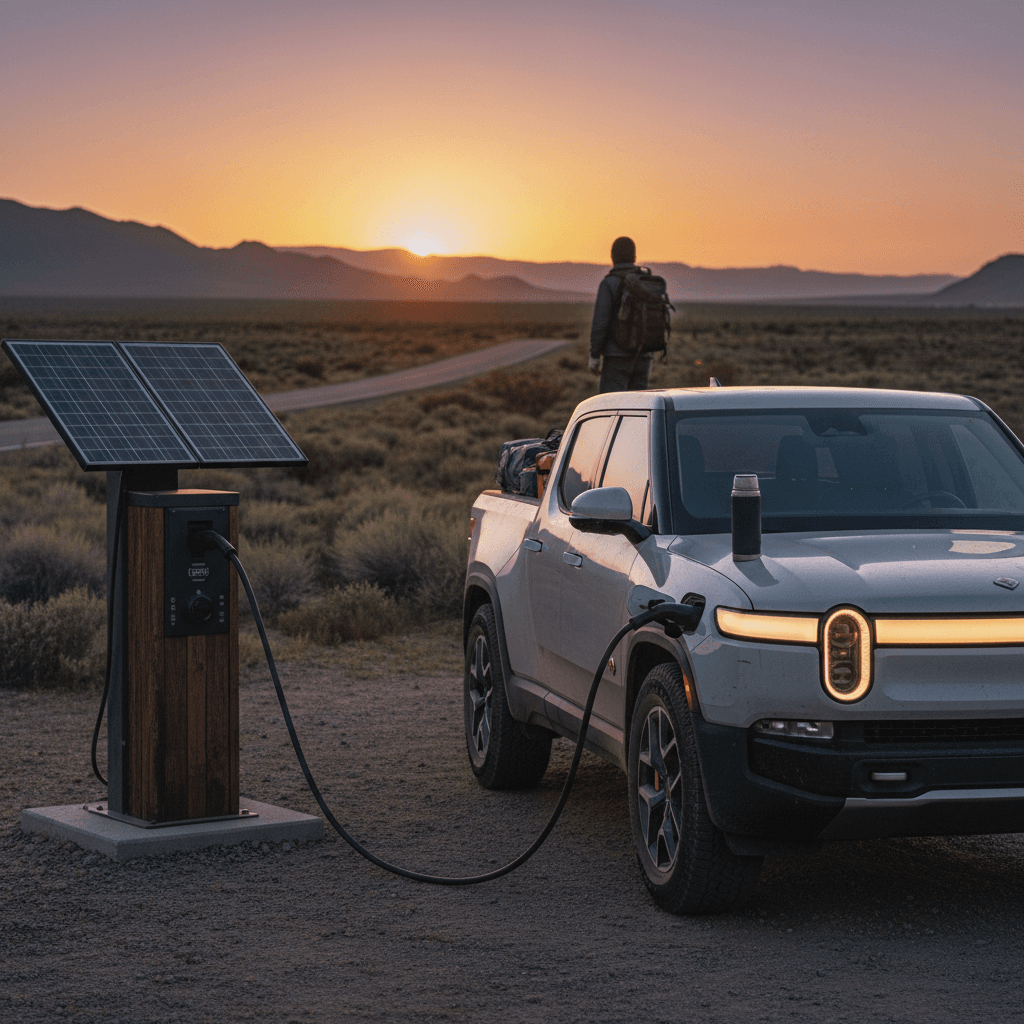
Take one look at the Rivian R1T and it sells you a story: four motors, air suspension, camp kitchen, cross-country adventure. But how does that promise hold up when you’re staring at a low state of charge on a lonely stretch of interstate? This Rivian R1T road trip review looks past the marketing and into what really matters on a long drive: usable highway range, how often you’re stopping to charge, how long those stops take, and how comfortable it is to live in the truck for hundreds of miles at a time.
What this review covers
Overview: Is the Rivian R1T a Good Road Trip Truck?
Where the R1T shines
- Comfortable cabin with quiet ride, supportive seats, and excellent driver assistance.
- Storage for days: big bed, gear tunnel, frunk, and under-bed storage swallow luggage and adventure gear.
- Strong DC fast charging peak (around 200+ kW on newer packs) means you can add a lot of miles quickly between 10–60%.
- Adventure-ready hardware: air suspension, drive modes, and power to spare if your road trip includes dirt, snow, or mountain passes.
Where it still frustrates
- Efficiency at high speed: think closer to 2.0–2.5 mi/kWh on the highway, not 3+ like some crossovers.
- Charging curve and reliability can be inconsistent on some third‑party DC fast chargers and even at some Tesla Superchargers with the CCS‑to‑NACS adapter.
- More stops than a hyper‑efficient EV: you’ll plan around 150–200‑mile hops rather than 250–300‑mile legs if you’re driving 75–80 mph.
- Price: even used, it’s still a premium truck, so you expect it to behave like one on the road.
Quick verdict
Real-World Highway Range: What You Can Actually Expect
On paper, recent Rivian R1T configurations span from about 270 miles of EPA range (Standard pack with LFP cells) up to roughly 400+ miles for Max pack trucks with 21‑inch road tires. In the real world, highway road trips are less kind. Aero, speed, elevation and weather all chip away at those ratings.
Rivian R1T Highway Range Snapshot (Real-World)
Think of the R1T as an efficient truck, not an efficient car. At 70–72 mph in warm weather on road tires, many drivers see mid‑2s mi/kWh and real highway legs that line up surprisingly well with EPA ratings. Push to 80 mph, switch to all‑terrain tires, add headwinds and winter temps, and you can watch efficiency slide toward 1.6–2.0 mi/kWh. That’s when a theoretical 350‑mile truck becomes a practical 220‑mile truck, especially if you keep a 10–15% buffer.
Speed is the silent range killer
Charging on the Road: Adventure Network, CCS and Superchargers
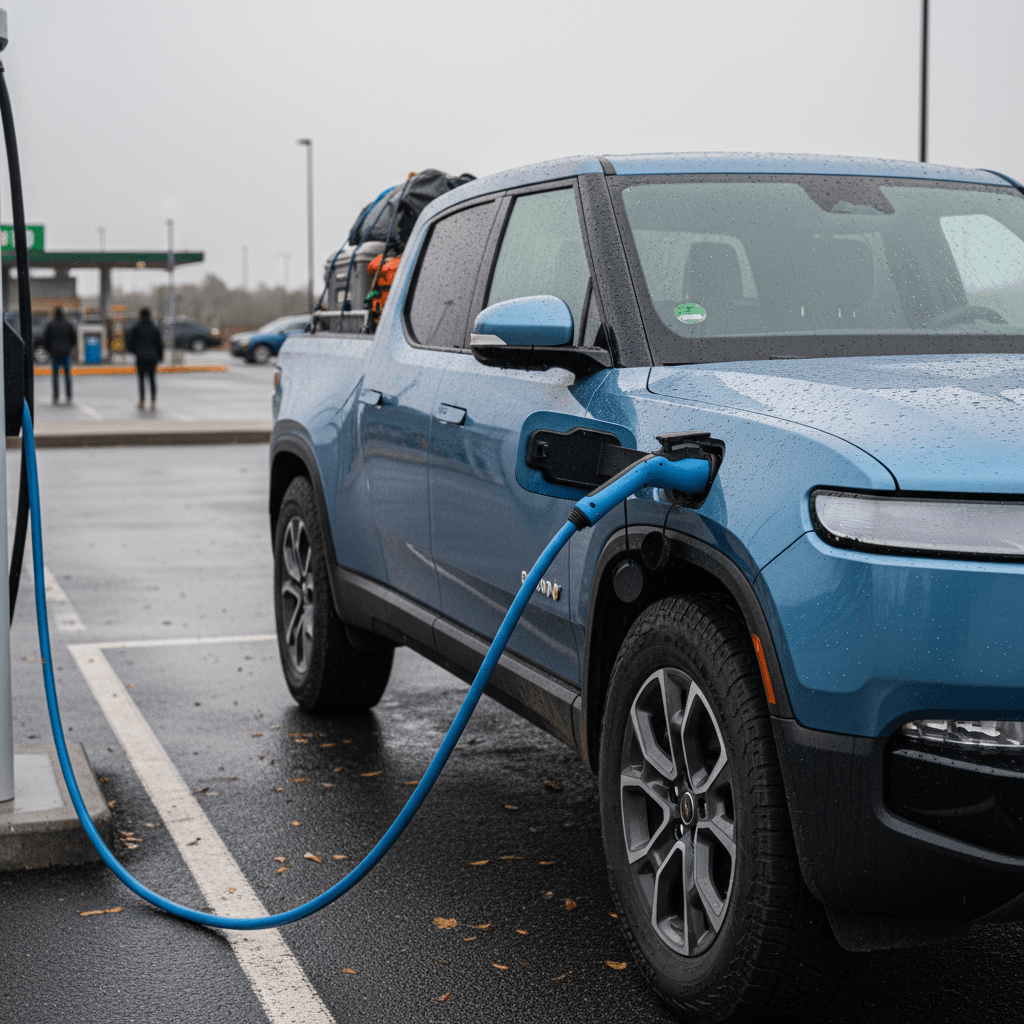
Charging is where the R1T can feel brilliant one day and moody the next. When everything lines up, warm pack, high‑power charger, no sharing, you can see peaks around 210–220 kW and add a big chunk of range in under half an hour. When conditions or chargers aren’t ideal, power can taper early and suddenly that same stop feels painfully long.
Where You’ll Charge a Rivian R1T on a Road Trip
Each network has its own personality. Knowing the differences makes planning a lot less stressful.
Rivian Adventure Network
Rivian’s own DC fast chargers, designed specifically for R1T and R1S owners.
- Simple plug‑and‑charge experience.
- Good reliability where available.
- Still a smaller footprint than Tesla’s Supercharger network.
CCS Fast Charging (EA, EVgo, ChargePoint)
Your core backbone today, especially off the main Rivian corridors.
- Look for 150–350 kW stations.
- R1T can pull strong power when the charger delivers.
- Quality varies by location and operator.
Tesla Supercharger (with adapter)
As NACS access expands, R1T drivers can tap into a huge additional network.
- Often well‑maintained locations.
- Some sessions show lower‑than‑expected power on certain stalls.
- Great backup when CCS options are sparse.
Use the truck’s nav to prep the battery
On a well‑planned stop, you’ll usually arrive around 10–15% state of charge, plug into a 250–350 kW‑rated unit, and watch power ramp quickly. The sweet spot is still the familiar 10–80% window, roughly 25–35 minutes on a strong charger. Some independent tests have shown charge curves that taper earlier than expected or sit well below station limits, which means occasionally you’ll stay plugged in longer than you’d hoped, especially at busy or older sites.
Time vs. Distance: How Often You’ll Stop and For How Long
Rivian owners quickly learn that a good R1T road trip is less about chasing range and more about getting into a rhythm. Drive 2–3 hours, stop to charge, walk the dog, find a restroom, stretch, grab a snack, and you’re back on the road with another couple hundred miles in the pack.
Sample R1T Road Trip Day (Max Pack, Mild Weather)
Assumes ~2.3 mi/kWh at 70–75 mph on road tires, using a mix of CCS and Rivian Adventure Network chargers.
| Leg | Miles Driven | Arrival SoC | Charge Window | Charge Time | Notes |
|---|---|---|---|---|---|
| Morning Leg 1 | 190 mi | 12% | 12% → 70% | 30 min | Coffee, restroom, dog walk |
| Midday Leg 2 | 170 mi | 15% | 15% → 65% | 25 min | Quick lunch while charging |
| Afternoon Leg 3 | 160 mi | 18% | 18% → 60% | 20–25 min | Stretch, check hotel, plan dinner |
| Total Day | 520 mi | , | ~3 sessions | 75–90 min | Most of your stopping time doubles as normal breaks |
Actual times and distances vary with speed, weather, elevation and tire choice, but this gives you a realistic template.
Charging doesn’t have to feel like “waiting”
Comfort, Noise and Storage on Long Drives
Here’s where the R1T behaves less like a truck and more like a premium SUV. After a few hundred miles, what you remember isn’t the energy graph, it’s the ride, the seats, the way the cabin sounds and feels.
Living With the R1T for 500+ Miles a Day
A luxury‑leaning cabin wrapped in an adventure truck shell.
Ride & Seats
- Air suspension takes the worst out of broken pavement and expansion joints.
- Seats are wide and supportive; the driving position is more SUV‑like than full‑size pickup upright.
- Adaptive dampers and multiple ride heights let you hunker down on the highway for stability.
Noise & Vibration
- Wind and road noise are well controlled for a truck, especially on 21‑inch road tires.
- All‑terrains will add a low‑frequency hum, but it’s rarely intrusive at sane speeds.
- Electric drive means no engine droning when you’re climbing grades for miles at a time.
Storage & Practicality
- Bed handles coolers, bikes and bulky luggage; under‑bed well adds hidden cargo volume.
- Gear tunnel is road‑trip magic: perfect for dirty gear, folding chairs, or recovery equipment.
- Front trunk and cabin cubbies swallow the rest, this is one of the most storage‑rich EVs you can buy.
Tech & Driver Assistance
- Large central screen is your trip nerve center; navigation integrates state of charge and charging stops.
- High‑quality cameras simplify parking with a full load of gear.
- Driver‑assist systems reduce fatigue, though button placement and interface quirks take a day or two to learn.
Pack like you mean it
Cost to Road Trip: Rivian R1T vs. Gas Truck
Road‑trip costs depend heavily on your local electricity rates and which networks you use, but the broad strokes are clear. An R1T isn’t the cheapest EV to feed, but it usually undercuts a comparable gas pickup, especially on long highway days where a big V8 or turbocharged V6 would be drinking hard.
Approximate Energy Cost: R1T vs. Gas Truck (500-Mile Day)
Illustrative example using typical U.S. energy prices. Your costs will vary with local rates, speed, weather and vehicle configuration.
| Scenario | Energy Use | Unit Cost | Total Cost (500 mi) | Notes |
|---|---|---|---|---|
| Rivian R1T – Mostly DC Fast Charging | ~227 kWh | $0.30/kWh | ~$68 | Blend of Rivian/CCS/Tesla rates |
| Rivian R1T – Mix of Home & DC | ~227 kWh | $0.20/kWh effective | ~$45 | Cheap home top‑off before/after trip |
| Gas Full-Size Truck | ~27.8 gallons | $3.75/gal | ~$104 | Typical 1500‑class pickup at 18 mpg |
Assumes R1T averages 2.2 mi/kWh on trip, gas truck averages 18 mpg on highway.
Don’t forget hotel chargers
Planning a Smooth R1T Road Trip: Step-by-Step
A good EV road trip is mostly preparation. The R1T gives you the tools; you just have to use them. Here’s a simple process to follow before you point the nose at the horizon.
R1T Road Trip Planning Checklist
1. Know your configuration
Make note of your battery pack (Standard, Large, or Max), wheel and tire setup, and any roof racks or accessories. A Max pack on 21s behaves very differently from a Standard pack on all‑terrains with a rooftop tent.
2. Set realistic efficiency targets
Look at your recent trip history in the truck. If you usually see 2.2 mi/kWh at 72 mph, build your route around that number, not the EPA label.
3. Map primary and backup chargers
Use the Rivian nav, PlugShare‑style apps, and the Tesla app (if you have NACS access) to find at least one <strong>backup DC fast charger</strong> near each planned stop.
4. Time your arrival
Aim to reach fast chargers between 10–20% state of charge. That’s where the R1T charges fastest and your breaks will feel shortest.
5. Pack charging essentials
Bring your mobile connector, gloves, a flashlight, and any adapters you own. Keep them in the gear tunnel so they’re easy to reach at night or in bad weather.
6. Plan your overnight strategy
Favor hotels or rentals with Level 2 charging so you can start each day at 80–100% and skip at least one DC stop.
Avoid this common mistake
Buying a Used Rivian R1T for Road Trips
If long‑distance travel is high on your wish list, the used market can be a smart way into an R1T, especially as early trucks come off lease and owners trade into the latest tri‑ or quad‑motor versions. That said, road‑trip duty is tougher on a battery and charging hardware than city commuting, so you’ll want to shop carefully.
What to look for in a used R1T
- Battery health: You want a pack that still holds strong range and delivers good fast‑charge performance.
- Charging history: Frequent DC fast charging is normal for adventure trucks, but extreme patterns can accelerate wear.
- Wheel/tire setup: If you plan lots of highway miles, 21‑inch road tires will be kinder to your energy consumption than chunky all‑terrains.
- Software updates: Make sure the truck has received recent updates; Rivian continually refines efficiency, navigation and charging behavior.
How Recharged can help
At Recharged, every used EV, including the Rivian R1T, comes with a Recharged Score Report that digs into battery health, charging behavior and fair‑market pricing. That means you’re not guessing about the truck’s past before you send it across two time zones with your family on board.
You can browse used EVs, get an instant trade‑in offer on your current vehicle, arrange financing, and even line up nationwide delivery, all online, or with help from an EV specialist if you’d rather talk through options.
Why battery diagnostics matter for road trips
Rivian R1T Road Trip FAQ
Frequently Asked Questions
Bottom Line: Is the R1T a Good Road Tripper?
The Rivian R1T isn’t a hyper‑efficient, set‑it‑and‑forget‑it mile‑eater like a low, slippery EV sedan, but that’s not what it was built to be. It’s a comfortable, wildly capable adventure truck that happens to take electricity instead of unleaded. Treat it like the truck it is, plan your route around 150–200‑mile legs, and learn where it likes to charge, and it rewards you with a road‑trip experience that’s calmer, quieter, and more storage‑friendly than most gas pickups.
If you’re shopping used, pairing that real‑world understanding with a Recharged Score Report gives you the last missing piece: confidence that the battery and charging hardware are as ready for the open road as you are. Get that right, and the R1T stops being just a lifestyle statement and starts being what it always wanted to be, a long‑legged electric truck that can carry you, your people, and your gear a very long way from home.