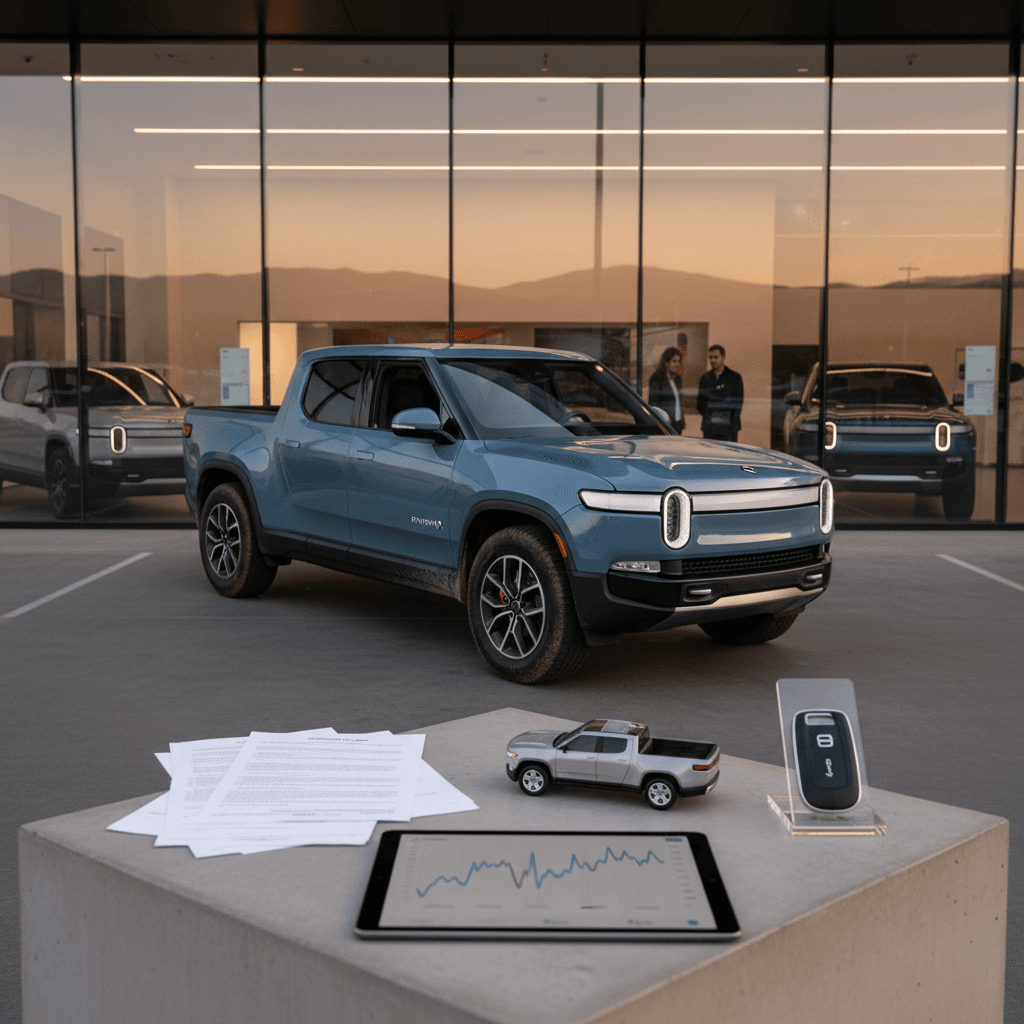
If you’re eyeing a Rivian R1T, you’ve probably noticed prices moving around a lot over the last two years, between MSRP changes, incentives, and a young used market, it’s tough to know what this truck will actually cost in 2026. This guide walks through a data‑driven Rivian R1T price forecast for 2026, covering new, used, and lease scenarios so you can plan your budget with fewer surprises.
Forecasts, not certainties
Why Rivian R1T prices are so hard to pin down
With legacy trucks like the Ford F‑150, you can look at decades of transaction data and incentives. The Rivian R1T is different. It launched in late 2021, has seen multiple price moves since, and still sells in relatively low volumes compared to mainstream pickups. On top of that, Rivian’s direct‑to‑consumer model and its mix of online orders, inventory vehicles, and occasional price adjustments make it harder to read than a traditional dealer lot.
- Rivian has adjusted R1T pricing several times as battery packs, motors, and features have evolved.
- EV incentives and tax credits keep shifting, changing effective out‑the‑door prices year to year.
- The used R1T market is young, so depreciation curves are still settling.
- Broader EV demand has cooled slightly from 2021–2022 highs, pressuring prices, but high‑end vehicles like the R1T still command a premium.
Beware of outdated price screenshots
Where Rivian R1T pricing stands today
Rivian R1T pricing snapshot heading into 2026
New 2025 R1T Adventure Dual‑Motor trucks with the Standard or Large pack generally sticker in the low‑$70,000s once you add popular options like upgraded wheels or paint. Tri‑Motor and Max Pack configurations push pricing much higher. Meanwhile, valuation guides and recent used‑vehicle listings show three‑year‑old R1Ts selling for roughly 30% less than original MSRP, with many 2022–2023 examples landing between the high‑$40,000s and mid‑$60,000s depending on mileage, spec, and condition.

New Rivian R1T price forecast for 2026
Let’s start with new‑truck pricing. We now have early visibility into model‑year 2026 R1T MSRPs. Across the lineup, Rivian has nudged prices up modestly versus the prior year, but stopped well short of the big hikes we saw industry‑wide in 2021–2022.
Illustrative 2025 vs. 2026 Rivian R1T pricing
Approximate starting MSRPs for common configurations, based on publicly available 2025 and 2026 pricing plus modest year‑over‑year increases. Your exact build and destination fees will vary.
| Configuration | Model year | Approx. starting MSRP | Notes |
|---|---|---|---|
| Adventure Dual‑Motor, Standard pack | 2025 | Low $70,000s | Baseline dual‑motor truck with the smallest pack. |
| Adventure Dual‑Motor, Standard pack | 2026 | Low‑to‑mid $70,000s | Small year‑over‑year increase as standard equipment improves. |
| Adventure Dual‑Motor, Large pack | 2025 | Mid $70,000s | Popular configuration for mix of range and price. |
| Adventure Dual‑Motor, Large pack | 2026 | High $70,000s | Slight increase vs. 2025; options still drive big swings. |
| Tri‑Motor, Large/Max pack | 2025 | $90,000+ | High‑performance halo model with limited volume. |
| Tri‑Motor, Large/Max pack | 2026 | $90,000s+ | Expect modest increases but also potential incentives on inventory. |
These figures are directional, not official Rivian price quotes. Always confirm current pricing on Rivian’s site.
Directionally higher, but not runaway inflation
Our base‑case forecast: modest MSRP creep, bigger variance in discounts
For 2026, a reasonable base‑case forecast is that headline MSRPs will be 1–4% higher than 2025 for most R1T trims. In dollar terms, that’s roughly $1,000–$3,000 more for a typical Adventure Dual‑Motor configuration. The bigger story, though, is likely to be transaction prices, what people actually pay after incentives, interest rates, and any Rivian or dealer‑partner discounts are factored in.
Scenario 1: Rivian stays supply‑constrained
If R1T demand continues to outstrip production, especially for certain colors, wheels, or the most desirable battery packs, Rivian will have little reason to discount. In this case, you should expect to pay close to full MSRP on 2026 builds, with only modest promotional offers.
Scenario 2: Competition and higher rates bite harder
If overall EV demand softens further or traditional brands get more aggressive with discounts on electric pickups, Rivian may lean on financing offers, loyalty rebates, or quiet price cuts on in‑stock units. That could effectively offset some of the MSRP creep you see on paper.
Don’t just watch the MSRP
Used Rivian R1T price forecast for 2026
If you’re value‑oriented, 2026 is when the used Rivian R1T market really starts to get interesting. Early depreciation data points to roughly 30% value loss over three years on first‑wave R1Ts, which is steep compared to traditional trucks but broadly in line with other premium EVs from startup brands.
How we expect used R1T prices to shape up in 2026
Approximate U.S. retail price ranges for well‑maintained trucks, assuming typical mileage and no major accidents.
2022 R1T (3–4 years old)
By 2026, many 2022 trucks will be coming off early leases or first ownership cycles.
- Forecast: mid‑$40,000s to mid‑$50,000s
- Higher for low‑mileage, desirable specs
2023 R1T (2–3 years old)
The sweet spot for many buyers balancing price and tech freshness.
- Forecast: high‑$40,000s to low‑$60,000s
- Adventure Dual‑Motor Large pack likely in the upper half of that band
2024–2025 R1T (1–2 years old)
Lightly‑used trucks with near‑new hardware.
- Forecast: low‑to‑mid‑$60,000s for nicely optioned builds
- Deeply optioned Tri‑Motor or Max Pack examples will sit higher
Beware early build quirks and hard use
Why depreciation is likely to stay elevated, but stabilize
Rivian is still a relatively young brand, so used‑vehicle shoppers price in more risk than they would with, say, a Ford F‑150. At the same time, the R1T occupies a niche, premium adventure truck, that doesn’t have many direct EV competitors yet. Those two forces push in opposite directions: they keep resale values from collapsing outright but also cap how strong they can be until Rivian proves out long‑term durability and service coverage.
Our base‑case view is that 2026 used R1T prices will remain 20–35% below comparable new MSRPs for similar trims, with the widest discounts on higher‑priced Tri‑Motor and Max Pack trucks. That’s painful for first‑owners, but it creates real opportunity if you’re shopping used, especially if you have tools to verify battery health and past use.
Where Recharged can help on used pricing
Ready to find your next EV?
Browse VehiclesWhat to expect for Rivian R1T lease costs in 2026
Leasing has been a popular way to get into an R1T without fully committing to startup‑brand residual risk. In 2023–2024, real‑world consumer reports often showed leases in the roughly $700–$1,100 per‑month range for well‑equipped R1Ts, depending heavily on down payment, term length, and local taxes.
Key forces shaping 2026 R1T lease pricing
1. Residual values remain conservative
Lease providers don’t yet have long‑term Rivian resale histories to lean on, so they tend to assume steeper depreciation than with an F‑150 or Silverado. That keeps monthly payments higher than you might expect for a truck with similar MSRP.
2. Interest rates and money factors
If rates ease in 2026, money factors on leases should improve, trimming monthly costs even if MSRPs edge up slightly. If rates stay elevated, expect limited relief.
3. EV tax credit pass‑throughs
Depending on how federal and state EV incentives are structured in 2026, Rivian or its financing partners may be able to roll credits into lease deals, effectively lowering your monthly payment.
4. Competitive responses
If Ford, GM, or Ram aggressively subsidize electric truck leases, Rivian may need to respond with more attractive terms on the R1T to stay in the consideration set.
Put it together and a reasonable 2026 forecast is that mainstream R1T leases will still cluster in the high‑hundreds to low‑thousands per month for typical 36‑month, 10,000–12,000‑mile‑per‑year deals, with well‑qualified buyers and meaningful cash due at signing. Deeply optioned Tri‑Motor trucks will sit above that, especially if residuals remain conservative.
Factors that could push 2026 R1T prices up or down
Key drivers of Rivian R1T pricing in 2026
These are the levers that could move R1T prices away from our base‑case forecast.
Manufacturing scale & costs
As Rivian ramps production and continues to squeeze cost out of its supply chain, it gains more flexibility in pricing. Strong efficiency gains could let Rivian hold or even lower MSRPs despite inflation.
Battery and component prices
Battery prices trended downward after 2022 spikes, but they’re still volatile. Cheaper cells could open room for lower pricing; new chemistry costs or supply disruptions would push the other way.
Competitive pressure
If rival electric pickups gain traction, especially in the $55,000–$70,000 range, Rivian may need to rely more on discounts, financing offers, or equipment upgrades at the same price points.
Policy and incentives
Changes to federal or state EV incentives, or stricter battery‑sourcing rules, can swing effective R1T pricing by thousands of dollars. Some customers will qualify for credits, others won’t.
Macroeconomy & demand
Higher interest rates and economic uncertainty tend to favor cheaper trucks and delay purchases, pressuring R1T pricing. A strong economy supports higher MSRPs and firmer transaction prices.
Brand trust & ownership experience
As more R1Ts rack up high mileage and Rivian’s service network matures, used‑market confidence can improve, which supports both resale values and stronger lease residuals.
2026 price scenarios: how much will you actually pay?
Instead of focusing on a single number, it’s more useful to think in realistic ranges for different shopper types. Here are three illustrative 2026 scenarios that map to how many buyers actually approach an R1T purchase.
The early‑adopter upgrader
Profile: Trading out of a 2022–2023 R1T or another premium EV into a 2026 R1T.
- New 2026 R1T Adventure Dual‑Motor with options: high‑$70,000s to low‑$80,000s MSRP.
- Trade‑in value on old R1T: potentially mid‑$40,000s to low‑$60,000s, depending on year and spec.
- Net out‑the‑door: Highly dependent on equity position, but many will roll negative equity if they swap early.
The pragmatic used‑truck buyer
Profile: Wants an R1T experience without new‑truck pricing.
- Targeting a 2023–2024 R1T in 2026.
- Likely purchase price: high‑$40,000s to low‑$60,000s for mainstream trims.
- Biggest swing factor: Battery health and accident history, clean trucks command a premium.
The payment‑focused lessee
Profile: Prioritizes predictable monthly cost and wants to avoid long‑term tech risk.
- Typical 2026 lease: roughly $800–$1,100/month for a well‑equipped build, with several thousand due at signing.
- Effective cost varies with money factor, residual, and whether tax credits are passed through.
Run the numbers across new, used, and lease
How to shop smart for a Rivian R1T in 2026
Whether you end up buying new or used, the smartest 2026 R1T shoppers will treat price as more than just the number on the window sticker. Here’s a practical playbook for approaching the market with eyes wide open.
Smart 2026 R1T shopping checklist
1. Separate MSRP from transaction price
Ask yourself: What incentives, financing offers, and trade‑in values are actually on the table? A truck with a slightly higher MSRP might be cheaper to own if it comes with better terms or qualifies for more credits.
2. Make battery health non‑negotiable
On used R1Ts, insist on objective battery diagnostics, not just a full‑charge range reading. Degraded packs reduce real‑world value and can erase any price advantage you thought you were getting.
3. Compare total cost of ownership
Factor in insurance, energy costs, maintenance, and expected depreciation over the period you actually plan to own the truck. A strong resale trajectory can offset a slightly higher upfront price.
4. Time your purchase around incentives
EV tax credits and state programs can change mid‑year. If you’re flexible, track upcoming policy changes, waiting a few months could be worth thousands of dollars, or the reverse.
5. Shop across channels
Don’t just look at Rivian’s own inventory. Cross‑shop certified used trucks, marketplaces that specialize in EVs, and online lenders. At Recharged, for example, you can pre‑qualify, value your trade, and browse used R1Ts with a transparent Recharged Score in one place.
6. Don’t stretch for a halo trim
Tri‑Motor and heavily optioned Max Pack trucks tend to depreciate faster in absolute dollars. If you’re payment‑sensitive, a more modest Dual‑Motor configuration is usually the smarter play.
Leverage EV‑specific marketplaces
FAQ: Rivian R1T price forecast 2026
Frequently asked questions about 2026 Rivian R1T pricing
Bottom line: should you wait or buy sooner?
Looking across new, used, and lease options, the most likely 2026 outcome is measured R1T price softening in the used market and only modest upward drift on new MSRPs. If you want a brand‑new, custom‑spec 2026 build, waiting probably won’t save you thousands versus ordering in late 2025, but you may benefit from slightly better financing or incentives if macro conditions improve.
If your priority is value, 2026 is shaping up as a compelling window to buy used. Three‑ to four‑year‑old R1Ts will finally be available in meaningful volume, depreciation will have done its work, and tools like the Recharged Score Report make it easier to separate great trucks from problem children. Whichever path you choose, go in with a clear budget, insist on transparency around battery health and prior use, and compare offers across new, used, and lease channels before you sign.