If you’re shopping a Rivian R1T in 2026, the big question that keeps coming up is simple: is the Rivian R1T Max battery worth it, or is the cheaper Large Pack all you really need? The answer depends less on bragging rights and more on how you actually drive, tow, and charge this truck in the real world.
Quick take
Who actually needs the R1T Max battery?
Before we get lost in specs, step back and look at your use case. The Max Pack is a long‑range tool, not a status symbol. Ask yourself how often you: (1) drive 250+ miles in a day, (2) tow at highway speeds, or (3) venture far from fast charging. If those are rare occasions, you’re paying a lot of money for capability you may barely tap.
Who benefits most from the Rivian R1T Max battery?
Match your driving style to the right pack
Frequent road‑trippers
If you regularly crush interstate runs of 300–400 miles in a day, the Max Pack cuts the number of charging stops and gives you more flexibility to skip busy stations.
Serious towers
Pulling a camper, boat, or enclosed trailer? Expect your effective range to drop 30–50%. The Max Pack helps keep your towing day manageable without constant range anxiety.
Remote explorers
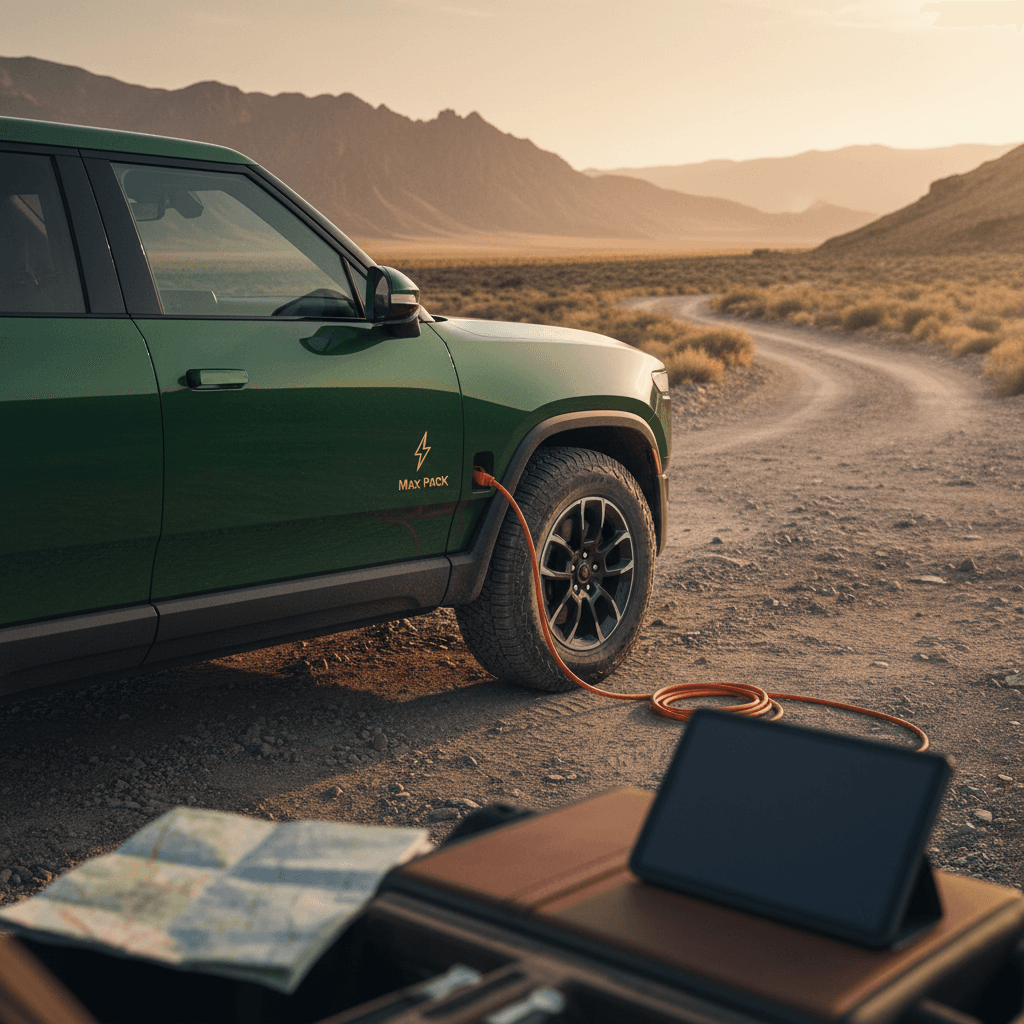
If you’re off to trailheads, remote campsites, ski cabins, or desert tracks far from DC fast chargers, the extra buffer of the Max Pack is worth real peace of mind.
When Max Pack is overkill
Rivian R1T battery options at a glance
R1T battery-pack snapshot (2026 context)
Rivian’s exact ratings vary by wheel/tire combo and model year, but the pattern is clear: the Max Pack sits roughly 50–70 miles above the Large Pack on paper for the R1T. In practice, the gap can matter a lot on long days, and hardly at all on short ones.
Rivian R1T battery packs: simple comparison
Approximate figures for a Dual‑Motor R1T. Exact numbers depend on wheels, tires, climate, and driving style.
| Pack | Approx. usable capacity | EPA range (no towing) | Typical daily range buffer | Upgrade cost vs. previous pack* |
|---|---|---|---|---|
| Standard | ~105 kWh | ~270 mi | Plenty for commuting, tight for long towing | Base |
| Large | ~131 kWh | ~350 mi | Comfortable for most road trips | +$7K–$8K range |
| Max | ~142 kWh | ~400–410 mi | Optimized for towing & remote trips | ~+$16K over Large (new) |
EPA ratings and upgrade pricing are approximations; always verify current numbers with Rivian before ordering.
About the numbers
How much extra range does the Max pack really give you?
On paper
The Dual‑Motor R1T with the Max Pack is rated around 410 miles of EPA range, versus roughly 350 miles with the Large Pack when similarly equipped. That’s roughly a 15–20% bump.
Put simply, if you like to arrive at chargers with 10–15% remaining instead of 2–3%, the Max Pack stretches every leg of your trip.
In the real world
Highway speeds, winter temps, headwinds, and big all‑terrain tires all trim range. Many owners see something closer to 275–320 miles out of a Large Pack and 320–360 miles out of a Max Pack on real highway drives.
The important takeaway: that extra 40–60 miles often equals one fewer stop on a long day or the ability to skip a busy or inconvenient station.
Think in legs, not raw miles
Max battery vs. Large Pack: key ownership tradeoffs
Max Pack vs. Large Pack: where it helps and where it hurts
The Max Pack changes more than just your range number
Upfront & long‑term cost
The Max Pack typically adds around $16,000 to a new R1T versus the Large Pack, before wheels and options. That’s real money, even in this price class.
Spread over 8–10 years of ownership, it’s effectively a few hundred dollars a year for extra flexibility and some additional resale value, but only if you truly use that extra range.
Efficiency & weight
More battery equals more weight. Expect the Max Pack to be slightly less efficient, especially in stop‑and‑go and city use.
For many owners the hit is modest, but it does blunt the advantage of the bigger pack a bit on shorter drives.
Charging behavior
At the same charger power level, a larger pack takes longer to go from 10–80%. You can add more miles per session, but you’ll sit longer if you always charge deep.
If you mostly DC fast‑charge on trips only and rely on Level 2 at home, this is usually a fair trade.
Battery health and stress
A higher‑capacity pack can actually make life easier on the cells: you can live between, say, 20–70% charge day‑to‑day and still have plenty of usable range.
Keeping an EV out of the extremes (near 0% and near 100%) is one of the simplest ways to support long‑term battery health.
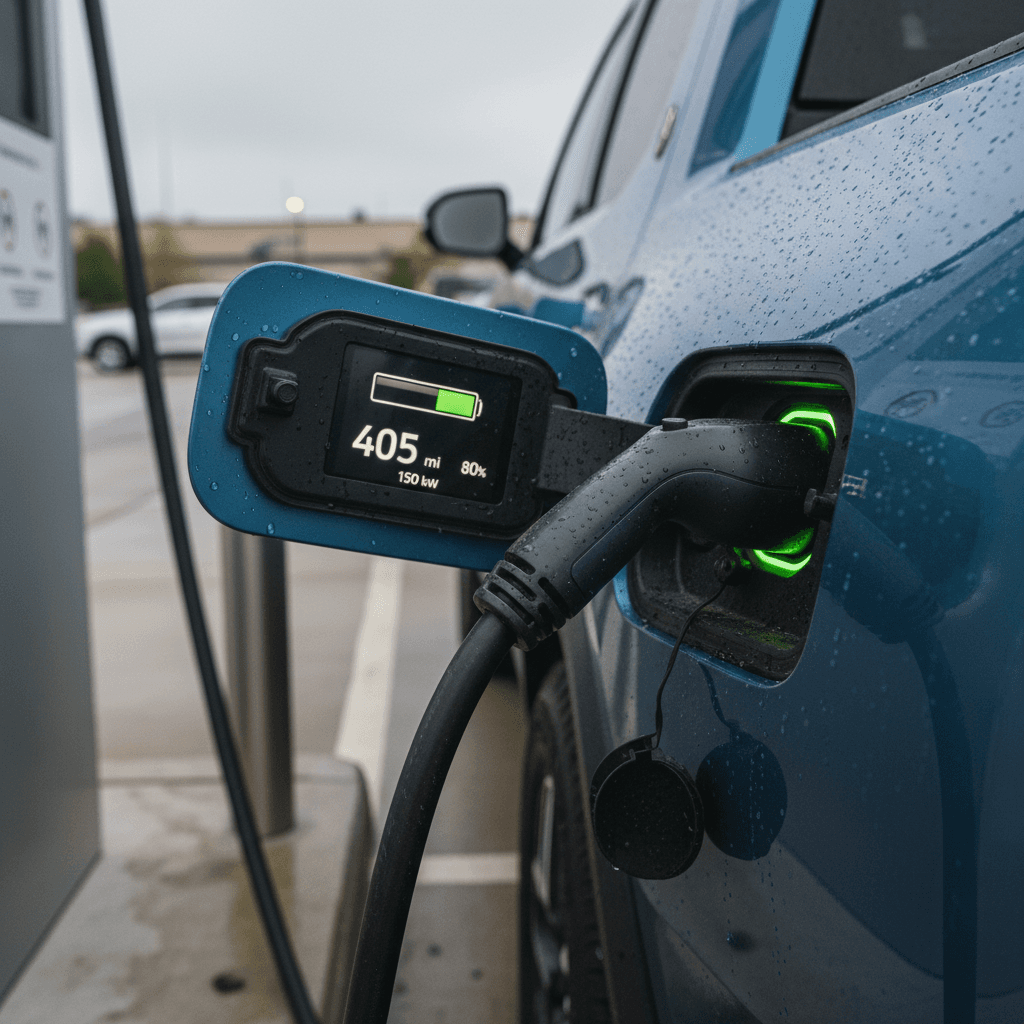
Is the R1T Max battery worth it for towing and overlanding?
Towing and off‑road travel are where the Rivian R1T Max battery upgrade starts to justify itself more clearly. Both activities chew through energy; the Max Pack simply gives you more room to work with.
Towing with the R1T
- Range hit: With a mid‑size camper or enclosed trailer, it’s reasonable to plan on 40–50% less effective range at highway speeds.
- Large Pack reality: That 350‑mile rating can feel more like 170–200 miles when towing.
- Max Pack reality: Instead of 170–200 miles, you’re often looking at 210–240 miles under similar conditions.
If you’re crossing long gaps between fast chargers with a trailer in tow, that extra buffer can be the difference between a relaxed day and white‑knuckle range watching.
Overlanding & remote trips
- Slow trails, big climbs, and cold temps all whittle away at range. You may spend days without DC fast charging.
- Even if you cover few miles each day, preconditioning, camp mode, and accessories loom larger when you’re living out of the truck.
- The Max Pack lets you run more gear and climate control without obsessing over the state of charge.
If your bucket list includes remote desert trails, Rockies passes, or winter ski huts, a Max Pack R1T is one of the few EV trucks that can make those adventures realistically doable today.
When the Max Pack is an easy “yes”
Charging time and road-trip planning with Max Pack
A common concern is that the Max Pack takes “forever” to charge. What matters more than absolute minutes is how you plan stops. The R1T’s DC fast‑charging curve is built around adding a lot of miles in the 10–60% window; that doesn’t change just because the pack is larger.
- On a strong 250 kW DC fast charger, both Large and Max packs add the fastest miles between roughly 10–60% state of charge.
- The Max Pack simply means that each 10–60% session adds more miles than on the Large Pack.
- If you routinely charge from very low to very high (e.g., 5–90%), the Max Pack will take longer, but you’ll also go farther between stops.
- For most road‑trippers, it’s more efficient to stop a bit more often for shorter, high‑power sessions than to deep‑charge infrequently.
Plan around where you want to stop, not just where chargers exist
Resale value and used Rivian R1T Max Pack considerations
Whether you’re ordering new or shopping used, the Max Pack’s value doesn’t stop at its sticker price. It also shapes how the truck will appeal in the used market several years down the road.
How the Max Pack plays in the used R1T market
What buyers, and sellers, should expect
Depreciation math
Options rarely return 100 cents on the dollar on resale, and big batteries are no exception. But long‑range variants typically hold value better, and they’re often easier to sell.
Regional demand
In dense, charger‑rich metro areas, many used‑EV shoppers are content with a Large Pack. In parts of the Mountain West or rural Midwest, the Max Pack becomes a much bigger selling point.
Battery health transparency
On a used R1T, what matters isn’t just pack size but pack health. A well‑documented Max Pack that shows minimal degradation is a strong differentiator when you go to sell or trade.
How Recharged helps with used R1Ts
In the used market, range is the one spec you can’t fix with an accessory. That’s why long‑range EV trims consistently pull more interest and stronger offers, especially as the vehicle ages.
Checklist: is the Rivian R1T Max battery worth it for you?
Walk through these questions before you order or buy used
1. How often do you drive 250+ miles in a day?
If that kind of distance is a once‑or‑twice‑a‑year event, the Large Pack plus smart charging stops will handle it. If it’s a monthly habit, the Max Pack starts to earn its keep.
2. Do you tow more than a few weekends a year?
Occasional boat‑ramp duty is one thing; frequent highway towing of a camper or car trailer is another. Regular towers get the clearest benefit from the Max Pack’s extra buffer.
3. What does your charging network look like?
If you live near dense DC fast‑charging and rarely leave that footprint, the Large Pack is normally fine. In sparse networks or harsh winters, the Max Pack feels more like a necessity than a luxury.
4. Will this be your only long‑range vehicle?
Households with a long‑range gas SUV or truck in the driveway can afford to keep their R1T on a smaller pack. If the Rivian is your primary road‑trip machine, leaning into maximum range is easier to justify.
5. How long do you plan to keep the truck?
The longer your ownership horizon, 8, 10, 12 years, the more chances you’ll have to benefit from the extra range and the more it can support resale when you eventually move on.
6. Are you stretching your budget to get Max?
If the Max Pack forces uncomfortable compromises on payments, insurance, or savings, step back. A well‑priced Large Pack R1T bought comfortably is a better ownership experience than a Max Pack that keeps you awake at night.
FAQ: Rivian R1T Max battery questions answered
Common questions about the Rivian R1T Max Pack
Bottom line: is the Rivian R1T Max battery worth it?
If your R1T will mostly commute, carry bikes, and tackle the occasional weekend away, the Large Pack is the right answer for most buyers. It’s cheaper, more efficient day‑to‑day, and already delivers more range than many drivers will realistically use.
The Rivian R1T Max battery is worth it when you buy the truck as a genuine long‑distance, long‑term adventure tool: frequent road trips, regular towing, or remote weekends where public charging is scarce. In those cases, the extra upfront cost comes back to you in fewer compromises, less range anxiety, and stronger appeal when it’s time to sell.
If you’re weighing a new or used R1T, it’s wise to look beyond the window sticker. Compare total ownership costs, battery health, and how each configuration fits your life. On Recharged, every used EV, including R1Ts with Large and Max packs, comes with a Recharged Score Report so you can see real battery performance, fair pricing, and buy with the same confidence you’d want on a new‑car lot.