If you’re eyeing a Rivian R1T, or already have one in the driveway, you’re probably wondering how its value will hold up. The phrase you’re searching for is **Rivian R1T depreciation curve 5 years**: what the truck is likely to be worth at years 1, 3, and 5, and how that compares with other electric pickups.
Depreciation is a curve, not a cliff
Why Rivian R1T depreciation matters over 5 years
Depreciation is simply **how much value your R1T loses as it ages and racks up miles**. Over a five‑year span, it’s usually the single biggest ownership cost, larger than electricity, insurance, or maintenance. For an $80,000 truck, a few percentage points one way or the other can mean thousands of dollars at trade‑in time.
- If you’re buying new, understanding the curve helps you decide how long to keep the truck.
- If you’re buying used, the sweet spot is often after the steepest early‑years drop.
- If you’re selling, timing the market and your mileage can keep thousands in your pocket.
Think in dollar amounts, not just percentages
How EV and truck depreciation usually works
Before we narrow in on the R1T, it helps to zoom out. Traditionally, **gas pickups** have been depreciation champs, often losing around 35–45% of their value over five years in normal markets. EVs, especially early models with short range, have tended to lose value faster than gas cars as new tech arrives and incentives shift.
Typical 5‑year depreciation patterns
Where electric pickups sit today
Gas half‑ton pickups
Historically strong resale. In normal conditions, many full‑size gas trucks lose roughly 35–45% of MSRP in 5 years when well cared for.
Early EV sedans & crossovers
Many mainstream EVs have seen faster depreciation, often 50%+ in 5 years, as newer models with better range and incentives arrive.
Electric pickups
So far, electric trucks like the R1T have landed in the middle: more volatile than gas trucks, but some trims hold value surprisingly well.
The Rivian R1T lives at the crossroads of high‑end trucks and newer EV tech. That means its 5‑year curve is shaped by both traditional truck logic (brand, capability, demand) and EV‑specific factors (battery health, range, incentives, and charging access).
Real‑world Rivian R1T depreciation so far
What early data says about R1T value
Real‑world used listings back this up. On Recharged and other marketplaces, **early R1T Launch and Quad Motor trucks that stickered in the $80,000–$90,000 range** commonly show up in the $55,000–$70,000 range today, depending on miles and options. Newer Dual Motor trucks that were priced lower to start are seeing more modest dollar drops but similar percentages.
Depreciation is not perfectly smooth
Projected 5‑year Rivian R1T depreciation curve
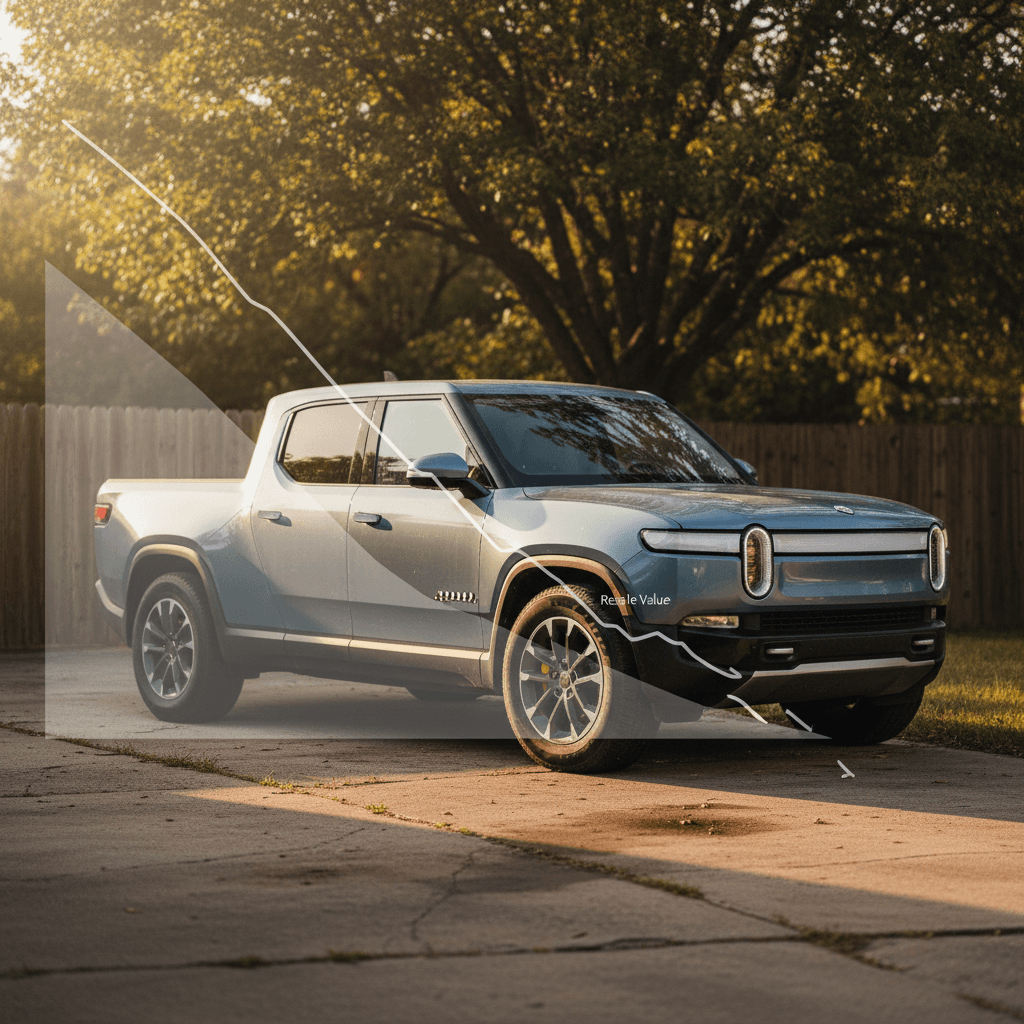
Let’s put the numbers into a simple, hypothetical curve. To keep things clean, we’ll assume a new R1T with a **$80,000 effective price** (after any incentives but before taxes and fees). Your truck may be higher or lower, but the percentages give you a working model.
Illustrative 5‑year Rivian R1T depreciation curve
Approximate retained value vs. original $80,000 effective price
| Age | Approx. % of original value | Estimated value ($80k baseline) | What this period feels like |
|---|---|---|---|
| 1 year | 75–80% | $60,000–$64,000 | Steepest drop as the truck becomes “used,” especially if a newer model year has launched. |
| 2 years | 70–73% | $56,000–$58,500 | Demand is still strong, but discounts on new trucks can tug values down. |
| 3 years | 66–70% | $52,800–$56,000 | Curve starts to flatten; good balance of price vs. remaining warranty for used buyers. |
| 4 years | 55–60% | $44,000–$48,000 | Out of basic warranty for early builds; battery health and service history matter more. |
| 5 years | 45–50% | $36,000–$40,000 | Truck is well into used‑truck territory; condition and configuration drive big price spreads. |
These figures combine current resale data with 5‑year EV truck forecasts. Your actual numbers will vary with trim, miles, and market conditions.

How this compares to the average EV
Factors that bend your R1T’s curve up or down
What actually moves the needle on R1T depreciation
Four big levers you can’t ignore
Battery health & pack choice
Healthy batteries help an EV truck hold value. Large and Max packs with strong range tend to stay above the curve, especially in colder regions or for towing use.
Miles, use, and off‑road wear
High mileage, hard towing, and heavy off‑road use show up in auctions and listings. Light‑duty commuting and clean underbodies are rewarded at trade‑in time.
Updates, recalls & repairs
Rivian pushes frequent software updates, which is a plus. Completed recalls, documented repairs, and clean service history build confidence in later buyers.
Macro market & incentives
Interest rates, gas prices, and EV tax credit rules all influence used values. Big price cuts on new R1Ts or rival trucks can pull used prices down temporarily.
Why diagnostics matter on a used R1T
How the R1T compares to other electric trucks
No truck depreciates in a vacuum. Used‑value forecasts for electric pickups now cover the Ford F‑150 Lightning, Tesla Cybertruck, and others. Looking across those models, the R1T usually lands **in the middle of the pack**, not the very best, not the worst.
Electric pickup 5‑year depreciation snapshot (illustrative)
How the R1T stacks up against key electric truck rivals on 5‑year loss from MSRP
| Model | Estimated 5‑year depreciation | Notes |
|---|---|---|
| Rivian R1T | ≈50–53% | Strong early demand, premium positioning, but subject to broader EV headwinds. |
| Ford F‑150 Lightning | ≈55–60% | Many analyses show steeper early‑years drops, especially on high‑MSRP trims. |
| Tesla Cybertruck | ≈45–55% (highly volatile) | Still new; early data shows big swings tied to hype, supply, and configuration. |
| Average gas half‑ton | ≈35–45% | Historically stronger resale, but subject to fuel prices and fleet demand. |
These ranges are based on public residual estimates and early used pricing. Actual numbers will depend on trim, discounts, and incentives.
Beware of pricing whiplash
Buying a used R1T: Where you’re jumping onto the curve
If you’re shopping used, your question isn’t “How much value has this truck lost?” It’s “**Where am I joining the curve, and how much value is still likely to fall while I own it?**” Here’s how that usually breaks down for an R1T.
Used‑buyer sweet spots along the R1T curve
1. 1–2 years old: Nearly new, steepest drop behind you
You skip the painful first‑year hit from MSRP but pay a premium for low‑mileage trucks that still carry most of their warranty. Great if you plan to keep it 5+ years.
2. Around 3 years: Often the best value balance
By the three‑year mark, a typical R1T has shed roughly a third of its value but still feels fresh. This is where many budget‑conscious buyers find the most truck for the money.
3. 4–5 years: Value hunting, but inspect carefully
At this age, price is attractive, but your homework matters. Battery health, service history, and any accident damage will make or break whether you’re getting a deal or a headache.
4. High‑mile work trucks
Some R1Ts are piling on miles quickly as daily work rigs. They can be bargains, but depreciation is steeper; you’ll want extra attention on suspension, brakes, and tires.
How Recharged fits in
Selling or trading your R1T: Strategies by year
Years 1–2: Maximize remaining new‑truck appeal
If you’re selling early, you’re trying to recover as much of the initial hit as possible. Low miles, original accessories, and immaculate condition matter. Buyers at this stage often cross‑shop new trucks, so appearance and warranty coverage are critical.
- Keep detailed service records and software‑update notes.
- Highlight options like Max Pack, quad motor, and premium audio.
- Consider selling to an enthusiast audience who understands the spec.
Years 3–5: Stand out on condition and history
By the time your R1T is 3–5 years old, buyers know they’re shopping used. Depreciation has slowed, but price spreads get wider between “pristine and pampered” and “used hard, put away wet.”
- Address cosmetic issues and curb rash before listing.
- Be upfront about towing and off‑road use, with photos to match.
- Get a battery health report to justify a stronger asking price.
The warranty cliff to watch
How Recharged helps you navigate R1T value and risk
Tracking a 5‑year depreciation curve is one thing on paper; it’s another when you’re staring at real trucks with real histories. That’s where Recharged steps in. We’re a used‑EV marketplace built around **transparent battery health, fair pricing, and expert guidance**, so you’re not guessing where a particular R1T sits on the curve.
Tools Recharged gives you for smarter R1T decisions
Whether you’re buying, selling, or just value‑checking
Recharged Score Report
Every vehicle on Recharged comes with a Recharged Score that includes battery diagnostics, usage patterns, and pricing versus the market.
EV‑specialist support
Talk with EV‑savvy specialists who understand how R1T options, mileage, and battery health affect depreciation and resale.
Financing, trade‑in & delivery
From financing and instant offers to consignment and nationwide delivery, Recharged can help you move into or out of an R1T without guesswork.
Ready to find your next EV?
Browse VehiclesRivian R1T depreciation FAQ
Frequently asked questions about the R1T 5‑year curve
Key takeaways on the R1T 5‑year depreciation curve
When you strip away the hype, the Rivian R1T looks like what it is: a premium electric pickup with **solid but not miraculous resale value**. Over five years, most trucks are likely to lose just over half their original value, with the steepest slide in the first three. How your personal curve looks depends on which truck you buy, how you use it, and how well you document its life.
If you’re buying, aim to join the curve after someone else has taken the early‑years hit, and lean on tools like the Recharged Score Report to separate great trucks from risky ones. If you’re selling, timing, condition, and battery health transparency are your best friends. Either way, understanding the **Rivian R1T depreciation curve over 5 years** turns a big, fuzzy number into a manageable part of owning one of the most interesting trucks on the road.