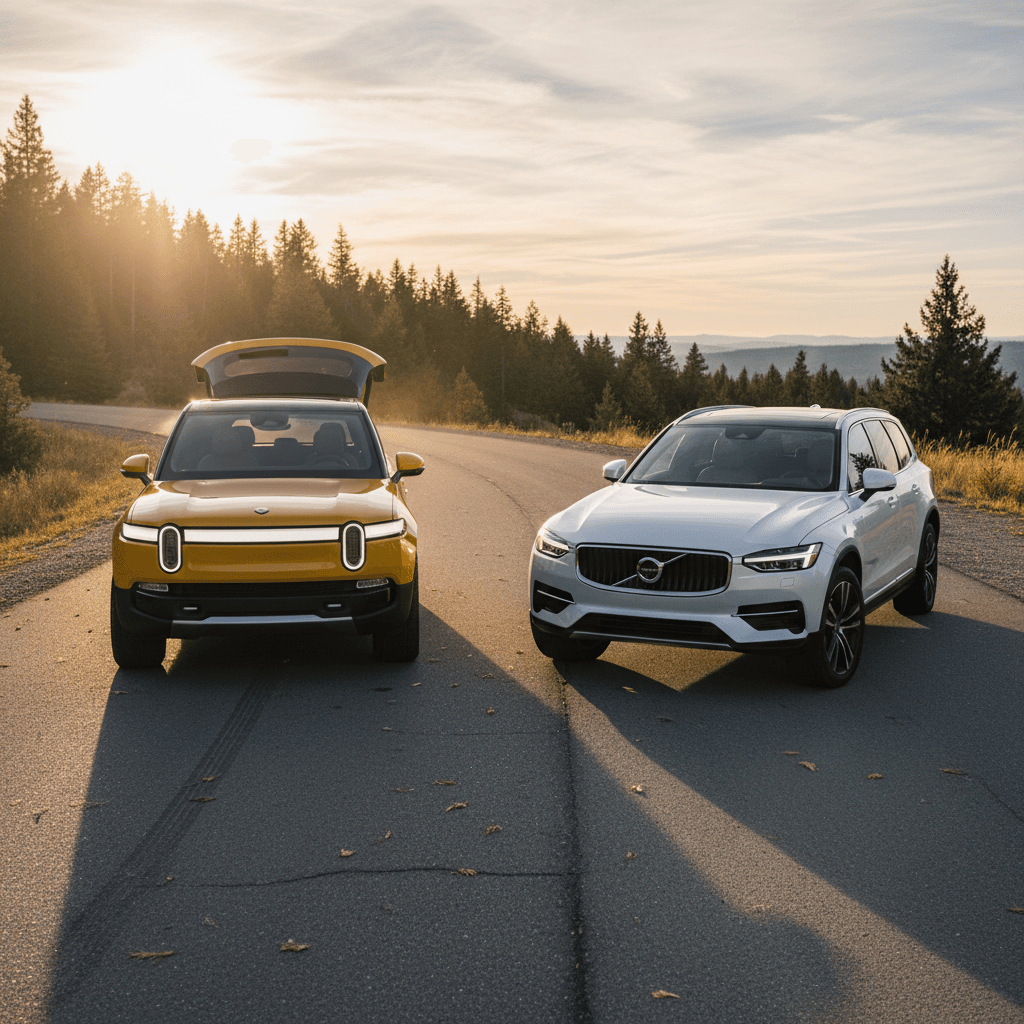
You could hardly pick two more different takes on the three‑row electric SUV than the Rivian R1S and the Volvo EX90. On paper they’re rivals, luxury, seven‑seat, all‑electric family haulers. In reality, shopping Rivian R1S vs Volvo EX90 is like choosing between a backcountry expedition and a weekend at a Nordic design hotel.
Two flagships, two philosophies
Rivian R1S vs Volvo EX90: who are these SUVs really for?
Rivian R1S: the electric Land Rover you always wanted
If your weekends involve trailheads, ski racks, and a dog that thinks mud is cologne, the R1S will speak your language. It can tow up to 7,700 lbs, has serious ground clearance with its air suspension, and in quad‑motor form will smoke sports cars to 60 mph in roughly three seconds. It feels like a native EV: skateboard platform, short overhangs, big frunk, clever storage, and software‑defined everything.
Volvo EX90: the Scandi safe room on wheels
The EX90 is arguably the spiritual successor to the XC90: calm, airy, safety‑obsessed, and family‑centric. It’s softer‑riding, quieter, and more conventionally luxurious than the Rivian. Volvo’s new platform is loaded with sensors, lidar on the roof, radar, cameras everywhere, and the cabin is a master class in minimalist design. Think less "overlanding" and more "Brooklyn school run, two violins, three car seats."
Start with your lifestyle, not the spec sheet
Quick spec comparison: Rivian R1S vs Volvo EX90
Core specs at a glance
Key headline numbers for current U.S. versions as of early 2026. Always double‑check a specific VIN’s equipment when you’re shopping, especially on the used market.
| Spec | Rivian R1S (2025–2026) | Volvo EX90 (2025–2026) |
|---|---|---|
| Seating | Up to 7 | Up to 7 |
| Battery (usable/nominal) | ~106–143 kWh packs (varies by trim) | ~111 kWh usable (approx. 111–111.5 kWh pack) |
| EPA/estimated range | ≈270–410 miles depending on pack & wheels | ≈300–360 miles depending on configuration (EPA‑style) |
| Max DC fast‑charge rate | ~200–220 kW | Up to 250 kW |
| 0–60 mph | ≈3.0–3.1 s (Quad), 4–5 s (Dual‑motor) | ≈4.5–5.7 s (Twin Performance vs base) |
| Max towing | 7,700 lbs | Up to 4,850 lbs (varies by market/trim) |
| Drive layout | Standard dual‑motor AWD; available quad‑motor AWD | Dual‑motor AWD only |
| Charging port | NACS (Rivian has transitioned in North America) | NACS from 2025+ in U.S. with adapter support during transition |
| Starting MSRP new (2025 R1S / 2025 EX90) | Around high‑$70Ks for Dual Standard, up past $100K for loaded Quad | Commonly high‑$70Ks to $80Ks+ before options in U.S. launch |
| Country of origin | USA | USA production for U.S. market (Chattanooga, TN) |
Figures are manufacturer‑quoted or EPA‑/EPA‑style estimates where available; real‑world results will vary.
Specs are moving targets
Range, battery, and charging: how far can you really go?
If you have a long commute or you’re scheming road trips, this is the section that matters. On paper, both SUVs offer enough range for typical U.S. daily driving with plenty of buffer. The differences show up on the edges: towing, winter, and 80‑mph‑with‑three‑bikes‑on‑the‑hitch highway use.
Battery and range showdown
Different philosophies on the same problem: making 6,000‑lb bricks go very far very fast.
Rivian R1S batteries & range
- Dual Standard: smaller pack, roughly mid‑200s EPA miles; best for shorter‑range, price‑sensitive buyers.
- Dual Large: around 330 miles EPA with efficient wheels, solid sweet spot for most families.
- Dual Max: up to roughly 410 miles EPA in ideal spec; the road‑trip and towing hero.
Real‑world owners often report 10–25% less at 75 mph, more in cold weather or with a trailer.
Volvo EX90 batteries & range
- Single large pack around 111 kWh usable powering all trims.
- EPA‑style estimates around 300–360 miles, depending on wheel size and performance tune.
- Volvo tends to tune for efficiency and comfort rather than drama.
Expect range to fall in line with similar‑sized luxury EV SUVs at highway speeds.
Charging speeds & road‑trip cadence
- Both support DC fast charging in the 200–250 kW neighborhood at peak.
- In good conditions, you’re looking at roughly 25–35 minutes from 10–80% on a strong DC fast charger.
- Both now use or are adopting the NACS connector in North America, opening access to Tesla’s Supercharger network over time.
The towing reality check
For everyday life, school runs, Costco missions, the occasional 200‑mile weekend trip, either SUV’s range is more than enough, especially if you can charge at home. The Rivian’s optional Max pack is overkill for many people but fantastic if your idea of a good time involves a trailer, high speeds, or high altitudes. The EX90’s single‑pack strategy feels more conservative but easier to understand: pick your wheels and trim, live in that 300‑plus‑mile window, and don’t overthink it.
Performance and driving character
On a spec sheet the R1S absolutely clobbers the EX90 in straight‑line numbers. The quad‑motor Rivian does 0–60 mph in the neighborhood of 3.0–3.1 seconds, which is absurd in a seven‑seat truck‑shaped thing. Even the dual‑motor versions are brisk. The Volvo is no slouch, the Twin Performance variant lives in the five‑second range to 60, but the character is radically different.
Rivian R1S: playful, sometimes busy
The R1S feels like a giant hot hatch on stilts. Steering is quick, body motions are well controlled, and the adaptive air suspension can hunker down on the highway or rise for off‑road. You’re always aware of the mass, but the chassis and instant torque make it hilariously capable. The flip side is that the ride can feel busier and more truck‑like than a traditional luxury SUV, especially on 22‑inch wheels.
Volvo EX90: calm, collected, less theatrical
The EX90 is tuned like a classic Volvo wagon scaled up and electrified. The steering is lighter, the brake feel more conventional, and the suspension gives you a proper luxury‑car glide. It’s not trying to entertain you in a corner; it’s trying not to wake the baby in row three. Power is ample and quiet rather than cartoonish.
Translation: which is more relaxing to drive?
Interior space, comfort, and family duty
This is where these SUVs earn, or lose, their place in your driveway. Both pack three rows, usable cargo space, and kid‑friendly touches, but the vibes are night and day.
Cabin experience: adventure loft vs Scandinavian lounge
Design & materials
R1S gives you adventure‑chic: open‑pore wood, exposed metal, and vegan or leather upholstery that feels more Patagonia than Prada. The big center screen dominates the dash, and physical controls are intentionally sparse.
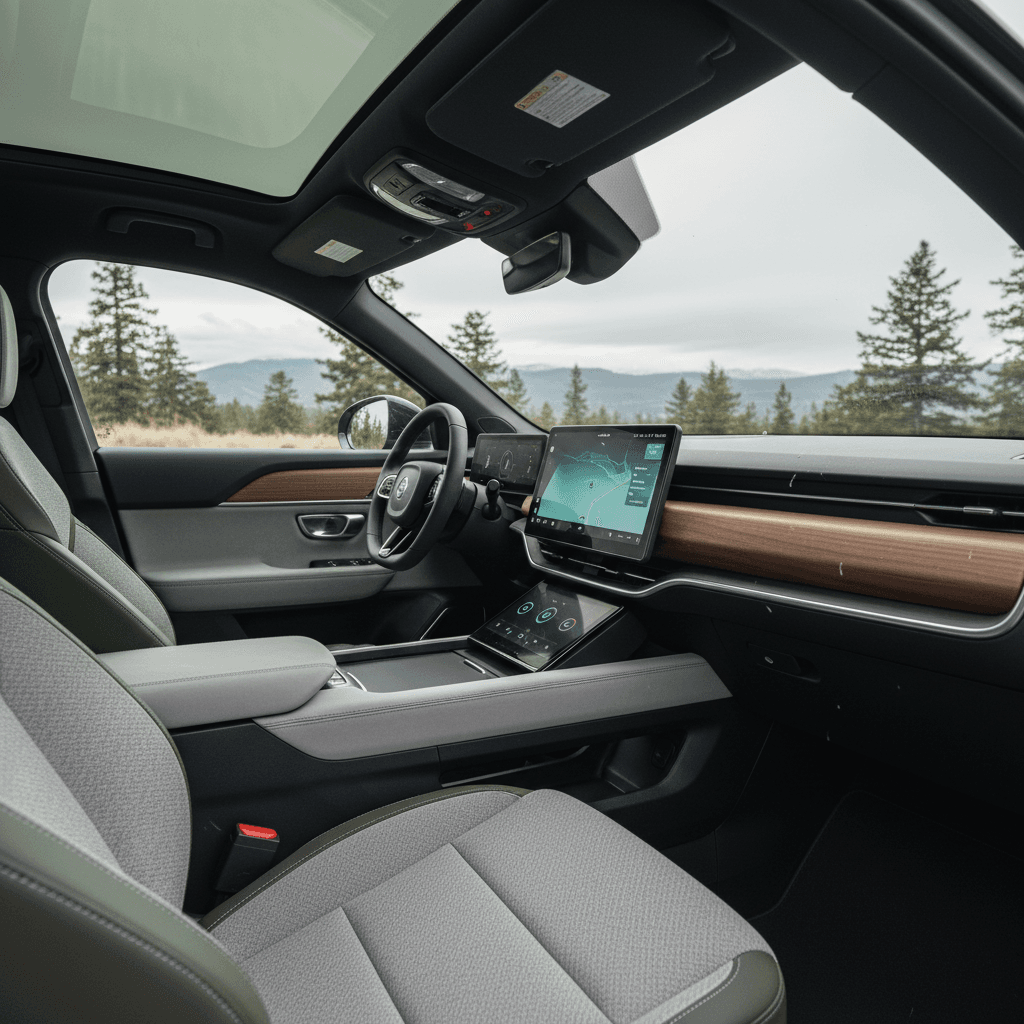
EX90 is pure Scandinavian: light colors, woven textiles, tasteful wood. The cabin feels like an upscale living room curated by someone who owns many candles and speaks softly.
3-row practicality
- Both offer three rows with adult‑survivable third rows for shorter stints.
- R1S’s boxier shape and shorter rear overhang make loading camping gear or a dog crate easy.
- EX90’s cargo area is long and low, better for strollers, luggage, and the general detritus of family life.
Noise and comfort
Multiple owners note that the EX90’s ride and sound insulation are a strong point, especially with the optional high‑end audio. The R1S is comfortable but a bit more SUV‑ish: more tire noise, more awareness of the suspension doing its thing over broken pavement.
Car‑seat reality check
Tech, safety, and driver assistance
Both SUVs are rolling computers. In the Rivian, the software is the brand, everything from suspension height to drive mode to camp‑friendly features lives behind a fun, game‑like interface. In the Volvo, the software is the butler: polite, understated, and mostly there to keep you out of trouble.
Safety and tech highlights
Volvo has staked its reputation on the EX90 as “the safest car it has ever built,” with an almost paranoid sensor suite watching both outside the car and the driver. The R1S has a robust ADAS stack too, adaptive cruise, lane‑keeping, automatic emergency braking, but the emphasis feels more on convenience and capability than lab‑coat safety research.
Software: early days on both sides
Off‑road ability and bad‑weather confidence
Here the R1S plays a home game. Quad‑motor versions can torque‑vector their way up or down practically anything you’re brave enough to aim at, and the air suspension plus underbody protection mean this is not cosplay off‑roading. The Volvo can manage dirt roads, ski‑town winters, and gravel driveways just fine, but it’s not meant to be a rock crawler or desert toy.
- Rivian R1S: multiple off‑road modes, serious approach/departure angles, standard tow hooks, a legit low‑speed control mode, and genuine all‑terrain tires available.
- Volvo EX90: all‑wheel drive traction, stability tuning, and ground clearance adequate for snow and light trails, but on street‑biased tires with less articulation and fewer off‑road toys.
Snow, ice, and storms
Pricing, trims, and ownership costs
As of early 2026, both the R1S and EX90 live firmly in luxury‑SUV money. New, you’re looking at high‑$70Ks as an entry point and six‑figure window stickers for well‑optioned, high‑performance trims. The nuances start when you compare equipment and longer‑term costs.
How the money shakes out
Upfront pricing
- Rivian R1S: Dual‑motor Standard/Large pack models generally start in the high‑$70Ks before options; Max pack and Quad‑motor pushes easily into the $90Ks and beyond.
- Volvo EX90: Launch‑year U.S. pricing has clustered in roughly the high‑$70Ks to $80Ks before adding packages like high‑end audio and climate packages.
Running costs & value
- Both benefit from low fuel and maintenance costs vs comparable gas SUVs.
- Insurance can be higher than average; these are heavy, powerful, tech‑dense EVs.
- Depreciation on early luxury EVs has been steep historically, which is painful for first owners, but creates excellent opportunities on the used market.
Leverage depreciation in your favor
New vs used: what the market looks like right now
Because both models are young, the used market is still maturing, but there are patterns. Early‑build R1S models (2022–2023) are already common on used‑EV sites, often with healthy miles and aggressive discounts compared with new. The EX90, having launched later, is just starting to appear as lightly used inventory from first‑wave adopters and buy‑backs.
Key checks when shopping used R1S or EX90
1. Verify battery and range configuration
On the R1S, battery pack and motor choice dramatically change range and performance. On the EX90, wheel size and trim matter. Don’t rely on the badge, confirm via documentation and a trusted report like the <strong>Recharged Score</strong>.
2. Look for software and hardware updates
Both SUVs are evolving quickly. Some early cars may have had hardware retrofits or significant software updates affecting driver‑assist, charging curves, or infotainment. Service records and update histories help you avoid surprises.
3. Inspect for off‑road or towing wear
A used R1S may have actually lived the adventure life. Check underbody panels, hitch receiver, suspension components, and tires. On both models, heavy towing or constant DC fast‑charging can influence long‑term battery health, another reason the battery diagnostics in a Recharged Score report are valuable.
4. Test all driver‑assist features
Spend time on a real highway test: adaptive cruise, lane‑keeping, parking aids. Glitches here can be expensive or annoying, and they’re a big part of why you’re paying luxury money.
5. Evaluate charging fit for your life
Make sure the port standard, charging speed, and included cables/adapters match how you plan to charge, especially if you rely on public fast‑charging or want to use Tesla’s Superchargers. A Recharged specialist can walk you through this in plain English.
How Recharged helps with used R1S and EX90 buys
Which should you buy: Rivian R1S or Volvo EX90?
Buy the Rivian R1S if…
- You prioritize performance and capability, towing, off‑road, big‑range road trips.
- You like expressive, slightly experimental design and don’t mind a bit more noise and firmness in exchange for fun.
- You want a truly native EV platform with clever packaging, big battery options, and a brand identity built around adventure.
- You’re okay living through the occasional software quirk in exchange for rapid new features and modes.
Buy the Volvo EX90 if…
- Your first priority is family comfort and safety, a quiet, calm cabin, world‑class crash engineering, and sophisticated driver‑monitoring.
- You prefer an understated, classic luxury feel with a softer ride and simple controls.
- You mostly do paved‑road life, commutes, school runs, road trips on interstates, not Moab.
- You like the idea of owning a Volvo flagship with a dealer and service network that already knows how to coddle busy families.
There isn’t a wrong answer here, just a better match for your reality. The Rivian R1S is the extrovert, rapid, rugged, full of personality. The Volvo EX90 is the introvert, quiet, composed, obsessively safe. If you’re still on the fence, driving both back‑to‑back and then running their VINs through a Recharged Score report is the clearest way to see which one actually fits your life, your budget, and your appetite for adventure.