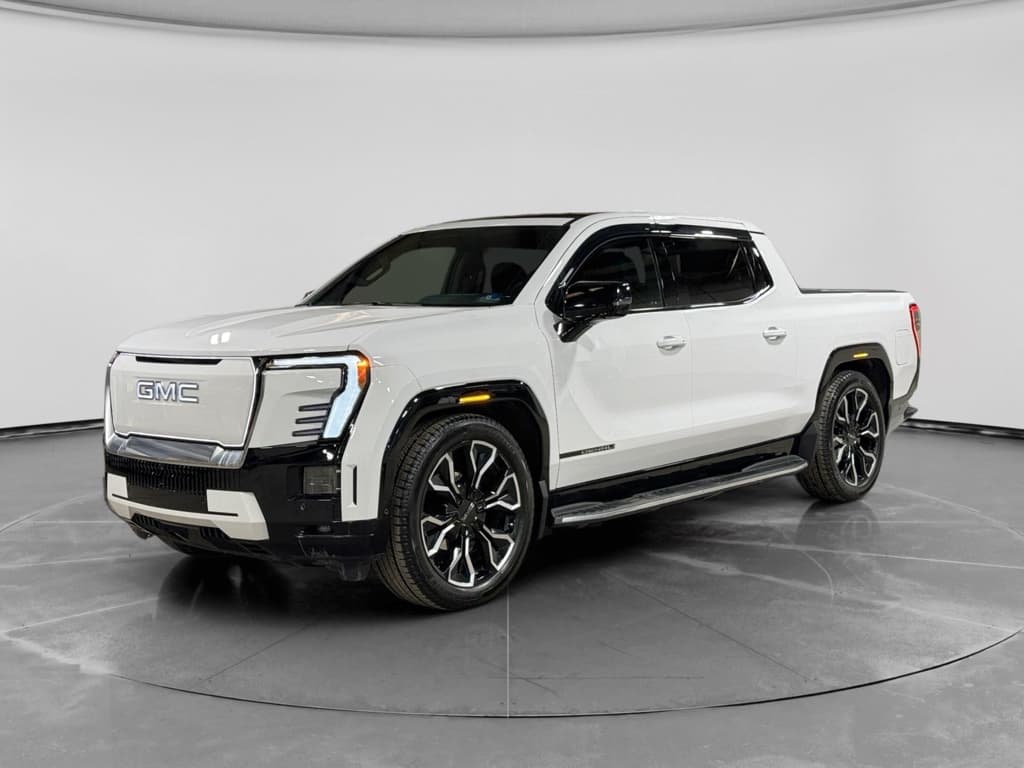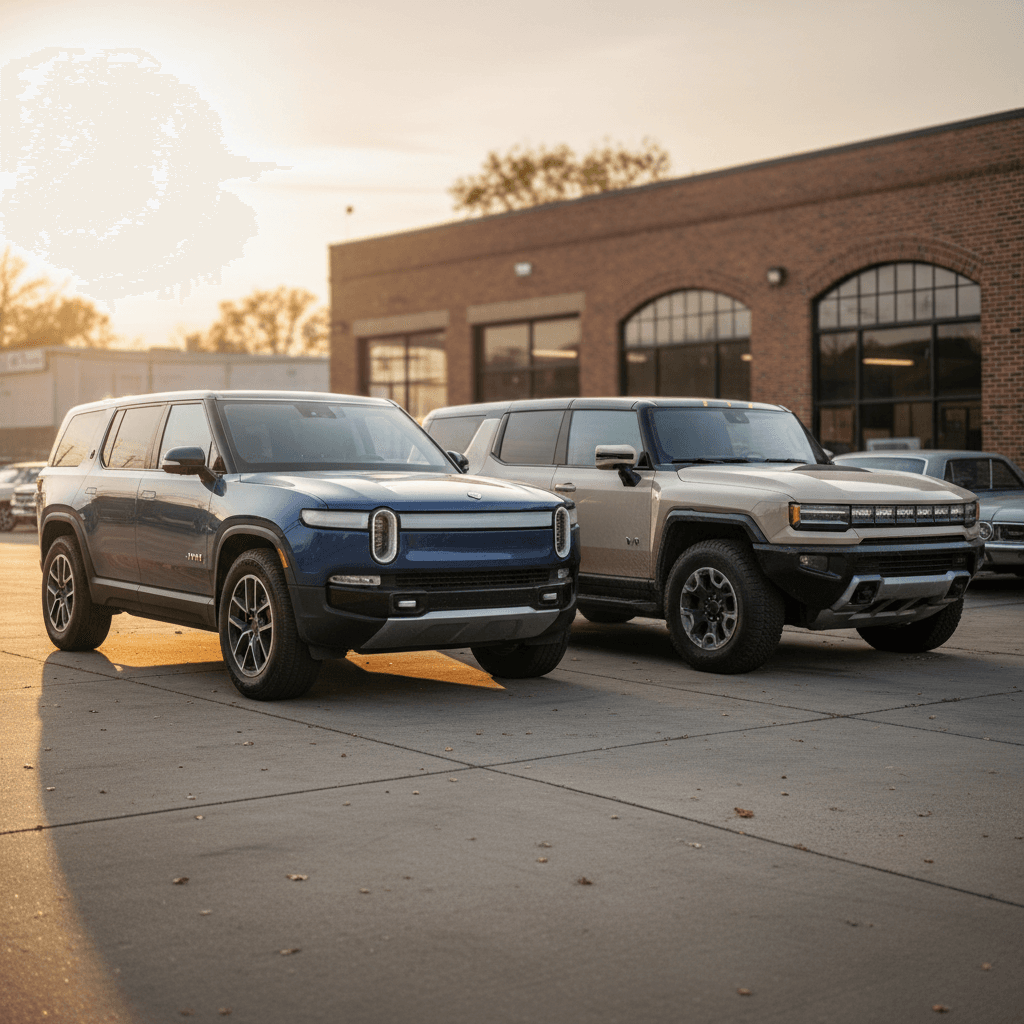
You don’t cross-shop the Rivian R1S and GMC Hummer EV SUV by accident. Both are big, bold, electric adventure rigs, but they solve very different problems. One’s a 3-row family explorer with serious off-road chops. The other is an unapologetic electric brute that turns every parking lot into a car show. If you’re stuck between these two, let’s sort out which one actually fits your life.
Two very different takes on the electric SUV
Overview: Rivian R1S vs GMC Hummer EV SUV
The Rivian R1S is a 3-row, midsize-to-large electric SUV aimed at families and outdoor enthusiasts. It offers seating for up to seven, adjustable air suspension, multiple motor configurations (dual-, tri-, and quad-motor), and some of the best real-world range in its class, up to around 410 miles in certain 2025+ dual-motor trims. It feels like a modern Land Cruiser that just happens to be electric.
The GMC Hummer EV SUV is closer to an electric supertruck with a wagon roof. It’s huge, heavy (around 9,000 pounds in some trims), seats five, and uses GM’s Ultium battery system with dual- or tri-motor setups. Expect up to roughly 315 miles of EPA range in the more efficient dual-motor versions, and about 312 miles in some tri-motor trims, depending on tires. Its real party tricks are CrabWalk four-wheel steering, a removable Infinity Roof, and outrageous off-road hardware.
Think about your parking space first
Key Specs at a Glance
Rivian R1S vs GMC Hummer EV SUV: Core Specs
High-level specs for popular configurations as of 2025–2026. Exact numbers vary by trim, wheel/tire choice, and test cycle.
| Spec | Rivian R1S (typical dual/quad configs) | GMC Hummer EV SUV (2X/3X) |
|---|---|---|
| Seating | Up to 7 (3 rows) | 5 (2 rows) |
| Max EPA range | Up to ~410 miles (Dual Max pack) | Up to ~315 miles (dual‑motor), ~312 miles (tri‑motor) |
| Battery capacity | ~135–180 kWh packs, depending on year/trim | ~170–205 kWh Ultium pack |
| Power (approx.) | ~533 hp (dual) to 1,025 hp (quad) | ~570 hp (dual) to ~830 hp (tri‑motor) |
| 0–60 mph (best trims) | As quick as ~2.5–3.0 seconds | Around 3.4–3.5 seconds |
| Towing capacity | Up to 7,700 lbs | Expected around 8,000–10,000+ lbs (varies by trim) |
| Curb weight | Roughly 6,500–7,000 lbs, depending on pack/motors | Around 8,600–9,000 lbs, depending on trim |
| Ground clearance | Up to ~14–15 inches with air suspension | Up to ~16 inches in Extract/Off‑Road modes |
| Starting MSRP (new, recent model years) | High‑$70Ks for base dual‑motor, well into six figures for top quad‑motor trims | High‑$90Ks and up, easily into six figures for 3X tri‑motor and options |
Always verify final specs for the exact model year and trim you’re shopping, especially in the fast‑moving EV world.
Specs change fast
Range, Efficiency & Charging Experience
Range and efficiency are where the Rivian R1S and GMC Hummer EV SUV split paths. Rivian leans into usable road‑trip range; the Hummer leans into shock and awe.
Real-World Range & Efficiency
How far they go, and how hungry they are doing it.
Rivian R1S: Road-trip ready
Depending on year and configuration, the R1S offers:
- Approx. 270–410 miles of EPA range across packs and motors.
- Generally better efficiency than the Hummer, owners often see 2.1–2.6 mi/kWh in mixed driving when driven reasonably.
- Lower monthly charging cost than the Hummer by a noticeable margin.
It’s still a big, heavy SUV, but it behaves more like a long‑legged family cruiser than a rolling brick.
GMC Hummer EV SUV: Big battery, big appetite
The Hummer EV SUV fights physics with a massive battery and wild aero:
- EPA ranges typically in the 280–315 mile neighborhood, depending on trim and tires.
- Real‑world efficiency can dip to around 1.5–1.8 mi/kWh in mixed use, among the lowest of any EV SUV.
- That huge Ultium pack can mask the inefficiency, but your energy use (and charging cost) will be noticeably higher.
If you’re stepping out of a full‑size gas SUV, it’s still a giant leap forward. Compared with other EVs, it’s a thirsty giant.
Charging networks and connectors
On DC fast charging, the Hummer EV SUV can hit peak rates around 300–350 kW on an 800‑volt section of its pack, adding roughly 100 miles in about 10 minutes under ideal conditions. The R1S typically peaks lower, but compensates with better efficiency, so you often need fewer kilowatt‑hours to travel the same distance.
Heavy EVs punish weak charging
Performance, Ride & Driving Character
Headline Performance Numbers (Best Trims
From behind the wheel, these SUVs feel radically different. The Rivian R1S, especially in dual‑motor or updated quad‑motor form, is quick, composed, and surprisingly easy to drive in tight spaces. Steering is light but accurate, and the adjustable air suspension can smooth out potholes or firm up for canyon roads. It still feels big, but you settle into it quickly.
The GMC Hummer EV SUV is equal parts theme park ride and luxury barge. Tri‑motor versions launch with drama, and the weight never truly disappears, you’re always aware you’re piloting something massive. Four‑wheel steering helps shrink its turning circle, and the ride can be plush, but narrow city streets and parking garages can feel intimidating.
Noise and refinement
Off-Road Capability: Tech Toys vs Trail Tools
Both the Rivian R1S and Hummer EV SUV were built with trails in mind, but they approach off‑roading with different personalities.
Rivian R1S: Thoughtful adventure rig
- Up to roughly 14–15 inches of ground clearance with air suspension cranked up.
- Dual-, tri-, or quad‑motor torque vectoring gives precise control on loose surfaces.
- Multiple off‑road drive modes, including rock crawl, sand, and all‑purpose, with easy on‑screen adjustments.
- Excellent approach/breakover/departure angles for an SUV with three rows.
- Strong water fording capability and hill‑descent control.
It feels like a highly capable overland SUV you could daily drive in the suburbs without drama.
GMC Hummer EV SUV: Cartoonishly capable bruiser
- Up to 16 inches of ground clearance and dramatic "Extract" modes in some trims.
- CrabWalk four‑wheel steering for diagonal moves out of tight obstacles.
- Available 35‑inch mud‑terrain tires, locking differentials, heavy skid plates, and Ultravision off‑road camera views.
- Approach/breakover/departure angles rival hardcore off‑road icons.
- Super‑low‑speed torque makes crawling over boulders feel effortless.
If you want an electric SUV that looks at Moab and laughs, this is it. Just be ready to thread a needle in tight tree tunnels.
Off-road range reality check
Space, Utility & Everyday Comfort
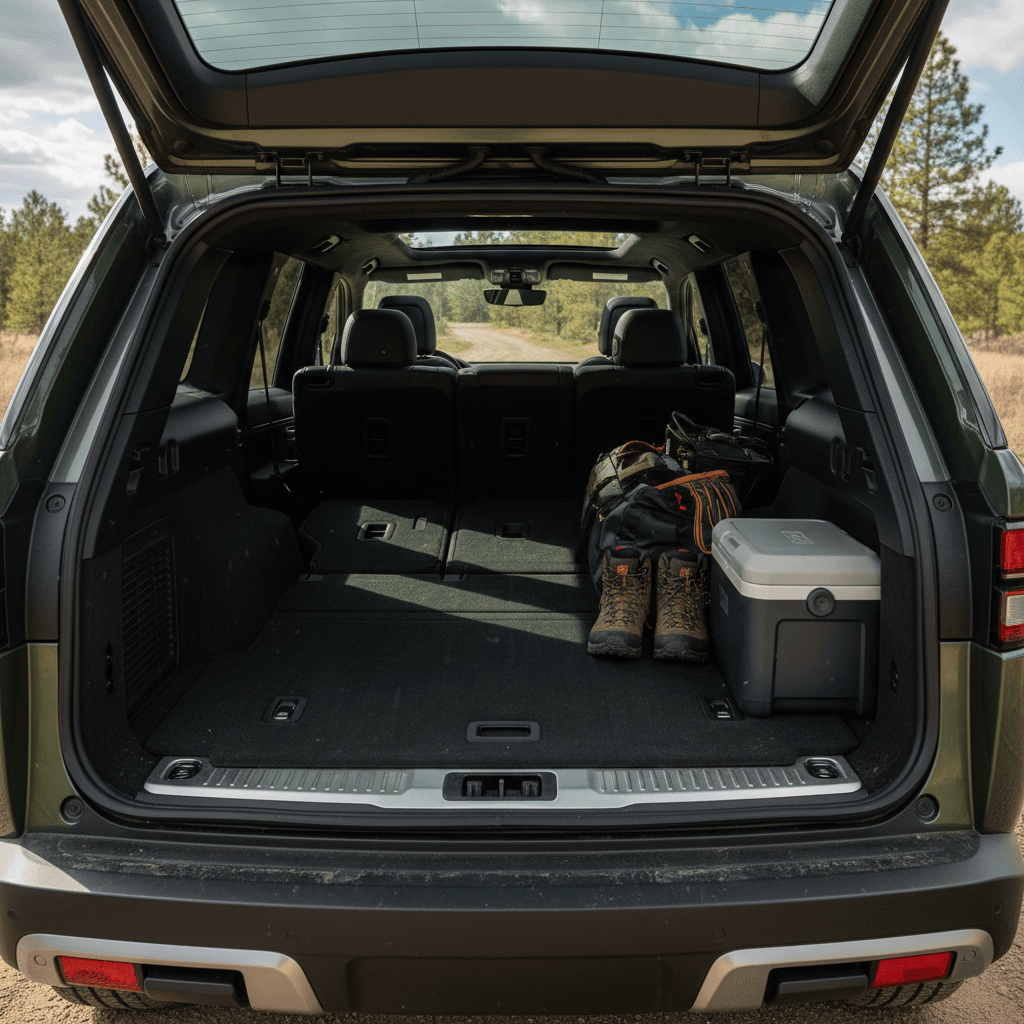
Interior Space & Cargo: Who Carries What?
A 3-row family hauler versus a 2-row electric super-SUV.
Rivian R1S: Seats seven, flexes like a wagon
- Standard 3-row seating, with a usable (if cozy) third row for kids or occasional adults.
- With all rear seats folded, you get a flat, long cargo floor and over 100 cubic feet of total cargo volume in early models.
- Power tailgate, under‑floor storage bin, and a useful front trunk (frunk) make road‑trip packing easy.
- Cabin design is warm and upscale, with big windows and good outward visibility.
GMC Hummer EV SUV: Lounge for five
- Two-row, five-passenger layout only, no third row.
- Individual seats offer generous space; front and second-row legroom and headroom are excellent.
- Plenty of cargo room with the second row folded; less total volume than a 3-row R1S, but still generous.
- Infinity Roof with removable panels turns it into an open‑air cruiser, as long as you’ve got somewhere to store those panels.
If you’ve got more than two kids, carpools, or regular multi‑generation road trips, the R1S’s third row is the tiebreaker. If it’s usually just you and a couple of friends, or you want the electric equivalent of a luxury desert toy, the Hummer EV SUV’s five-seat layout won’t be a dealbreaker.
Car seats and real life
Tech, Safety & Driver Assistance
Rivian R1S technology
- Minimalist interior with two large screens handling nearly all controls.
- Rivian’s Driver+ advanced driver assistance system, with adaptive cruise, lane centering, and more, improving via over‑the‑air updates.
- Native navigation focused on charging stops and adventure destinations.
- No Apple CarPlay or Android Auto as of early 2026, so you live in Rivian’s software world.
Think of it as a clean, modern tech experience that still has a few rough edges in menus and learning curve.
GMC Hummer EV SUV technology
- Bold, squared‑off dashboard with 13.4‑inch center touchscreen and 12.3‑inch digital cluster.
- Available Super Cruise hands‑free driving on hundreds of thousands of mapped highway miles.
- Ultravision camera system with multiple off‑road views, great for rock crawling and tight parking.
- Full support for Apple CarPlay and Android Auto in many trims.
The Hummer feels like a tech showcase, especially if you value Super Cruise and smartphone mirroring.
Safety and crash structure
Ownership Costs, Incentives & Practicality
Neither of these SUVs is a budget choice. But the way they burn through dollars, and electrons, is different.
Cost & Practicality Checklist
1. Upfront price
New or nearly new, the Hummer EV SUV tends to sit at the higher end of the price spectrum, especially in 3X tri‑motor form with options. Rivian R1S pricing also climbs quickly in high‑performance trims, but some dual‑motor and earlier builds may undercut similarly equipped Hummers on the used market.
2. Energy use and monthly costs
Because the Rivian is more efficient, your monthly electricity bill for the same miles will usually be lower than in a Hummer EV SUV. In regions with high electricity rates, this difference adds up quickly over a few years.
3. Tires, brakes, and wear items
Both are heavy, powerful EVs. Expect to pay real money for quality tires, especially off‑road or 22‑inch performance rubber. The heavier Hummer will be harder on consumables if you drive it aggressively.
4. Insurance and repairs
High purchase prices, advanced driver-assistance hardware, and big body panels mean insurance and collision repairs won’t be cheap for either SUV. Rivian’s newer service network may mean longer trips to a service center in some areas; GMC dealers are easier to find, but not all are yet EV‑savvy.
5. Tax credits and used incentives
Eligibility for federal tax credits or used‑EV incentives changes often and can depend on where the vehicle was built, price caps, and your income. When you shop a used R1S or Hummer EV SUV, have a dealer or tax professional confirm which credits apply before you factor them into your budget.
Used EV sweet spot
Which EV SUV Is Right for You?
Rivian R1S vs GMC Hummer EV SUV: Buyer Profiles
Match your lifestyle to the right electric beast.
Choose the Rivian R1S if…
- You need three rows and regularly haul kids, friends, or dogs and camping gear.
- Range and efficiency matter, you do long highway trips or live far from fast charging.
- You want serious off‑road ability without giving up everyday maneuverability.
- You prefer a cleaner, more understated design that still feels special.
- You’re willing to live inside Rivian’s software ecosystem without CarPlay or Android Auto.
Choose the GMC Hummer EV SUV if…
- You want an EV that makes a statement every time you pull up to a trailhead or valet stand.
- You care more about presence and capability than squeezing every mile out of a kilowatt-hour.
- You’ll actually use features like CrabWalk, Ultravision off‑road cameras, and removable roof panels.
- You mostly carry 1–4 passengers and don’t need a third row.
- You like having Super Cruise and full smartphone integration in a GM ecosystem.
The short version
Shopping a Used R1S or Hummer EV SUV with Recharged
Shopping either of these SUVs used raises very smart questions: How’s the battery holding up? Has it lived a hard off‑road life? Is the price fair for this exact spec and software level? That’s where buying through Recharged can remove a lot of the guesswork.
How Recharged Helps with Big EV SUVs
Extra confidence when you’re buying a six‑figure electric toy, or family hauler.
Verified battery health
Fair market pricing
EV‑specialist guidance
Ready to find your next EV?
Browse VehiclesWhether you end up in a Rivian R1S or a GMC Hummer EV SUV, you’re buying more than basic transportation, you’re buying a rolling manifesto about how you want to move through the world. The key is matching that statement to your daily reality: school runs or slickrock trails, tight garages or wide‑open desert. Take the time to be honest about what you’ll really do with your EV SUV, then let solid data, battery health, range, and true total cost of ownership, steer the final choice.