If you’re eyeing a Rivian R1S for boats, campers, or toys, you probably have two big questions: how much can it tow, and how much range you lose while towing. On paper the R1S is a 7,700‑lb towing monster, but hook up a trailer and your real‑world range can drop by half or more. This guide breaks down Rivian R1S towing capacity and range loss in plain English, so you can plan trips confidently instead of white‑knuckling it between chargers.
At a glance
Rivian R1S towing capacity: the quick answer
Core Rivian R1S towing numbers
The short version: the Rivian R1S is rated to tow up to 7,700 pounds (about 3,500 kg) when equipped with a weight‑distributing hitch. That rating applies across trims and battery packs for the current generation of R1S; it’s one of the higher tow ratings among electric SUVs, and it even compares well with many midsize gas SUVs.
There are two numbers to pay attention to:
- 7,700 lbs max trailer weight – the most you should tow with a properly set up weight‑distributing hitch.
- 5,000 lbs without a weight‑distributing hitch – Rivian limits you to around this figure if you’re just using a standard hitch setup, largely for stability and control reasons rather than raw power.
Don’t ignore the fine print
Key Rivian R1S specs that matter when towing
The specs that actually matter for towing
Beyond the marketing headline, these numbers drive real‑world capability.
Power & torque
Battery size
Curb weight & GVWR
Compared with the R1T pickup, the R1S gives up a bit of ultimate towing headroom but keeps the same 7,700‑lb rating most owners will ever use. You’re trading open‑bed practicality for a three‑row family SUV that can still handle a serious camper.
How it compares to other EVs
How much range you actually lose towing an R1S
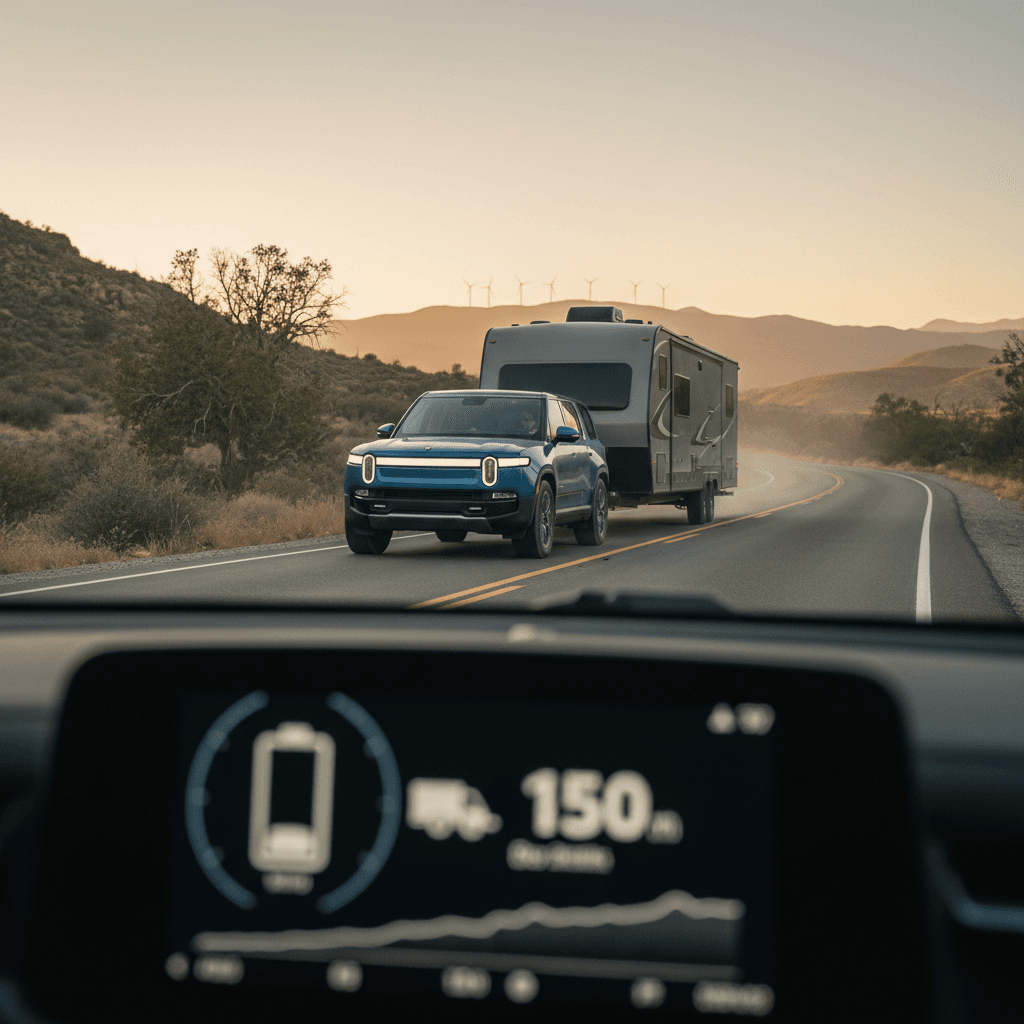
This is where owning an electric tow vehicle feels very different from a gas truck. The R1S has excellent power, but a trailer is a brick in the wind. Aerodynamics and speed dominate, and the result is that most owners see roughly 40–60% range loss on the highway when towing a travel trailer.
Typical Rivian R1S towing range loss scenarios
Approximate one‑way highway range at 65 mph in mild weather, starting from an EPA rating of ~350–400 miles for a large or Max‑pack R1S. These are ballpark numbers, not guarantees.
| Trailer type & weight | Example setup | Approx. efficiency (mi/kWh) | Effective highway range | Approx. range loss vs. empty |
|---|---|---|---|---|
| Small utility trailer (1,000–1,500 lbs) | Open trailer with bikes, cargo box, or small mower | 1.6–1.8 | ≈ 220–260 miles | ~25–35% |
| Pop‑up or teardrop camper (2,000–3,000 lbs) | Low‑profile, narrower than R1S roofline | 1.3–1.5 | ≈ 180–220 miles | ~35–45% |
| Mid‑size travel trailer (4,000–5,500 lbs) | 20–24 ft boxy camper, similar height to R1S | 0.9–1.2 | ≈ 120–170 miles | ~50–60% |
| Large, tall travel trailer (6,000–7,500 lbs) | 25–30 ft box with big frontal area | 0.7–0.9 | ≈ 90–130 miles | ~60–70% |
Real‑world towing range is driven more by trailer shape and speed than by the exact Rivian trim.
Why trailers annihilate EV range
What owners actually report
Across early Rivian tow reports, it’s common to see roughly half the normal range when towing a 20–25 ft camper. Numbers around 1.0–1.3 mi/kWh at 60–70 mph keep popping up, which lines up with the mid‑size trailer row in the table.
Drop down to a small pop‑up, teardrop, or light utility trailer and you can keep more like 60–75% of your normal range, especially if you stay closer to 60 mph.
Why Rivian’s estimate screen can be optimistic
Rivian’s trailer mode lets you enter trailer type and weight, and it does adjust the range estimate. But owners regularly report that the truck is more optimistic than reality, especially with boxy campers and higher speeds.
Treat the on‑screen estimate as a best‑case scenario. Build in an extra 20–30% buffer until you have a few trips of your own data to work from.
Don’t plan around the EPA number
Battery pack, wheels, and drive modes: how they change towing range
Not every R1S is the same under the skin. Over the first generation Rivian added Standard, Large, and Max battery packs and multiple motor configurations. The tow rating stayed the same, but your usable range with a trailer can swing a lot depending on spec.
How different R1S configurations affect towing
Same 7,700‑lb rating, very different real‑world range and comfort.
Standard pack R1S
Large pack R1S
Max pack R1S
Wheels and tires matter, too. The off‑road‑oriented 20‑inch wheel/tire packages look great and work brilliantly on rough roads, but they’re less efficient at highway speeds than the street‑biased 21‑ or 22‑inch setups. If your priority is towing range, lean toward the more efficient wheel and tire combinations.
Use the right drive mode when towing
Planning road trips in a Rivian R1S with a trailer
If you’re used to towing with a gas half‑ton, your instinct is probably to fill up whenever convenient and keep rolling. With an electric tow rig like the R1S, the game changes: you’re planning around fast chargers and charge curves, not just exits with diesel pumps.
Step‑by‑step trip planning with a trailer
1. Start with conservative range assumptions
For your first long tow, assume <strong>50–60% of your solo highway range</strong> with a mid‑size travel trailer, and 60–75% with a small teardrop or utility trailer.
2. Use EV‑aware route planners
Tools like A Better Routeplanner, PlugShare, or Rivian’s built‑in navigation can help you string together DC fast chargers that are <strong>pull‑through or have trailer‑friendly layouts</strong>.
3. Keep charge stops in the sweet spot
Plan to arrive at chargers around <strong>10–20% state of charge</strong> and charge back up to about <strong>60–80%</strong>. The R1S, like most EVs, charges fastest in the middle of the pack.
4. Build in weather and terrain buffer
High winds, cold temperatures, and long climbs can all cut range. Add at least <strong>20% buffer</strong> beyond what your planner says for unfamiliar routes.
5. Think about charger access with a trailer
Some stations are easy to pull through with a trailer; others require you to <strong>unhitch in the parking lot</strong>. Scout ahead on maps and user photos so you’re not improvising at 2 a.m.
6. Do a shakedown run close to home
Before a big trip, take a shorter weekend tow on familiar roads. Note your <strong>mi/kWh at different speeds</strong>, that data is gold for future planning.
Where the R1S shines for towing trips
Towing safety, hitches, and loading best practices
Torque and battery capacity get all the attention, but if you’re using the Rivian R1S as a family tow vehicle, safety and setup matter just as much. The best‑planned charging strategy won’t help if your trailer is swaying in crosswinds.
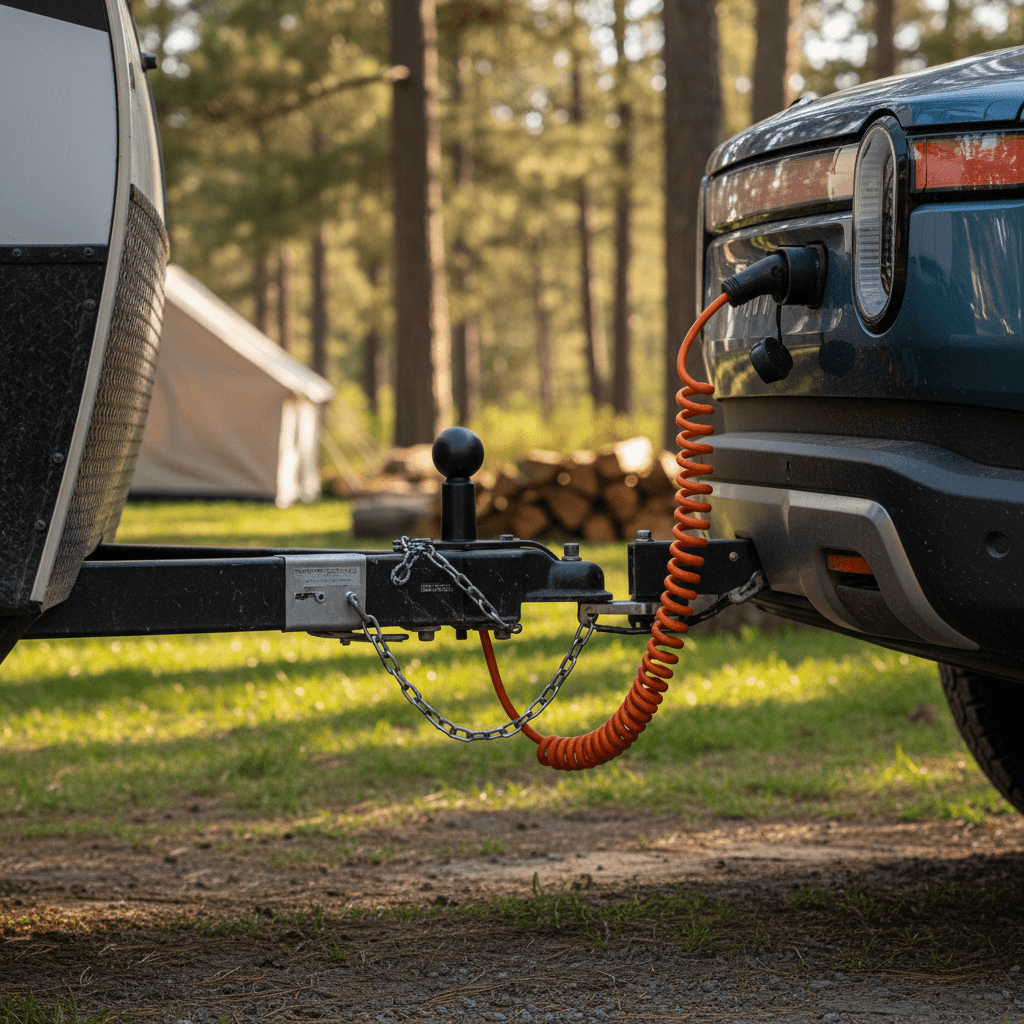
- Use a weight‑distributing hitch for heavy trailers. Rivian’s 7,700‑lb tow rating assumes you’re using one. It shifts some tongue weight back onto the R1S’s front axle, improving steering and braking feel.
- Target ~10% tongue weight. Too little weight on the hitch is a recipe for sway; too much can overload the rear axle and suspension. As a rule of thumb, aim for roughly 10%, so about 500–700 lbs on the hitch with a heavy trailer, staying within Rivian’s limits.
- Balance your load front to back and side to side. Stack firewood and gear just ahead of the trailer axle, not all the way at the rear. Uneven or rear‑heavy loading exaggerates sway and makes the R1S work harder.
- Check your tire pressures religiously. Underinflated tires on either the R1S or trailer increase heat, rolling resistance, and stopping distances. Verify pressures before every long tow day.
- Let the R1S help you. Use Trailer Mode so the truck adjusts its stability control, blind‑spot monitoring, and ride height for towing. The system can apply individual brakes to counter developing sway.
Near the limit? Consider a smaller trailer
Does towing hurt Rivian R1S battery health?
A common worry with any EV tow rig is whether pulling heavy loads will accelerate battery degradation. The physics are straightforward: towing pulls more power from the pack, especially at highway speeds and up long grades. That means more heat and more time at higher charge rates, both things that can, in theory, age a pack faster.
What matters most for pack longevity
- Average state of charge – Living between about 10–80% is easier on the pack than constant 100% charges.
- Temperature – Rivian’s thermal management is robust, but constant heavy towing in extreme heat can keep the pack warmer.
- Charge behavior – Rapidly DC‑fast‑charging from 5–90% multiple times a day is tougher on cells than slower home charging.
How to tow without abusing the battery
- For big trips, precondition the battery on the way to fast chargers so they’re efficient and shorter.
- Try to arrive around 10–20% and leave once you’ve got the range you need, often around 60–80%, not 100%.
- At home, plug into Level 2 and let the R1S charge more gently overnight instead of relying on public DC fast charging every time.
Good news for used‑R1S buyers
Buying a used Rivian R1S for towing: checklist
If you’re shopping the used market, the Rivian R1S is especially attractive: early depreciation plus serious capability. But if you plan to tow, you’ll want a bit more diligence than a typical test drive around the block.
Key checks for a used Rivian R1S tow rig
Confirm factory tow package & hitch condition
Make sure the R1S has the <strong>factory tow package</strong>, not just an aftermarket receiver. Inspect the hitch, wiring, and safety‑chain points for rust, damage, or signs of overloading.
Review battery health, not just EPA range
Ask for a <strong>third‑party battery health report</strong> like the Recharged Score, or at least check for unusually low displayed range at 100% compared with the original EPA figure.
Inspect tires and suspension components
Uneven tire wear, tired dampers, or bushing play can make towing feel sloppy. A vehicle that’s done a lot of heavy towing but never had an alignment can show its history in the tread.
Drive it at highway speed
On your test drive, include a stretch of highway. Listen for vibration, wind noise, or steering vagueness. A solid R1S should feel rock‑steady up to freeway speeds.
Ask how it was used
There’s a big difference between occasional boat‑ramp duty and full‑time cross‑country camper hauling. An honest conversation with the seller about use, charging habits, and storage pays off.
Leverage experts
Buying through a specialist like <strong>Recharged</strong> means the vehicle already has a verified <strong>Recharged Score battery health report</strong>, fair‑market pricing, and EV‑savvy advisors who understand how towing impacts ownership. That’s especially valuable if you’re new to EVs.
FAQ: Rivian R1S towing capacity and range loss
Common questions about Rivian R1S towing
Bottom line: is the Rivian R1S good for towing?
If your idea of a good weekend is loading up kids, bikes, and a camper, the Rivian R1S is one of the most capable electric SUVs you can buy. Its 7,700‑lb tow rating, rock‑solid road manners, and quiet, torque‑rich powertrain make it feel more like a high‑end truck than a traditional three‑row crossover. The trade‑off is range: expect 40–60% range loss with a typical travel trailer, and build your trips around reliable fast‑charging stops rather than gas stations.
If that sounds like a worthwhile trade, the next step is finding the right R1S and getting honest about your trailer and travel patterns. A carefully chosen battery pack, sensible trailer size, and thoughtful planning turn the R1S into a remarkably capable, low‑stress electric tow rig. And if you’re shopping used, Recharged can help you compare R1S listings with verified battery health reports, transparent pricing, and EV‑savvy guidance so you end up with an SUV that fits both your driveway and your favorite campsite.