If you’re looking at a Rivian R1S road trip review, you’re probably asking a simple question: can this big, electric adventure SUV really replace a gas family hauler when you’re driving 300, 600, even 1,000 miles in a day? The short answer is yes, if you understand its range, charging quirks, and how to plan around them.
At a glance
Who this Rivian R1S road trip review is for
- Drivers cross-shopping a Rivian R1S against large gas SUVs (Tahoe, Sequoia, XC90) and wondering how an EV changes road trips.
- New R1S owners planning their first long highway drive and trying to set realistic expectations about range and charging time.
- Shoppers considering a used Rivian R1S and wanting to know how to evaluate battery health and road-trip readiness.
This review focuses on what the R1S is like on real highways at real speeds, with people, luggage, and sometimes bad weather, then connects that to what you should look for if you’re buying one used, especially through a marketplace like Recharged where battery health and road-trip suitability really matter.
Rivian R1S batteries, range and what the numbers really mean
Rivian has offered several battery packs in the R1S, and they matter a lot more on a road trip than they do around town. In simple terms, think of them as Standard, Standard+, Large, and Max, with newer “Gen 2” packs bringing efficiency gains and faster charging.
Rivian R1S battery options and road trip implications
Approximate EPA ranges and what they feel like at 70–75 mph in good conditions, without towing.
| Pack | EPA range (best case) | Highway comfort zone* | Best use case |
|---|---|---|---|
| Standard | ~260 miles | 140–180 miles between fast charges | Regional trips, lighter loads |
| Standard+ | ~315 miles | 170–210 miles | Good all-rounder |
| Large | ~321–352 miles | 190–230 miles | Frequent road trips with family |
| Max | Up to ~400 miles | 230–270 miles | Longest legs, towing, or harsh climates |
These are ballpark figures; your actual range will vary with speed, weather, elevation, wheels, and tires.
About that "comfort zone"
Rivian R1S long-distance performance by the numbers
Real-world Rivian R1S road trip experiences
Laboratory numbers are useful, but what matters is how an R1S behaves with you, your family, and your weekend gear on real roads.
What owners report on long highway runs
- Big-trip capable: Owners have documented 1,500–2,200 mile trips in the R1S, calling it more comfortable and less fatiguing than many luxury gas SUVs.
- Fewer stops than some smaller EVs: Thanks to the big battery, drivers often need fewer charging stops than they did in smaller crossovers like the Model Y, especially with the Max pack.
- Planning still matters: Compared with a gas SUV, road trips take more forethought. You’ll plan A and B charging options and think about weather and elevation.
Where expectations need adjusting
- Cold weather hits hard: In sub‑freezing conditions at highway speeds, it’s not unusual to see 30–40% range loss, more with headwinds or a roof box.
- Charging adds time, not drama: On a 6‑hour ICE trip, an R1S might turn it into 7–7.5 hours with one or two 30–40 minute fast-charge stops, time you typically use for food and rest anyway.
- Network quality varies: A great trip can be made annoying by a single slow or broken charger. Having access to multiple networks is key, and the R1S does that well.
Use real trip reports as your baseline
Charging on the road: Rivian Adventure Network, Tesla and more
On a road trip, charging is your new fuel stop. The good news is that the R1S plays well with almost every major DC fast-charging network, and newer models can also use Tesla Superchargers with a NACS port or adapter.
Your main charging options in a Rivian R1S
Think of these as overlapping safety nets rather than a single lifeline.
Rivian Adventure Network
Rivian’s own DC fast chargers, often placed near outdoor destinations and along popular routes.
- High-power hardware, typically well-maintained.
- Optimized for R1T/R1S charging curves.
- Best experience when they line up with your route.
Major public fast chargers
Electrify America, EVgo, ChargePoint and others.
- Great coverage along interstates and in metro areas.
- Power levels vary by site (150–350 kW).
- App and card issues do happen, have accounts set up before you leave.
Tesla Superchargers
With NACS access or adapter, the R1S can use select Superchargers.
- Opens up thousands of additional highway charging stalls.
- Reliability and ease-of-use are generally excellent.
- Not every site or stall may support non‑Teslas, so always check in advance.
Don’t rely on a single network
Comfort, cargo and driving experience on long trips
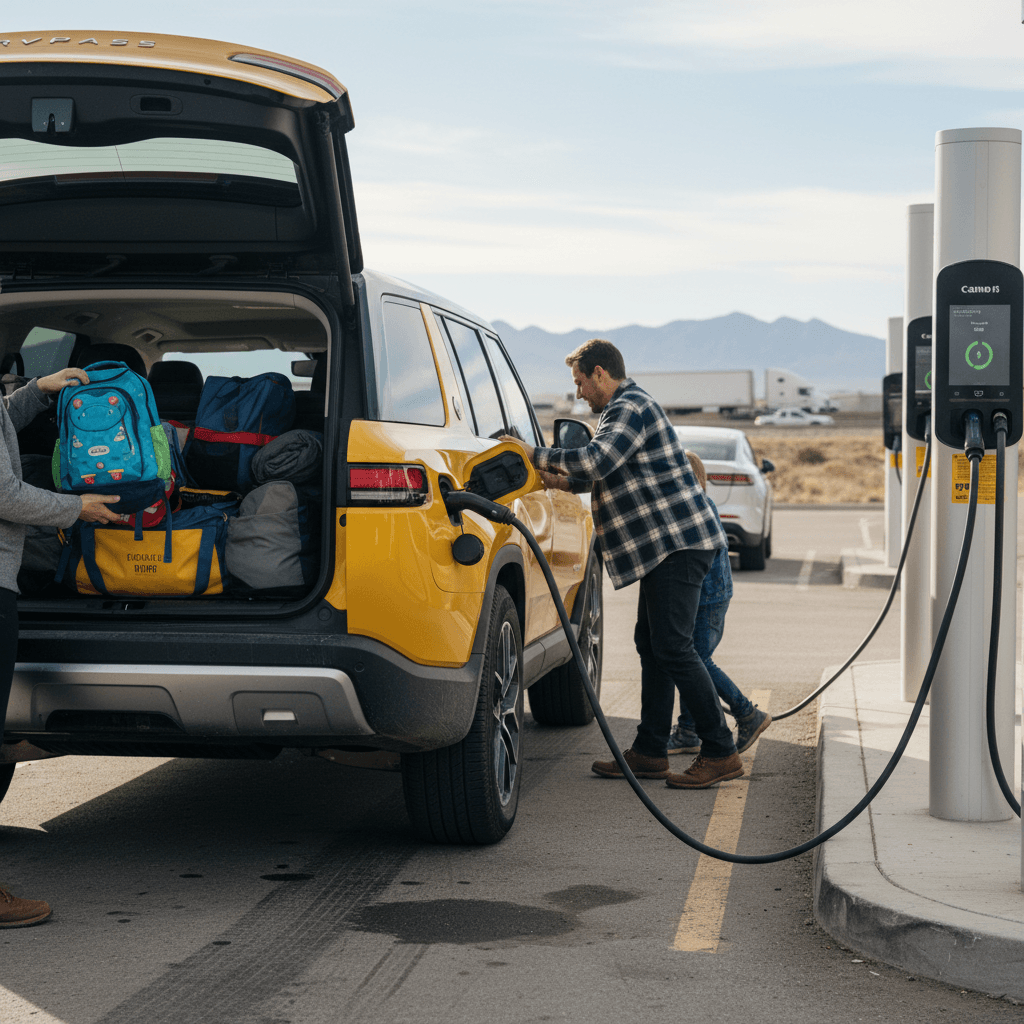
If you’re going to add charging stops to your travel day, the trade needs to be comfort. In that respect, the R1S earns its keep.
- Seating and space: The R1S offers three rows and a surprisingly comfortable second row for adults. The third row is kid‑friendly and serviceable for adults on shorter stints.
- Cargo room: With all seats up, you still get respectable cargo space plus a large frunk. Fold the third row and it turns into a genuinely capable gear hauler for camping or ski trips.
- Ride and noise: Air suspension and a stiff body structure mean the R1S feels composed at 75 mph. It’s quieter than many gas SUVs, with mostly wind and tire noise at speed.
- Driver assistance: Rivian’s Driver+ system can take the edge off long highway stretches, but like most systems, it’s not perfect. Think of it as a way to reduce fatigue, not a self‑driving solution.
Where the R1S beats many gas SUVs
Planning a road trip in a Rivian R1S: step-by-step
Step-by-step R1S road trip game plan
1. Start with honest range assumptions
Look up your exact R1S year, battery pack, wheel size, and tires. For a first trip, plan legs using roughly 60–65% of EPA range in mild weather, and 50% in deep winter or high speeds.
2. Use built-in navigation as your baseline
Rivian’s nav will route you through compatible fast chargers and estimate arrival state of charge. Let it build the skeleton of your trip, then cross‑check with third‑party apps for backup options.
3. Anchor stops around natural breaks
Plan main fast‑charging stops around meals and longer rest breaks. A 25–35 minute stop feels far less intrusive when you’re already stretching, walking the dog, or ordering food.
4. Precondition for fast charging
Use the truck’s built-in battery preconditioning (especially after recent software updates) so the pack is warm and ready when you arrive at a DC fast charger. This can significantly improve speeds, particularly in cold weather.
5. Book lodging with Level 2 charging
An overnight Level 2 charge at your destination can reset your road trip day to 100% by morning. Many hotels and rentals now list EV charging as an amenity, filter for it when you book.
6. Have backup plans on sparse routes
In remote areas, always identify at least one alternative fast charger and, if possible, a slower Level 2 option (campgrounds, RV parks, dealerships) in case your first choice is busy or down.
Let the R1S do some of the work
How weather, speed and tires affect R1S road trip range
The R1S is a big, boxy SUV with serious off‑road chops. That’s part of its appeal, but it also means it’s more sensitive than a sleek sedan to conditions that hurt aerodynamics and efficiency.
Key factors that change your Rivian R1S road trip range
Most R1S owners can avoid surprises by understanding these three levers.
Temperature
Cold weather is the enemy of EV range. Below freezing, your R1S will use extra energy to heat the battery and cabin.
- Expect 20–30% loss around freezing.
- In single digits with wind, 40%+ loss isn’t unusual.
- Precondition with the charger plugged in when possible.
Speed & wind
Above about 65 mph, air resistance climbs quickly. A steady 75–80 mph cruise, especially into a headwind, can cut range dramatically.
- Driving 5–10 mph slower can gain you dozens of miles.
- Roof boxes, bikes, and cargo pods amplify the effect.
Wheels & tires
The R1S can be ordered with 20‑, 21‑, or 22‑inch wheels and different tire packages.
- 21‑inch road‑focused tires offer the best range.
- All‑terrain packages trade efficiency for traction and stance.
- Switching to aggressive off‑road rubber can cost tens of miles of range.
Don’t plan winter trips off summer range
Cost of a road trip in a Rivian R1S vs gas SUV
On home charging, the R1S is dramatically cheaper per mile than a comparable gas SUV. On the road, the calculus is closer, but still often favors the EV, depending on electricity and fuel prices along your route.
Illustrative 600-mile trip: Rivian R1S vs gas SUV
Back-of-the-envelope comparison using typical U.S. energy prices. Your actual costs will depend on local rates, your driving style, and which charging networks you use.
| Vehicle | Energy use assumption | Fuel or energy price | Total energy needed | Estimated trip cost |
|---|---|---|---|---|
| Rivian R1S (DC fast charging only) | ~34 kWh/100 mi | $0.40/kWh at public fast chargers | ~204 kWh | ~$82 |
| Rivian R1S (mix of home + DC) | ~34 kWh/100 mi | $0.16/kWh home, $0.40/kWh DC | ~100 kWh home, 104 kWh DC | ~$57 |
| Gas SUV (20 mpg) | ~3 gal/60 mi | $3.75/gal | ~30 gallons | ~$113 |
Assumes 34 kWh/100 mi for the R1S at highway speeds and 20 mpg for a comparable gas SUV.
Where the savings show up
Used Rivian R1S road trip checklist
If you’re considering a used Rivian R1S, you’re likely buying it precisely because you want an all‑electric SUV that can handle real travel. That makes it even more important to evaluate how road‑trip ready the vehicle is before you sign.
Key things to check before buying a used R1S for road trips
Battery health and real-world range
Ask for data on recent highway trips or a formal battery health report. With Recharged, every EV includes a <strong>Recharged Score Report</strong> with verified battery health so you know how much real range you can expect.
Charging history and software updates
Confirm the vehicle is on current software, recent Rivian updates have improved DC fast‑charging speeds and battery preconditioning, which directly affect road trips.
Wheel and tire setup
Note wheel size and tire type. An R1S on 21‑inch road‑focused tires will go meaningfully farther on the highway than one on chunky all‑terrains. Factor that into your expectations.
Included charging cables and adapters
Make sure the mobile connector, J1772 adapter (if applicable), and any NACS/CCS adapter you’ll rely on are included and in good condition. Replacing lost accessories adds cost and hassle.
Interior wear and comfort features
Road trips magnify seat comfort, noise, and interior rattles. Inspect seats, test the climate system, audio, and Driver+ on a mixed city/highway test drive.
Previous use: city car or mile‑eater?
Highway miles aren’t inherently bad for an EV, but a history of frequent DC fast charging can matter. Where possible, look for service records or usage notes; buying through a transparent marketplace like <strong>Recharged</strong> can make that easier.
How Recharged can help
Ready to find your next EV?
Browse VehiclesFrequently asked questions about Rivian R1S road trips
Rivian R1S road trip FAQ
Bottom line: Is the Rivian R1S a good road trip SUV?
If you’re expecting an EV that completely erases the differences between electricity and gasoline on a 700‑mile day, the Rivian R1S isn’t that, and no current EV is. But if you’re willing to trade a few planned charging stops for quiet, instant torque, and a truly comfortable three‑row cabin, the R1S is one of the best long‑distance electric SUVs you can buy.
The recipe for a great R1S road trip is straightforward: pick the right battery and tire combo, set realistic highway range expectations, leverage multiple charging networks, and treat your stops as built‑in breaks rather than annoyances. Do that, and you’ll find that the R1S turns long drives into something you and your passengers can actually look forward to.
If you’re shopping used, focus on battery health, charging history, and configuration. With a transparent marketplace like Recharged, backed by a verified Recharged Score Report, nationwide delivery, and EV‑specialist support, you can find an R1S that’s road‑trip ready from day one, not just on paper.