If you’re eyeing a Rivian R1S as the family adventure rig, the big question isn’t range or 0–60. It’s more basic: how do child seats actually fit? This Rivian R1S child seat fit guide pulls together crash-test-lab specs, car-seat tech insights, and real owner experiences so you can see how infant, convertible, and booster seats work in the second and third rows, before you swipe your card on a new or used R1S.
Quick verdict
Rivian R1S as a family hauler: what to expect
The R1S is a three-row, seven-seat electric SUV with a second-row bench and a two-seat third row. On paper, that sounds like a Tesla Model X alternative; in practice, the packaging is a bit different. The second row is the star for child seats: good width, flat-ish cushions, and accessible LATCH anchors. The third row is usable but tight, especially for rear-facing seats and for adults trying to buckle kids in back.
How car seats fit in the Rivian R1S at a glance
Latch and seat belt locations in the R1S
Before you start playing car‑seat Tetris, it helps to know where Rivian actually put the anchors. The layout has remained broadly similar for 2022–2026 R1S model years, so this applies whether you’re buying new or used.
Rivian R1S child seat anchor map
Where you can safely install child restraints in the R1S using LATCH and top tethers.
| Row / Position | Lower LATCH | Top Tether | Notes |
|---|---|---|---|
| 2nd row – driver side | Yes | Yes | Standard LATCH spacing; great for infant or convertible seat |
| 2nd row – center | No | Yes | Seat-belt install only; very narrow cushion |
| 2nd row – passenger side | Yes | Yes | Standard LATCH spacing; often used for rear-facing infant seat |
| 3rd row – driver side | Yes | Yes | Works best for forward-facing or high-back booster |
| 3rd row – passenger side | Yes | Yes | Same as other third-row seat; limited legroom behind tall adults |
Always confirm in your specific R1S owner’s manual, but this is the general layout Rivian uses.
Always check your manual
Second row: best child seat positions and 3-across reality
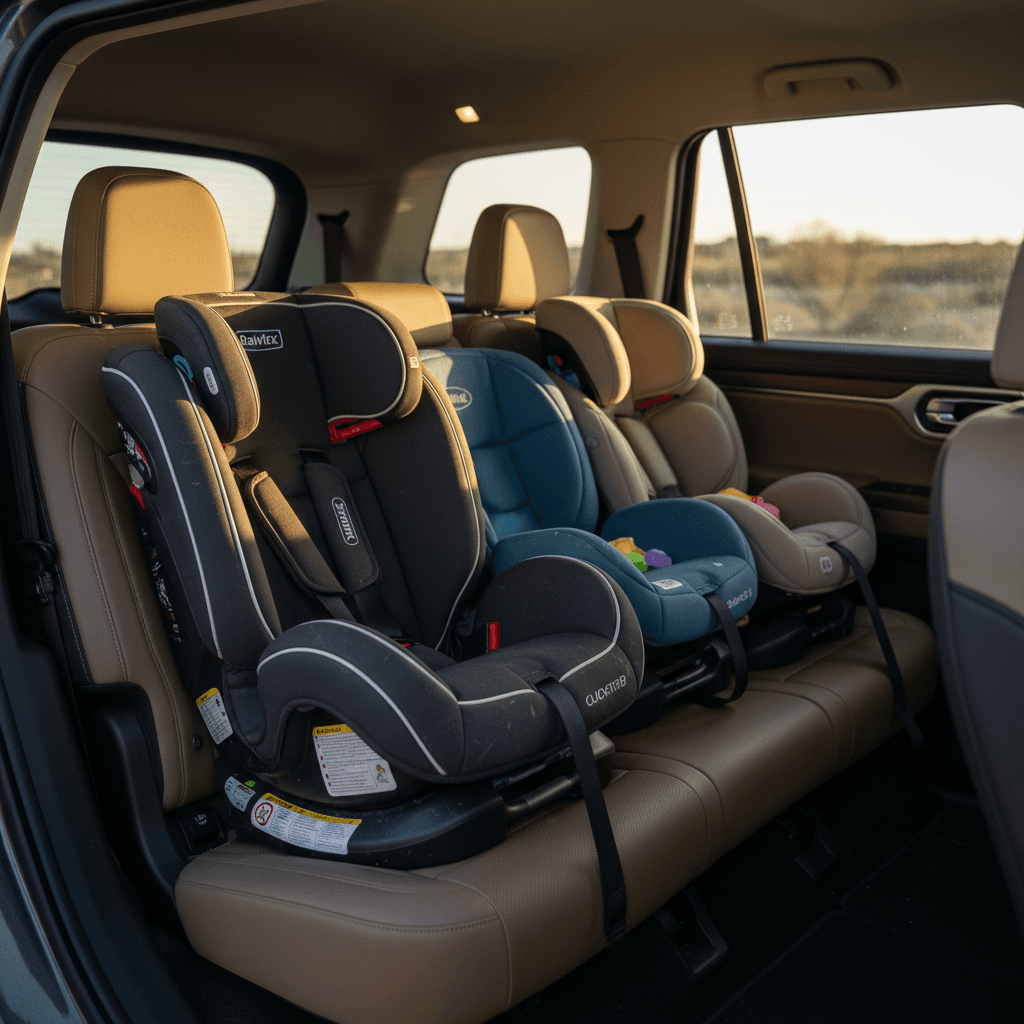
The second row of the R1S is where your life will be easiest. You get two full LATCH positions on the outboard seats and tethers across the back. In independent car‑seat checks, technicians praised how accessible the LATCH anchors are and how straightforward it is to get a solid install with typical infant, convertible, and booster seats.
- Outboard seats (left and right) are ideal for rear-facing infant or rear/forward-facing convertibles.
- The center seat is narrow and doesn’t have lower anchors, but you can use a seat-belt install plus tether for a forward-facing seat.
- Booster seats fit well on the outboard positions; buckle stalks are firm enough for most kids to use without hunting.
Best everyday layout for two kids
Can the Rivian R1S fit three car seats across?
Official lab-style car seat checks often say “no” to three across in the R1S, mainly because they’re using a fixed set of mainstream seats and expect slam‑dunk buckling access for a booster in the middle. In the real world, owners are more…motivated. With slim car seats (around 17 inches wide), multiple Rivian parents have successfully run three across the second row, especially with narrow convertibles and travel-friendly boosters.
3-across reality check
Checklist for 3-across success in the R1S
1. Choose slim seats
Look for seats marketed as “slim fit” or with widths around 16–17 inches. Wide all‑in‑one thrones will make three across nearly impossible.
2. Mix LATCH and seat belt installs
Using seat belts for at least one or two positions lets you slide seats a bit closer to the doors and free up precious millimeters in the center.
3. Test buckle access
A three-across install is only a win if the kid in the booster can actually reach and unbuckle without twisting the buckle stalk or sitting crooked.
4. Install in this order
Start with the center seat, then add the outboard seats. Re‑check that nothing has shifted and that all seats are still tight at the belt path.
5. Check front-row comfort
Rear-facing seats behind tall drivers may force the front seat forward. If the driver is 6'2", three across with a big rear‑facing seat behind them may not be viable.
Third row: when it works and when it doesn’t
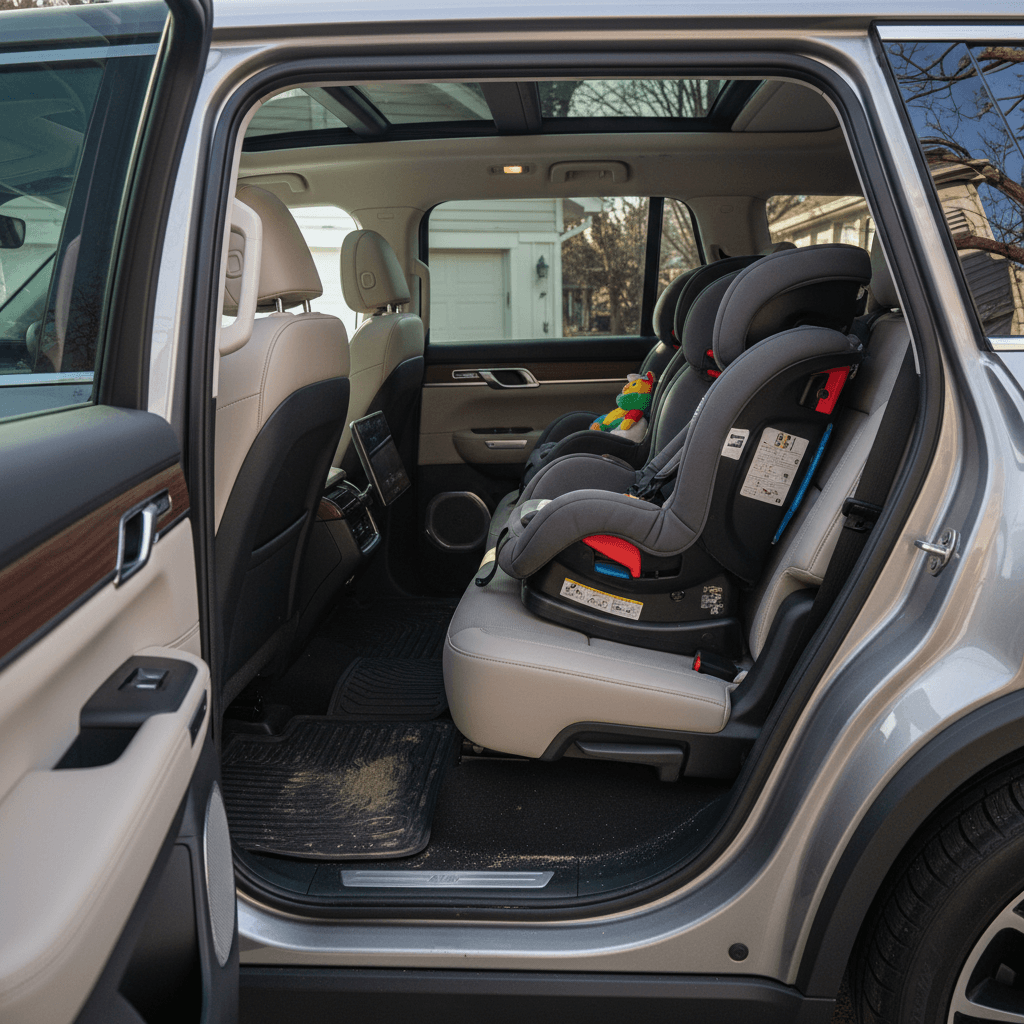
The third row of the Rivian R1S is technically very child‑seat friendly, each seat gets full LATCH plus a top tether. The practical challenge is getting to those seats when the second row is loaded up. There are no captain’s chairs; you’re sliding and tilting a bench that may already have one or two seats installed.
When the third row works well
- Forward-facing seat for an older child who can climb in from the door or cargo area and mostly buckle themselves.
- Occasional use on road trips when grandparents or friends join and you just need one extra kid spot.
- Two adults, three kids: put one forward-facing or booster in row three to keep space in row two.
When the third row is frustrating
- Daily use with multiple small kids who need help buckling; you’ll be half in, half out of the car for every school drop‑off.
- Two or more rear-facing seats; the legroom and roofline just aren’t made for it, and access is awkward.
- Needing all three rows at once while also keeping cargo space for strollers and gear.
Third-row access with car seats in row two
Real-world Rivian R1S child seat layouts
Numbers and anchor diagrams are helpful, but what you really want to know is: how are other parents actually running their R1S day to day? Here are sample layouts that reflect what’s working in the wild for families with different kid ages.
Common child seat layouts in the Rivian R1S
Use these as starting templates when you test‑fit your own seats.
Three under five
Goal: Max child seats, ignore third row.
- Second row: three slim seats across (rear‑facing infant, forward‑facing convertible, slim harnessed booster).
- Third row: folded for maximum cargo and stroller space.
Downside: Tight buckle access, limited rear visibility.
Two kids, one occasional extra
Goal: Comfort plus flexibility.
- Second row: rear‑facing behind passenger, forward‑facing/booster behind driver.
- Third row: one seat left up for an older sibling or visiting friend.
Works well if one child is old enough to climb in and buckle.
Three kids, frequent third-row use
Goal: All three rows in fairly regular rotation.
- Second row: two seats on the wider 60% portion of the bench.
- Third row: one forward‑facing or booster on the side that’s easiest to access.
Expect more gymnastics than a minivan, but it can work.
"Rivian has made their hardware really car seat friendly, especially for three across in the second row… Yes, the Rivian R1S can fit three car seats across, but it is not going to work with every car seat out there."
Installation tips specific to the R1S
Every SUV has its little quirks when you start wrestling LATCH hooks and seat‑belt locks. The R1S is generally friendly, but there are a few details worth knowing before you spend an afternoon swearing in the driveway.
R1S-specific child seat installation tips
Mind the fixed head restraints
The second- and third-row head restraints in the R1S don’t remove conventionally. With tall boosters, they can push the seat forward slightly. Choose boosters with adjustable headrests and check that the back is flat to the seat.
Use kneel mode to your advantage
The R1S can lower itself to make entry easier. Dropping the ride height can help you lift heavy rear‑facing seats or older kids into the third row without hulking a kettlebell at shoulder height.
Check third-row legroom with front seats set for adults
Set the driver and front passenger seats where real adults will sit, then install a child seat in the third row and see if the kid’s legs have space. Third‑row comfort drops fast as you slide the second row back.
Lock the belts properly
If you’re using seat belts instead of LATCH, be sure you understand how Rivian’s belts lock (usually via slowly pulling them all the way out to switch to locking mode). A seemingly tight install can loosen if the belt isn’t locked.
Plan your loading pattern
Decide which kid goes in first and from which door. With three rows in play, a repeatable sequence, third row first, then second row, then doors shut, saves drama in school drop‑off lines.
Safety first, always
Pros and cons vs other three-row EV SUVs
If you’re cross‑shopping the R1S with other three‑row EVs like the Kia EV9, Volvo EX90, or Tesla Model X, the child‑seat story is part ergonomics, part theater seating chart. The Rivian lands in an interesting spot: more rugged than the Tesla, more personality than the Kia, and more honest about its third row than pretty much any marketing brochure.
Where the R1S shines for car seats
- Full LATCH in the third row, which some rivals skip or limit.
- Solid, accessible anchors in both rows; techs rate them highly.
- Flat cargo floor when the third row is folded, ideal for strollers and wagons when you keep kids in row two.
- Huge frunk that can swallow diaper bags, scooters, or emergency car‑seat spares.
Where a minivan or EV9 might be easier
- No captain’s chairs means accessing the third row with two car seats installed is always a compromise.
- Higher ride height makes lifting sleepy toddlers into the third row more effort than a low‑floor minivan.
- Third-row space is kid-sized, not adult-friendly on long trips when child seats eat into legroom.
Why many families still pick the R1S
Buying a used Rivian R1S for family duty
Shopping used for a Rivian R1S can make sense if you want all the hardware, triple‑digit horsepower, three rows, big battery, without the brand‑new price. But for family duty, you’re not just buying a performance SUV; you’re buying a mobile nursery, snack bar, and argument arena. Condition and battery health matter just as much as car‑seat fit.
Used R1S checks for parents
Look beyond the spec sheet when kids are part of the plan.
1. Inspect seat fabric and anchors
Check for frayed belts, damaged plastic around LATCH anchors, and any evidence of DIY modifications. Stressed anchors or twisted belts can compromise safe installs.
2. Review battery health and range
Family life means surprise detours and climate control blasting. A healthy battery gives you more margin for pickups, practices, and weekend trips.
3. Confirm safety & software updates
Make sure the R1S has current software and any recall work done. Updates can improve everything from seat sensors to driver‑assist behavior.
With Recharged, every used EV, including any Rivian R1S we list, comes with a Recharged Score Report that verifies battery health, checks major systems, and benchmarks fair market pricing. If you’re planning to bolt multiple car seats into the back of a six‑figure SUV, having objective data about how its battery and components are aging is more than peace of mind; it’s part of keeping your family safe and your budget on track.
Trade-in or sell the gas SUV
Rivian R1S child seat FAQ
Frequently asked questions about child seats in the Rivian R1S
Bottom line: is the R1S a good car seat car?
If your mental image of the perfect family car is a sliding‑door minivan where kids can’t touch each other and everyone walks to the third row like it’s an airport jet bridge, the Rivian R1S will feel like a beautiful compromise, with emphasis on compromise. But if you want a three-row EV that can actually accommodate real child seats, handle winter, swallow camping gear, and still make you smile on the morning commute, the R1S belongs on your shortlist.
The second row is genuinely excellent for car seats, the third row is perfectly workable for kids you trust to climb and buckle, and three across is on the table if you choose your seats wisely. Shop smart, bring your actual seats to any test drive, and when you’re ready to go electric with your family fleet, consider browsing Recharged for a used Rivian R1S with a verified battery and transparent pricing. Your kids may never notice the kilowatts, but they’ll notice the space, the quiet, and the fact that their ride feels like a spaceship rather than a compromise.