If you’re considering a Rivian R1S, or already drive one, your big question isn’t just range. It’s **how much it really costs per mile to charge a Rivian R1S**, and how that compares with a gas SUV. The good news: once you understand your efficiency and electricity rate, the math is straightforward and usually comes out in your favor.
Quick answer
Overview: What does it cost per mile to charge a Rivian R1S?
Two numbers drive your **Rivian R1S charging cost per mile**:
- How much energy the R1S uses to drive a mile (its efficiency, in mi/kWh or kWh/100 mi).
- What you pay for electricity (cents per kWh), which varies by state and even time of day.
Recent EPA and independent testing puts the R1S in roughly the **2.2–2.6 miles per kWh** range in mixed driving, depending on battery, wheels, and how you drive. That translates to roughly **38–46 kWh per 100 miles** in real‑world use for many owners.
Rivian R1S charging cost per mile at a glance
Next, let’s pin down how efficient the R1S really is so you can plug in more precise numbers for your situation.
How efficient is the Rivian R1S in kWh per mile?
Rivian sells multiple R1S configurations (Standard, Large, and Max packs; dual‑ and quad‑motor; different wheel sizes). Each has slightly different efficiency. Instead of memorizing EPA charts, it’s easier to think in **mi/kWh** ranges you’re likely to see day to day.
Typical Rivian R1S efficiency by configuration
Approximate mixed‑driving efficiency ranges based on EPA data and real‑world reports. Your results will vary with speed, terrain, temperature, and driving style.
| Configuration | Battery / Drive | Wheels | Typical mi/kWh | kWh per 100 mi |
|---|---|---|---|---|
| Dual Motor Standard / Large | Dual motor AWD | 20–21 in | 2.4–2.7 | 37–42 |
| Dual Motor Max Pack | Dual motor AWD | 20–22 in | 2.3–2.6 | 38–43 |
| Quad Motor Large Pack | Quad motor AWD | 20–22 in | 2.0–2.4 | 42–50 |
| Heavy winter / towing (any) | Any | Any | 1.4–1.8 | 55–70 |
Use these numbers as starting points for cost‑per‑mile estimates, not absolute promises.
Cold weather changes everything
For the rest of this guide, we’ll use **2.5 mi/kWh** (40 kWh per 100 miles) as a realistic, easy‑to‑work‑with baseline for a dual‑motor R1S in moderate weather. You can adjust the math later with your own real‑world numbers from the trip computer.
Home charging: Rivian R1S cost per mile
Most Rivian owners do **nearly all** of their charging at home. That’s where you’ll get your lowest **cost per mile**, especially if your utility offers off‑peak or EV‑specific rates.
Step 1: Know your electricity price
Recent federal data shows U.S. households paying around **17–19 cents per kWh** on average as of late 2025 and early 2026. Some states are under 12¢; others are well over 25¢. Grab your most recent bill and look for the **“$/kWh”** line.
Quick way to find your rate
Step 2: Plug numbers into a simple formula
Here’s the basic cost‑per‑mile equation for any EV, including the R1S:
Cost per mile = (Electricity price per kWh) ÷ (Miles per kWh)
Using our 2.5 mi/kWh baseline and a typical 18¢/kWh residential rate:
- Cost per mile = $0.18 ÷ 2.5 ≈ **$0.07 per mile**
- 100 miles of driving uses about 40 kWh → 40 × $0.18 ≈ **$7.20 per 100 miles**
- 1,000 miles/month would cost roughly **$72** in electricity at home
Lower‑cost power (12¢/kWh)
At 2.5 mi/kWh:
- Cost per mile ≈ $0.048
- 100 miles ≈ $4.80
- 1,000 miles/month ≈ $48
If you live in a low‑cost electricity state or have a great off‑peak EV plan, your R1S can be incredibly cheap to run.
Higher‑cost power (24¢/kWh)
At 2.5 mi/kWh:
- Cost per mile ≈ $0.096
- 100 miles ≈ $9.60
- 1,000 miles/month ≈ $96
Even in a high‑cost state, your cost per mile is often competitive with or better than a similar gas SUV.
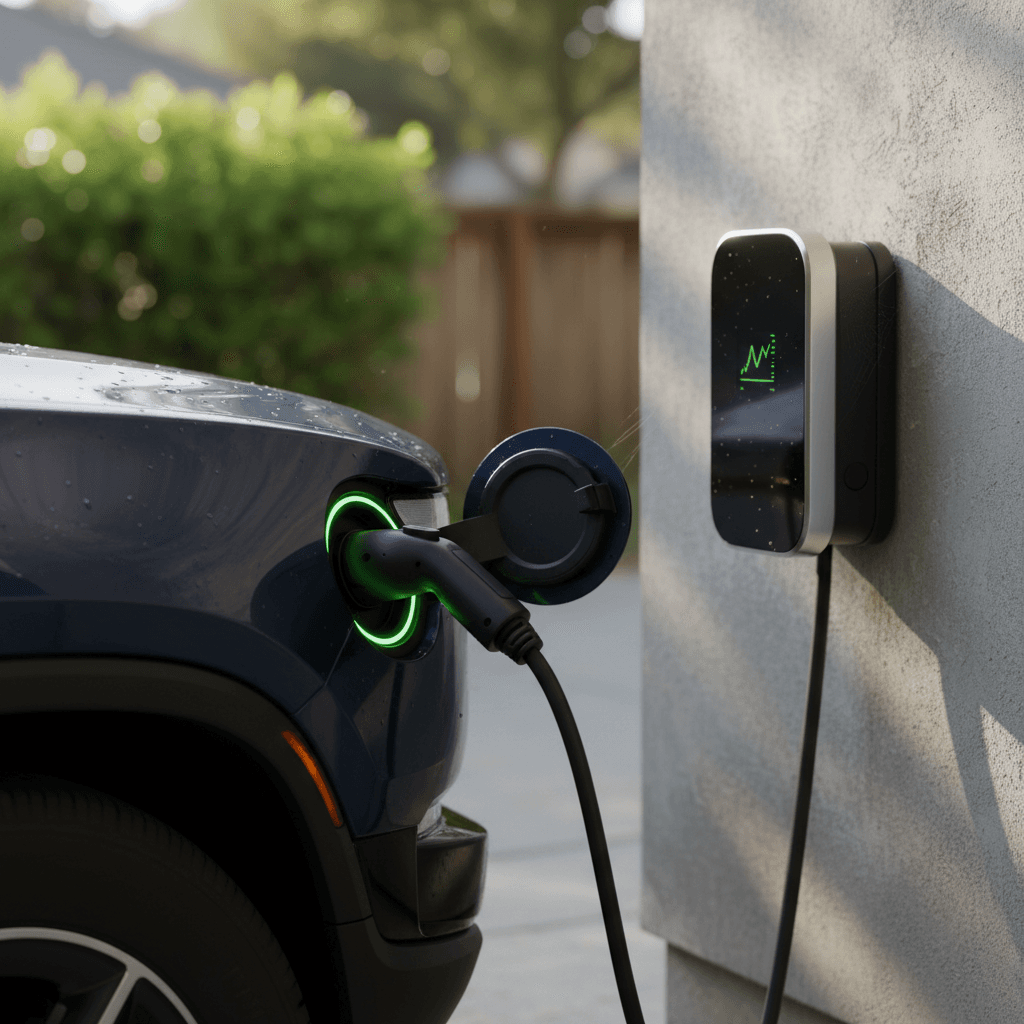
Why home charging is the real game‑changer
Public fast charging: real-world cost per mile
Home charging may be where you do most of your fueling, but long‑distance trips in a Rivian R1S rely heavily on **DC fast charging**, Rivian’s own Adventure Network plus third‑party networks. Those convenience kWhs cost more and raise your per‑mile cost.
Typical fast‑charging prices
Fast‑charging networks often price power either **per kWh** (for example, $0.38–$0.55/kWh, depending on state and station) or **per minute**. Rivian’s own network has raised prices over time, and many owners now see rates in the mid‑30‑ to 40‑cent range per kWh at some locations.
Using that same 2.5 mi/kWh efficiency figure:
Rivian R1S cost per mile on DC fast charging
Illustrative per‑mile costs at common DC fast‑charging prices.
| Price per kWh | Cost per mile (2.5 mi/kWh) | Cost per 100 miles |
|---|---|---|
| $0.30 | $0.12 | $12.00 |
| $0.40 | $0.16 | $16.00 |
| $0.50 | $0.20 | $20.00 |
Use your local station’s posted price to customize these figures.
Don’t fast‑charge like a gas tank
A realistic blended cost for many owners
If you do **80–90% of your charging at home** and only use DC fast charging on trips, your long‑term blended cost per mile will look much closer to the home‑charging numbers, often in the **7–10¢ per mile** range, depending on your utility rate and driving conditions.
How your state’s electricity rate changes the math
Because electricity prices vary widely, the same Rivian R1S can cost noticeably more or less to run depending on where you live. Here are broad examples using 2.5 mi/kWh and typical mid‑2020s rates:
Sample Rivian R1S cost per mile by electricity price
Your real numbers will depend on your exact utility plan and efficiency.
Low‑cost states (~12¢/kWh)
Home charging:
- Cost per mile ≈ 4.8¢
- 100 miles ≈ $4.80
This is cheaper per mile than most hybrid SUVs, let alone traditional gas models.
Average‑cost states (~18¢/kWh)
Home charging:
- Cost per mile ≈ 7.2¢
- 100 miles ≈ $7.20
Still a clear edge over many three‑row SUVs that get mid‑20s mpg or less.
High‑cost states (~26¢/kWh)
Home charging:
- Cost per mile ≈ 10.4¢
- 100 miles ≈ $10.40
In very high‑cost markets, shopping carefully for off‑peak or EV‑specific rates becomes essential.
Ask about time‑of‑use (TOU) plans
Rivian R1S cost per mile vs. a gas SUV
A big three‑row electric SUV like the Rivian R1S invites comparison with similar gasoline models, think Chevy Tahoe, Ford Expedition, or luxury crossovers. To keep it simple, let’s assume a gas SUV that averages **20 mpg** in mixed driving, and a fuel price of **$3.50–$4.00 per gallon**.
Rivian R1S vs. gas SUV: energy cost per mile
Illustrative comparison using typical U.S. prices in the mid‑2020s.
| Vehicle & scenario | Assumptions | Energy cost per mile |
|---|---|---|
| Rivian R1S – home charging | 2.5 mi/kWh, $0.18/kWh | ≈ $0.07 |
| Rivian R1S – mostly DC fast charge | 2.5 mi/kWh, $0.40/kWh | ≈ $0.16 |
| Gas 3‑row SUV (20 mpg, $3.50/gal) | 100 miles uses 5 gal | ≈ $0.17 |
| Gas 3‑row SUV (20 mpg, $4.00/gal) | 100 miles uses 5 gal | ≈ $0.20 |
This only covers fuel/energy costs, not maintenance or purchase price.
EV advantage grows when gas spikes
7 ways to lower your Rivian R1S charging costs
Practical steps to reduce R1S cost per mile
1. Charge at home whenever possible
Home electricity is almost always cheaper than DC fast charging. Even a basic 240‑volt Level 2 setup in your garage or driveway can cover nearly all your miles overnight.
2. Use off‑peak or EV‑specific rates
Ask your utility about time‑of‑use or EV plans. Setting your R1S to charge after midnight can dramatically lower your cents per kWh, and your cost per mile.
3. Keep speeds in check on the highway
Aerodynamic drag rises quickly above 70 mph, especially in a tall, boxy SUV. Cruising at 65–70 instead of 80 can add meaningful range and shave a couple cents per mile on long trips.
4. Precondition while plugged in
On cold or hot days, use the Rivian app to heat or cool the cabin while the vehicle is still charging. That way, the wall supplies much of that energy instead of the battery on the road.
5. Watch wheel choice and tire pressure
Larger, more aggressive tires look great but hurt efficiency. Keep tires properly inflated and recognize that upsized wheels can add **several kWh per 100 miles**, raising per‑mile cost.
6. Avoid frequent 0–100% DC fast charges
Fast charging all the way to 100% is slower, more expensive, and harder on the battery. For both cost and battery health, it’s often smarter to charge from about 10–70% and drive.
7. Track your real efficiency
Use the trip computer to note your **actual mi/kWh** over 1,000+ miles. Then plug that into the formula with your true kWh price. You’ll know your personal cost per mile, not just estimates.
Used Rivian R1S: battery health and long‑term costs
If you’re shopping the **used Rivian R1S** market, charging cost per mile is only half the story. You also want to understand **battery health**, because a degraded pack effectively reduces your usable range and can change how often you need to charge on trips.
Battery health vs. cost per mile
This is where a used‑EV specialist can help. At Recharged, every vehicle, including any used Rivian R1S we sell, comes with a **Recharged Score Report** that includes battery health diagnostics and how that compares to similar vehicles. That gives you insight into how efficient the vehicle should be and whether you’re likely to rely more on home charging or on pricier public networks.
Pair that battery insight with your expected **annual mileage**, local electricity rate, and typical driving mix (city, highway, towing, off‑road), and you can build a realistic **total cost of ownership** picture before you buy.
FAQ: Rivian R1S charging cost per mile
Frequently asked questions
Bottom line: What you should budget per mile
When you cut through the charts and formulas, a Rivian R1S is typically a **single‑digit cents‑per‑mile vehicle** as long as you do most of your charging at home. In much of the U.S., planning on **6–9 cents per mile** for everyday driving is reasonable, with road‑trip days landing higher when you rely on DC fast charging.
Compared with a similarly sized gas SUV, that’s a compelling advantage, especially when gas prices spike. The real key is matching the R1S to your driving pattern, electricity rate, and charging options. If you’re exploring a **used Rivian R1S**, working with an EV‑focused retailer like Recharged, where every vehicle comes with verified **battery health data, fair market pricing, and expert support**, can help you understand your true cost per mile before you ever sign on the dotted line.