If you drive an electric car, you’ve probably searched for portable power with outlet, something that can keep laptops, fridges, or even your EV itself alive when there’s no plug in sight. The market has exploded with compact battery boxes that promise wall-style outlets on the go, but not all of them are useful for EV owners. This guide breaks down what these units can and can’t do, how they fit into real-world EV life, and how to choose the right one for your needs.
A fast-evolving category
Why portable power with outlets matters for EV owners
For EV drivers, portable power with outlets does more than keep phones topped up. It can power a 12V fridge on a camping trip, run tools at a remote job site, or give you a few extra miles of emergency range when the nearest charger is just out of reach. As more households add an EV but don’t yet have a full home backup system, these devices have become a flexible middle ground between a glovebox power bank and a fixed wall battery.
Portable power stations in 2025 at a glance
What “portable power with outlet” actually means
When shoppers search for portable power with outlet, they’re usually talking about a portable power station: a rechargeable battery box with built‑in AC outlets, USB ports, and often a 12V car socket. Think of it as a silent, battery-powered generator you can use indoors. Core components include a lithium battery, an inverter that turns DC into 120V AC, a charge controller to manage incoming power, and a small computer that keeps everything safe.
Portable power station vs. other options
How it compares to power banks, generators, and home batteries
Power bank
Best for: Phones & tablets
- USB only, no AC outlets
- 100–300Wh typical size
- Pocketable, airline-friendly
Portable power station
Best for: Small appliances & light EV backup
- AC outlets plus USB/12V
- 300–3,600+W output
- 1–10kWh usable capacity
Gas generator / home battery
Best for: Whole‑home backup
- High power for long outages
- Not truly portable (noise or size)
- Higher upfront and install cost
Check for pure sine wave AC
Can portable power stations really charge an EV?
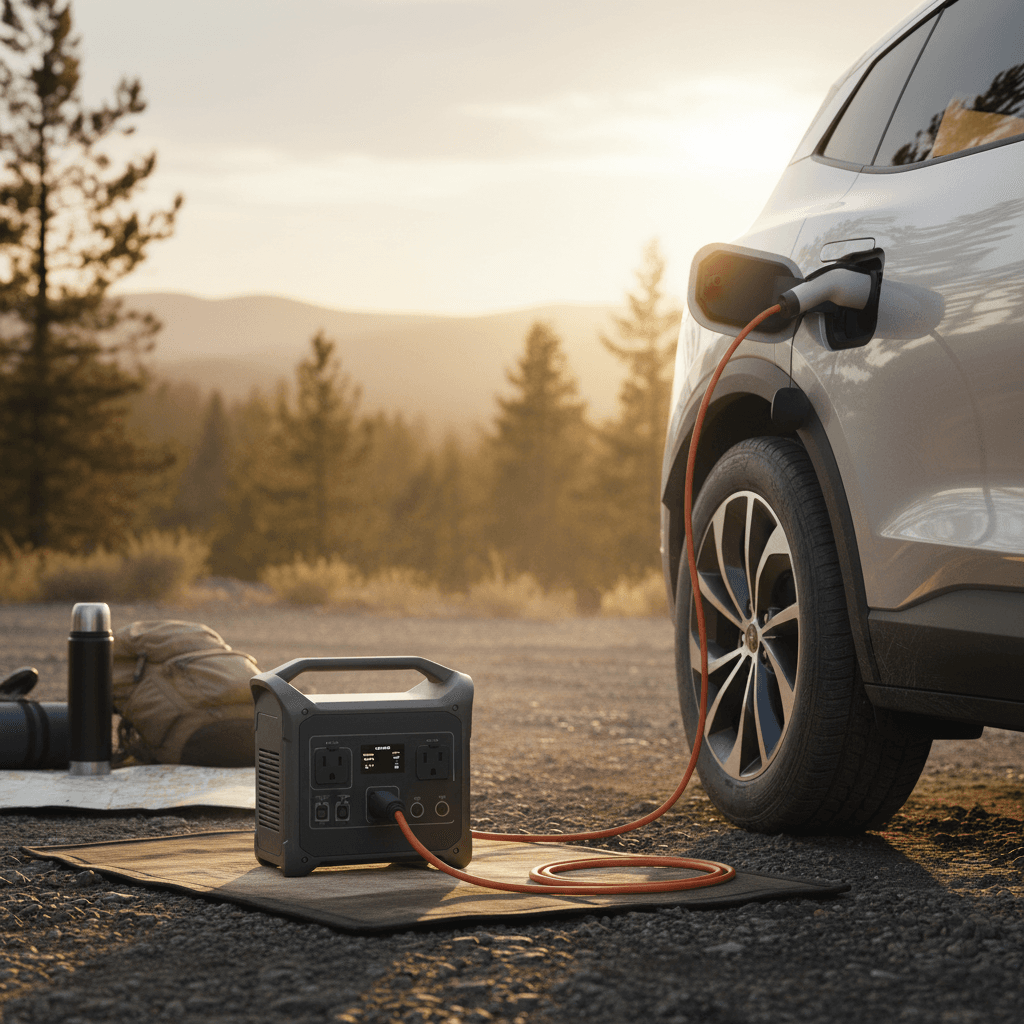
Yes, but with important caveats. You can use a high‑output portable power station with a standard Level 1 EVSE (your 120V “granny charger”) to add a few miles of range in an emergency. You cannot treat it like a mobile Supercharger. Even large units like EcoFlow’s DELTA Pro or Jackery’s 3000‑class stations hold only a small slice of the energy in a modern EV pack.
Why it’s possible
- Many portable stations offer 1,000–3,000W of continuous 120V AC output.
- Your EV’s Level 1 charger typically draws 8–12A at 120V (≈1.0–1.4kW).
- As long as the power station’s continuous rating exceeds the EVSE draw, the car will charge.
Why it’s limited
- Even a 3kWh station is tiny compared with a 60–80kWh EV battery.
- You’re typically adding 1–5 miles of range per hour at Level 1 rates.
- Running the station to empty for EV charging wears its battery faster than light household use.
Think of it as a gas can, not a gas tank
Key specs to compare when buying portable power with outlets
Once you know your use case, camping, work, emergency backup, or all of the above, you can start comparing portable power stations more intelligently. Don’t just chase the biggest number on the box; look at how the specs line up with your EV lifestyle.
Core specs for portable power with outlets
Use these numbers to quickly compare models before you buy.
| Spec | What it means | Why it matters for EV owners |
|---|---|---|
| Capacity (Wh / kWh) | Stored energy in the battery | Higher capacity means longer runtime for fridges, heaters, or more emergency miles for your EV. |
| AC output (W continuous / surge) | How much power the outlets can deliver | Needs to exceed your Level 1 charger’s draw; also determines which appliances you can run. |
| Battery chemistry (Li-ion vs LiFePO4) | Type of cells inside | LiFePO4 generally offers more cycles and better longevity, useful if you cycle often. |
| Input options (AC, solar, car, EV station) | How you recharge the unit | More options mean more flexibility on the road and in outages. |
| Weight & form factor | How heavy and bulky it is | Matters if you’re lifting it into a frunk or hauling it into a cabin or campsite. |
| Cycle life & warranty | How long it lasts before capacity fades | Important if you rely on it regularly, not just as a glovebox insurance policy. |
Prioritize capacity and AC output for EV‑adjacent use, then weigh weight, charge speed, and cycle life.
Nice-to-have features that improve daily use
Beyond watts and watt‑hours, these quality‑of‑life details matter.
App control
Lets you monitor state of charge, adjust output limits, and get alerts if loads trip, especially handy when the unit is tucked in a trunk or tent.
High solar input
If you camp or live off‑grid, higher solar input (800W+) means you can genuinely recharge from the sun instead of just slowing the drain.
Quiet cooling
Better‑designed fans and thermal management keep noise down in cabins and RVs. Some units offer eco modes that throttle output to stay quieter.
Popular use cases for EV drivers
EV owners tend to use portable power with outlets in four main ways: emergency range insurance, EV‑adjacent camping power, roadside work support, and home backup for smaller loads. The right size station depends on which of those you care about most.
Where portable power earns its keep
1. Emergency EV range top‑ups
A 2–3kWh station paired with your Level 1 cable can add a handful of miles when you misjudge a stretch between public chargers or hit an unexpected outage.
2. EV camping and tailgating
Instead of running everything from the car’s 12V sockets, let a power station handle fridges, induction cooktops, and lights so your traction battery stays focused on driving.
3. Mobile work or vanlife
Contractors, photographers, and remote workers use AC outlets to run tools, laptops, and monitors at sites where power isn’t guaranteed.
4. Home outage support
A mid‑size station can keep Wi‑Fi, phones, a few lights, and even a small space heater going during short blackouts, without running a noisy generator.
Good news for apartment dwellers
Example setups: from small to serious backup
To make the trade‑offs concrete, here’s how different classes of portable power with outlets line up for a typical EV driver. These aren’t brand endorsements, just realistic scenarios based on today’s products.
Compact (300–600Wh)
Use it for: Phones, laptops, LED lights, tiny appliances.
- Great for weekend car camping.
- Too small for meaningful EV charging.
- Light enough to toss in any trunk.
Think of this as a super‑sized power bank with AC outlets.
Mid‑range (1–2kWh)
Use it for: 12V fridges, projectors, routers, small heaters.
- Can add a couple miles of EV range in a pinch.
- Good balance of price, weight, and capability.
- Popular size for family road trips and outages.
This is where many value‑conscious EV owners land.
Large / EV‑focused (3kWh+)
Use it for: Serious backup and limited EV charging.
- Can realistically add several emergency miles.
- Heavy; often on wheels or semi‑permanent in a garage.
- Pairs well with solar or home transfer switches.
Best fit for drivers far from dense charging networks or in outage‑prone regions.
What about “whole‑home portable” systems?
Safety and what not to do
Any time you’re dealing with 120V AC and large batteries, whether in your car or in a portable box, safety comes first. Most major brands build in good protections, but user error can still trip breakers or create dangerous situations.
- Don’t daisy‑chain power strips or extension cords off a portable station’s outlet to run more gear than it’s rated for.
- Avoid covering the unit with blankets or stuffing it into tight compartments while it’s under heavy load; it needs airflow to stay cool.
- Keep it dry. “Weather‑resistant” doesn’t mean rain‑proof AC outlets, use covers or a sheltered spot.
- Use a properly rated, grounded extension cord if you must extend your EVSE; undersized cords can overheat.
- Follow your EV maker’s guidance. Some warn against using unapproved power sources for continuous charging, especially at high current.
Never backfeed your house
How portable power fits into your EV ownership plan
A good way to think about portable power with outlets is as part of a layered charging and backup strategy, not a silver bullet. Public fast charging networks, home Level 2, workplace charging, and portable power all play different roles. Where you live, how far you drive, and whether you own or rent will shape which layers matter most.
Different EV owners, different portable power strategies
Urban & suburban commuters
Prioritize a reliable home Level 2 charger or consistent workplace charging.
Choose a mid‑range (1–2kWh) station mainly for outages and lifestyle use.
Use apps like PlugShare to avoid relying on portable units for routine charging.
Rural drivers & long‑distance road‑trippers
Focus on a larger (2–3kWh+) station that can add a few emergency miles.
Pair it with solar if you spend time off‑grid or at remote cabins.
Build routes around fast‑charging networks; treat portable power strictly as backup.
Apartment dwellers without home charging
Lean on public and workplace charging as your primary fuel.
Use portable power with outlets for household resilience, not day‑to‑day EV charging.
If you’re shopping for your next EV, look closely at battery size, efficiency, and access to nearby DC fast chargers.
Multi‑EV families
Consider whether a larger portable or semi‑permanent home battery makes more sense than several small units.
Map out which car gets priority during outages or winter storms.
If you’re upgrading vehicles, a used EV with strong battery health, verified by a <strong>Recharged Score Report</strong>, can reduce range anxiety and your dependence on backup power.
Where Recharged fits in
FAQ: portable power with outlets for EVs
Frequently asked questions
Bottom line for EV shoppers
Portable power with outlets has become a useful sidekick for EV ownership, but it’s not a magic solution. For most drivers, a modest portable power station is about comfort and flexibility, keeping food cold on a weekend trip, powering work gear, and adding a safety buffer when you misjudge a stretch between chargers. If you routinely drive long distances far from public fast charging, stepping up to a larger unit can make sense, as long as you’re realistic about the slow pace of Level 1 charging.
If you’re still in the market for an EV, start with the fundamentals: battery health, real‑world range, and how you’ll charge day to day. That’s where Recharged focuses, with verified battery diagnostics, fair market pricing, financing, and even trade‑in options, all available in a fully digital experience or at our Experience Center in Richmond, VA. Get those pieces right, and portable power with outlets becomes what it should be: a helpful backup, not a crutch.