If you drive an EV long enough, you will eventually stare at the range readout and think: "I would pay real money for an outlet right now." That nagging thought is exactly why the phrase portable EV charging station has exploded in search boxes. But portable means very different things, from glovebox cords to suitcase-sized DC fast chargers. Let’s untangle the marketing and talk about what actually works in the real world.
First things first
Why portable EV charging stations matter now
Portable EV chargers are a fast-growing niche
In 2011, owning an EV meant mapping your life around a handful of chargers. In 2025, the public network is larger and faster, but still patchy, especially if you live in an apartment, drive long distances, or park on the street. That gap is driving a booming market for portable EV chargers: devices you can toss in the trunk or move between outlets to turn almost anywhere into a charging spot.
How this helps used-EV shoppers
What a “portable EV charging station” actually is
The phrase is a bit of a mess. When people say portable EV charging station, they’re usually talking about one of three things:
- A compact Level 1 or Level 2 EVSE (charging cable with electronics box) you plug into an existing outlet.
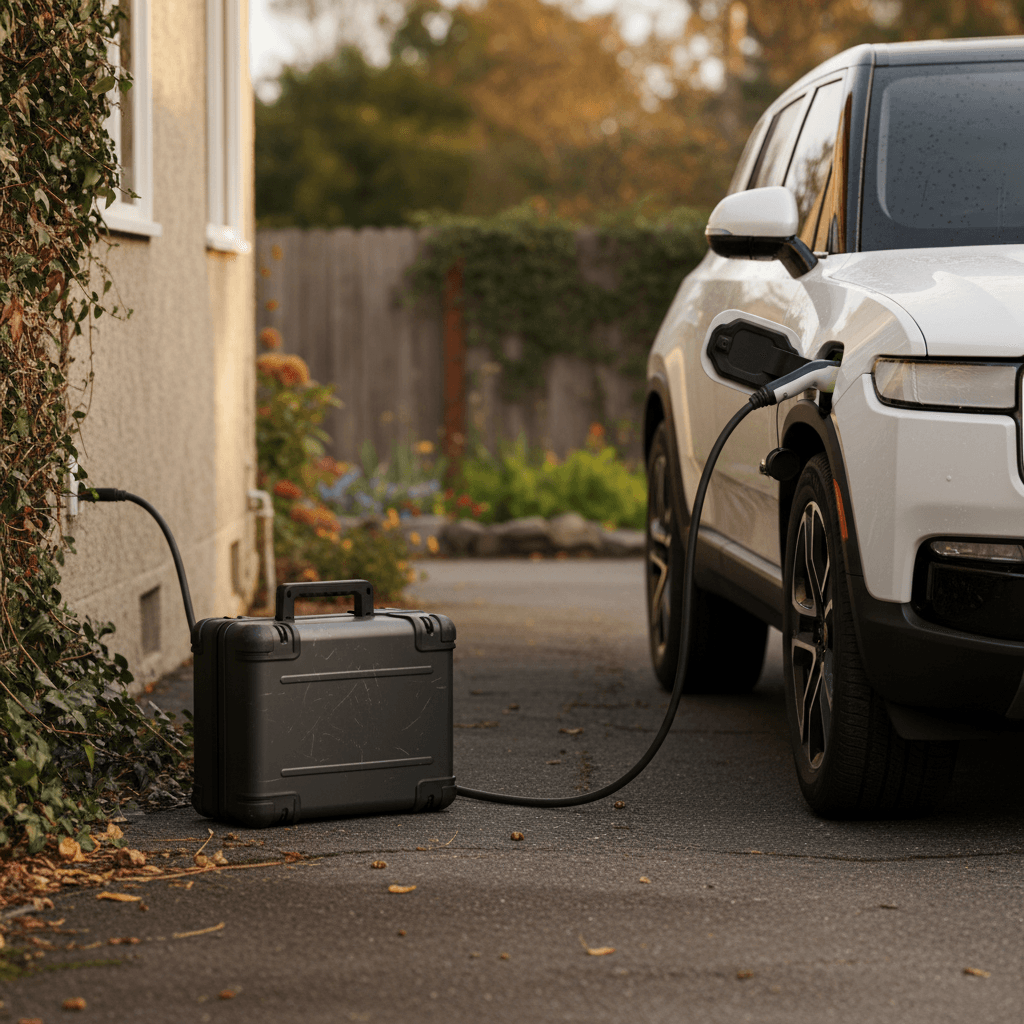
- A bigger suitcase-style device that combines a high‑capacity battery with an EV charging outlet, essentially a rolling power bank.
- A trailer‑ or skid-mounted DC fast charger that can be moved between locations for fleets or events.
EV jargon decoder
The 3 main types of portable EV chargers
Three flavors of portability
From glovebox backup to rolling power plant
1. Level 1 portable cords
These are the basic 120V cords many EVs ship with.
- Best for: Overnight top‑ups, emergencies.
- Typical speed: ~3–5 miles of range per hour.
- Pros: Cheap, truly portable, works almost anywhere.
- Cons: Painfully slow for larger batteries.
2. Portable Level 2 stations
240V units that plug into a dryer/RV outlet or hardwired circuit.
- Best for: Daily home charging, shared parking, multi‑location use.
- Typical speed: 20–40 miles of range per hour depending on amps and your car.
- Pros: Sweet spot of speed, cost, and size.
- Cons: Needs 240V outlet; not every rental or garage has one.
3. Portable DC fast & power stations
Big batteries or compact DC fast chargers designed to be moved.
- Best for: Roadside service, remote work sites, fleets, off‑grid cabins.
- Typical speed: Can deliver DC fast-charge rates, limited by unit size and vehicle.
- Pros: Can charge without grid power (battery) or provide DC fast charging where no station exists.
- Cons: Large, heavy, and expensive, often thousands of dollars.
Don’t confuse adapters with chargers
How fast will a portable EV charging station charge your car?
Speed is where expectations go to die. A box on wheels that bills itself as a "portable EV charging station" might add anywhere from 3 to 150 miles of range per hour depending on three things: outlet voltage, amperage, and your EV’s onboard charger.
Typical real‑world charging speeds
Approximate range added per hour of charging for a modern EV, assuming mild weather and efficient driving.
| Charger type | Power source | Approx. kW | Miles of range per hour* | Good for |
|---|---|---|---|---|
| Portable Level 1 EVSE | 120V household outlet, 12A | 1.2–1.4 | 3–5 | Emergency backup, occasional overnight use |
| Portable Level 2, 16A | 240V (NEMA 6‑20, small RV plug) | 3.3–3.8 | 12–18 | Daily charging for smaller batteries |
| Portable Level 2, 32–40A | 240V (NEMA 14‑50, 50A circuit) | 7.7–9.6 | 25–35 | Primary home charging for most EVs |
| Portable Level 2, 48A | 240V (60A+ circuit, not truly plug‑in) | 11.5 | 35–40 | High‑power home charging if your panel supports it |
| Portable DC fast power station | Battery‑backed or grid‑tied DC, 25–50kW | 25–50 | 100+ | Fleets, roadside assistance, temporary sites |
Use this as a sanity check before you buy, marketing numbers often quote best‑case scenarios.
Match the charger to your car
Key features to compare when shopping
Portable EV charging station buying checklist
1. Understand your charging environment
Do you have access to a 240V outlet (dryer, RV, or dedicated circuit), or just standard 120V? If you rent or park on the street, portability and plug options matter more than maximum power.
2. Check your vehicle’s max AC charge rate
Most EVs land between 6.6kW and 11.5kW. There’s no benefit to a 40‑amp portable EV charging station if your car can only accept 32 amps on AC.
3. Look at plug type and adapters
In North America, common plugs are NEMA 5‑15 (standard), 6‑20, and 14‑50. The more plug tails included, the easier it is to share the charger between locations without an electrician visit every time.
4. Decide on smart vs dumb
Smart portable chargers connect to Wi‑Fi or Bluetooth for scheduled charging, usage tracking, and sometimes utility rebates. Dumb chargers just turn electricity into miles. If you pay time‑of‑use rates, smart is usually worth it.
5. Cable length and durability
A 25‑foot cable makes life much easier in tandem garages or street‑adjacent parking. Look for thick insulation, clear labeling, and a robust handle. Your charging cable will see more abuse than your phone charger ever did.
6. Weather rating and portability
If your charger will live outdoors or in a shared parking lot, check for NEMA 4 or at least NEMA 3R weather ratings and some kind of locking or mounting option. Handles and a storage case make trunk duty far less annoying.
7. Safety certifications and warranty
Look for UL or ETL listings and a warranty of at least 2–3 years. This isn’t a gadget; it’s a high‑power appliance that can pull 40 amps for hours near your car and house.
Where Recharged fits in
Ready to find your next EV?
Browse VehiclesPortable charger vs fixed home station
Portable EV charging station
- Pros: Can move with you, share across cars and locations, often cheaper upfront, no permanent installation.
- Best for: Renters, people expecting to move soon, multi‑home households, early in EV ownership.
- Drawbacks: Easier to steal if left outside, cable management is messier, fewer ultra‑high‑power options.
Fixed Level 2 wallbox
- Pros: Clean install, usually higher power, integrated cable hooks, can boost home value.
- Best for: Homeowners with a dedicated parking spot and long‑term plans to stay put.
- Drawbacks: Requires an electrician, can’t come with you easily, more expensive all‑in once installation is included.
One smart hybrid approach
Real-world use cases: Who actually needs one?
Not everyone needs a portable EV charging station. In fact, if you have a driveway, a panel with spare capacity, and you’re not moving for a decade, a fixed wallbox is arguably the more civilized solution. Portable shines in edge cases and transitional life phases.
Four common scenarios where portable wins
If you recognize yourself in one of these, a portable EV charger is likely money well spent.
Apartment or condo parking
You park in a shared garage or outdoor lot with limited power access.
- Run a 240V circuit to a shared post and hang a lockable portable Level 2 unit.
- Or share a single unit across multiple residents with plug adapters and an extension post.
- Good way to pilot EV charging without the politics of a permanent install.
Long‑distance commuter
You routinely arrive home with 10–20% state of charge.
- Portable Level 2 on a 40A circuit lets you refill 50–70% overnight.
- Keep the factory Level 1 cord in the trunk as a just‑in‑case backup.
RV parks, cabins, and weekend houses
You split time between multiple places with 240V outlets.
- Many RV parks already have NEMA 14‑50 outlets, the same plug many portable Level 2 chargers use.
- One charger, multiple garages and driveways.
Roadside assistance & fleets
You’re not just charging one car, you’re rescuing others.
- Battery‑backed portable DC fast systems or trailer‑mounted chargers can add meaningful miles in minutes at the side of the road.
- For fleets, portable DC units bridge the gap while permanent depots are built.
Portable EV charging isn’t about replacing the grid. It’s about buying yourself options when the grid is in the wrong place at the wrong time.
Safety, setup, and what not to do
Electricity is wonderfully boring when installed correctly and properly dangerous when it’s not. A portable EV charging station doesn’t change that. You still need a safe circuit, good wiring, and a basic respect for things that can melt metal.
- Have a licensed electrician evaluate any 240V circuit you plan to use regularly, especially older dryer or range outlets.
- Never run a high‑power portable charger through a daisy‑chained series of cheap extension cords or power strips.
- Avoid charging at full power on outlets that get warm to the touch or show signs of discoloration or prior overheating.
- Mount or hang the EVSE box so it’s not dangling by the cable; strain relief is your friend.
- If you regularly charge outdoors, use weather‑rated outlets, in‑use covers, and a charger with an appropriate NEMA rating.
- Update your charger’s firmware if it’s a smart unit, manufacturers often improve safety logic and temperature monitoring.
Red flags: Stop and get help
Market trends: Where portable charging is headed
Portable EV charging is no longer a fringe accessory category; it’s a small but fast‑growing slice of the broader charging market. Analysts peg the dedicated portable EV charger segment at tens of millions of dollars in 2024–2025, with forecasts climbing into the hundreds of millions over the next decade as EV adoption accelerates and infrastructure tries to keep up.
Three trends reshaping portable EV charging
Useful to know before you buy in 2025
Smarter, connected units
More portable Level 2 chargers now offer Wi‑Fi or Bluetooth apps.
- Schedule charging for off‑peak electricity rates.
- Monitor kWh usage and cost per mile.
- Share access with family or tenants.
Integration with home energy
Portable stations are increasingly pairing with solar and home batteries.
- Some power stations can charge from solar during the day.
- Others support bidirectional power sharing, letting your EV help power the home during outages.
Truly mobile DC fast charging
Fleet operators and roadside services are adopting trailer‑mounted or skid‑mounted DC fast chargers.
- Deploy temporary fast charging at events or construction sites.
- Use portable units as a bridge while permanent infrastructure is built.
Don’t overspend for edge‑case tech
Portable EV charger FAQ
Frequently asked questions about portable EV charging stations
Bottom line: Is a portable EV charging station worth it?
A portable EV charging station won’t turn your hatchback into a rolling power plant, and it won’t save a bad charging situation from itself. What it can do, when chosen thoughtfully, is make EV life much more forgiving. It lets renters treat a 240V outlet at the back of a dim garage like a private fuel pump. It lets commuters sleep while electrons quietly refill the pack. And it lets used‑EV buyers enjoy the discount of a pre‑owned battery without living at the nearest DC fast charger.
If you have stable housing, a driveway, and long‑term plans, a fixed wallbox is still the gold standard. If your life is messier, and whose isn’t, a well‑chosen portable EV charging station is the right sort of compromise: boring, reliable, and there when you need it. And when you’re ready to pair the right used EV with a right‑sized charging setup, Recharged can help you see the whole picture, from battery health to budget to the outlet you’ll actually be using on Tuesday night.