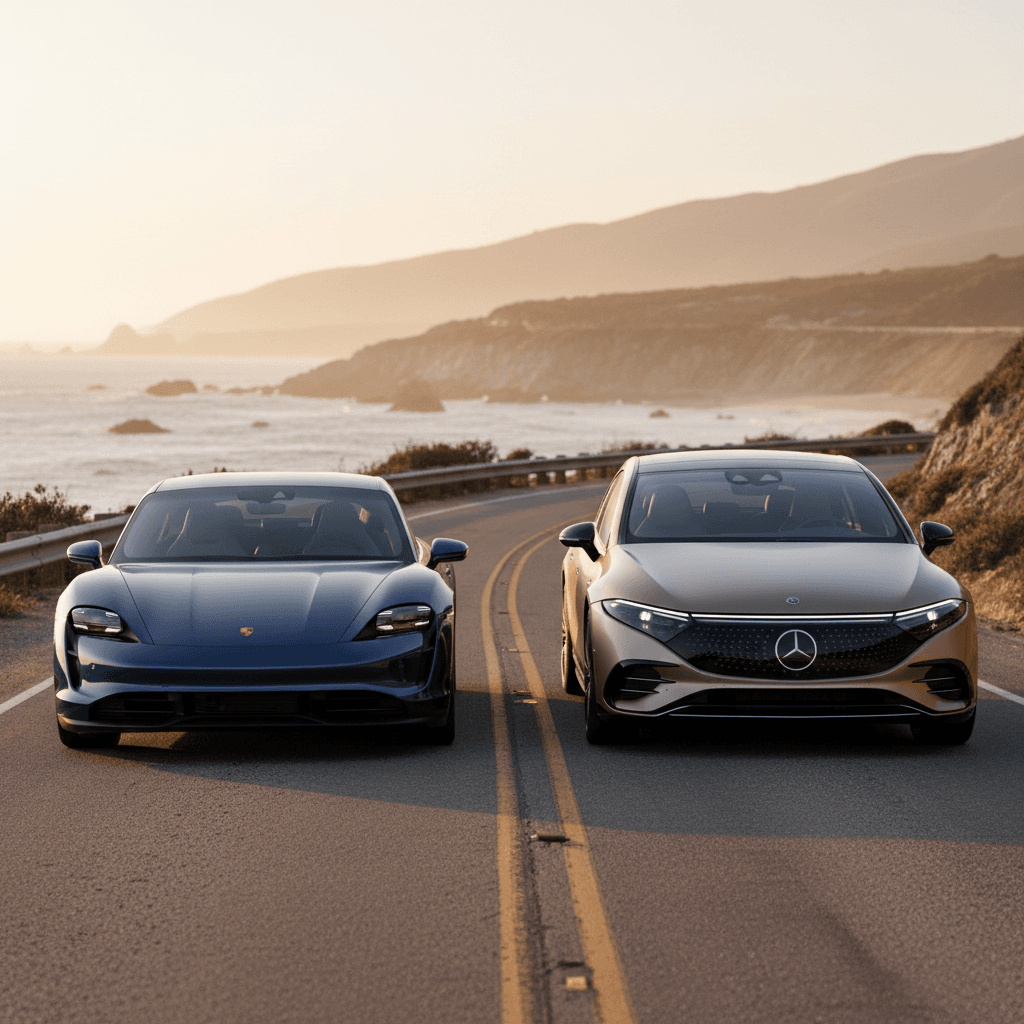
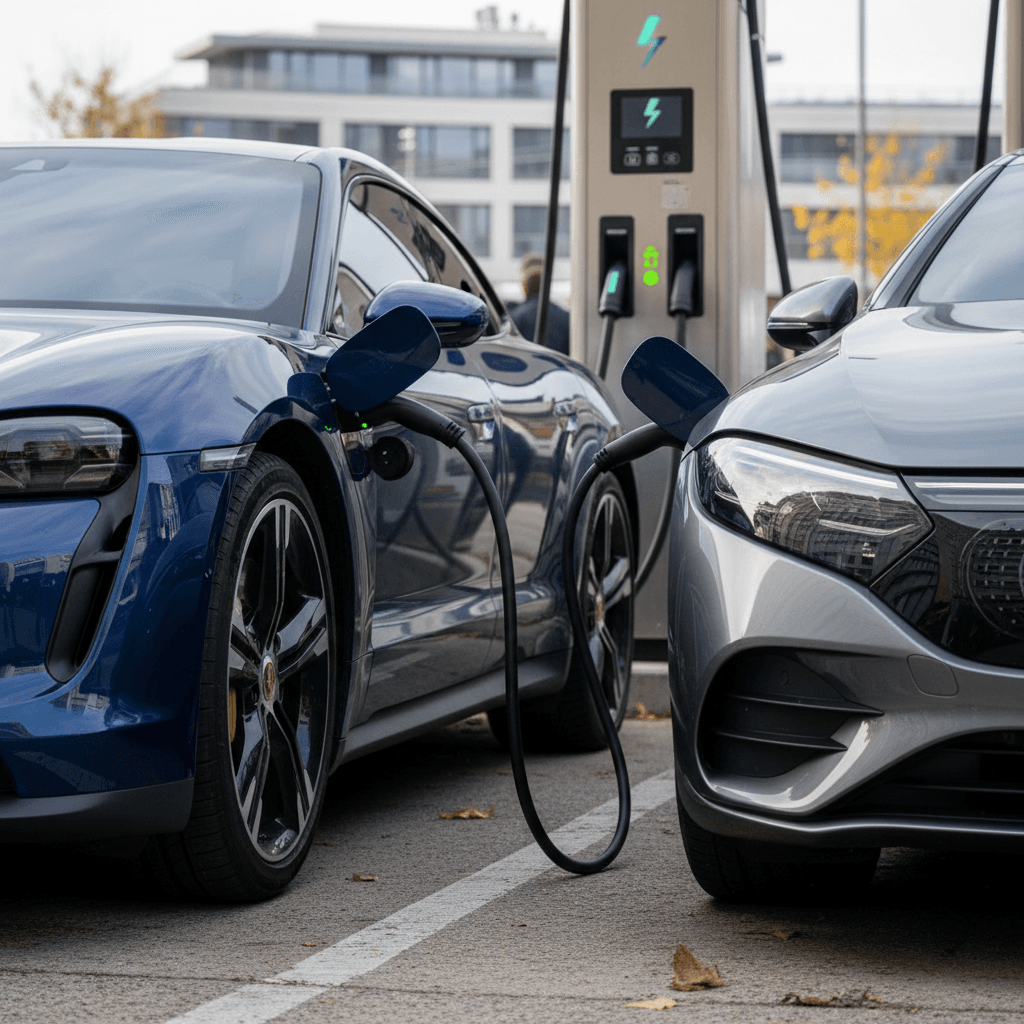
If you’re cross-shopping the Porsche Taycan vs Mercedes EQE, you’re probably looking for a quiet, quick, long-range luxury EV that still feels special every time you drive it. The good news: both cars deliver that. The better news is that they do it in very different ways, which makes choosing the right one much easier once you’re clear on your priorities.
Big picture
Porsche Taycan vs Mercedes EQE: who each car is for
Two excellent EVs with very different personalities
Match the car to your real-world driving style, not just the badge
Porsche Taycan: the driver’s EV
Best if you care most about:
- Steering feel and handling that rival top sports sedans
- Powerful acceleration across the lineup
- Low seating position and coupe-like stance
- High-quality interior that feels tailored around the driver
Trade-offs: firmer ride, tighter rear seat and trunk, and typically higher purchase price when new.
Mercedes EQE: the luxury lounge
Best if you care most about:
- Comfortable, quiet ride for commuting and road trips
- Spacious rear seat and easy ingress/egress
- Upscale, lounge-like cabin with lots of tech
- Typically softer pricing on the used market than a Taycan
Trade-offs: softer, less engaging handling and styling that some buyers find less distinctive.
Used EV angle
Key specs comparison: Taycan vs EQE
Porsche Taycan vs Mercedes EQE: specs at a glance (U.S. market)
Representative figures for popular trims. Exact numbers vary by model year, battery, and wheels, so always verify the specific car you’re considering.
| Porsche Taycan (base / 4S) | Mercedes EQE 350+ Sedan | Mercedes EQE 350+ SUV | |
|---|---|---|---|
| New MSRP (approx.) | From around $100,000 | Mid-$70,000s when new | High-$70,000s when new |
| Body style | Low-slung sports sedan / wagon | Mid-size luxury sedan | Mid-size luxury SUV |
| Drivetrain | RWD or AWD | RWD or AWD | RWD or AWD |
| 0–60 mph | ~5.0s (base) to under 4.0s (4S) | Around mid-6s (350+) | Around mid-6s (350+) |
| EPA range (select trims) | Varies widely; updated 2025 models see major improvements | Roughly 250–280 miles depending on trim | Roughly 250–300+ miles depending on trim |
| DC fast charge peak | Up to ~270 kW on newer models | Around 170 kW | Around 170 kW |
| Character | Sporty, precise, ultra-composed | Comfort-first, quiet, tech-heavy | Higher seating, more cargo, crossover feel |
Approximate specs for common Taycan and EQE variants as of 2024–2025.
Check the year and trim
Performance and driving feel
Porsche Taycan: benchmark dynamics
The Taycan was engineered to feel like a Porsche first and an EV second. Even the lower trims offer:
- Sharp, communicative steering that makes the car feel smaller than it is
- Very flat cornering thanks to a low battery and sophisticated suspension
- Strong regenerative and friction braking with excellent pedal feel
- Plenty of power, with higher trims moving into genuine supercar territory
If you enjoy canyon roads, on-ramps, or simply want your EV to feel special every time you drive it, the Taycan is one of the best-driving electric cars on sale.
Mercedes EQE: relaxed and refined
The EQE takes a different approach. Think of it as a fully electric E‑Class with:
- Softer, more compliant suspension tuning focused on comfort
- Light, easy steering that makes city driving effortless
- Strong, quiet acceleration, especially in dual‑motor variants
- Excellent noise isolation at highway speed
It’s not as eager or precise as the Taycan, but for daily commuting, long freeway runs, and passengers who value smoothness, the EQE’s tuning is exactly what many buyers want.
Quick rule of thumb
Range, battery, and charging experience
Range and charging: what most shoppers care about
On paper, the Mercedes EQE sedan and SUV deliver very competitive range, especially in single‑motor EQE 350+ trims that can crest 270–300 miles in ideal EPA conditions. The Taycan’s range story has evolved: early cars were criticized for modest EPA numbers, but real‑world owners often reported better results, and the 2025 update brought significantly larger usable battery capacity and improved efficiency.
- If you prioritize EPA-rated range for long highway trips, a rear‑drive EQE 350+ or updated 2025+ Taycan with the larger battery pack are your best bets.
- For everyday mixed driving under 200 miles per day, either car will feel abundant, especially if you have Level 2 charging at home or work.
- Taycan’s 800‑volt system is still a reference point for high-power DC fast charging, which is handy if you road trip often through areas with robust 350 kW stations.
Home charging matters more than you think
Comfort, interior, and tech
Taycan cabin: minimalist and sporty
The Taycan’s cabin feels like a modern reinterpretation of classic Porsche design:
- Low seating position and thick steering wheel that immediately feel “Porsche”
- Clean, horizontal dash with multiple screens but restrained ornamentation
- Excellent driving position once you’re settled in, but tight headroom in the rear for taller passengers
- Trunk plus small frunk; enough for weekend bags, but not a cargo hauler
The downside is practicality. Loading a child seat or taller adults in the rear is more work than in the EQE, and the sweeping roofline limits cargo versatility unless you move up to the Taycan Sport/Cross Turismo body style.
EQE interior: calm and comfortable
The EQE aims squarely at comfort and tech:
- Higher, easier step-in height (especially in EQE SUV)
- Spacious rear seat and more headroom than the Taycan
- Modern MBUX interface with large central screen and available "Hyperscreen"-style layouts
- Quiet cabin with strong sound insulation and available air suspension
If you regularly drive clients, friends, or family, the EQE is the more accommodating choice. It feels like a traditional Mercedes luxury car that just happens to be electric.
Test-sit both, even if you don’t drive them
Ownership costs, depreciation, and used-market reality
Why the used market looks so different from the original window stickers
These are expensive cars when new, but the story changes dramatically in the used market. The Taycan’s performance reputation and Porsche brand halo help it hold value better, while the Mercedes EQE – like several EQ siblings – has seen heavy MSRP cuts, lease support, and dealer discounts. That creates attractive opportunities for used‑car shoppers.
Cost and value: what to look at beyond the sticker price
1. Depreciation curve
A 2–3 year old EQE sedan or SUV can often be purchased for a surprisingly low price versus its original MSRP. Taycans depreciate as well, but typically not as dramatically, especially well-optioned trims.
2. Insurance and tires
High-performance EVs ride on large, expensive tires and carry higher insurance premiums. Taycan owners in particular should budget for frequent tire replacement if they drive enthusiastically.
3. Scheduled maintenance
EVs avoid oil changes, but luxury brands still charge for inspections, brake fluid, cabin filters, and alignment checks. Porsche publishes Taycan maintenance plan pricing; Mercedes dealers can quote EQE service plans. Build those costs into your 5‑year budget.
4. Energy and charging costs
Both cars benefit from off‑peak home charging. Public DC fast charging is convenient but more expensive per kWh. If you’ll rely heavily on public charging, pay closer attention to real‑world efficiency and charging curve behavior.
Don’t shop on payment alone
Reliability, battery health, and warranty coverage
Both Porsche and Mercedes engineered these cars with long battery life in mind, and both brands offer strong battery warranties. In the U.S., you’ll generally see EV battery coverage of around 8–10 years and 100,000+ miles against excessive degradation. The fine print varies, so verify the specific car, but either way you’re not on your own if the pack has an unusual problem early in its life.
- In real-world use, most Taycan and EQE packs show modest, gradual degradation when properly charged and stored.
- Fast charging on road trips is fine; living on DC fast chargers every day is not ideal for long-term battery health in any EV.
- Software updates from both brands have improved range, charging behavior, and even driving feel for some model years.
Used EV buying risk: invisible battery history
How Recharged de‑risks used EVs
Ready to find your next EV?
Browse VehiclesWhich is the better used EV buy?
Choosing between a used Taycan and a used EQE
Start with your priorities, then use price and condition as tie-breakers
Choose a Porsche Taycan if…
- You want the most engaging drive in the segment.
- You don’t need massive rear-seat space or SUV practicality.
- You’re okay paying a bit more, up front or used, for the Porsche experience.
- You value the Taycan’s charging performance and engineering depth.
Look for: solid battery health reports, clean wheel and tire condition (a good window into how the car was driven), and a documented service history.
Choose a Mercedes EQE if…
- Your priorities are comfort, space, and quiet more than maximum cornering grip.
- You like the idea of getting a lot of car for the money thanks to generous depreciation.
- You prefer an SUV body style (EQE SUV) or a more traditional sedan shape.
- You regularly carry adults in the rear seats or bulky cargo.
Look for: updates applied (software, range tweaks), clean interior electronics, and any remaining factory warranty.
Drive both, then look at the numbers
How Recharged can help you shop smarter
Shopping for a used Porsche Taycan or Mercedes EQE is different from shopping for a used gas E‑Class or 5‑Series. You’re not just evaluating leather and paint; you’re buying a complex battery, high-voltage system, and fast‑charging capability. That’s exactly the gap Recharged was built to fill.
- Every EV we sell includes a Recharged Score Report with verified battery health, charging history insights, and fair-market pricing analysis.
- Our EV specialists can help you compare specific Taycan and EQE listings, estimate real‑world range based on your commute, and talk through home charging options.
- You can handle the entire purchase digitally, arrange financing, value your trade‑in, or even get an instant offer or consignment help for your current car.
- Nationwide delivery and an Experience Center in Richmond, VA make it easy to shop on your terms.
Next step: narrow it to real cars, not just models
FAQ: Porsche Taycan vs Mercedes EQE
Frequently asked questions
Both the Porsche Taycan and Mercedes EQE represent the sharp end of today’s luxury EV market, but they answer different questions. If you want a car that stirs your soul on a back road and still fast‑charges with authority, the Taycan is hard to beat. If you want an electric E‑Class experience – calm, comfortable, tech-rich, and now often attractively priced used – the EQE makes a very strong case. Either way, your smartest move is to compare real cars, not just brochure stats, and to insist on clear battery health data before you sign. That’s where a data-driven partner like Recharged can turn a complicated decision into a confident one.