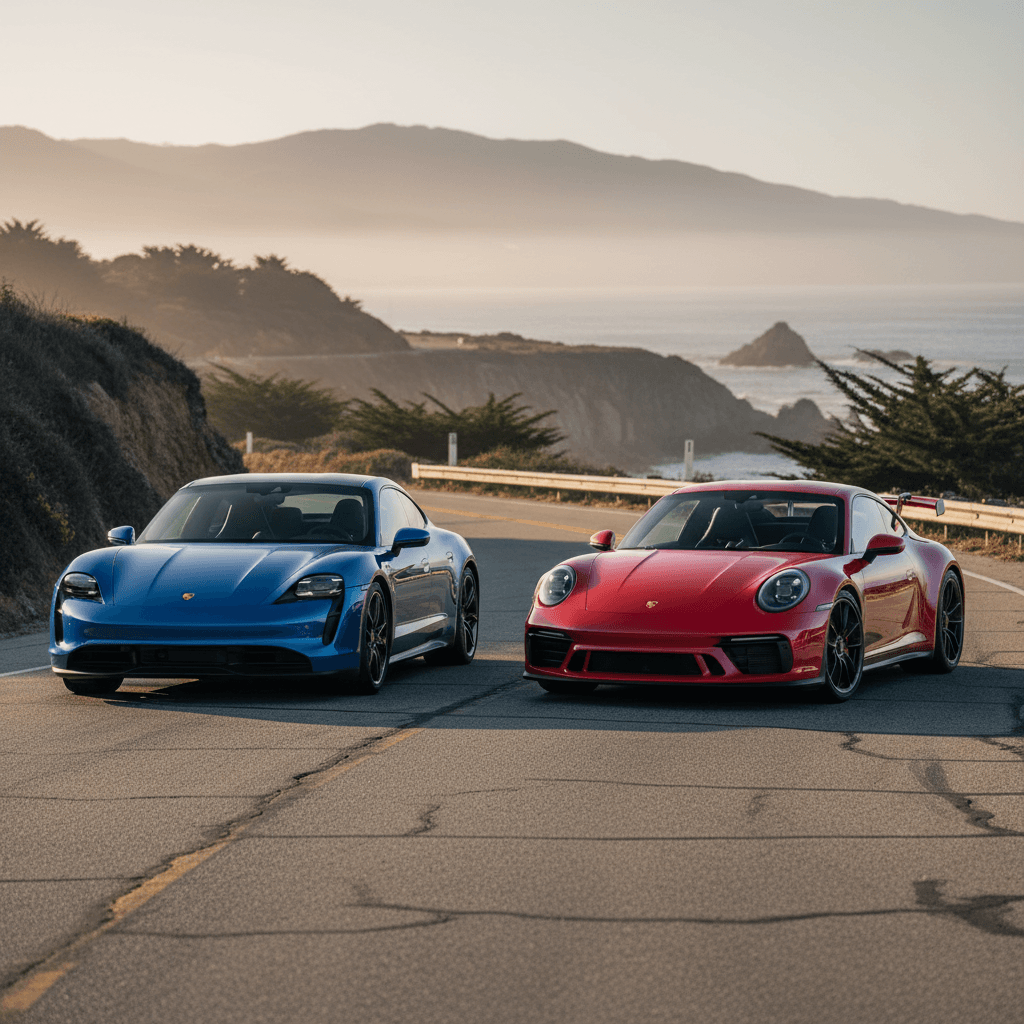
You’re standing at the spiritual fork in the road of modern performance cars: Porsche Taycan vs Porsche 911. One is the future, silent, violently quick, tech-forward. The other is the six‑decade sports‑car benchmark, still burning premium gas and goodwill in equal measure. Picking between them isn’t just about lap times; it’s about how you live, what you value, and how you feel every time you press the starter, or the “On” button.
Same badge, very different promises
Taycan vs 911: What You’re Really Choosing Between
Porsche Taycan (EV super-sedan)
- Body style: 4-door fastback sedan or wagon (Cross Turismo)
- Powertrain: Dual- or single‑motor electric, 79–105 kWh battery (depending on model year and trim)
- Performance: 0–60 mph from ~5.0 sec (base RWD) to ~2.3 sec (Turbo S / Turbo GT)
- Mission: Everyday usability + brutal straight‑line pace + quiet, tech‑heavy refinement
Porsche 911 (sports car icon)
- Body style: 2+2 coupe or cabriolet
- Powertrain: Rear‑ or all‑wheel‑drive flat‑six gasoline engines, now with hybrid assistance on some 992.2 models
- Performance: 0–60 mph from ~4.0 sec (base Carrera with PDK) down to the low‑2s in Turbo S territory
- Mission: Emotional, analog‑leaning sports‑car experience with bank‑vault build and strong resale value
Decide by use‑case, not horsepower
Headline Numbers: Taycan vs 911 (Typical Modern Trims)
Performance & Driving Feel: Electric Punch vs Mechanical Theater
On paper, the Porsche Taycan and 911 often trade blows. A Taycan 4S or GTS will run with, and sometimes out‑drag, a Carrera S or 4S. Turbo and Turbo S Taycans punch into true supercar territory. But how they go fast, and how that speed feels, could not be more different.
How Each Porsche Makes Speed
Same crest, radically different sensations
Taycan: Instant, silent violence
- Instant torque: Electric motors hit hard from 0 rpm; city speeds feel effortless.
- All‑weather traction: Dual‑motor AWD Taycans deliver huge grip, especially in wet or cold conditions.
- Weight: You’re hustling a ~5,000‑lb sedan, but Porsche’s chassis tuning and optional adaptive suspension mask the mass better than physics says they should.
- Track reality: Immense one‑lap pace. On longer sessions, battery heat management and weight eventually make themselves known.
911: Light on its feet, alive in your hands
- Engine character: A twin‑turbo flat‑six that sings, snarls, and pops, especially in S, GTS, and GT models.
- Balance: Rear‑engine traction out of corners, a front end that telegraphs grip the old‑fashioned way through the steering wheel.
- Transmission: Razor‑sharp PDK dual‑clutch or a true manual in select trims.
- Track reality: Built for this. Brakes, cooling, and tire options all say “stay all day.”
If pure driving joy is the only goal…
But don’t underestimate Taycan talent
Running Costs: Electricity vs Premium Gasoline
Here’s where the Taycan quietly annihilates the 911, at least if you drive much. Electricity is cheaper per mile than premium gas almost everywhere in the U.S., and EVs have far fewer moving parts to service. The 911 counters by being simpler to fuel on road trips and less dependent on charging infrastructure.
Typical U.S. Running Costs (High‑Level Illustration)
Exact numbers will vary by electricity prices, gas prices, and how hard you drive, but the pattern is remarkably consistent.
| Factor | Porsche Taycan (EV) | Porsche 911 (gas) |
|---|---|---|
| Energy cost per mile | Generally lower, especially with home charging and off‑peak rates | Higher, premium fuel, 18–22 mpg in mixed real‑world driving |
| Routine maintenance | Tire rotations, brake fluid, cabin filter; less wear on brakes thanks to regen | Oil changes, plugs, belts, filters, plus more complex exhaust and cooling systems |
| Unexpected repairs (long‑term) | Battery and high‑voltage components are expensive but typically well‑warrantied; fewer small mechanicals to fail | More mechanical systems overall; excellent reliability record, but more things that can age |
| Road‑trip fueling | Fast DC charging, but you plan your stops; great on major corridors, trickier off the beaten path | Gasoline anywhere; no planning, just pay and go |
Energy and maintenance are where Taycan starts to claw back its higher MSRP, especially if you buy used.
Home charging is the quiet superpower
Depreciation & Used-Market Reality
This is where the decision gets financially interesting. The Taycan and the 911 live on opposite sides of the depreciation curve. One falls like a tech gadget, the other glides down like a limited‑production mechanical watch.
How Each Porsche Treats Your Wallet Over Time
Same brand, very different curves
Taycan: Brutal up front, kinder later
- Early Taycans have seen extremely steep depreciation, some examples are trading at roughly half their original MSRP within 3–4 years.
- This is painful for first owners but fantastic for second and third owners, who get six‑figure‑MSRP performance for high‑end BMW money.
- Battery health and option sets matter a lot; well‑optioned, clean‑history cars with strong battery reports tend to stabilize and behave more like used 911s over time.
911: The slow fade
- The 911 is famously resistant to depreciation, especially well‑specced Carreras, S models, and anything with a GT badge.
- You still lose money, but the slope is gentle; it’s not uncommon for clean 911s to command strong money a decade on.
- If low total cost of ownership and eventual resale are critical, the 911 is one of the safest places to park car money.
Don’t ignore Taycan battery health when buying used
If you’re buying new, the 911 is usually the safer financial move. If you’re buying used, especially from a trusted source that can prove battery health, a Taycan can be the wildly undervalued bargain in Porsche‑land.
Practicality & Daily Usability
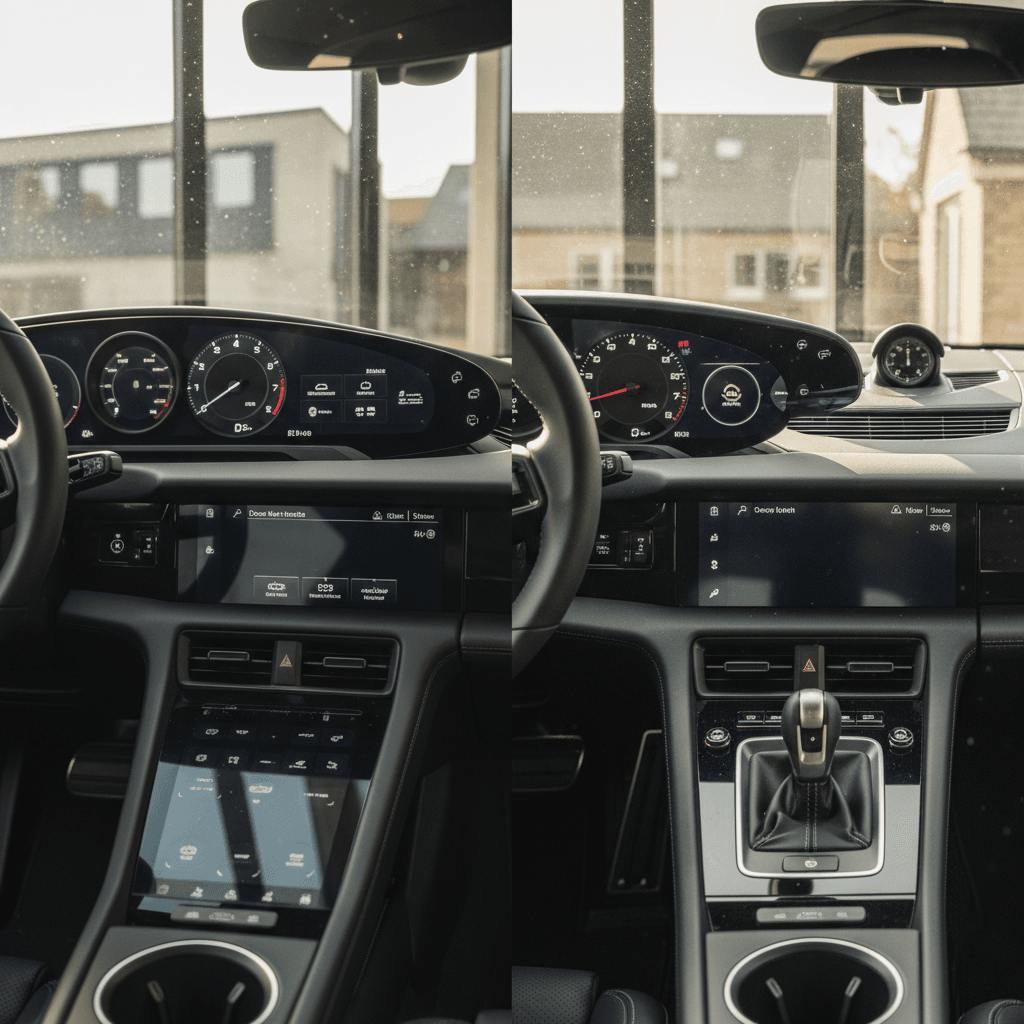
Taycan: The grown‑up choice that happens to be a rocket
- Space: Four real doors, adult‑usable rear seats (especially in the sedan/Cross Turismo), more legroom and easier ingress/egress.
- Cargo: Front trunk + rear trunk; Cross Turismo wagons are shockingly useful.
- Comfort: Quiet, refined, with air suspension options that turn rough commutes into non‑events.
- Climate: Instant heat in winter, great for cold‑weather starts. Range does dip in extreme temps, but so does mpg in a 911.
911: A livable toy, but still a toy
- Space: Two good front seats, tiny rear buckets that are fine for kids, dogs, or jackets.
- Cargo: A modest frunk and some space behind the rear seats, but you’re not hauling IKEA wardrobes.
- Comfort: Daily‑drivable if you accept a firmer ride, more cabin noise, and the ergonomics of a car engineered around the driver, not the family.
- Weather: Modern 911s with AWD, winter tires, and stability systems are perfectly usable in bad weather, but you’ll still be stopping for gas more often.
Kids, car seats, and real life
Ownership Experience, Sound, and Image
A 911 is theater. You turn a real key or press a switch, and a flat‑six coughs awake behind you. You feel the driveline, smell warm oil on a hot night, catch reflections of that curved roofline in shop windows. It’s deeply, gloriously analog in its emotional palette, even as the tech quietly modernizes.
A Taycan is science fiction come true. You glide out of your neighborhood on electrons and silence, then warp to highway speed in a way that feels less like acceleration and more like a render glitch. There’s optional synthetic sound, but the car’s real soundtrack is the space‑age whir of motors and the sub‑bass thump of instant torque.
What Each Porsche Says About You (Rightly or Wrongly)
Garage psychology, unscientific but real
911 owner
Perceived as: traditionalist enthusiast, knows their cars, probably reads spec sheets for fun.
Message: "I love driving and I wanted the icon."
Taycan owner
Perceived as: tech‑forward, EV‑curious (or committed), wants performance without the gas‑station ritual.
Message: "I love driving and I like the future."
If you keep both…
You’ve effectively split the atom: Taycan as fast, quiet daily; 911 as weekend and track toy. That combo covers 99% of driving experiences worth having.
Which Porsche Fits Your Life? Buyer Profiles
Match Yourself to the Right Porsche
1. The Daily-Driver Commuter
You drive most days, often in traffic. Comfort, quiet, and low running costs matter. You want something that still feels special on a Monday morning. <strong>Recommendation:</strong> Taycan RWD/4S/GTS depending on budget. It behaves like a luxury sedan but goes like a supercar.
2. The Weekend Warrior
You have another car for the grind. This one is for backroads, canyon mornings, and the occasional track day. You live for steering feel and engine noise. <strong>Recommendation:</strong> 911 Carrera S, GTS, or a lightly used GT car if your budget stretches.
3. The One-Car-To-Do-It-All Household
You need four usable seats at least some of the time, road‑trip capability, and you don’t want a SUV. <strong>Recommendation:</strong> Taycan sedan or Cross Turismo. It’s the closest thing to an electric 911 wagon that Porsche actually builds.
4. The Long-Term Value Hawk
You care a lot about resale, residuals, and the idea of parking money in a car that won’t evaporate in five years. <strong>Recommendation:</strong> 911. Especially well‑specced Carreras and special models; they are historically safer bets.
5. The Tech-Forward Early Adopter
You love OTA updates, digital dashboards, and the idea that your car is more smartphone than steampunk. You’re fine working around charging for the right experience. <strong>Recommendation:</strong> Taycan, ideally bought used once the steepest depreciation is behind it.
6. The Apartment or Street Parker
You don’t have predictable home charging and rely on public infrastructure. <strong>Recommendation:</strong> Strong lean toward a 911 unless your local DC fast‑charging network is dense and reliable enough to make a Taycan painless.
Quick Spec Comparison: Taycan vs 911 Carrera
Representative Modern Trims (Approximate Factory Figures)
These aren’t exhaustive spec sheets, just anchors for how the cars line up in typical configurations.
| Spec | Taycan 4S (EV) | 911 Carrera 4S (Gas) |
|---|---|---|
| 0–60 mph | ≈ 3.5 sec (Launch Control) | ≈ 3.4 sec with PDK |
| Drivetrain | Dual‑motor AWD | Flat‑six, AWD |
| Power | ~520 hp equivalent (overboost) | 443 hp |
| Energy use / economy | EV range commonly ~280–300+ miles in newer trims, depending on spec and conditions | ~20 mpg combined in spirited real‑world use |
| Seats | 4 (adult‑usable rear) | 2+2 (tight rear seats) |
| Luggage | Front + rear trunk | Front trunk + rear shelf |
| Noise level | Very quiet; optional synthetic sound | Classic flat‑six soundtrack, more cabin noise |
Both are properly fast; the real differences show up in body style, efficiency, and how you use them.
Buying Used: How Recharged De-Risks the Decision
Most shoppers cross‑shopping a Porsche Taycan vs Porsche 911 aren’t buying brand‑new; they’re hunting the sweet spot of value and performance. That’s where how, and where, you buy matters as much as which badge is on the decklid.
Why a Used Taycan or 911 Is a Very Different Buy on Recharged
Same dream car, more transparency
Verified battery health for Taycan
Fair market, not fantasy pricing
EV-specialist help & delivery
Ready to find your next EV?
Browse VehiclesSide‑by‑side, apples‑to‑apples
FAQ: Porsche Taycan vs Porsche 911
Frequently Asked Questions
Final Thoughts: So, Taycan or 911?
If you reduce it to a single sentence, here it is: Buy a Taycan if you want an everyday weapon from the future; buy a 911 if you want a forever sports car from the past that refuses to die. Both are deeply satisfying, both are recognizably Porsche, but they scratch different itches.
In a two‑car garage, the answer is obviously “both”: Taycan as fast, quiet daily; 911 as weekend and track accomplice. In a one‑car life, the choice runs through your daily realities, charging vs gas, kids vs no kids, commute vs canyons, and your appetite for EV tech versus mechanical nostalgia.
Whichever way you lean, don’t buy on badge and paint color alone. For Taycans, demand hard data on battery health. For 911s, demand complete service history and a thorough inspection. Recharged was built to make exactly these decisions simpler, pairing transparent pricing with expert‑guided support and the Recharged Score Report on every EV. That way, whether you choose electrons or octane, the only surprise you get is how much you look forward to the next drive.