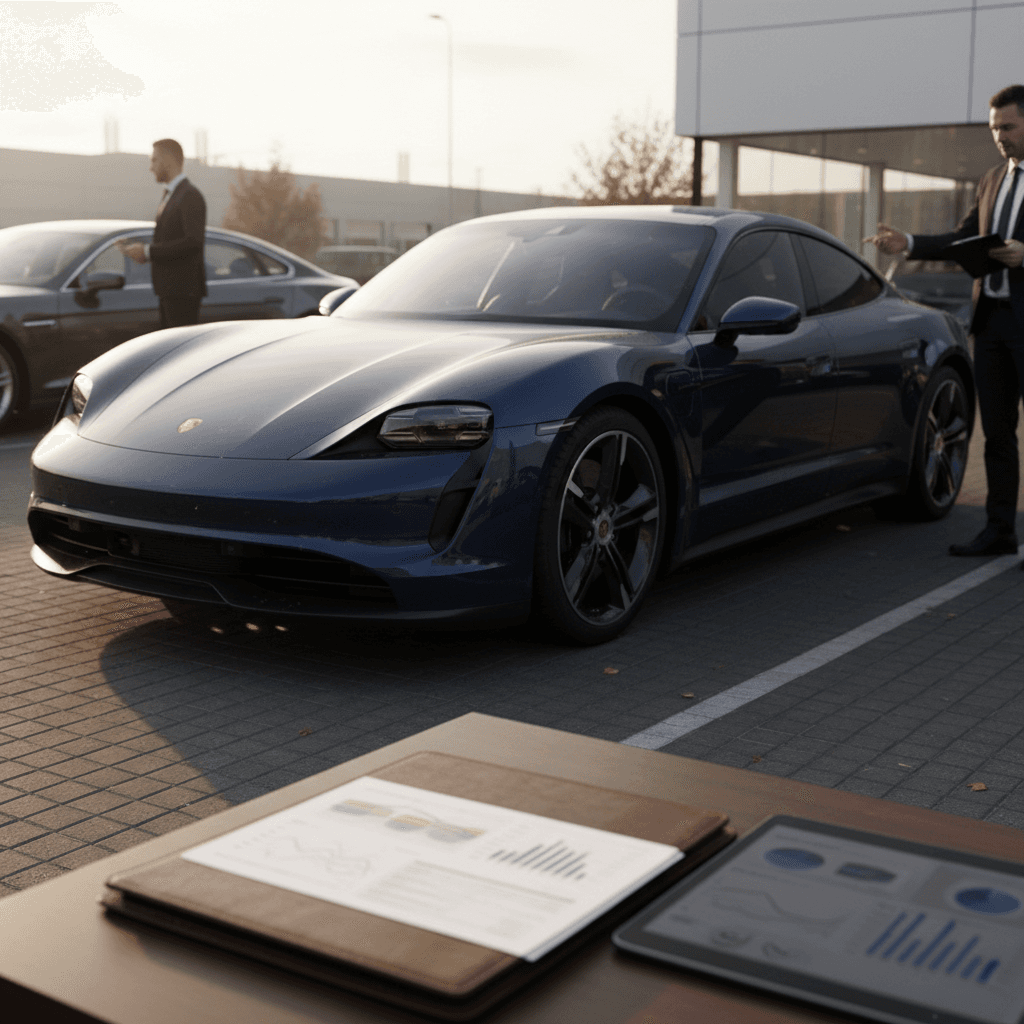
If you own a Porsche Taycan, you’re sitting on one of the most desirable used EVs on the market, but also one of the most volatile. In the last couple of years, Taycan values have swung sharply as EV prices reset, technology moved fast, and used‑car demand cooled. Understanding your Porsche Taycan trade‑in value in 2025–2026 is the difference between leaving thousands on the table and walking away with real leverage.
Quick snapshot
Why Porsche Taycan trade‑in value matters now
For most owners, the Taycan wasn’t a rational purchase, it was an emotional one. But when it’s time to sell, the math matters. Over five years, a Taycan can shed well over 50% of its original MSRP, and that depreciation often accelerates when a new battery update, range bump, or tech refresh hits. At the same time, lingering supply tightness in some luxury segments means clean, low‑mile cars can still pull surprisingly strong offers.
If you’re looking to trade your Taycan on another EV or cash out while values are still comparatively firm, this guide walks through current pricing, real‑world depreciation, what actually moves offers up or down, and how marketplaces like Recharged can help you get credit for things traditional trade tools ignore, especially battery health.
Porsche Taycan value by the numbers
Current Taycan prices and real‑world trade‑in ranges
To get a feel for what your Porsche Taycan is worth today, it helps to look at both new‑car MSRPs and current used listing data. While the exact number depends on trim, mileage, options, and condition, there are clear bands where most trades land.
Typical Porsche Taycan price and trade-in bands (U.S., 2025–2026)
Illustrative ranges for well‑maintained cars with average miles and clean history. Your actual number may be higher or lower.
| Model years / type | Example trims | Typical retail asking price* | Likely dealer trade-in range* |
|---|---|---|---|
| 2024–2025 nearly new | Taycan, Taycan 4, 4S, GTS | $90,000–$135,000 | $80,000–$120,000 |
| 2022–2023 mid‑cycle | Taycan 4S, GTS, Turbo | $70,000–$110,000 | $60,000–$95,000 |
| 2020–2021 early builds | Base, 4S, Turbo | $55,000–$85,000 | $45,000–$75,000 |
| Cross Turismo / Sport Turismo | 4, 4S, GTS, Turbo | Typically +$5k–$10k vs. sedan | Trade premium of $3k–$7k |
| High‑performance halo | Turbo S, Turbo GT | Often still above $140,000 | $110,000–$130,000+ |
Use these bands as a starting point, then refine using battery health, condition, and local demand.
About these numbers
How fast does a Porsche Taycan depreciate?
The Taycan behaves like most high‑end German metal: a steep early drop, then a more orderly slide. But as an EV, it also faces rapid tech updates and shifting incentives, which can amplify resale swings.
Years 0–3: The steep part of the curve
- Typical first‑year hit around 15% of MSRP for mainstream Taycan trims.
- By year 3, many 4S models have lost roughly 40–45% of original value, especially if miles are above average.
- Mid‑cycle updates (battery capacity increases, charging upgrades, software features) can push older cars down another step.
Years 4–6: Slower, value‑oriented buyers
- Annual depreciation often settles in the mid‑teens, especially once the car is out of bumper‑to‑bumper warranty.
- Buyers become more sensitive to battery health, repair history, and warranty coverage than paint‑to‑sample colors.
- Strong brand equity helps Taycan hold value slightly better than some EV rivals, but not enough to escape EV price pressure entirely.
How Taycan compares to the market
Factors that move your Taycan trade‑in value up or down
Key drivers of Porsche Taycan trade-in value
What appraisers and online buyers actually look at
Miles & usage
For a Taycan, mileage bands matter a lot. A car under 15,000 miles can be worth thousands more than an otherwise similar car with 40,000+ miles. Frequent DC fast charging without proper battery care can also raise eyebrows.
Condition & history
Clean Carfax/AutoCheck, no structural damage, and documented Porsche service are table stakes in this price bracket. Wheel rash and minor cosmetic flaws won’t kill a deal, but they give dealers bargaining room.
Battery health & warranty
Because a battery pack is the single most expensive component, any verified report on state of health (SoH) can raise or lower offers. Cars still within Porsche’s 8‑year/100,000‑mile HV battery warranty usually trade stronger.
Trim & options mix
Performance Battery Plus, adaptive air suspension, 4S or GTS trims, and desirable wheel/brake packages all help. Odd color combos or heavy personalization can narrow your buyer pool and soften trade value.
Market & seasonality
High‑income metro areas with dense EV infrastructure tend to support higher Taycan prices. Tax‑time months and early fall (before winter range anxiety kicks in) often see firmer luxury EV demand.
Tech & charging updates
New features like higher DC charge rates or native access to Tesla Superchargers can reshape shopper expectations and push older builds down a rung, especially if adapters or software updates are not included with the car.
Seller’s edge
Battery health: why it matters more for a Taycan
With any EV, the battery is the story. On the Taycan, it’s the headline and the fine print. Buyers paying $60,000–$120,000 for a pre‑owned Porsche expect both performance and usable range to hold up. That’s why proving your battery’s health can shift trade‑in value more than almost any other lever you can pull.
Battery health checklist before you request Taycan offers
1. Pull a recent battery diagnostic
Use Porsche diagnostics or a reputable third‑party EV health tool to capture state‑of‑health (SoH), DC charge count, and any battery fault codes. Save this as a PDF.
2. Document charging habits
If you primarily used Level 2 home charging and avoided frequent 100% fast charges, mention that in your listing or when speaking with appraisers. It reassures buyers who know what to look for.
3. Note remaining battery warranty
Porsche’s high‑voltage battery warranty runs for up to eight years/100,000 miles. Make sure you know your in‑service date and mileage so buyers can quickly see how much coverage is left.
4. Fix simple range-impacting issues
Worn tires, incorrect pressures, or outdated software can all hurt real‑world range. Address the basics and update software before your evaluation so test drives feel as strong as possible.
5. Be ready to share reports
Whether you trade into a franchised dealer or an online marketplace like <strong>Recharged</strong>, having a battery report ready separates your Taycan from anonymous auction cars and supports a higher number.
How Recharged uses battery data
Ready to find your next EV?
Browse VehiclesPorsche Taycan vs Tesla Model S resale value
It’s impossible to talk about Taycan trade‑in value without mentioning the Tesla Model S. Both are large, fast electric sedans with premium badges, and both have been hammered by recent EV price resets. Yet they don’t behave identically in the used market.
Taycan vs. Model S: how resale stacks up
High‑level comparison of resale dynamics for 1–5‑year‑old cars.
| Factor | Porsche Taycan | Tesla Model S |
|---|---|---|
| 5‑year depreciation (approx.) | ~59% loss of value | ~65% loss of value |
| Recent 1‑year used price change | Down roughly 26% for typical used examples | Down ~15–22% depending on model year |
| Brand perception | Traditional luxury, lower volumes, stronger dealer network | Tech‑forward, higher volumes, heavy discounting on new cars |
| Buyer priorities | Driving dynamics, build quality, Porsche badge | Range, software ecosystem, Supercharger access |
| Effect on trade‑ins | Better retention vs some EVs, but still volatile in down markets | Heavy supply and frequent new‑car price cuts push trade offers down |
In percentage terms, Taycan has held value slightly better than Model S, but both have seen big dollar drops.
Why this matters for your trade
How to estimate your own Taycan trade‑in value
Online pricing tools are a start, but they can lag fast‑moving EV segments and rarely account for nuanced options like Porsche’s brake and suspension packages. A more realistic approach combines data from multiple sources with what you know about your car.
- Start with the basics: plug your VIN, mileage, and ZIP into a few appraisal tools to get a rough trade‑in range and private‑party estimate.
- Check real listings: look at comparable Taycan trims within a few hundred miles, similar model year, miles, options, and color. Those asking prices are the ceiling; trade value will be lower.
- Adjust for condition and history: if your car has curb rash, paintwork, or a prior accident, mentally subtract. If it’s pristine with full records, you can lean toward the high end of online ranges.
- Layer in battery health: if you have a recent battery report showing strong state‑of‑health and limited DC fast‑charge use, expect that to support offers toward the top of the band.
- Sense‑check against alternatives: ask yourself what else someone could buy at your asking price, high‑spec Model 3 Performance, Lucid Air, EQE, etc. If your number feels optimistic compared to those, buyers and dealers will think so too.
Use a spread, not a single number
Strategies to maximize your Taycan trade‑in offer
Practical ways to lift your Taycan’s trade-in value
Most owners can meaningfully improve their number in a weekend
Detail and recondition smartly
Have the car professionally detailed, repair inexpensive curb rash, address obvious door dings, and replace worn wipers or inexpensive trim. A few hundred dollars in reconditioning can add thousands to perceived value on a six‑figure EV.
Organize records and accessories
Gather service history, charger receipts, wheel/tire paperwork, and recall documentation. Include both key fobs, the owner’s manual, original floor mats, and the factory mobile charger or wallbox if you’re not using it anymore.
Time your trade
Values tend to be firmer when luxury buyers are active, tax refund season, early summer road‑trip planning, and in some markets ahead of year‑end bonus season. Trading in the middle of a local EV slump can cost you real money.
Shop multiple channels
Get numbers from your local Porsche store, a couple of high‑end independent dealers, and online buyers, including marketplaces like Recharged that specialize in used EVs. Let them compete; don’t take the first offer as gospel.
Decide on trade vs. sale
In many U.S. states, trading in your Taycan reduces the taxable amount of your next purchase. A slightly lower trade value may still beat a private‑party sale once sales tax savings and hassle are factored in.
Consider consignment
If you’re not in a rush and your Taycan is especially desirable (rare color, Turbo S, low miles), consignment through an EV‑focused platform like Recharged can expose it to a wider audience at retail rather than wholesale pricing.
Avoid these common mistakes
Where to sell or trade your Porsche Taycan
Once you understand your likely trade‑in range, the next decision is where to shop the car. Each channel values a Porsche Taycan slightly differently, and the spread between the best and worst number can easily reach five figures.
Franchised Porsche dealer
- Strong appetite for late‑model, low‑mile Taycans they can CPO.
- Best fit when you’re trading into another Porsche and can leverage sales tax credits.
- Can be conservative on early‑build cars or those with non‑Porsche mods.
High‑end independents & auctions
- Some independent luxury dealers specialize in performance EVs and will step up for rare specs.
- Online auction platforms can shine for unusual colors or heavily optioned GTS/Turbo S cars.
- Fees, transportation, and buyer financing risk can eat into top‑line numbers.
EV‑focused marketplaces like Recharged
- Built around used EVs, with buyers who understand battery reports and charging history.
- Recharged offers instant‑offer, trade‑in and consignment paths, plus a Recharged Score Report that showcases your Taycan’s battery health.
- Digital process with nationwide reach and optional delivery simplifies selling a high‑ticket EV.
FAQ: Porsche Taycan trade‑in value
Frequently asked questions about Porsche Taycan trade-in value
Bottom line on Porsche Taycan trade‑in values
A Porsche Taycan is not a depreciation champion, but it’s not a disaster either, especially compared with some early EVs. Values have reset sharply from pandemic highs, yet well‑spec’d, low‑mile cars with clean history and documented battery health still command real money. The owners who come out ahead are the ones who treat trade‑in value as a moving target, track market conditions, and present their cars with the same attention to detail Porsche put into building them.
If you’re considering trading or selling your Taycan, start by building a realistic value band, then line up competing offers from local dealers, online buyers, and EV‑focused platforms. A marketplace like Recharged, with battery diagnostics, a Recharged Score Report, and flexible paths from instant offer to consignment, can turn your Taycan’s strengths into real dollars instead of just line items on a Monroney sticker.