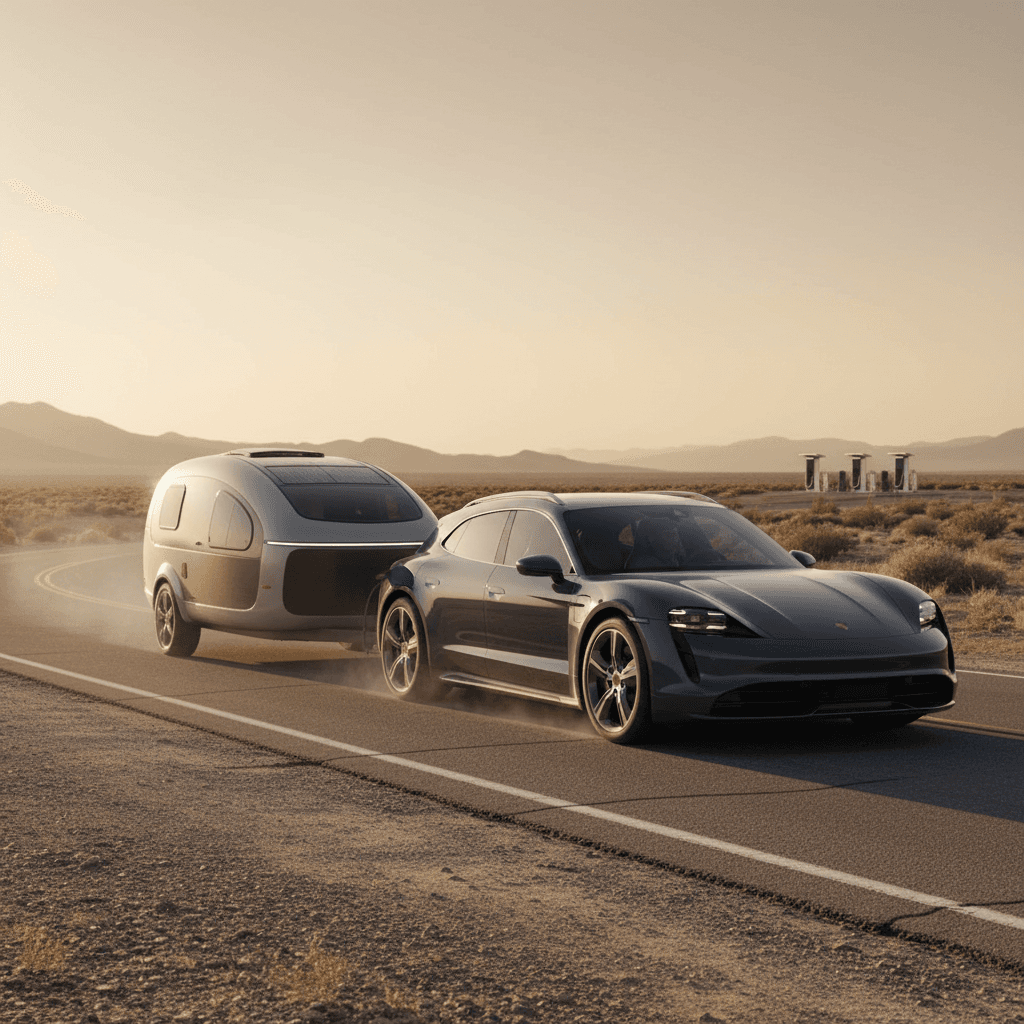
You don’t buy a Porsche Taycan because you secretly want a pickup. You buy it because you like fast, beautiful things that just happen to be electric. But life is messy: bikes, track tires, a pair of kayaks, maybe a small camper. Suddenly you’re on Google at midnight typing “Porsche Taycan towing capacity and range loss” and wondering if this sleek German electron torpedo can actually do truck stuff.
Quick takeaway
Porsche Taycan towing overview
Here’s the headline: the Taycan was engineered first as a low‑slung electric sports sedan, and only secondarily as a utility device. That said, Porsche quietly gave the wagon-bodied Cross Turismo and Sport Turismo real towing capability in Europe and other markets, while the standard sedan is mostly treated as a non‑towing car in North America.
- Factory tow prep exists for wagon body styles in many regions; it’s a proper, integrated solution, not a U‑Haul special.
- European‑spec Taycan Cross Turismos commonly carry a braked towing rating around 2,200–2,650 lbs (1,000–1,200 kg) when equipped with the factory tow bar.
- In U.S. documentation, many sedan models are listed as “towing not recommended,” so dealers will typically refuse to install or support a hitch on those cars.
- Regardless of rating, any EV towing at highway speeds takes a major range hit; the Taycan is no exception.
Warranty reality check
Taycan towing capacity by model and market
Towing with a Taycan isn’t just yes or no; it depends heavily on body style, market, and equipment. Use this as a high‑level guide and always verify against the specific owner’s manual for your VIN.
Approximate Taycan towing capacity by body style
High‑level view of how different Taycan variants are typically treated for towing. Always confirm against your specific market’s documentation.
| Model family | Body style | Factory tow bar available | Typical braked tow rating | Typical unbraked rating | U.S. stance |
|---|---|---|---|---|---|
| Taycan / Taycan 4S / Turbo (sedan) | Sedan | No in most markets | 0 lbs (not rated) | 0 lbs | Often “towing not recommended” |
| Taycan GTS Sport Turismo | Low wagon | Yes in many EU markets | ≈2,200–2,650 lbs | ≈1,650 lbs | Limited availability; towing often not referenced |
| Taycan 4 Cross Turismo | Raised wagon | Yes | ≈2,200–2,650 lbs | ≈1,650 lbs | Cross Turismo tow package rare but sometimes seen |
| Taycan Turbo Cross Turismo | Raised wagon | Yes | ≈2,200–2,650 lbs | ≈1,650 lbs | Same story: check individual car |
| Aftermarket hitch (sedan or wagon) | Any | Varies by vendor (often 1,500–2,000 lbs suggested) | Varies | Unofficial | Usually not supported by Porsche |
Towing ratings vary by region; these values are typical for factory‑equipped cars in markets where towing is approved.
Why wagons get the hitch
If you’re shopping used, it’s worth specifically searching for Cross Turismo or Sport Turismo models with the factory tow package. On a site like Recharged, that’s the difference between a Taycan that can credibly replace the family wagon and one that’s basically a very fast, very pretty hatchback.
How much range you lose while towing
Now to the painful part. The Taycan is one of the more efficient big‑battery performance EVs, especially after the 2025 update, which pushed many trims into the 252–318‑mile EPA range window depending on configuration. But stick a trailer in that smooth German airflow and physics sends you a bill.
Typical Taycan range while towing
The exact number depends on three things you can’t negotiate with: aero, weight, and speed.
What really kills Taycan range when towing
All EVs suffer here, but the Taycan’s sleek body makes the contrast extra obvious.
1. Aerodynamic drag
2. Trailer + cargo weight
3. Average speed
Back‑of‑napkin rule for Taycan towing
That means a 2025 Taycan 4 Cross Turismo that might comfortably cover 260–280 miles between fast charges solo is more realistically a 140–170‑mile vehicle with a trailer. Plan your charging stops around that shorter figure, not the glossy brochure number.
Real‑world Taycan towing examples
Because Porsche doesn’t publish detailed “towing range” charts, you have to lean on physics and the growing body of owner reports for guidance. Patterns emerge pretty quickly.
Light, low trailer (best case)
- Setup: Taycan 4 Cross Turismo with factory tow bar, small aluminum utility trailer carrying 2–3 bikes, total extra weight ~600–800 lbs.
- Driving: 60–65 mph, mostly flat freeway.
- Result: Many owners report roughly 25–35% range loss. A 260‑mile solo car now feels like a 170–195‑mile car.
Small camper or box trailer (typical case)
- Setup: Same car, but with a 1,800–2,500‑lb teardrop or compact camper that sits higher than the roofline.
- Driving: 65–70 mph, mixed hills.
- Result: 40–50% range loss is common. A 280‑mile EPA car is suddenly a 130–160‑mile tow vehicle between charges.
High‑speed + hills = worst case
Battery health, heat and braking when towing
If you’re thinking long‑term, your next question is obvious: does towing in a Taycan hurt the battery or brakes? The short answer is that occasional, sensible towing is fine; repeated abuse is not.
What towing does to a Taycan mechanically
The car is overbuilt in some ways, but it’s not a heavy‑duty truck.
Battery & inverter heat
Regen vs. friction brakes
Suspension & rear structure
Keep your Taycan happy when towing
From a degradation standpoint, brief periods of high load aren’t a death sentence for the pack. What ages batteries most are deep cycles, high average temperatures, and chronic 100% charging. Towing just raises your energy use temporarily; if you let the car cool and avoid living at full charge, the long‑term impact is modest.
Planning trips in a Taycan with a trailer
If you approach Taycan towing like you would Cayenne towing, you’ll be miserable. The game here isn’t brute capacity; it’s precision planning. Fortunately, the Taycan’s fast‑charge capability, especially on 2025+ cars, which can hit 10–80% in roughly 18 minutes on a strong DC fast charger, makes that planning pay off.
Road‑trip checklist for Taycan towing
1. Start with a conservative range target
Take your solo highway range (EPA or real‑world) and slash it by 40%. Use that number as your <strong>planning</strong> range between DC chargers, not the optimistic figure in the trip computer.
2. Map chargers at 60–120‑mile spacing
With a trailer, your ‘buffer’ matters more than ever. Use apps like PlugShare and A Better Routeplanner and aim to hit fast chargers every 60–120 miles, depending on terrain and weather.
3. Prioritize easy‑access sites
Some charging stations are shoehorned into tight parking lots. When towing, favor highway sites with drive‑through bays or room to loop around so you’re not forced to unhitch just to reach the pedestal.
4. Charge in the middle of the pack
The Taycan charges fastest between roughly 10–60%. On tow trips, it’s often faster overall to stop more frequently for short, high‑power sessions than to sit once for a slow top‑off to 90%.
5. Watch weather and headwinds
Cold weather thickens the electrons, and strong headwinds make your trailer feel twice its size. Both can add another 10–20% penalty on top of your towing loss, so build extra margin into winter or storm‑season routes.
6. Do a shakedown run first
Before a 600‑mile vacation, do a 50–80‑mile local loop with your trailer to see how the Taycan behaves: consumption, stability, braking, and hitch noise. Adjust load and expectations accordingly.
Is a Taycan actually a good tow vehicle?
Here’s the frank answer: the Taycan is an excellent occasional tow vehicle for people who value driving dynamics first and utility second. It is not, and will never be, a direct replacement for a body‑on‑frame SUV or a heavy‑duty pickup if you regularly move serious weight over long distances.
Where the Taycan shines
- Stability: The low battery and long wheelbase make it unflappable with a modest trailer. It feels more planted than many crossovers.
- Torque: Instant shove off the line means no drama merging or passing, even loaded.
- Braking: Strong regen plus big brakes give you confidence, especially on mountain descents.
- Silence: No engine thrash. You hear the trailer and tires, which actually makes you a more attentive driver.
Where the Taycan falls short
- Range with a trailer: 120–170 miles per leg is typical. That’s fine for regional adventures, not ideal for crossing Nebraska.
- Packaging: It’s still a low sports sedan or wagon; kids, dogs, and gear quickly fill the cabin.
- Official support: In some markets, especially for sedans, towing simply isn’t approved by Porsche.
- Charging infrastructure: You’re dependent on public fast charging that may not be trailer‑friendly in layout.
Who should tow with a Taycan
Used Taycan shopping: towing and range checks
If you’re eyeing a used Taycan at a place like Recharged and towing is on your wish list, you have to think about two separate questions: can this particular car tow safely, and what’s its true usable range today?
Essential checks for a used Taycan you plan to tow with
1. Confirm body style and tow rating
Look up the VIN in Porsche documentation or ask for the original window sticker. You’re chiefly hunting for <strong>Cross Turismo or Sport Turismo</strong> with factory tow prep in markets where towing is approved.
2. Inspect the hitch setup
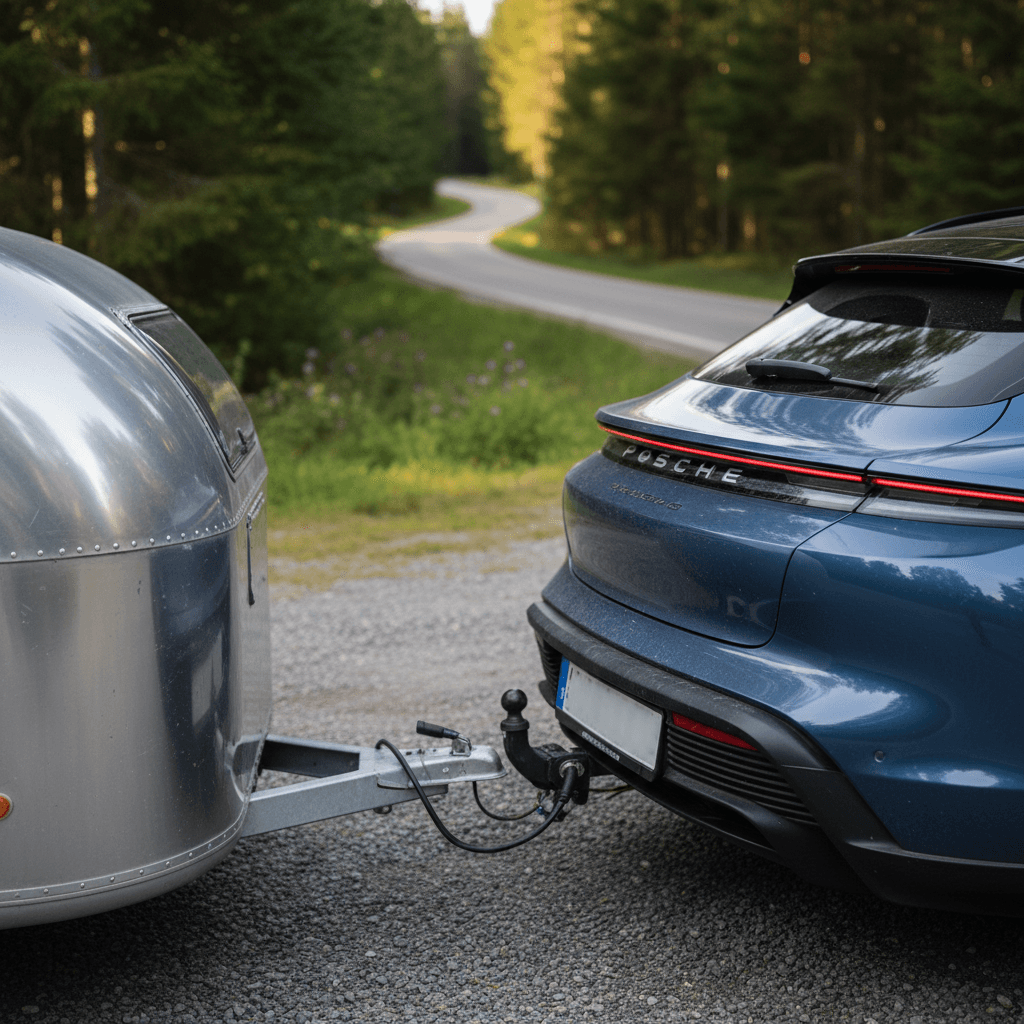
Factory tow bars integrate cleanly behind the bumper with a removable receiver. Aftermarket solutions often hang low or require trimming. Look for signs of overloading: bent hardware, cracked paint, or distorted mounting points.
3. Check brake and tire history
Towing is hard on consumables. Ask for records on pad and rotor replacements and check tire load ratings. An over‑tired Taycan is a joy; an under‑tired Taycan with a trailer is a headache.
4. Get objective battery health data
Range while towing is only as good as the battery underneath you. On Recharged, every EV comes with a <strong>Recharged Score report</strong> that includes independent battery health diagnostics, so you’re not guessing from a dash estimate.
5. Look for previous towing abuse
Scuffed rear bumper cover, deformed wiring connectors, or aftermarket trailer brake controllers crudely wired into the cabin can all hint at heavy previous towing, even if the seller swears it “only pulled a bike rack.”
How Recharged can help
FAQ: Taycan towing capacity and range loss
Frequently asked questions about Taycan towing
The Porsche Taycan will never be your neighbor’s three‑quarter‑ton truck, and that’s fine. What it offers instead is a kind of modern GT magic: a car that can blitz a back road in the morning, carry bikes to the trailhead in the afternoon, and hum quietly through the night on electrons alone. If you respect its limits, especially on towing capacity and range loss, and plan your routes with a bit of care, a Taycan wagon can absolutely anchor a small‑adventure lifestyle. And if you’re shopping used, the right inspection and battery‑health data turn this from a speculative experiment into a well‑understood upgrade to your garage.