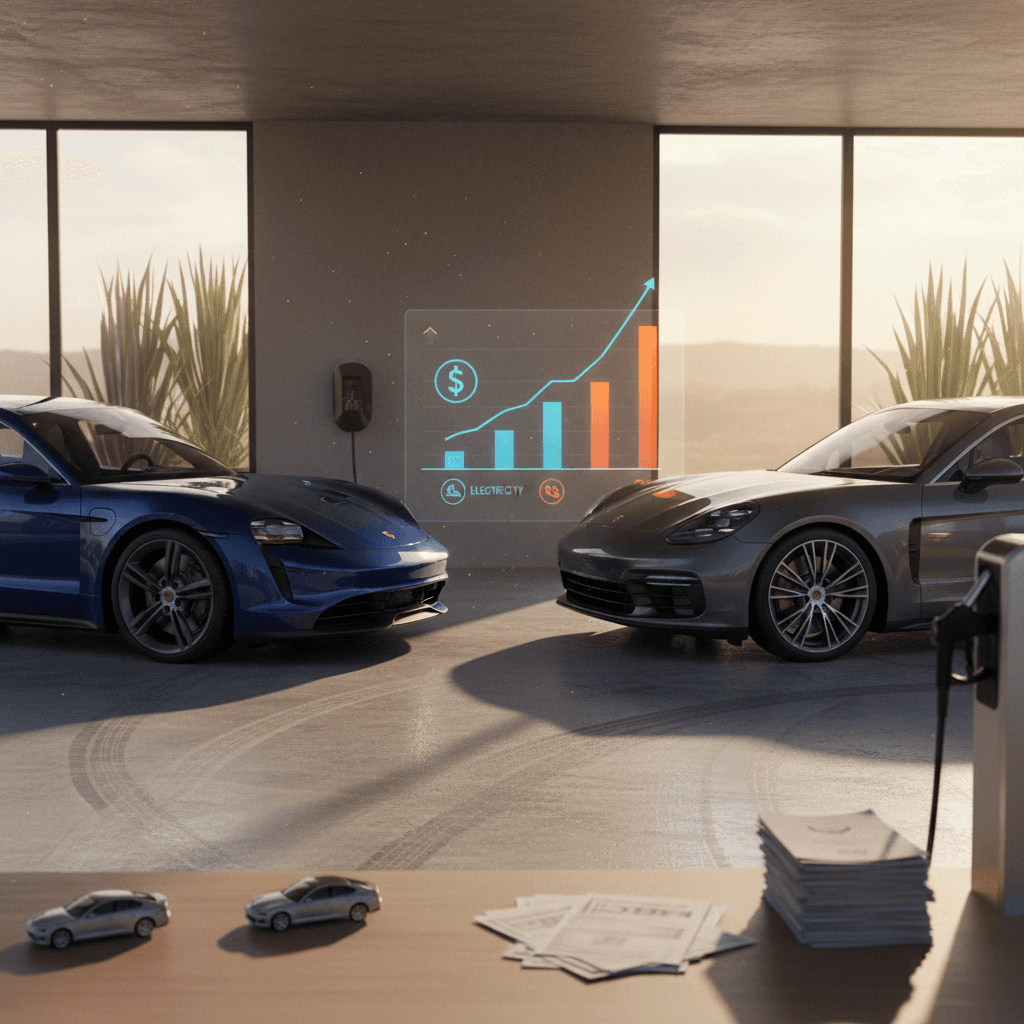
If you’re cross‑shopping a Porsche Taycan against a comparable gas Porsche, the sticker prices only tell a small part of the story. The real question most shoppers have is: what’s the Porsche Taycan total cost vs a gas car equivalent once you factor in energy, maintenance, depreciation, and everything else over several years of ownership?
What this guide covers
Why Taycan vs gas Porsche costs are tricky
Comparing a Taycan to a gas Porsche isn’t as simple as “EVs are cheaper to run.” You’re balancing higher upfront price and faster early depreciation against lower fuel and maintenance costs. On top of that, real‑world electricity and gasoline prices vary wildly by state, and so do things like EV registration fees and insurance.
- Porsche positions the Taycan as a high‑performance luxury EV, so its closest gas counterparts are also expensive to run.
- Electricity prices have risen over the last few years, but so has the price of premium gasoline.
- EV depreciation has been steeper recently than many people expected, especially for high‑MSRP models like the Taycan.
- How you charge (mostly at home vs mostly at DC fast chargers) can swing annual “fuel” costs by thousands of dollars over 5 years.
Don’t compare a Taycan to an economy sedan
Which gas Porsche is a fair comparison?
As of early 2025 pricing, a base Porsche Taycan and a base Porsche Panamera are in the same ballpark: U.S. base prices are around low‑six‑figures for both. That makes the Panamera, Porsche’s luxury four‑door grand tourer, the most sensible gas comparison for total cost of ownership. The Cayenne (especially in higher‑output trims) is another reasonable proxy if you prefer SUV form, but its fuel economy is even worse than the Panamera’s, which only strengthens the Taycan’s operating‑cost advantage.
Taycan (base, new)
- Approx. MSRP: ~$100,000 (2025 U.S. base price region)
- EPA‑rated range: mid‑200s miles depending on battery and wheels
- Performance: instant torque, sports‑sedan dynamics
Panamera (base, new)
- Approx. MSRP: slightly above $100,000 for 2025 models
- Real‑world fuel economy: typically high‑teens MPG combined for V6, worse for V8s
- Performance: similar luxury and speed, but with gas‑engine running costs
Why we focus on 5 years / 60,000 miles
Headline numbers: 5‑year cost summary
Illustrative 5‑Year Ownership Cost (New Taycan vs New Panamera)
These are not precise quotes, they’re directional scenarios based on U.S. averages for energy prices in 2024–2026, Porsche’s own maintenance plan pricing, and realistic depreciation curves for six‑figure luxury cars. The important takeaway is that a Taycan can match or slightly beat a comparable gas Porsche over 5 years if you charge smart and buy at the right point in the depreciation curve.
Big caveat on new vs used
Energy costs: electricity vs premium gas
Let’s start with the most visible line item: what it costs you every time you “fill up.” We’ll work with conservative, middle‑of‑the‑road assumptions appropriate for a U.S. driver who mostly charges at home but does some road‑trip DC fast charging.
Assumptions for 5‑Year Energy Cost Comparison
Realistic, not best‑case, numbers for a U.S. driver doing 12,000 miles per year.
| Parameter | Taycan (EV) | Panamera (Gas) |
|---|---|---|
| Annual miles driven | 12,000 mi | 12,000 mi |
| Efficiency (real‑world) | 2.8 mi/kWh | 20 mpg (premium) |
| Home electricity price | $0.17/kWh (U.S. 2024–26 avg) | , |
| Mixed DC fast charging | 20% of miles at highway trips | , |
| DC fast charging price | $0.40–0.45/kWh typical | , |
| Premium gasoline price | $4.00/gal long‑run assumption | Uses 91–93 octane |
Your local prices and driving style will change these numbers, but the relative gap tends to remain similar.
With those assumptions, 12,000 miles per year works out roughly like this:
Approximate Annual “Fuel” Costs
Home‑dominant charging scenario: 80% home, 20% DC fast charge for the Taycan.
| Taycan | Panamera | |
|---|---|---|
| Energy use per year | ≈4,285 kWh | ≈600 gallons |
| Home charging (80%) | 3,428 kWh × $0.17 ≈ $580 | , |
| DC fast charging (20%) | 857 kWh × $0.45 ≈ $385 | , |
| Total annual energy | ≈$965 | 600 gal × $4.00 ≈ $2,400 |
| 5‑year energy total | ≈$4,800 | ≈$12,000 |
Rounded numbers for clarity, your reality will rarely match the spreadsheet, but the magnitude is what matters.
Energy edge: Taycan saves ≈$7,000 over 5 years
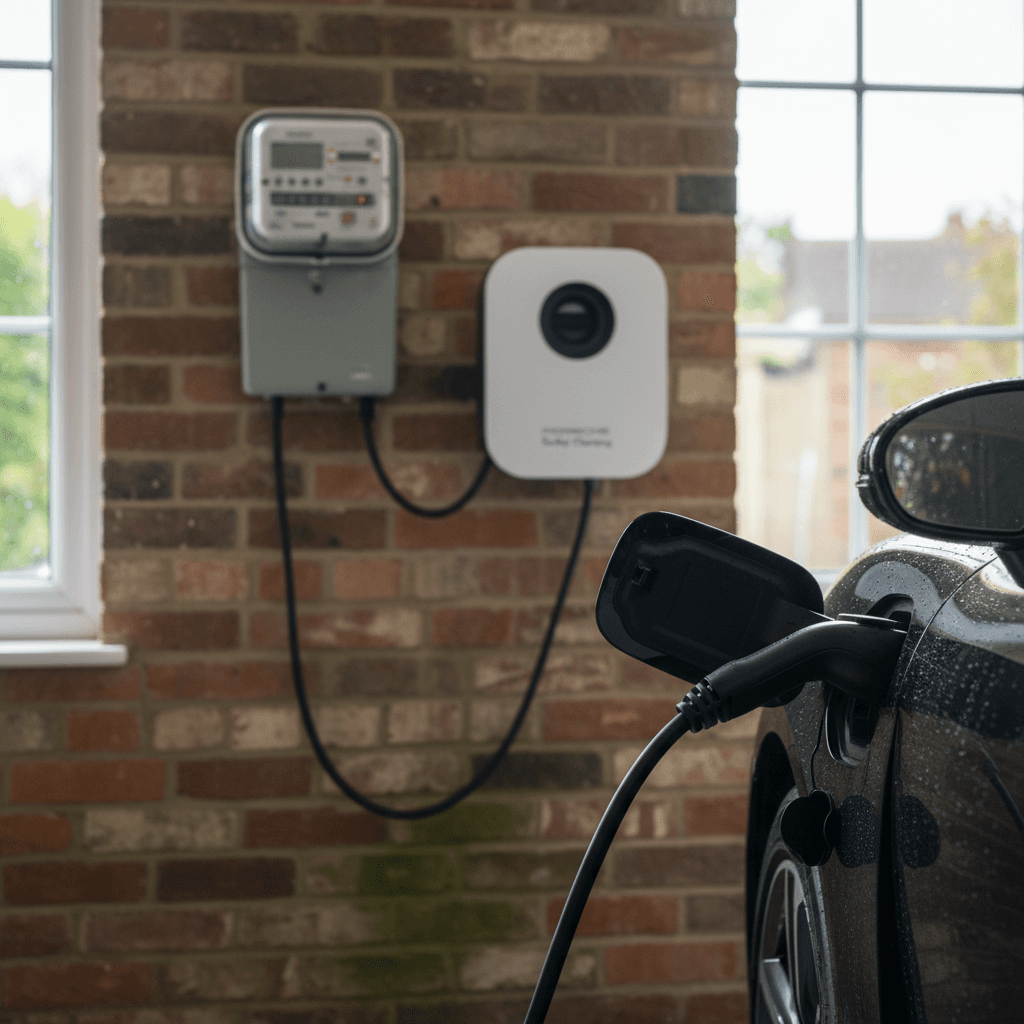
Home solar can supercharge the savings
Maintenance, repairs, and warranty differences
On maintenance, the Taycan benefits from the classic EV advantage: no oil changes, far fewer moving parts, and less brake wear thanks to regenerative braking. But “it’s an EV” doesn’t mean “maintenance is cheap” when the crest on the hood says Porsche.
Porsche Scheduled Maintenance Plan Pricing Snapshot
Illustrative 6‑year / 60,000‑mile factory maintenance plan MSRPs for 2025 model‑year Porsches.
| Model | 6‑Year / 60k mi Plan MSRP |
|---|---|
| Taycan | ≈$7,550 |
| Macan (gas SUV) | ≈$6,750 |
| Panamera* | Similar order of magnitude to Macan, varies by engine |
| Note | *Porsche doesn’t always publish a simple, single Panamera number, but real‑world owner reports confirm that high‑output gas Porsches are at least as expensive to service as Taycans. |
Actual dealer service bills can vary, but Porsche’s own plans give a good baseline for comparing EV vs gas complexity.
The key takeaway is that baseline scheduled maintenance costs are high for both, but once you factor in things like spark plugs, belts, fluids, and exhaust‑system complexity, gas Porsches tend to be at least as costly, and often more, over time. The Taycan’s big wild card is out‑of‑warranty repairs, especially anything involving battery or power electronics, which is why warranty coverage and battery health matter so much on the used market.
Where Taycan tends to be cheaper
- No oil changes or fuel‑system service
- Less brake wear thanks to regen (pads and rotors last longer in normal driving)
- Fewer engine‑related failure points (no turbos, head gaskets, etc.)
Where gas Panamera can bite harder
- Complex turbocharged engines with expensive parts and labor
- Transmission and driveline wear that EVs often avoid or minimize
- Additional fluids, filters, and emissions components over the life of the car
Don’t ignore tire costs
Insurance, taxes, and fees
Insurance will depend heavily on your driving record and ZIP code, but for many U.S. drivers a Taycan and a similarly priced Panamera will fall into a similar band: high, but not radically different from each other. Where things diverge is in state‑level EV fees and incentives.
Non‑energy ownership costs that matter
These don’t usually determine the winner, but they can nibble at (or boost) the Taycan’s advantage.
Insurance premiums
High‑MSRP luxury cars are expensive to insure regardless of powertrain. Some carriers currently price EV repairs higher, but others don’t. Quotes are the only reliable data here.
Registration & EV fees
Several states add annual EV fees to replace lost fuel‑tax revenue. In a few places, those fees can run into the hundreds of dollars per year and partially offset fuel savings.
Incentives & tax breaks
Federal and state incentives for new EVs have shifted repeatedly. Used EV tax credits and local utility rebates for home chargers can still shave thousands off your effective Taycan ownership cost.
Budget them similarly in your spreadsheet
Depreciation: where the real money actually moves
For six‑figure luxury vehicles, depreciation dwarfs everything else. Whether you burn gas or electrons, the biggest line item in a 5‑year total cost of ownership model is almost always how much value the car sheds between the day you buy it and the day you sell it.
New EVs, including the Taycan, have seen steeper depreciation than many owners expected, for a few reasons: rapid improvements in range and charging speed, shifting incentives, and a market still feeling out long‑term battery risk. Gas Porsches like the Panamera have a longer track record and, in many trims, more predictable resale behavior.
Illustrative 5‑Year Depreciation Scenarios (New Purchase)
Very rough, directional numbers assuming 12,000 miles per year and typical usage.
| Model | Purchase Price | Value After 5 Years | Depreciation Cost |
|---|---|---|---|
| Taycan (new) | $100,000 | $45,000–$50,000 | ≈$50,000–$55,000 |
| Panamera (new) | $105,000 | $50,000–$55,000 | ≈$50,000–$55,000 |
Exact resale values are highly spec‑dependent, but this gives you a sense of scale.
On paper, that looks like a wash. But in practice, timing and spec matter enormously. Early‑build Taycans with shorter range, or very high‑MSRP builds with expensive options, have already taken outsized hits. That’s painful for first owners, and a huge opportunity for savvy second owners.
Where used Taycans start to shine
Home charging vs fast charging: how it changes the math
So far we’ve assumed a relatively healthy mix of 80% home charging and 20% DC fast charging. Shift that balance and the Taycan’s “fuel” cost story moves a lot.
Scenario 1: Mostly home charging
- 90–100% of miles charged at home on a Level 2 charger.
- At ~$0.17/kWh, you’re effectively paying $0.25–$0.30 per ‘gallon equivalent’.
- Energy savings vs a Panamera can easily exceed $1,800 per year at typical premium‑gas prices.
Scenario 2: Mostly DC fast charging
- Frequent use of 150–300 kW highway fast chargers at $0.40–$0.60/kWh.
- Effective ‘gallon equivalent’ cost can approach or even exceed $4.00, especially in high‑cost markets.
- In the worst cases, the Taycan’s energy bill gets close to a Panamera’s, eroding one of its biggest advantages.
Plan for a home Level 2 charger if you can
Used Taycan vs used gas Porsche: a smart play?
From a total‑cost perspective, the used market is where the Taycan becomes most interesting. A 3‑year‑old Taycan has already shed a steep chunk of depreciation, often more than an equivalent Panamera. At that point, you’re buying into the flatter part of the curve, with most of the EV’s running‑cost benefits still ahead of you.
Key checks when comparing a used Taycan to a used gas Porsche
1. Battery health and warranty
Confirm remaining factory battery warranty (typically 8 years / 100,000+ miles) and look for a <strong>third‑party battery health report</strong>, like the Recharged Score, so you’re not guessing about degradation.
2. Charging profile history
A Taycan that lived on home Level 2 charging and occasional road‑trip fast charging is a better long‑term bet than one that relied heavily on DC fast charging every day.
3. Maintenance and recall history
For both Taycan and Panamera, you want fully documented dealer service, completed recalls, and clear records for any major repairs.
4. Local energy and fuel prices
If you live somewhere with very high electricity costs and relatively cheap gasoline, pencil that into your spreadsheet; the Taycan still may win, but by a smaller margin.
5. Financing and insurance on a used luxury car
Rates and insurance premiums can differ meaningfully between a 3‑year‑old Taycan and a 7‑year‑old Panamera. Make sure you quote both, not just assume parity.
Why a verified used Taycan can undercut gas
How Recharged helps you de‑risk a used Taycan
All of this total‑cost theory only matters if you’re confident in the specific car you’re buying. That’s especially true with high‑end EVs like the Taycan, where battery health and charging behavior matter as much as leather quality and option packages.
Buying a Taycan through Recharged
Reduce uncertainty, not just your fuel bill.
Recharged Score battery report
Every Taycan listed on Recharged includes a Recharged Score Report with verified battery health, so you can see how the pack has aged and how it’s performing today, critical for predicting long‑term total cost.
Transparent pricing & financing
You get fair‑market pricing on used EVs, access to financing, and options to trade in or sell your current car, making it easier to step into a Taycan at the right point in the depreciation curve.
Nationwide delivery & EV specialists
Recharged offers nationwide delivery and EV‑specialist support from start to finish, plus an Experience Center in Richmond, VA if you want to see and feel vehicles in person.
Side‑by‑side cost comparisons
Our team can help you compare a Taycan against other EVs or gas alternatives, looking at payment, energy, and maintenance rather than just an asking price on a screen.
Ready to find your next EV?
Browse VehiclesFAQ: Porsche Taycan total cost vs gas car equivalent
Frequently asked questions
Bottom line: is the Taycan cheaper to own?
When you put all the pieces together, purchase price, depreciation, energy, maintenance, insurance, and fees, the answer is nuanced but clear enough for most shoppers: a Porsche Taycan can match or beat the total cost of a comparable gas Porsche over a 5‑year ownership window, provided you buy smart and charge smart.
Buy a brand‑new, heavily optioned Taycan, rely mostly on highway fast charging, and sell it in three years, and you’re unlikely to “save money” compared with a Panamera. But shop for a well‑specced used Taycan that’s already taken its biggest depreciation hit, verify its battery health with something like the Recharged Score, and plug it into reasonably priced home electricity, and you end up with a car that’s not just quicker and cleaner than its gas cousin, it can be meaningfully cheaper to own on a cost‑per‑mile basis.
If you’re ready to put real numbers against specific cars rather than generic spreadsheets, you can browse used Taycans on Recharged, compare them to other EVs and gas alternatives, and see transparent battery and pricing data before you ever step into a showroom.