
If you own a Nissan Rogue or you’re shopping for a used one, understanding the Nissan Rogue maintenance schedule is the difference between a quietly dependable crossover and a surprise four‑figure repair. The Rogue is comfortable and efficient, but like any compact SUV, especially one with a CVT, its long‑term reliability depends on timely oil changes, fluid services, and inspections.
Model years and trim notes
Why the Nissan Rogue maintenance schedule matters
Nissan sells the Rogue as the sensible, do‑it‑all crossover for school runs, Costco raids, and road trips. Underneath that civility is a continuously variable transmission (CVT) and a small turbo or naturally aspirated four‑cylinder engine working pretty hard for its keep. That hardware will treat you well, if you treat it well.
- Sticking to the Nissan Rogue service intervals keeps the engine and CVT cooler and cleaner, which directly improves reliability.
- Documented maintenance helps you command a higher price or trade‑in value when it’s time to move on.
- Skipping fluid changes (especially CVT fluid and brake fluid) is how you end up browsing transmission-rebuild horror stories at 80,000 miles.
CVT reality check
Nissan Rogue maintenance schedule at a glance
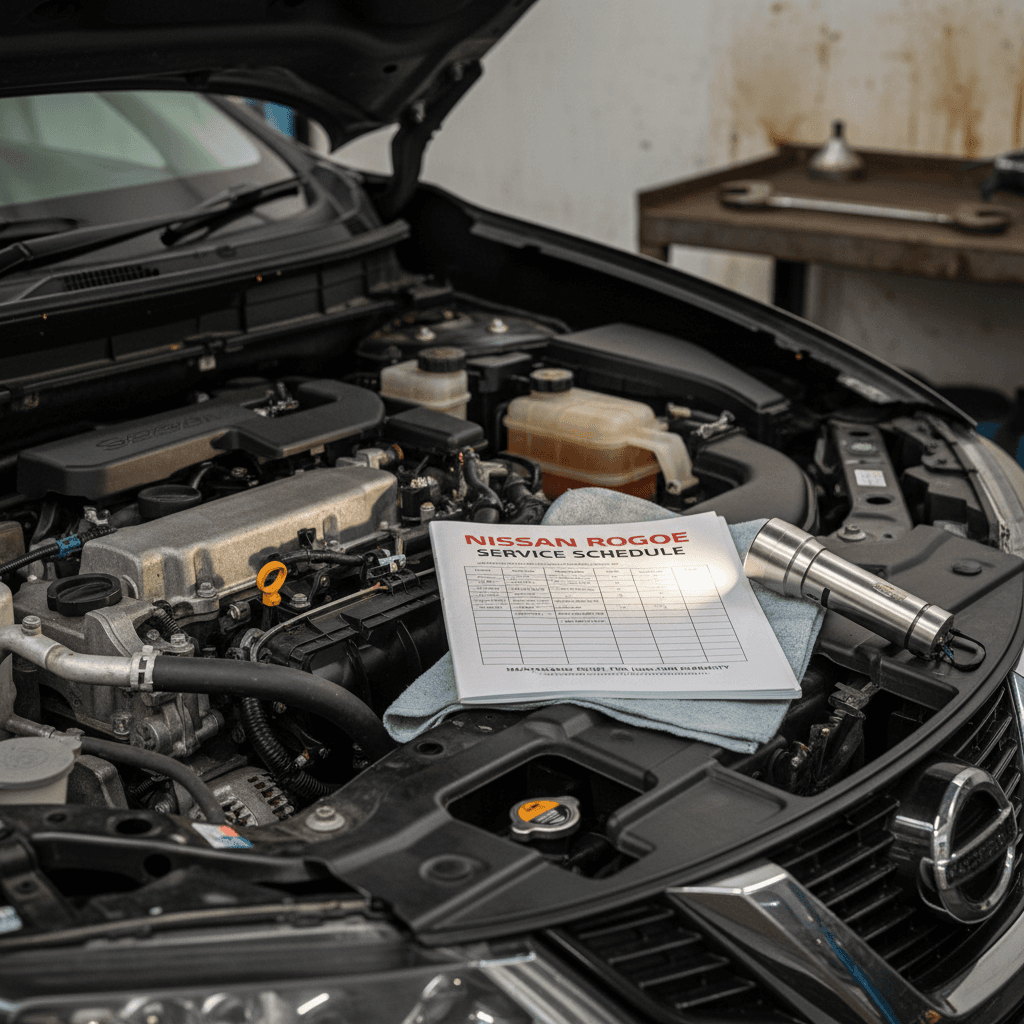
Nissan dealers publish detailed tables, but for most Rogue models you can think of maintenance in simple bands. Here’s a high‑level Nissan Rogue maintenance schedule most owners can follow before diving into the finer print.
Nissan Rogue maintenance schedule overview
Core service intervals many dealers recommend for modern Nissan Rogue models. Always verify with your specific model year and engine.
| Mileage / Time | Key Services | Notes |
|---|---|---|
| Every 5,000–7,500 miles or 6 months | Engine oil & filter, tire rotation, basic inspection | Shorter interval if lots of city driving, idling, or towing. |
| 15,000 miles or ~18 months | Engine air filter, brake inspection, suspension check | Often bundled with an oil change visit. |
| 20,000–30,000 miles (~2–3 years) | Cabin air filter, fuel line inspection | Good time to check alignment if tires show uneven wear. |
| 30,000–40,000 miles (~3 years) | Deeper brake inspection, drive belt check, CVT fluid inspection | Many techs recommend first CVT fluid change by ~30,000 miles for peace of mind. |
| 60,000 miles (~5–6 years) | Brake fluid replacement, repeat filters, CVT fluid service, belt inspection | Major service window, budget a bit extra this year. |
| 100,000 miles (~8–10 years) | Spark plugs, coolant service, transmission and driveline inspection | Where a well‑maintained Rogue separates itself from a neglected one. |
Use this as a planning roadmap, then confirm details against your owner’s manual.
Bookmark your own schedule
Service intervals explained: what happens and when
Every 5,000–7,500 miles: routine visits
This is the basic heartbeat of the Nissan Rogue maintenance schedule. Most newer Rogues can stretch oil changes toward 7,500 miles under ideal conditions, but many U.S. owners live in the real world: short trips, stop‑and‑go, hot summers, cold winters. In practice, 5,000‑mile intervals keep the engine and turbo (where fitted) much happier.
- Engine oil and filter change (use the correct viscosity and Nissan‑approved oil).
- Tire rotation and pressure check; inspect for uneven wear that hints at alignment or suspension issues.
- Visual brake inspection: pads, rotors, and brake lines.
- Top off washer fluid and check coolant, brake fluid, and power steering (if applicable).
- Quick under‑body inspection for leaks or damaged splash shields.
15,000–30,000 miles: breathing and comfort items
Between 15,000 and 30,000 miles, dealers start to layer in items that affect how smoothly your Rogue runs and how livable it feels inside.
Filters that keep your Rogue clean and efficient
Small, inexpensive parts that make a big difference over time.
Engine air filter
Usually replaced around 15,000–30,000 miles, sooner in dusty climates. A clogged filter chokes performance and fuel economy.
Cabin microfilter
Typically changed between 15,000–30,000 miles. Keeps pollen, dust, and odors out of the cabin and protects HVAC components.
Key fob battery
Dealers often replace the Nissan Intelligent Key battery around 30,000–45,000 miles or every few years to avoid no‑start surprises.
30,000–60,000 miles: deeper inspections and fluids
Around 30,000 miles (or roughly 3 years), the maintenance schedule starts to look more serious. This is where a lot of owners either cement their Rogue’s long‑term reliability, or start quietly devaluing it.
Typical 30,000–60,000 mile service items
Pulled from several dealer Nissan Rogue service schedules, generalized for clarity.
| Interval | Common Services |
|---|---|
| 30,000–40,000 miles | Oil and filter, engine air filter, cabin filter, key battery, brake inspection, CVT fluid inspection, driveline checks (especially on AWD). |
| 40,000–45,000 miles | Repeat oil service, inspect EVAP and fuel lines, drive belt, steering and suspension components, exhaust system. |
| 60,000 miles | Oil and filter, air filter, cabin filter, key battery, brake fluid replacement, CVT fluid service or at minimum inspection, belt inspection, steering/suspension/exhaust check. |
CVT transmission care: the big-ticket item
Let’s talk about the elephant in the service bay: the Nissan Rogue’s CVT. It delivers smooth, efficient power when it’s happy, and eye‑watering repair bills when it’s not. The maintenance schedule usually calls for regular inspections and, depending on model year and conditions, CVT fluid service somewhere between about 30,000 and 60,000 miles.
Why CVT fluid is a big deal
- Have the CVT fluid inspected at least every 10,000 miles, especially beyond 30,000 miles.
- Under “normal” driving, many technicians suggest a CVT fluid change around 30,000–40,000 miles, then every 30,000–60,000 miles after that.
- Under “severe” conditions, lots of stop‑and‑go, steep hills, frequent heatwaves, err on the early side of that range.
- Watch for symptoms: shuddering, whining, delayed engagement when shifting from Park, or the engine revving without much acceleration. Those are “call your shop today” noises, not “wait for the light” noises.
Ask the right question at service
Brakes, tires, and suspension: safety first
Your Rogue’s ability to stop, turn, and handle bad pavement is more important than any touchscreen feature. Fortunately, brake and suspension care folds neatly into the existing Nissan Rogue maintenance schedule.
How often to service brakes, tires, and suspension
Intervals are approximate, driving style makes a huge difference.
Brakes
Inspect every 5,000–7,500 miles with each oil change. Many Rogues need front pads around 30,000–50,000 miles; rears can last longer.
If you feel pulsing, grinding, or hear squealing, don’t wait for the next scheduled visit.
Tires & alignment
Rotate every 5,000–7,500 miles. Most original‑equipment tires last roughly 40,000–60,000 miles if properly rotated.
Uneven wear or a pull to one side means it’s alignment‑time, not “let’s see how it looks next year.”
Suspension and steering components, control arms, struts, tie‑rod ends, are usually inspected during the major 30,000‑, 60,000‑, and 100,000‑mile services. If your Rogue feels floaty, clunks over bumps, or wanders in its lane, don’t wait for the odometer to catch up; have it looked at.
Fluids, filters, and other small things that matter
Most owners fixate on oil changes and forget the rest. Yet the “supporting cast” of fluids and filters is what keeps the Rogue’s braking, cooling, and climate systems in good shape for the long haul.
- Engine oil and filter: every 5,000–7,500 miles, using the correct grade and a quality filter.
- Brake fluid: typically every 3–5 years or around 40,000–60,000 miles. Old fluid absorbs moisture and can corrode internal components.
- Coolant: usually inspected regularly and replaced somewhere around 100,000 miles on many modern Nissans, sometimes sooner based on age.
- Differential and transfer case fluids (AWD): inspected around each major service (30k/60k/100k) and replaced per the manual or sooner if contaminated.
- Battery: test annually after year three; heat and short trips shorten lifespan.
Good maintenance is good business
Ready to find your next EV?
Browse VehiclesNormal vs. severe driving: which schedule fits you?
What Nissan calls “normal” use
- Mostly highway driving at steady speeds.
- Moderate climates without long heatwaves or harsh winters.
- Regular, longer trips that fully warm up the engine and CVT.
If this sounds like you, you can usually follow the longer end of the official intervals: closer to 7,500‑mile oil changes and CVT service toward 60,000 miles.
What counts as “severe” use
- Mostly city driving or short trips under 10 miles.
- Regular stop‑and‑go traffic, hills, or towing.
- Extreme temperatures, very hot summers or very cold winters.
If this is your life, treat the schedule as a ceiling, not a target. Think 5,000‑mile oil changes and earlier CVT, brake fluid, and coolant service.
Don’t let the word “severe” fool you
How good maintenance boosts Rogue resale value
Used‑car buyers have long memories when it comes to CVT stories, and the Rogue is on that list. That doesn’t mean you should avoid one; it means maintenance is the entire ballgame. A Rogue with regular fluid changes, documented services, and a smooth test drive is a very different animal from the neglected rental refugee with bald tires and a mystery rattle.
Why a well‑maintained Rogue is worth more
The same schedule that protects reliability also protects your wallet when you sell.
Service history
Stamped service records and receipts show future buyers, and dealers, that you didn’t treat the Rogue like an appliance.
Transparent condition
Fresh fluids and healthy brakes make pre‑purchase inspections boring, which is exactly what you want.
Higher offers
Dealers and private buyers pay more for clean, documented cars. It lowers their risk, so they can sharpen the pencil on price.
How Recharged uses maintenance history
Owner checklist: what to ask for at service time
Nissan Rogue maintenance visit checklist
1. Confirm the basics
Make sure the shop is changing the oil and filter with the correct spec, rotating tires, and inspecting brakes every visit or two. Ask them to note pad thickness on the invoice.
2. Ask for fluid condition notes
Have the advisor record the condition of CVT fluid, brake fluid, and coolant: color, smell, and whether they recommend service now or next visit.
3. Request a multipoint inspection printout
Most dealers perform one automatically. Actually read it. Look for yellow or red items related to leaks, suspension components, or tires.
4. Keep a simple log
Write mileage, date, and what was done on a single sheet in your glove box or notes app. It’s amazing how quickly you forget when that last CVT inspection happened.
5. Plan big services ahead
If you’re approaching 60,000 or 100,000 miles, ask for an estimate ahead of time. Spreading those costs across visits is easier than swallowing them all at once.
6. Save every receipt
Whether you use a Nissan dealer or an independent shop, save digital or paper copies. Those pages tell a reassuring story to the next owner, or to a buyer like Recharged.
Nissan Rogue maintenance schedule: FAQ
Frequently asked questions about Nissan Rogue maintenance
The Nissan Rogue can be a quietly faithful crossover for well past 100,000 miles, but it doesn’t get there by accident. Follow a sensible maintenance schedule, prioritize engine oil, CVT fluid, brake service, and regular inspections, and you dramatically reduce the odds of expensive surprises. And when it’s time to sell or trade, you’ll have the records to prove your Rogue’s story, whether you’re working with a local buyer or a transparent marketplace like Recharged.