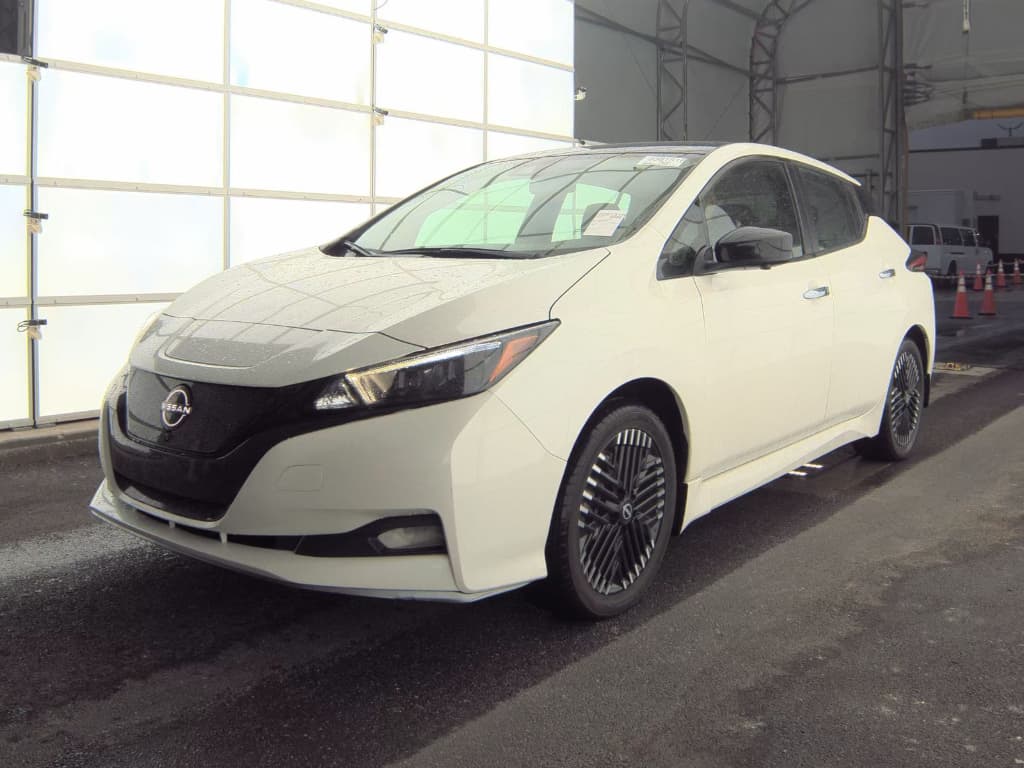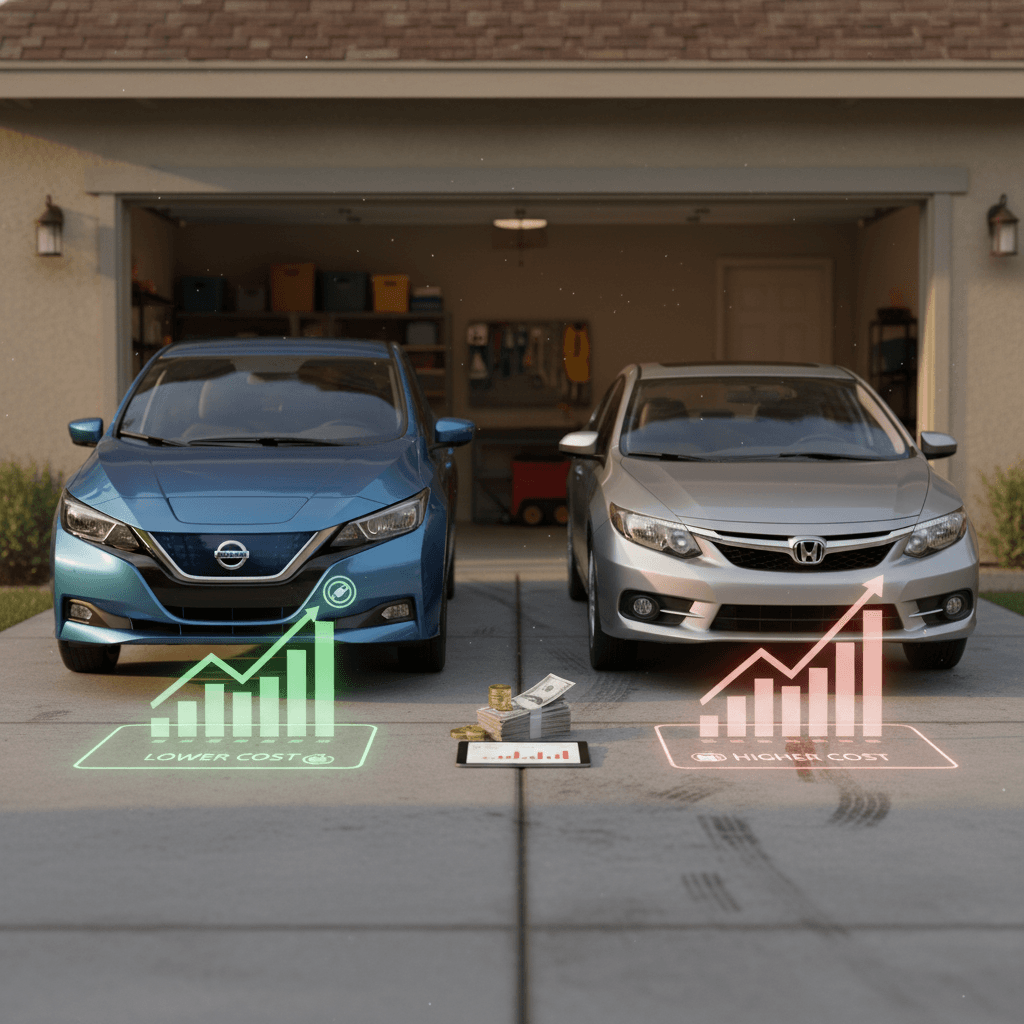
You don’t buy a Nissan Leaf for bragging rights at the country club. You buy it because you’re tired of watching dollars vaporize out the tailpipe. The real question isn’t “EVs are cheaper, right?” It’s much sharper: how does Nissan Leaf vs gas car cost actually play out for someone like you in 2025–2026? This guide runs the numbers on fuel, maintenance, insurance and depreciation, then gives you a clear 5‑year cost picture.
Key idea in one line
Nissan Leaf vs gas cost: what you’re really comparing
When people say “EVs are cheaper,” they’re often cherry‑picking fuel and skipping everything else. To compare Nissan Leaf vs gas car cost honestly, you need to look at all five pillars of ownership:
- Purchase price (or monthly payment)
- Fuel vs electricity cost per mile
- Maintenance and repairs
- Insurance and registration fees
- Depreciation and resale value
The Leaf is a compact hatchback, so the natural gas comparison is something like a Toyota Corolla, Honda Civic, or Nissan Sentra. Throughout this article we’ll use a well‑equipped compact gas car as the benchmark and show you where the Leaf wins, where it loses, and what really moves the needle over five years.
Quick Leaf vs gas cost signals (U.S. 2024–2026
How much does a Nissan Leaf cost to own?
Let’s start with the car itself. A new Leaf remains one of the least‑expensive EVs on sale in the U.S., and used Leafs can be astonishing bargains, if you understand the battery story.
New vs used Nissan Leaf: cost personality
Same car, very different economics depending on age and battery health
New Nissan Leaf (2025 model year)
Think of a new Leaf as the low‑drama EV entry ticket:
- MSRP under many other EVs: typically high‑$20Ks to low‑$30Ks before incentives.
- Low running costs: no oil changes, cheap electrons.
- Biggest risks: faster initial depreciation and higher insurance vs a simple gas compact.
Used Nissan Leaf (3–8 years old)
This is where the math gets interesting:
- Purchase price: often thousands less than a similar‑age gas car.
- Battery health is the linchpin: a strong pack makes it a steal; a tired pack kills range and value.
- Best play: buy a vetted Leaf with documented battery state of health.
How Recharged fits in
Fuel vs electricity: cost per mile in 2025–2026
Fuel is where the Leaf usually crushes a gas car, but the gap isn’t as cartoonishly large as TikTok would have you believe. Let’s put some realistic numbers on the board for a typical U.S. driver.
Step 1: Nissan Leaf electricity cost per mile
We’ll use conservative, middle‑of‑the‑road assumptions:
- Efficiency: 3.5 miles per kWh (many owners beat this in mild climates).
- Home electricity: 13¢/kWh blended rate.
Math:
- Cost per mile = $0.13 ÷ 3.5 ≈ 3.7¢ per mile.
- If your utility offers off‑peak EV rates (say 9¢/kWh), you’re closer to 2.6¢ per mile.
Step 2: Gas compact cost per mile
Now for a modern gas compact:
- Real‑world fuel economy: ~32 mpg combined.
- Gas price: use $3.10/gal as a recent U.S. average.
Math:
- Cost per mile = $3.10 ÷ 32 ≈ 9.7¢ per mile.
Even with today’s more reasonable fuel prices, the Leaf is usually less than half the cost per mile on energy alone.
Public fast charging changes the story
Maintenance and repairs: where EVs quietly win
A gas car is a symphony of small, expensive explosions. The Nissan Leaf is a battery, a motor and not much drama. Over time, that simplicity matters more than any single repair bill.
Typical maintenance patterns: Leaf vs gas compact
Not every owner will see these exact numbers, but the pattern is consistent
Nissan Leaf maintenance profile
- No oil changes, spark plugs, timing belts, or transmission fluid swaps.
- Regenerative braking stretches brake pad life dramatically.
- Fewer moving parts in the powertrain = fewer things to wear out.
- Big wild card is the high‑voltage battery, which is why a health report is critical on a used Leaf.
Gas compact maintenance profile
- Regular oil and filter changes, tune‑ups, fluids, emission system checks.
- More complex transmission with more potential for expensive failures.
- Exhaust systems, fuel systems and emissions hardware can generate four‑figure repair bills in middle age.
- Less catastrophic if you ignore one service, but more of them over the years.
Illustrative 5‑year routine maintenance estimate
Very rough ballpark for a 12,000‑mile‑per‑year driver, assuming no major failures.
| Item | Nissan Leaf | Gas Compact |
|---|---|---|
| Oil & filter services | $0 | $600–$900 |
| Brake pads/rotors | Lower likelihood in 5 yrs | $400–$800 |
| Engine/tune‑up items | N/A | $400–$700 |
| Coolant/transmission service | Minimal/EV‑specific | $300–$600 |
| Total routine maintenance (est.) | Lower overall | Higher overall |
Actual costs depend heavily on brand, shop rates and how religious you are about service intervals.
Where the Leaf shines
Insurance and fees: the hidden costs
Here’s where the Nissan Leaf doesn’t automatically win. Across the U.S., EVs tend to cost more to insure than comparable gas cars because of repair complexity and battery replacement risk.
Why EV insurance often runs higher
- Battery replacement: A serious pack damage claim can total the car.
- Repair networks: more work funneled to brand‑certified shops with higher labor rates.
- High‑tech front ends: sensors and cameras in bumpers and windshields drive up minor‑collision costs.
Aggregated data for 2025 shows EVs, on average, running 20–40% higher annual premiums than gas cars, with some estimates higher still for certain models.
What that might mean in dollars
Think in broad tiers, not absolutes:
- Typical compact gas car: maybe $1,300–$1,700/year for a clean driver.
- Typical EV (Leaf included): often in the $1,700–$2,300/year band for similar coverage.
If your driving record or location already pushes rates up, the EV penalty can feel sharper. Shopping quotes specifically for EVs is crucial before you commit.
How to keep Leaf insurance sane
Depreciation and resale value, especially used Leafs
The Leaf’s biggest financial flaw is on paper: depreciation. New EVs in general, and early Leafs in particular, have historically lost value faster than equivalent gas cars. That’s ugly if you’re buying new, and a gift if you’re buying used.
- New Leafs take a sharper early hit as tech improves and incentives move the market.
- Gas compacts hold value better because their technology evolves slowly and buyers understand the risk profile.
- Used Leafs can be under‑priced when the market overreacts to the word “battery” without looking at actual health.
Depreciation cuts both ways
5‑year Nissan Leaf vs gas car: simple math example
Let’s stitch it together with a realistic, back‑of‑the‑envelope comparison. These are not promises; they’re a framework so you can plug in your own local numbers.
Illustrative 5‑year cost of ownership: used Leaf vs used gas compact
Assume 12,000 miles per year, mostly home charging, similar purchase price around the low‑$20Ks.
| Category | Used Nissan Leaf | Used Gas Compact |
|---|---|---|
| Purchase price (used) | $20,000 | $20,000 |
| Energy cost (5 yrs) | $2,200–$2,600 | $5,800–$6,200 |
| Routine maintenance | Lower (no engine work) | Higher (engine + transmission) |
| Insurance (5 yrs) | $9,000–$11,000 | $7,000–$9,000 |
| Unexpected repairs | Battery is main risk | More small ICE items |
| Estimated resale after 5 yrs | Lower, but can be strong with healthy pack | Generally stronger |
| Overall 5‑yr cost tendency | Often similar or slightly lower than gas if battery is good and you home‑charge | Often similar or slightly higher once fuel and maintenance are added |
Numbers rounded for clarity. Your situation will vary by state, utility, insurer and vehicle age/condition.
The catastrophic outlier: bad battery
When a Nissan Leaf saves you money faster
The Leaf doesn’t always “win.” But there are clear patterns where a Nissan Leaf vs gas car cost comparison tilts decisively in the Leaf’s favor.
You’re likely to come out ahead with a Leaf if…
1. You drive a lot of miles each year
The more you drive, the more those 3–7 cents‑per‑mile fuel savings matter. If you’re covering 15,000–20,000 miles annually, fuel becomes a starring character in your budget.
2. You can charge cheaply at home
A driveway, garage or reliable Level 2 charger at work is almost a cheat code. Public fast charging should be the exception, not the rule, if you’re chasing savings.
3. You buy used, not new
Let someone else eat the steepest depreciation. A carefully chosen 3‑ to 7‑year‑old Leaf with healthy battery can undercut a similar gas car on both purchase price and running costs.
4. Your insurance quotes aren’t punishing
In some ZIP codes, the EV insurance bump is mild; in others it’s brutal. If your quotes for a Leaf are within ~10–15% of a gas compact, the fuel and maintenance savings usually win.
5. You can live with Leaf range
If daily life fits comfortably inside the Leaf’s real‑world range with margin, you avoid range‑anxiety‑driven fast‑charging, which preserves both battery health and savings.
How Recharged helps you “win” the Leaf vs gas math
If you’re running Nissan Leaf vs gas car cost numbers, you’re already thinking like a spreadsheet person. Recharged exists for exactly that kind of shopper.
Four ways Recharged derisks a used Leaf purchase
Because the whole game is buying the right car, not just any EV with a plug
Battery health, quantified
Fair‑market pricing
Financing tailored to EVs
Nationwide delivery & support
Ready to find your next EV?
Browse VehiclesIf you have a gas car to trade, Recharged can give you an instant offer or consignment option, letting you roll straight from combustion into electrons with one, clean transaction.
FAQ: Nissan Leaf vs gas car cost
Frequently asked questions about Leaf vs gas costs
Viewed over a five‑year span, the Nissan Leaf vs gas car cost story is less about brand loyalties and more about how you actually live. Drive a lot, charge at home, buy used with a healthy battery, and the Leaf quietly turns the energy economy of your daily life upside down. Skimp on homework, overpay for a tired pack, or rely on fast chargers like a rolling IV drip and the gas car suddenly looks like the sensible uncle again. The good news is that the information you need to win this game, battery health, fair pricing, smart financing, is no longer locked inside dealer back rooms. Recharged was built to hand that playbook to you, so by the time you plug in your first Leaf, the hardest part of the decision is already behind you.