If you’re looking at a Nissan Leaf in 2026, you’ve probably heard that EVs are cheaper to maintain than gas cars. That’s mostly true, but **how much does Nissan Leaf maintenance actually cost in 2026**, and what should you budget each year, especially if you’re shopping used?
Key takeaway
Nissan Leaf maintenance cost in 2026: quick overview
2026 Nissan Leaf maintenance snapshot (U.S.)
Those are broad ranges built from cost-to-own models and real-world owner data. Your number will move up or down based on **mileage, climate, driving style, and how closely you stick to Nissan’s service schedule**.
How much is Nissan Leaf maintenance per year in 2026?
Different data sources frame Nissan Leaf maintenance a little differently, but they all point in the same direction: **maintenance is significantly cheaper than for a gas compact, even once you add a few real-world repairs.**
Estimated Nissan Leaf maintenance cost per year in 2026
Approximate annual maintenance and light repair costs for a U.S. Nissan Leaf driven 10,000–15,000 miles per year, excluding insurance, registration, and energy.
| Leaf age (model year) | Owner situation in 2026 | Estimated annual maintenance cost | What this typically covers |
|---|---|---|---|
| 0–3 years old (2023–2026) | Still in basic warranty | $250–$450 | Tire rotations, cabin filter, brake-fluid service, inspections; occasional tire or 12V battery replacement. |
| 4–7 years old (2019–2022) | Out of basic warranty | $400–$650 | Same items as above plus higher odds of tires, 12V battery, alignment, minor suspension or brake work. |
| 8–12 years old (2014–2018) | Higher wear and tear | $500–$800 | More frequent tires and brake work, suspension components, A/C service; occasional EV-specific diagnostics if issues arise. |
| 13+ years old (2011–2013) | First-generation Leaf | $600–$900* | All of the above plus **higher risk** of big-ticket items (on-board charger, cooling system work) if the car wasn’t maintained well. |
These are planning numbers, not guarantees, your local labor rates and service choices will affect the outcome.
Why ranges, not a single number?
Nissan Leaf maintenance cost vs a similar gas car
Routine maintenance
Compared with a compact gas sedan like a Nissan Sentra or Honda Civic, a Leaf simply has **less to service**:
- No oil or oil filters
- No spark plugs or ignition system tune-ups
- No timing belt, fuel system cleaning, or emissions hardware
- Far fewer moving parts in the drivetrain
Across 5–10 years, that usually translates to **hundreds of dollars a year in savings** on routine shop visits alone.
Repairs and collision work
The flip side: when EVs **do** need body or complex electrical repairs, they can cost more per incident. Industry repair data over the last few years shows EV collision repairs running **20–30% higher** than similar gas vehicles, mostly because of higher labor rates and specialized procedures.
For everyday Leaf ownership, you’re unlikely to see that difference unless you’re unlucky enough to need major collision or high-voltage system work.
Net result for most Leaf owners
What maintenance does a Nissan Leaf actually need?
One big reason Leaf maintenance cost in 2026 stays reasonable is that **there’s no engine to maintain**. But that doesn’t mean you can skip service entirely. Nissan’s U.S. maintenance schedules for recent Leafs focus on a small set of recurring items.
- Tire rotation and inspections – Typically every 5,000–7,500 miles. Even if you rotate at a tire shop, budget $60–$120 annually for rotations and basic inspections if you use a dealer.
- Brake system service – The Leaf’s regenerative braking helps pads last a long time, but brake fluid still absorbs moisture. Expect a brake-fluid change roughly every 2–3 years or 20,000–30,000 miles, at about $120–$200 at a dealer.
- Cabin (in-cabin) air filter – Often every 15,000–20,000 miles. A dealer might charge $80–$130; DIY with a quality filter is usually under $30.
- Coolant checks and eventual replacement – The Leaf uses coolant for the inverter and, on newer models, for more thermal management. Coolant typically lasts many years; some schedules suggest replacement around 10 years or high mileage. Expect $200–$400 when it comes due.
- 12‑volt auxiliary battery – Many Leafs need a 12‑volt battery around year 4–7. Parts and labor usually fall in the $200–$300 range at a dealer, less at an independent shop.
- Basic chassis and safety inspections – Suspension, steering, lights, wipers and the usual “safety check” items, often bundled into Nissan’s scheduled service visits.
Skip the unnecessary upsells
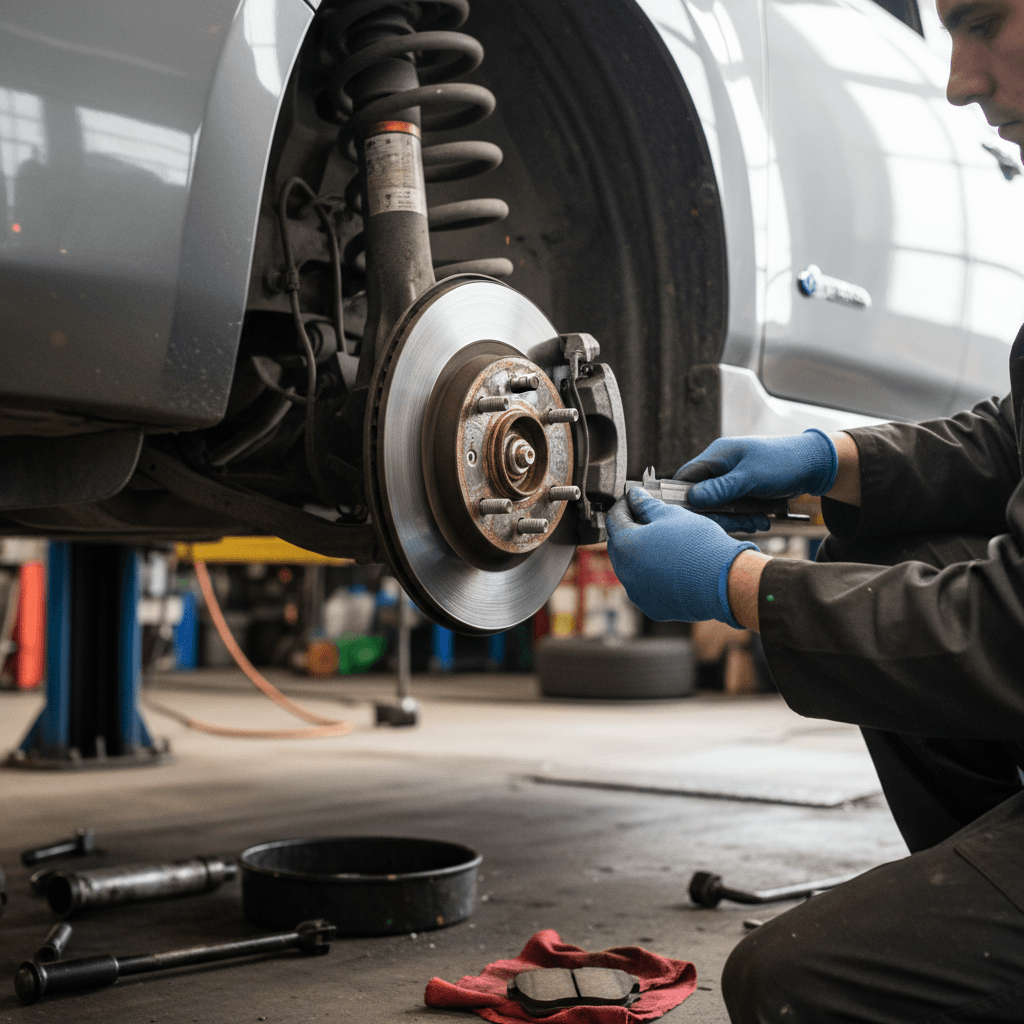
Nissan Leaf maintenance cost by age and mileage
Maintenance cost isn’t just about the calendar year; it’s about where your Leaf sits in its life cycle. A low-mileage 2018 Leaf may cost less to keep up than a high-mileage 2022 model, even though the 2022 is newer.
How Leaf maintenance typically changes over time
Use this as a planning guide for 2026 and beyond.
Years 1–3
What you’ll do: Mostly inspections, tire rotations, and maybe a cabin filter.
If you’re under warranty and on prepaid maintenance, your out-of-pocket cost can be extremely low beyond tires.
Years 4–7
What you’ll do: All of the above plus brake fluid, 12V battery, and occasional alignment or suspension work, especially on rough roads.
This is when your Leaf starts behaving like any other aging compact car from a maintenance standpoint, just without engine work.
Years 8+
What you’ll do: More frequent tires and brakes, possible A/C service, and higher odds of individual component failures (sensors, A/C compressor, on-board charger).
Budget on the higher end of the annual range and make sure you’ve had the car thoroughly checked before you buy if it’s used.
Common Nissan Leaf repairs in 2026 and what they cost
Routine maintenance is predictable. **Repairs** are where Leaf costs can jump, especially once the car is out of warranty. The good news: serious failures are still relatively uncommon compared with many older gas cars, but you should know what’s out there.
Typical Nissan Leaf repair items and price ranges in 2026
Approximate U.S. repair price ranges at independent shops and dealers; your local rates may vary.
| Repair item | When it tends to show up | Estimated 2026 cost range | Notes |
|---|---|---|---|
| Tires (set of 4) | Every 30,000–50,000 miles, depending on driving | $600–$1,000 | EV torque and weight can wear tires faster than on a comparable gas car. |
| Brake pads & rotors (front axle) | Often 60,000+ miles thanks to regen braking | $400–$800 | Some Leaf owners go well past 80,000 miles on original pads; rust and environment matter. |
| 12‑volt battery | 4–7 years | $200–$300 | Common across all modern vehicles; watch for slow starts or warning lights. |
| Wheel alignment | After potholes, curb hits, or suspension wear | $120–$200 | Can prevent premature tire wear. |
| Suspension components (links, bushings, shocks) | 7–10+ years or high mileage | $400–$1,200+ | Costs depend heavily on which parts and whether you do fronts, rears, or both. |
| On-board charger or charging port repair | Rare but possible on older/high‑mile Leafs | $1,000–$2,500+ | Most owners never experience this; inspect closely on high-mileage used cars. |
| HVAC/A/C repairs | Any age, more common after 6–8 years | $300–$1,500+ | From simple recharge or sensor to compressor replacement. |
EV-specific components usually cost more but are still rare compared with routine wear items.
Battery pack replacement: the outlier
Battery health, brakes, tires and other big-ticket items
When shoppers ask about "Nissan Leaf maintenance cost 2026," they’re usually really asking, “What big bills am I exposed to?” Four areas matter most: **battery health, tires, brakes and the rest of the chassis.**
- High-voltage battery – The traction battery is the Leaf’s most valuable component. Modern packs have proven durable, but early Leafs in hot climates saw faster degradation. Instead of assuming a pack replacement, focus on current capacity and charging history. Tools like the Recharged Score use deep diagnostics to show how much usable energy is left compared with new.
- Tires – Leaf torque and weight mean you should treat tires as a recurring big-ticket item. Budget for a full set roughly every 3–4 years at average U.S. mileage.
- Brakes – Regenerative braking means pads and rotors often last much longer than on gas cars. In practice, corrosion from road salt or infrequent use can be as big a factor as wear. Have a tech inspect pad thickness and rotor condition rather than just changing them on a mileage schedule.
- Suspension and steering – Control arms, bushings, sway-bar links and struts on an older Leaf look a lot like any compact car. They’re not EV-specific, and any competent shop can handle them. As the car ages, this area is where many of your non-tire bills will come from.
- High-voltage components – Inverters, on-board chargers and DC/DC converters are expensive if they fail, but real-world failure rates remain low. For a used Leaf, the goal is to identify cars with **no warning lights, clean recall history and documented service**, not to prepay for hypothetical failures that may never happen.
How Recharged reduces big-cost surprises
How to keep your Leaf’s maintenance cost low
Smart ways to control Nissan Leaf maintenance cost in 2026
1. Follow the Nissan schedule, no more, no less
Use Nissan’s official maintenance schedule as your baseline. Say yes to items like brake fluid, cabin filters and inspections on the recommended intervals, but politely decline engine-style services your Leaf doesn’t need.
2. Use independent EV‑friendly shops where possible
Once your Leaf is out of warranty, a good independent shop can handle most maintenance (tires, brakes, suspension, 12V battery) for less than a dealer. Reserve the dealer or EV specialist for high-voltage diagnostics and recalls.
3. Rotate tires and check alignment
Rotating tires on schedule and checking alignment after big pothole hits can add thousands of miles to a set of tires. That’s one of the easiest ways to shave real dollars off your annual cost.
4. Learn a couple of DIY basics
If you’re comfortable, simple jobs like replacing the cabin filter or wiper blades can save $50–$100 a visit. You don’t need to go anywhere near the high-voltage system to make a difference.
5. Watch for warning lights and odd behavior early
Catching an issue early, noises over bumps, intermittent charging errors, reduced A/C performance, often means a smaller bill. Waiting until a component fails completely tends to be more expensive.
6. Keep software and recalls up to date
Visit a Nissan dealer periodically to check for open recalls, service campaigns and software updates. Many are free and can prevent bigger issues down the road.
Use energy savings to offset maintenance
Maintenance budgeting tips for used Nissan Leaf buyers
If you’re shopping a used Leaf in 2026, you care less about theoretical averages and more about **what this specific car is likely to cost you**. That comes down to history, condition and mileage.
Before you buy a used Leaf, check these maintenance red flags
They tell you more about future cost than model year alone.
Service history and recalls
Ask for service records and check that required maintenance, especially brake-fluid changes and any open recalls, has been handled.
A Leaf that’s had regular basic care is usually a safer bet than a slightly newer one with no paper trail.
Battery and charging behavior
Look for a documented battery health report (like the Recharged Score) and ask how often the car fast‑charged. Frequent DC fast charging and repeated 100% charges on a hot pack may accelerate wear.
Suspension, brakes and tires
During a test drive, listen for clunks or rattles over bumps and feel for vibration under braking.
If tires, pads and rotors are all near the end of their life, you could be looking at $1,000+ in catch‑up work within the first year.
Plan a first-year “catch-up” budget
For an older Leaf (say, 2015–2019), it’s wise to budget $800–$1,200 in the first 12 months for baseline items, tires, 12V battery, fluid services and small repairs, then settle into a lower annual number if the car proves solid.
Where Recharged fits in
Ready to find your next EV?
Browse VehiclesFrequently asked questions: Nissan Leaf maintenance 2026
Nissan Leaf maintenance cost 2026: FAQ
Bottom line: Is Nissan Leaf maintenance cheap in 2026?
Put it all together, and the picture is pretty clear: **Nissan Leaf maintenance cost in 2026 is generally lower than for a comparable gas car**, especially over a 5–10 year window. You’ll still buy tires, brake fluid, cabin filters and the occasional 12V battery, and older cars can rack up more suspension and brake work, but you dodge oil changes, tune-ups and many of the high-frequency failures that come with an aging engine.
If you want to stack the odds in your favor, the recipe is straightforward: choose a Leaf with **verified battery health**, a clean service record and no warning lights; follow Nissan’s schedule without overbuying dealer add-ons; and use an EV‑savvy shop when the car needs attention. Platforms like Recharged make that easier by pairing each used EV with a Recharged Score report, transparent pricing and EV‑specialist support from search to delivery.
Do that, and your main surprise with a Nissan Leaf in 2026 won’t be a scary repair bill, it’ll be how rarely you need to think about maintenance at all.