Type “Nissan Leaf depreciation rate 2026” into a search bar and you’ll see two very different stories: owners who feel like their Leaf evaporated in value, and bargain hunters thrilled with how much EV they got for the money. The truth sits somewhere in the middle, and in 2026, it depends more than ever on your Leaf’s battery health, model year, and local demand.
Leaf depreciation in one sentence
Nissan Leaf depreciation in 2026 at a glance
Typical Nissan Leaf depreciation by 2026
If you’re trying to sanity‑check an offer in 2026, a simple rule works surprisingly well: expect an average Leaf to lose about **two‑thirds of its value over five years**, then lose smaller, steadier chunks after that. The catch is that the Leaf is **more sensitive than most EVs** to battery condition and charging convenience, which is why you’ll see cars of the same year advertised thousands of dollars apart.
Depreciation charts are averages, not a verdict on your car
How fast does a Nissan Leaf depreciate?
Let’s put numbers around the **Nissan Leaf depreciation rate in 2026**. Different analysts slice it different ways, but they mostly converge in the same neighborhood:
- Independent value tools like CarEdge peg the Leaf at about **66% depreciation after 5 years**, leaving roughly 34% of MSRP as resale value.
- Recent iSeeCars‑based analyses and resale studies land very close, with the Leaf losing around **64–65% of value in five years**, one of the steeper drops in the EV crowd.
- Broader EV cost‑of‑ownership studies find battery‑electric vehicles in general lose around **59% in five years**, so the Leaf is usually a bit worse than the EV average.
Translated into plain English: if a Leaf stickers at $34,000 new, many data sets expect it to be worth somewhere around **$11,000–$13,000** at the five‑year mark in 2026. Push the car out to eight or ten years, and you’re often talking **$6,000–$10,000**, heavily shaped by battery health and mileage.
Don’t apply one percentage to every Leaf
2026 Nissan Leaf value by model year
No two local markets are identical, but by spring 2026, U.S. asking prices for Nissan Leafs tend to stack up in familiar bands. Think of these as **illustrative market ranges**, not hard quotes:
Typical 2026 U.S. Nissan Leaf resale ranges by model year
Approximate private‑party or retail asking ranges in average‑cost U.S. markets, assuming normal mileage and fair battery health. Actual values vary with trim, options, region, and pack condition.
| Model year (age in 2026) | Original MSRP ballpark | Typical 2026 asking range | Implied value kept |
|---|---|---|---|
| 2024–2025 (1–2 yrs) | $30,000–$37,000 | $22,000–$30,000 | ~65–80% |
| 2021–2023 (3–5 yrs) | $31,000–$38,000 | $11,000–$18,000 | ~30–50% |
| 2017–2020 (6–9 yrs) | $30,000–$37,000 | $7,000–$13,000 | ~20–35% |
| 2013–2016 (10–13 yrs) | $29,000–$35,000 | $4,000–$9,000 | ~15–30% |
| 2011–2012 (14–15 yrs) | $33,000–$35,000 | $3,000–$6,000 | Often mileage & battery–limited |
Use this as a starting point, then adjust for mileage, battery health, and local demand.
The small‑battery trap
By contrast, a newer 62 kWh Leaf Plus or the upcoming 2026 redesign with stronger range and more modern tech can sit **well above** the average curve, holding on to more value simply because it solves more modern EV needs.
Why the Nissan Leaf depreciates faster than some EVs
If the Leaf is such an affordable way into EV ownership, why does it show up in so many “worst resale value” lists? A few structural realities push the **Nissan Leaf depreciation rate in 2026** higher than rivals like the Tesla Model 3 or Hyundai Ioniq 5.
Four big forces behind Leaf depreciation
None of them are about whether it’s a “good” car, it’s about how the market sees it.
1. Early‑generation battery chemistry
First‑gen Leafs (especially 2011–2014) were famous for air‑cooled packs that didn’t love heat. When shoppers see missing capacity bars, they instantly discount the car, sometimes by thousands.
2. Limited highway range
Even newer Leafs can feel range‑constrained compared with similarly priced crossovers. In 2026, buyers are cross‑shopping affordable EVs that easily crack 250–300 miles, and that comparison hurts older Leafs.
3. CHAdeMO fast‑charging fade‑out
The Leaf still uses the CHAdeMO fast‑charging standard in North America, just as networks are pivoting hard toward CCS and NACS. Fewer future DC options make buyers nervous and knock down values.
4. Tax credits & aggressive new‑EV pricing
Federal and state incentives, plus aggressive discounts on new EVs, keep the price gap between new and used small. When a new EV isn’t much more than a used Leaf, resale suffers.
Where the Leaf still shines
Battery health, CHAdeMO, and how they affect 2026 prices
In 2026, you can’t talk about **Nissan Leaf depreciation** without talking about its two wild cards: **battery state of health** and **fast‑charging access**.
Battery health: the real price lever
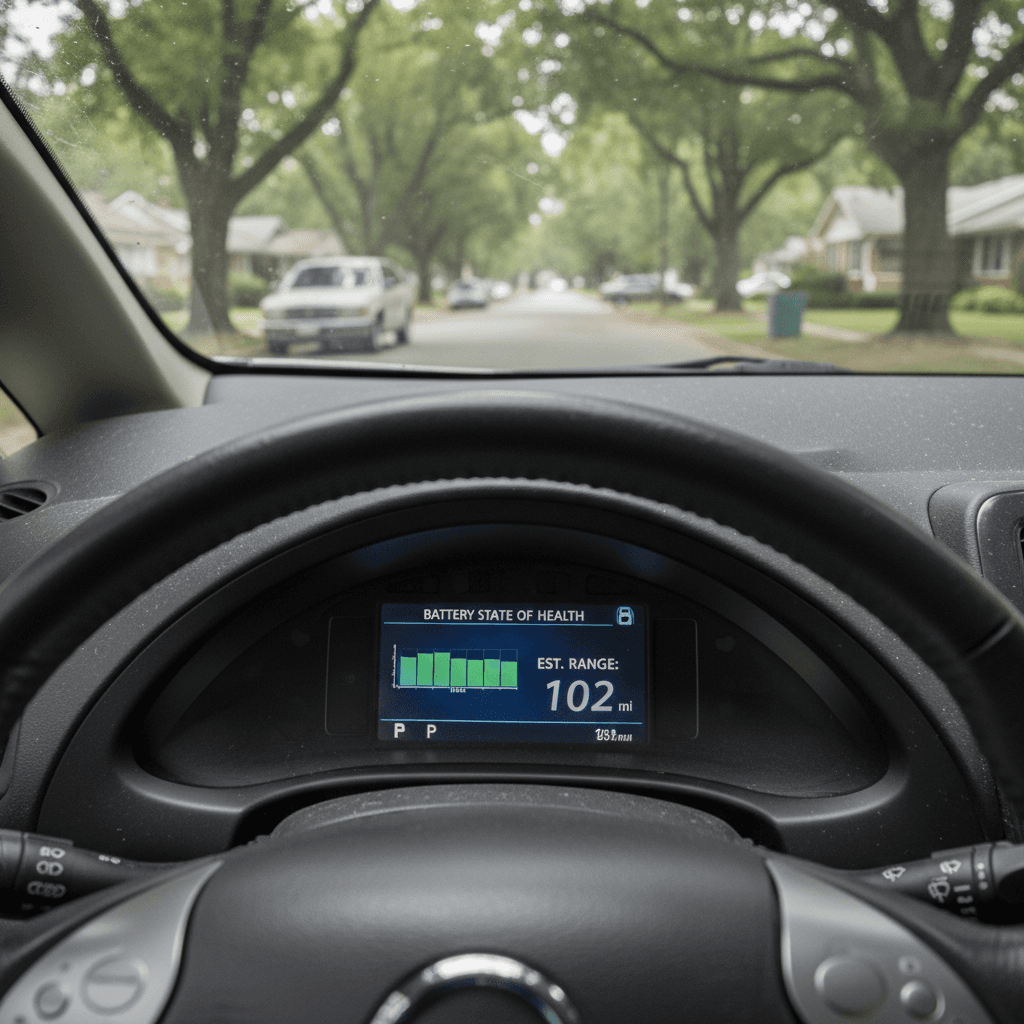
Two Leafs, same year, same mileage. One shows 12 healthy capacity bars and passes a professional health scan; the other is down to eight bars and struggles to hit 70 miles on the highway. On paper they look similar, but in the real world, buyers will often pay $3,000–$5,000 more for the healthier pack.
This is why Recharged bakes a Recharged Score battery report into every Leaf we sell, so you’re not guessing based only on dash bars and seller promises.
CHAdeMO: a shrinking but not useless network
Fast‑charging standards are shifting. New EVs are marching toward CCS and NACS, and networks are prioritizing those plugs for future build‑outs. That doesn’t mean CHAdeMO disappears overnight, but it does mean:
- Fewer new CHAdeMO stalls are being built.
- Some existing sites are being repurposed.
- Buyers price in the risk of inconvenient road trips.
For a commuter Leaf that mostly charges at home, this is less of a deal‑breaker, but it still nudges the 2026 depreciation curve down versus more future‑proof EVs.
How to talk about your Leaf’s battery when selling
When does Nissan Leaf depreciation finally slow down?
Like most cars, a Leaf’s biggest percentage drops happen early. The pattern we see across 2024–2026 data sets looks roughly like this:
Typical Nissan Leaf depreciation curve
Years 0–3: The steep slide
This is where the Leaf can easily shed **40–50%** of MSRP. New‑car discounts, tax credits, and rapid EV tech improvements all pile onto the curve.
Years 4–6: The “two‑thirds gone” zone
By year five, many tools show a Leaf down roughly **60–66%** from original price. This is where it often becomes a screaming deal for the next owner.
Years 7–10: Leveling out
Once you’re past the warranty and big early‑tech gaps, annual depreciation tends to drop into the **3–5% per year** range, more like a normal used car, heavily influenced by battery health.
Years 10+: Battery‑limited values
At this age, the question isn’t “what’s the book value?” so much as “how far will it go?” A Leaf with an unusually healthy pack can still command a premium; a tired pack might make the car a local‑only commuter priced accordingly.
Good news for second owners
2026 playbook: How to protect your Leaf’s value
You can’t fight market math, but you can absolutely slide your individual car to the **top of the value range** for its year. Here’s how to stack the deck in your favor:
Six ways Leaf owners can fight depreciation in 2026
Most of them cost less than you’d think, and pay back when it’s time to sell.
1. Baby the battery
Avoid leaving the pack at 100% or near 0% for long stretches. In hot climates, park in the shade when you can. Slower Level 2 charging is gentler than frequent DC fast charging.
2. Make home charging a selling point
Buyers love turnkey setups. If you can, have a licensed electrician install a tidy Level 2 outlet or charger. A Leaf that comes with easy home charging feels more valuable.
3. Keep records & recall history handy
Maintenance receipts, tire and brake records, and proof of completed recalls make your Leaf easier to trust, and easier to price at the higher end of the curve.
4. Fix the cheap cosmetic stuff
Headlight polish, wheel touch‑up, and a professional detail can move a shopper from "bargain hunting" to "this is the one," without big money out of pocket.
5. Advertise real‑world range, not just EPA
In your listing, share what you actually get on your commute or favorite trip. "I still see 115–130 miles mixed driving" lands harder than quoting a years‑old window sticker.
6. Price with fresh comps, not old memories
Leaf values moved quickly from 2022–2025 as used EV prices cooled. Use current tools and real listings, Recharged includes market‑driven pricing, so you’re competitive on day one.
How Recharged helps sellers in 2026
Ready to find your next EV?
Browse VehiclesIs a used Nissan Leaf a smart buy in 2026?
If all you looked at were depreciation charts, you might swear off the Leaf entirely. But those same charts that punish first owners can be a **gift** to 2026 shoppers who just want an honest, affordable EV for real‑world driving.
When a Leaf is a great buy
- You mainly drive local miles, commuting, errands, school runs.
- You can install or already have Level 2 home charging.
- You live near at least a few reliable CHAdeMO fast chargers for the occasional trip.
- You care more about **low total cost** than having the newest charging plug or software suite.
In those cases, a healthy‑battery Leaf can undercut many rivals on both purchase price and ongoing costs.
When you may want something else
- You routinely drive 150–200+ mile highway days.
- You rely heavily on public DC fast charging and live where CHAdeMO is fading fast.
- You care deeply about future‑proof connectors and access to the expanding NACS fast‑charge networks.
In those scenarios, the Leaf’s steeper depreciation is a hint that another EV might fit your life better.
Shopping used? Start with battery and price, in that order
FAQ: Nissan Leaf depreciation rate in 2026
Frequently asked questions about Nissan Leaf depreciation in 2026
The **Nissan Leaf depreciation rate in 2026** looks harsh on paper, but that doesn’t mean the car itself is a bad bet. It means early adopters paid a premium for first‑wave EV tech, and today’s shoppers get to scoop up those same cars for a fraction of their original price. Whether you’re selling a Leaf or hunting for one, the winning move is the same: focus on verified battery health, honest pricing, and how the car fits your real‑world driving. Get those pieces right, and depreciation stops being a scary headline and turns into an opportunity.