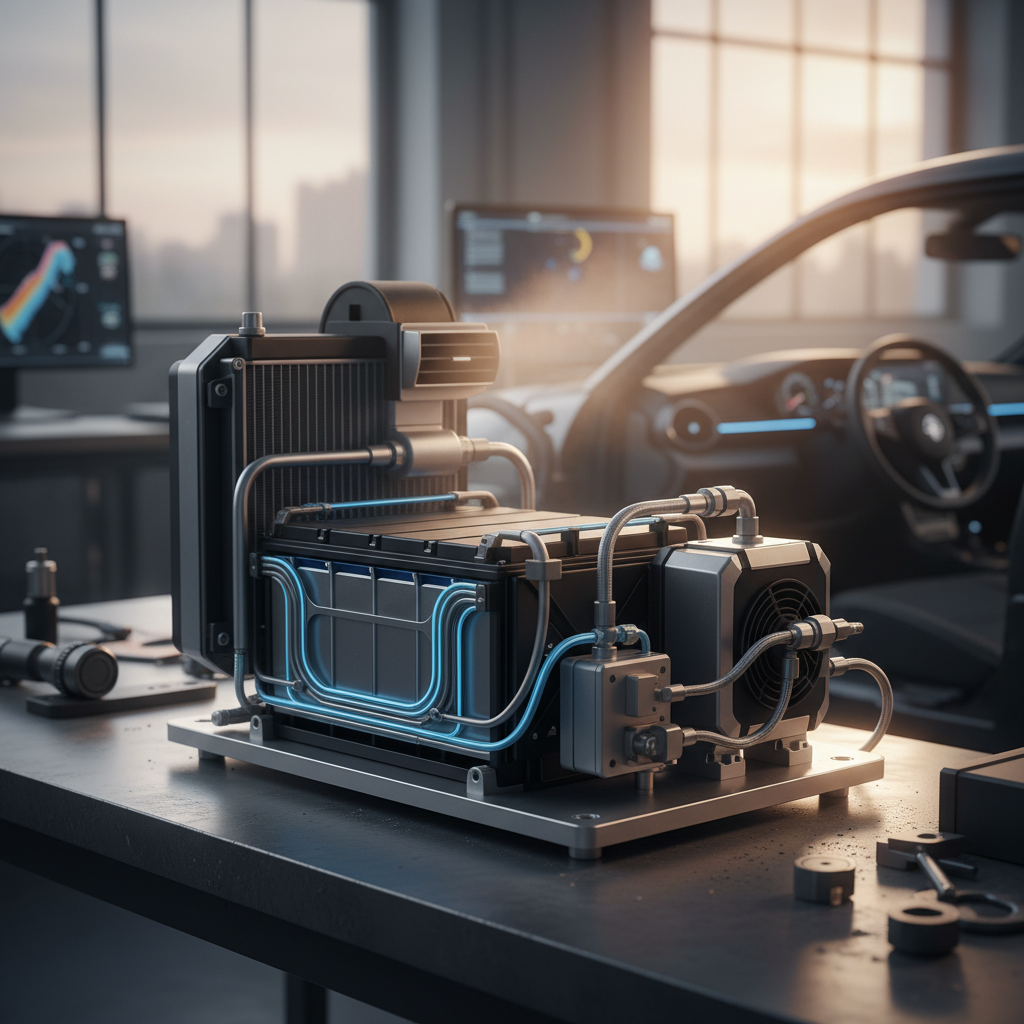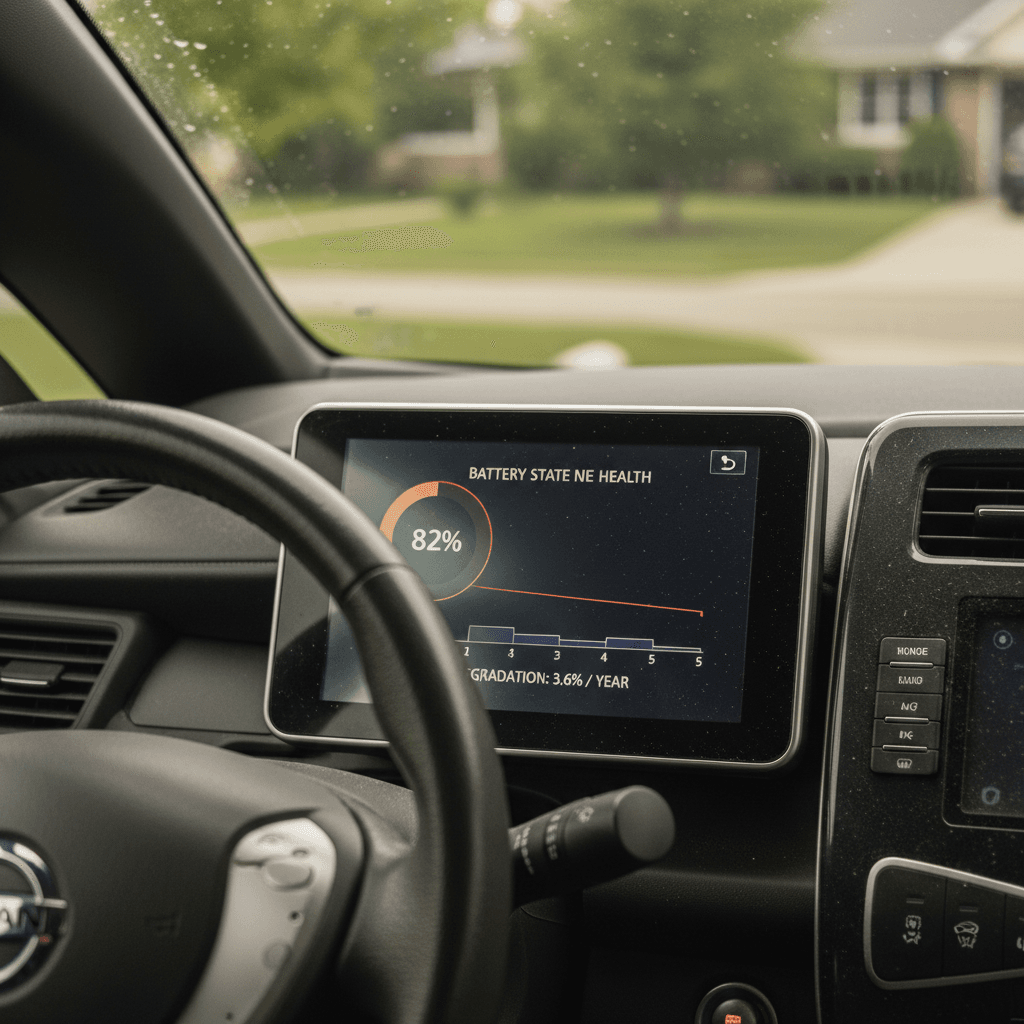
If you’re looking at a used Nissan Leaf, the question that really matters isn’t just mileage or trim level. It’s **battery degradation per year**, how quickly that big, expensive battery has lost usable capacity over time, and how much range you can realistically expect today and a few years down the road.
Bottom line up front
How much does a Nissan Leaf battery degrade per year?
Typical Nissan Leaf battery degradation (real-world ballpark)
Across EVs in general, large data sets show average battery degradation around 2–3% per year in normal use. The Leaf broadly fits that picture, but with some important wrinkles: early 24 kWh packs without liquid cooling can degrade faster in heat, while newer 40 and 62 kWh packs tend to hold up better when used reasonably.
Here’s a practical way to think about a Leaf used as a daily commuter in a moderate U.S. climate, with mostly Level 2 charging and normal annual mileage:
- Year 1: often 2–5% capacity loss as the pack “settles.”
- Years 2–5: roughly 2–3% per year for many owners.
- Years 6–10: degradation can keep following that 2–3% line, though some cars in harsh climates fall below it sooner.
- Beyond 10 years: age and prior abuse dominate, two Leafs of the same year can look very different.
Why early Leafs have a reputation for faster degradation
Leaf battery basics: kWh, SOH, and capacity bars
Battery size (kWh)
The Leaf has been sold with several battery sizes:
- 24 kWh (early cars, 2011–2015 primary size)
- 30 kWh (some 2016–2017 cars)
- 40 kWh (2018+ base battery)
- 62 kWh Leaf Plus / e+ variants
More kWh means more range and more buffer. Losing 20% on a 24 kWh pack hurts a lot more in daily driving than 20% on a 62 kWh pack.
SOH & capacity bars
Leaf owners talk about degradation in two main ways:
- State of Health (SOH %) – an estimate of how much usable capacity remains vs. new. Often read with Leaf‑specific apps.
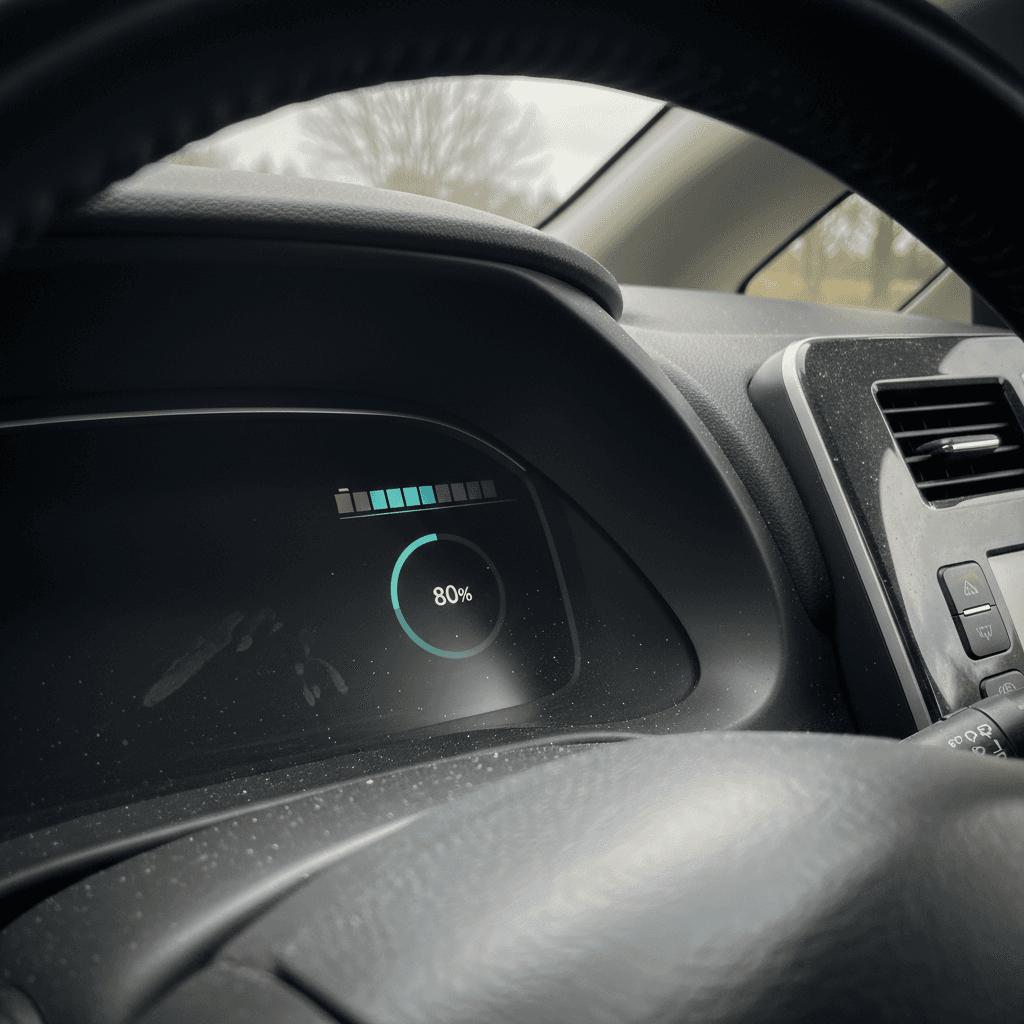
- Capacity bars – the 12‑segment gauge on the right of the cluster. New is 12/12; dropping to 8 bars or fewer is Nissan’s trigger for a warranty claim on later cars.
SOH gives you more granularity; bars give you a quick dash‑level sanity check.
Quick used-car rule of thumb
Degradation by battery size: 24, 30, 40, and 62 kWh
Real‑world Leaf data from owner communities, fleet studies, and our own experience at Recharged paints a consistent picture: **battery size and pack generation matter as much as model year.** Below are broad, practical ranges, not promises, and they assume typical mileage and no extreme abuse.
Approximate Nissan Leaf battery degradation per year by pack
These are directional, real-world ballparks for typical use, not guarantees. Individual cars can be better or worse.
| Battery size & era | Typical annual loss (yrs 2–8) | Climate sensitivity | Shopper’s takeaway |
|---|---|---|---|
| 24 kWh (2011–2015) | ~3–4%/year (can be higher in heat) | Very high – hot climates and frequent DC fast charging accelerate loss | Great around-town runabout in cool regions; in hot states, buy only with recent data and deep discount. |
| 30 kWh (2016–2017) | ~3–4%/year after early firmware fix | High – still air‑cooled, but many cars track similar to 24 kWh after software updates | Range bump vs. 24 kWh, but don’t assume the pack is bulletproof. Check SOH and bars closely. |
| 40 kWh (2018+) | ~2–3%/year in moderate climates | Moderate – still no liquid cooling, but chemistry and controls improved | Sweet spot for many commuters. A healthy 40 kWh Leaf can remain practical well into its second decade. |
| 62 kWh (Leaf Plus/e+) | ~1.5–2.5%/year in moderate climates | Moderate – more cells, less stress per mile | Best buffer against degradation. Even with some loss, remaining range is generous for most daily driving. |
Use this as a comparison tool when you’re shopping used Leafs, not as a lab-grade forecast.
Why bigger packs age more gracefully in daily use
Factors that speed up or slow down Leaf battery degradation
Biggest drivers of Nissan Leaf battery degradation
Some you can’t control. Others you absolutely can.
Heat and climate
High average temperatures are degradation’s best friend, especially for older air‑cooled Leafs.
- Hot garages and sunbaked parking lots accelerate chemical aging.
- Early 24/30 kWh packs in desert climates show some of the worst SOH numbers.
Fast charging habits
DC fast charging (CHAdeMO) is fine in moderation, but:
- Back‑to‑back fast charges drive cell temps up.
- Living on fast charging instead of home Level 2 is rough on early packs.
Time and storage patterns
Calendar age matters as much as miles.
- Keeping the car parked at 100% or near empty for long stretches is hard on the pack.
- Moderate states of charge and regular use tend to be healthier.
Mileage vs. calendar age
With Leafs, you’ll often see a 10‑year‑old, low‑miles car that has worse SOH than a higher‑mileage cousin. That’s because lithium‑ion chemistry continues to age even when the car isn’t driven.
All else equal, a Leaf that’s been driven and charged regularly in a cool climate can look far better than a garage queen that spent years sitting at a very high state of charge.
Driving and charging style
Your habits can move you up or down the degradation curve:
- Frequent, full 0–100% swings = more stress.
- Keeping most use between ~20–80% = gentler.
- Avoiding repeated fast charges on the same day keeps pack temps down.
None of this has to become a religion, but a few simple habits genuinely help.
A simple “good owner” routine
What Nissan’s warranty says about “acceptable” degradation
Nissan doesn’t promise that a Leaf battery will stay near 100% forever. Instead, the modern Leaf’s battery warranty is built around that 12‑bar capacity gauge on your dash.
- Most recent U.S. Leafs carry an 8‑year / 100,000‑mile battery capacity warranty.
- The warranty typically triggers if the battery falls to 8 capacity bars or fewer (about 66% of original capacity) within that window.
- Earlier models had slightly different terms, but the 8‑bar threshold is the key number on U.S. cars today.
Capacity vs. defects
From a shopper’s perspective, that means a 6‑year‑old Leaf at 9–10 bars is broadly tracking the degradation that Nissan considered reasonable. A car at 7–8 bars while still well inside the warranty window either lived a hard life or simply got unlucky, and it may be on the cusp of a claim if it qualifies.
Used Nissan Leaf: how much degradation is too much?
When you’re buying used, you’re not just buying a Leaf, you’re buying whatever’s left of its battery. The “right” amount of degradation depends on pack size, price, and how you’ll use it, but here are reasonable guardrails for U.S. shoppers in 2026.
How much Nissan Leaf battery degradation is reasonable by age?
Assumes typical annual mileage and moderate climate. Individual cars can vary; always verify with real data.
| Age of car | Battery size | “Healthy” range (SOH %) | Capacity bars you’d like to see | What it means for you |
|---|---|---|---|---|
| 3–4 years | 40 or 62 kWh | ~88–96% | 11–12 bars | Normal early loss. Great for daily commuting and moderate highway use. |
| 6–8 years | 40 or 62 kWh | ~78–90% | 10–12 bars | Still a very practical commuter if range meets your needs. |
| 10–12 years | 24 or 30 kWh | ~60–80% | 8–11 bars | At the low end, range is sharply reduced. Suitable as a second car or short‑trip runabout. |
| 10–12 years | 40 or 62 kWh | ~70–88% | 9–12 bars | Often still viable as a primary car, especially in 62 kWh form. |
| 12+ years | Any | <70% common on early 24/30 kWh cars | 7–10 bars | Range can be very limited; buy only with a clear plan and low price. |
If a car falls outside these ranges, either price should drop significantly or you should walk away unless you understand why.
Be cautious of “cheap but tired” early Leafs
How to check Leaf battery health before you buy
Because the Leaf’s value is so tightly tied to its battery, a proper battery health check is the single most important step when you’re evaluating a used car. Fortunately, you have several tools, ranging from a quick dash glance to a full diagnostic report.
Pre-purchase Nissan Leaf battery check
1. Count the capacity bars
With the car fully charged or close to it, look at the 12‑segment gauge on the right side of the instrument cluster. Each missing bar represents a chunk of lost capacity. For most buyers, <strong>10–12 bars</strong> is the comfort zone.
2. Ask for SOH data
A proper battery health report will show <strong>State of Health</strong> as a percentage. If the seller can’t provide it, ask if they’ll allow an independent check or provide prior service records that mention SOH.
3. Use a Leaf‑specific scan (when available)
Tools like Leaf‑focused OBD apps can read pack SOH and other useful metrics. At Recharged, our <strong>Recharged Score</strong> incorporates professional diagnostics of the Leaf’s battery so you don’t have to guess.
4. Take a range‑focused test drive
Reset a trip meter, note the state of charge, then drive a known route at your normal speeds. Compare miles driven to percent used to sanity‑check what the SOH number is telling you.
5. Check climate and usage history
A Leaf that spent its life in Seattle or Vermont is playing an easier game than one that survived years in Phoenix. Likewise, a car used mainly for DC fast charging road trips has had a rougher life than a home‑charged commuter.
6. Align range with your real needs
Instead of chasing the lowest‑degradation battery on paper, make sure the <strong>actual range today</strong> comfortably covers your daily driving plus a buffer, with room for a few more years of loss.
How Recharged takes the guesswork out
Ready to find your next EV?
Browse VehiclesProtecting your Leaf battery over the years
Once you own the car, your goal isn’t to eliminate degradation, that’s impossible, but to stay on the *gentle* curve instead of the ugly one. A few habits have an outsized impact on where you land.
Simple habits that slow Nissan Leaf battery degradation
You don’t need to obsess, just avoid the big mistakes.
Charge mostly on Level 2
Regular AC Level 2 charging is kinder to the pack than living on DC fast charging.
- Install a home Level 2 where possible.
- Use DC fast only when you genuinely need quick energy.
Avoid sitting at 100% or 0%
It’s fine to charge to 100% before a trip, but don’t leave the car parked there for days.
- For daily use, 60–90% is a healthy window.
- If storing the car, aim for roughly 40–60%.
Keep it cool when you can
You can’t change your climate, but you can:
- Park in shade or a garage when possible.
- Avoid repeated DC fast charges in the summer heat.
- Drive smoothly instead of constant drag‑race launches and hard regen.
- Keep tires properly inflated, less strain on the battery and more range.
- Stay current on software updates that may refine charging behavior or reporting.
High-risk patterns to avoid
Nissan Leaf battery degradation FAQ
Frequently asked questions about Nissan Leaf battery degradation per year
Key takeaways for shoppers
If you remember nothing else about **Nissan Leaf battery degradation per year**, remember this: the Leaf isn’t uniquely fragile, but its air‑cooled pack and long production run mean you’ll see more variation from car to car than with many newer EVs. A carefully used 40 or 62 kWh Leaf in a cool climate can still look impressively healthy after years on the road; an abused early 24 kWh car in the desert can be range‑strapped long before the odometer suggests it should be.
- Expect roughly 2–5% loss in year one and then around 2–3% per year in reasonable conditions, with early 24/30 kWh packs more sensitive to heat.
- Judge each car individually using SOH, capacity bars, climate history, and a reality‑check test drive.
- Buy the degradation profile that fits your life, a slightly tired 24 kWh Leaf can be a brilliant, low‑cost city car, while a healthy 62 kWh Leaf is a long‑term daily driver.
- Protect your investment with simple habits: mostly Level 2 charging, avoiding long stays at 100% or 0%, and keeping the car as cool as your climate allows.
If you’d rather not decode all of this yourself, you can always start your search with used Leafs listed on Recharged. Every car includes a Recharged Score battery health report, transparent pricing, and EV‑specialist support, from browsing and financing to trade‑in and nationwide delivery, so you can focus on how the car fits your life, not whether the battery is hiding any surprises.