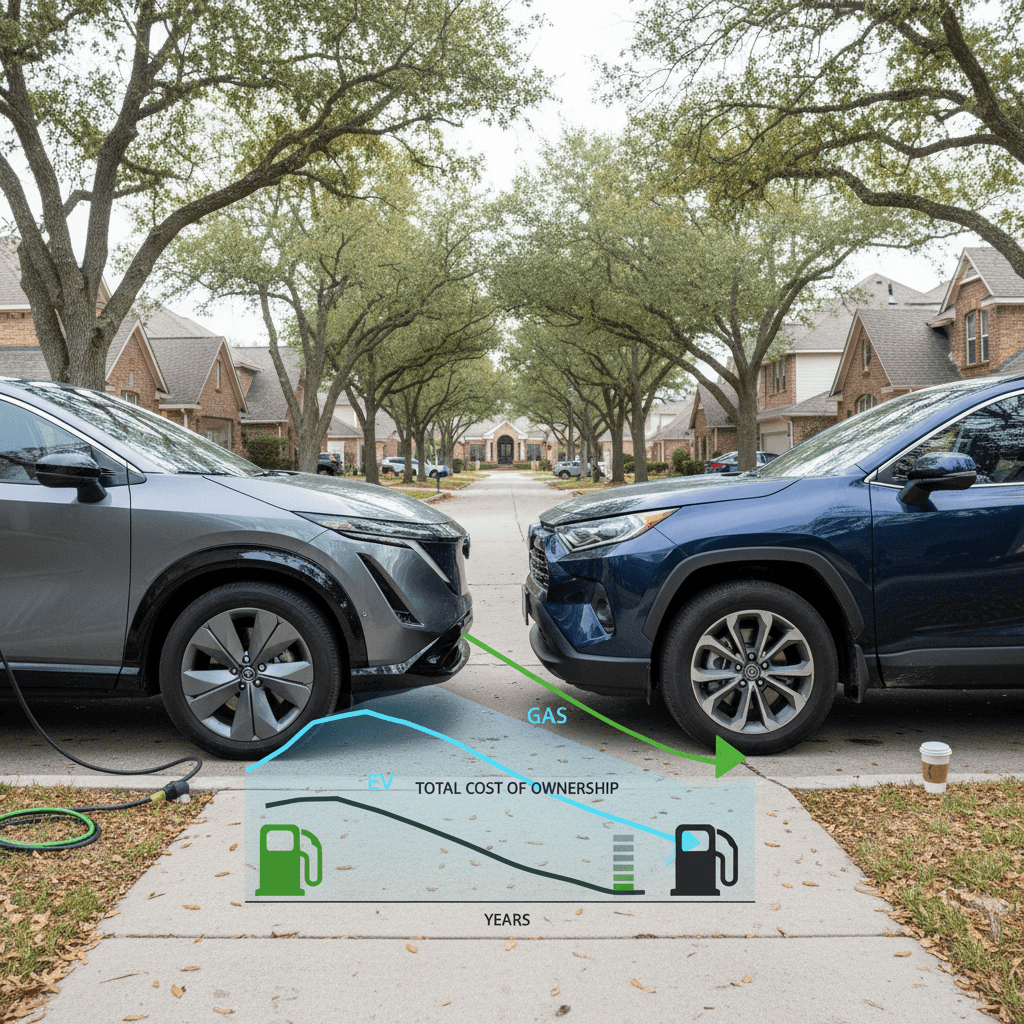
If you’re cross‑shopping a Nissan Ariya against a similar gas SUV, the big question isn’t just sticker price. It’s the total cost of ownership over the years you’ll actually live with the vehicle. In this guide, we’ll put real‑world numbers around “Nissan Ariya total cost vs gas car equivalent” so you can see where an electric SUV really saves you money, and where it doesn’t.
Short answer
Why compare Nissan Ariya total cost to a gas SUV?
On paper, the Ariya competes with compact and midsize crossovers like the Toyota RAV4, Honda CR‑V, Hyundai Tucson, Kia Sportage, Mazda CX‑50 and Subaru Forester. Many shoppers like the idea of quiet EV driving and cutting gas station visits, but hesitate because the Ariya’s MSRP can look higher than a mainstream gas SUV. Total cost of ownership (TCO) is how you cut through the noise: you’re comparing all the money out of your pocket, not just the number on the window sticker.
Quick cost context for U.S. drivers
What we compare and key assumptions
To make “Nissan Ariya total cost vs gas car equivalent” meaningful, we’ll compare an Ariya to a well‑equipped compact/midsize gas SUV a typical shopper would actually consider, not a stripped base model. We’ll use five years and 60,000 miles as our baseline ownership period and call out where your situation might change the result.
- Electric SUV: Nissan Ariya Engage+ or similar FWD long‑range model, around 87 kWh usable battery, real‑world efficiency about 3.1 miles/kWh.
- Gas SUV equivalent: A nicely equipped AWD compact/midsize crossover (think RAV4, CR‑V, CX‑50, Tucson) with a realistic mixed fuel economy around 28 mpg.
- Driving: 12,000 miles per year (60,000 miles in five years).
- Energy prices: Home electricity at about $0.19/kWh on average; gasoline at $3.75/gallon. Your local prices may be higher or lower.
- Tax treatment: We’ll ignore federal/state EV tax credits in the headline comparison (and mention them as upside), so you see a conservative picture.
Your numbers will vary
Five‑year cost summary: Nissan Ariya vs gas equivalent
Illustrative 5‑year total cost of ownership (60,000 miles)
These are rounded example figures to show how costs stack up for a Nissan Ariya vs a comparable gas SUV. They are not quotes but directional estimates.
| Cost item (5 years) | Nissan Ariya EV | Comparable gas SUV |
|---|---|---|
| Purchase price (out‑the‑door) | $44,000 | $40,000 |
| Fuel / energy | $3,700 | $8,000 |
| Maintenance & repairs | $1,800 | $4,000 |
| Insurance, taxes & fees | $7,500 | $7,200 |
| Depreciation (value lost) | $18,000 | $17,000 |
| Estimated resale value (end of year 5) | $26,000 | $23,000 |
| Approx. total cash out (5 yrs) | $55,000 | $56,200 |
All values in U.S. dollars; assumes purchase in the mid‑$40,000s and typical U.S. energy prices.
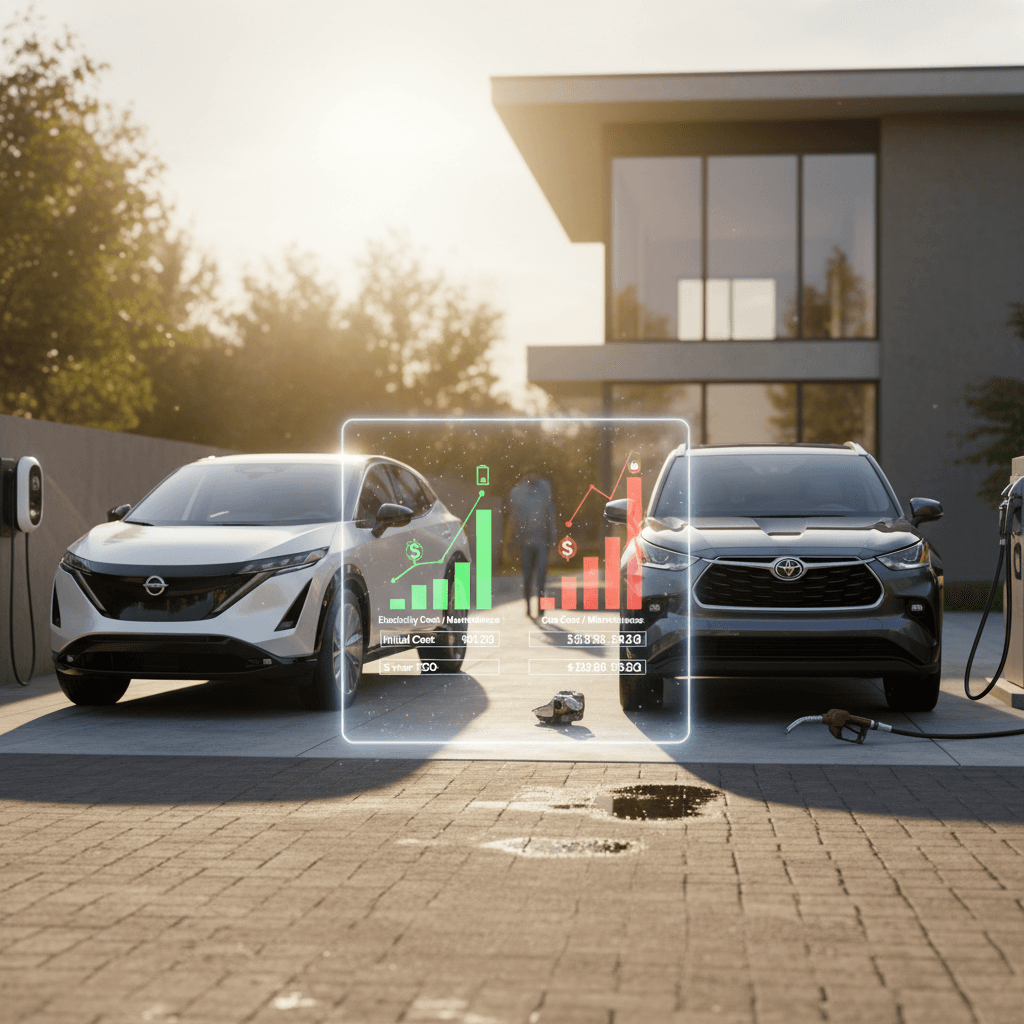
In this simplified scenario, the Ariya and a similar gas SUV land very close in 5‑year total cost, with the Ariya edging ahead by about $1,000–$2,000. But that’s before you factor in potential EV incentives, smart charging habits, or buying used, three levers that can swing the math strongly in the Ariya’s favor.
Where the Ariya usually wins
Purchase price, incentives, and used options
New Nissan Ariya pricing
Recent model years of the Nissan Ariya typically list in the high‑$30,000s to mid‑$50,000s depending on battery size, drivetrain (FWD vs e‑4ORCE AWD), and trim. In practice, discounts and dealer incentives often soften those MSRPs, especially as Nissan adjusts pricing to stay competitive in a crowded EV market.
Because the Ariya is being phased out in the U.S. after the 2025 model year, dealers may be more motivated to move remaining inventory, which can create opportunities if you’re comfortable owning an EV that’s no longer in production here.
Gas SUV equivalents
Compact and midsize gas SUVs like the RAV4, CR‑V, Tucson, CX‑50 and others generally transact in the low‑$30,000s to low‑$40,000s when similarly equipped with AWD and popular packages. That means you’ll often see a $3,000–$7,000 sticker gap against an Ariya with decent range.
That up‑front gap is what EV skeptics seize on, but it’s only one piece of the total‑cost puzzle, and it can be offset by incentives and lower running costs.
Incentives that can lower Ariya ownership cost
These won’t all apply to you, but the ones that do can erase much of the upfront price gap.
Federal EV tax credit
Depending on how the vehicle is sold and your personal tax situation, a used or new Ariya may qualify for federal tax credits or point‑of‑sale rebates under current rules. Always confirm with your dealer or tax professional.
State & utility rebates
Many states and utilities offer cash rebates for EVs or home charging equipment. These can effectively knock hundreds off your total cost in year one.
Used Ariya value
Lease returns and early off‑lease Ariyas have pushed used prices down. In some markets you can find clean used Ariyas at roughly half their original MSRP, which dramatically improves the total‑cost equation.
Where Recharged fits in
Ready to find your next EV?
Browse VehiclesEnergy costs: electricity vs gasoline
For most owners, the biggest long‑term advantage of an EV is energy cost. That’s where the Nissan Ariya can quietly make back a large chunk of any purchase‑price premium over a gas SUV.
Example 5‑year fuel / energy costs (60,000 miles)
Using 3.1 miles/kWh for the Ariya and 28 mpg for a gas SUV, with electricity at $0.19/kWh and gasoline at $3.75/gal.
| Metric | Nissan Ariya EV | Comparable gas SUV |
|---|---|---|
| Efficiency | 3.1 mi/kWh | 28 mpg |
| Energy needed for 60,000 mi | ≈19,350 kWh | ≈2,140 gallons |
| Energy price used | $0.19 per kWh | $3.75 per gallon |
| 5‑year energy cost | ≈$3,700 | ≈$8,000 |
| Cost per mile (energy only) | ≈$0.06/mi | ≈$0.13/mi |
You can plug in your own local energy prices to refine these numbers for your situation.
Charging where it’s cheapest
Ways to keep Ariya energy costs low
1. Charge at home whenever possible
Public DC fast charging is great for road trips, but it’s usually more expensive than home charging. Aim to do 80–90% of your charging at home or at low‑cost workplace chargers.
2. Use off‑peak or EV‑specific rates
Ask your utility if they offer a <strong>time‑of‑use or EV plan</strong>. Charging overnight during off‑peak windows can cut your per‑kWh cost by 20–40% in some areas.
3. Avoid living at 100% or 0% state of charge
Keeping the battery between roughly 10% and 80–90% for daily use isn’t just healthier for the pack, it also reduces how often you need expensive fast charging on the road.
4. Drive smoothly
Just like a gas vehicle, aggressive driving hurts efficiency. EVs respond instantly to the accelerator; using that power smoothly can net you <strong>more miles per kWh</strong> and lower your energy bill.
Maintenance and repairs
One of the quiet revolutions of EV ownership is how little you’ll see your service advisor. EVs have far fewer moving parts than gas powertrains, no oil changes, spark plugs, timing belts, or exhaust systems to worry about.
Typical 5‑year maintenance: Ariya vs gas SUV
Exact numbers vary by driving style and service menu, but trends are clear.
Nissan Ariya EV
- No engine oil or transmission fluid changes.
- Brake wear is lower thanks to regenerative braking.
- Routine items: cabin air filter, tire rotations, brake fluid, occasional coolant checks.
- Rough ballpark: $1,500–$2,000 over five years for routine service, excluding tires.
Comparable gas SUV
- Regular oil and filter changes, transmission service, and more complex cooling/exhaust systems.
- More wear items: spark plugs, belts, additional fluids.
- Rough ballpark: $3,500–$4,500 over five years for routine service, excluding tires.
The big EV wild card: out‑of‑warranty repairs
With a gas SUV, you’re more likely to see a stream of small‑to‑medium repair bills as the vehicle ages. With an EV like the Ariya, the pattern often shifts to very low ongoing maintenance but higher stakes if a major high‑voltage component ever needs replacement outside warranty.
Insurance, taxes, and fees
Insurance and registration don’t drastically change the Ariya vs gas SUV comparison, but they can nudge total cost one way or the other.
- Insurance: Because the Ariya is a relatively new EV with advanced driver‑assist tech, insurance can be slightly higher than a mainstream gas SUV in some ZIP codes, especially if repair labor rates for EVs are higher near you.
- Registration and EV fees: A few states add extra annual EV registration fees to replace lost gas‑tax revenue. It’s usually a few hundred dollars per year at most, which only partially offsets your fuel savings.
- Local incentives: Some cities counterbalance those EV fees with perks like HOV access, discounted tolls, or preferred parking. Those don’t show up in a spreadsheet, but they can matter for your daily life.
Net effect on 5‑year cost
Depreciation and resale value
Depreciation, the difference between what you pay and what the vehicle is worth when you sell, is one of the biggest and most misunderstood costs of car ownership. EVs have historically depreciated faster than some gas models, partly due to rapid tech changes and early‑adopter incentives. The Ariya is no exception.
Ariya depreciation reality
In many markets, nearly new Ariyas are already trading at around half of their original MSRP. That stings if you bought new at full price, but it’s great news if you’re buying used today. It means a lot of the steep early depreciation has already been taken by the first owner.
Over a five‑year window from your purchase date, a fairly bought Ariya today is likely to lose a similar or slightly higher percentage of its value than an equivalent gas SUV, but from a lower starting purchase price if you buy used.
Gas SUV depreciation
Popular gas crossovers tend to hold value well, especially Toyotas, Hondas, and Subarus. Over five years, you might see a 45–50% loss in value from new for a well‑kept example, depending on mileage and market cycles.
That said, if you buy new at the peak of pricing or load on expensive options, your real‑world depreciation can still rival what we see on some EVs.
Why used Ariya buyers have an edge
Real‑world ownership tips to tilt the math in your favor
Four ways to make an Ariya clearly cheaper than a gas SUV
These are levers you control, beyond sticker price.
Drive it longer
Many EVs shine when you own them for 7–10 years. The longer you spread the purchase cost, the more your low fuel and maintenance expenses dominate the equation.
Optimize charging
Keep most charging at home or low‑cost public Level 2 stations. Use DC fast charging strategically for trips, not daily driving.
Choose the right trim
Don’t overbuy power or options you don’t need. A mid‑level Ariya with solid range often hits the best cost‑per‑mile sweet spot.
Watch battery health
Battery condition is a huge part of an EV’s value. Use objective diagnostics, like a Recharged Score, to be sure you’re getting a healthy pack, especially when buying used.
How Recharged helps you manage Ariya total cost
If you decide an Ariya makes financial sense, the next step is buying the right one at the right price. That’s where Recharged is designed to help. We’re a retailer and marketplace built specifically for used EVs, which means our whole process is tuned to the questions EV shoppers actually ask, battery health, charging capability, and long‑term cost of ownership.
What you get with a Nissan Ariya from Recharged
Verified Recharged Score battery report
Every Ariya listed on Recharged includes a <strong>Recharged Score</strong>, a detailed, third‑party battery and high‑voltage system assessment. That gives you hard data on pack health instead of guessing from range estimates alone.
Transparent, fair‑market pricing
Our pricing tools look at nationwide EV transaction data so you can quickly see how a given Ariya is priced relative to the market. That helps you understand both <strong>today’s deal</strong> and likely future depreciation.
Financing built for EVs
Recharged offers financing options tailored to used EVs, with clear payment estimates. You can see how an Ariya’s monthly payment compares to a gas SUV <strong>before</strong> you commit.
Trade‑in and selling options
If you’re coming out of a gas SUV, Recharged can give you an instant offer or consignment option, so you can roll your existing vehicle’s equity directly into your Ariya purchase.
Nationwide delivery & EV‑savvy support
From virtual walk‑throughs to shipping logistics, our EV‑specialist team can guide you from first question to keys‑in‑hand, whether you’re near our Richmond, VA Experience Center or across the country.
FAQ: Nissan Ariya total cost vs gas car equivalent
Frequently asked questions
Bottom line: When does a Nissan Ariya beat a gas SUV?
When you look beyond the showroom and focus on total cost, a Nissan Ariya can be a smart financial move compared with a similar gas SUV, especially if you drive a lot, can charge at home at reasonable rates, and buy at the right price. In many scenarios, the Ariya’s lower fuel and maintenance costs make up for any purchase‑price premium within a few years, and buying used can turn it into a clear cost‑per‑mile winner.
If you’re ready to see how those numbers look for a specific vehicle, explore our deeper dive on Ariya long‑term costs or browse Nissan Ariya listings on Recharged. With verified battery health data, transparent pricing, financing, and trade‑in support, you can compare an Ariya and your current gas SUV on equal footing, and choose the one that serves both your budget and your driving life best.