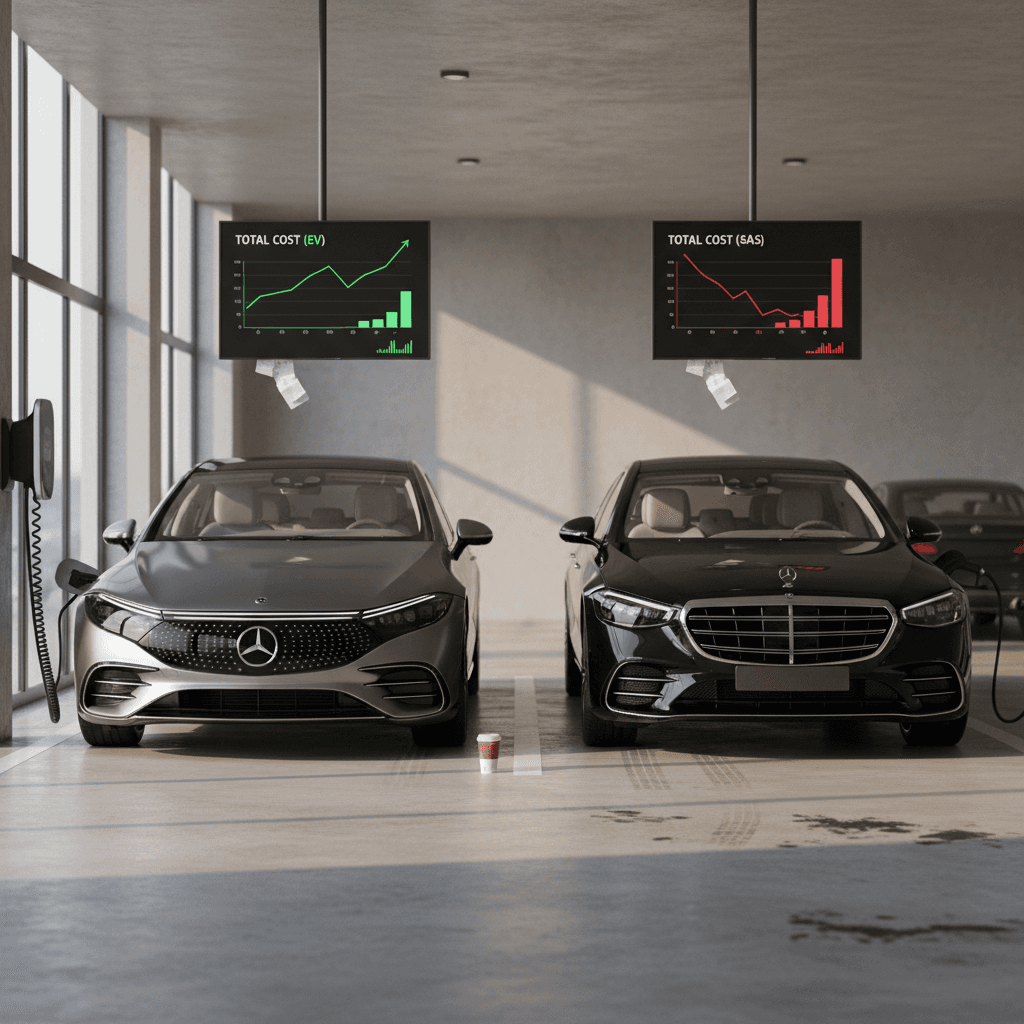
If you’re cross‑shopping a Mercedes EQS with a gasoline S‑Class, you’re not just choosing a powertrain. You’re locking in a five‑figure commitment to fuel, maintenance, and depreciation. This guide walks through the Mercedes EQS total cost vs a gas car equivalent in the U.S., using realistic numbers so you can see what you’ll actually spend over several years of ownership.
Quick answer
Overview: Mercedes EQS vs gas S-Class
To compare total cost fairly, you need to line the EQS up against its real gasoline twin. In Mercedes‑speak, that’s the EQS sedan versus the S‑Class sedan, both full‑size luxury flagships with similar size, comfort, and mission. Think EQS 450+ or EQS 580 on one side, and S 500 4MATIC or S 580 4MATIC on the other.
EQS vs gas S-Class: apples-to-apples pairs
The key matchups most U.S. shoppers are actually considering
Mercedes EQS 450+ vs S 500 4MATIC
EQS 450+ (RWD) is the efficiency champ in the EQS lineup.
- EPA combined energy use around 34–36 kWh/100 miles
- Comparable to an S 500 4MATIC with about 24 mpg combined
Mercedes EQS 580 4MATIC vs S 580 4MATIC
EQS 580 (dual‑motor) adds power and weight.
- Higher energy use than the 450+, closer to real‑world 30–32 kWh/100 miles
- Comparable to S 580 4MATIC with V8‑like fuel thirst
Focus on the body style, not the badge
How we compared the EQS to a gas equivalent
To keep this simple but honest, we’ll use round‑number assumptions that are close to recent U.S. data as of early 2026 and published efficiency figures. Your exact numbers will vary by state, driving style, and how you charge, but the relationships hold up.
Key assumptions for this EQS vs gas S-Class cost comparison
U.S.-focused numbers that make for a fair, realistic matchup.
| Factor | Mercedes EQS (EQS 450+ example) | Gas S-Class (S 500 4MATIC example) |
|---|---|---|
| Annual mileage | 12,000 miles | 12,000 miles |
| Ownership window | 5 years | 5 years |
| Energy efficiency | ~36 kWh/100 miles (0.36 kWh/mile) | 24 mpg combined |
| Electricity price (home) | $0.17 per kWh U.S. average | , |
| Electricity price (DC fast) | $0.40 per kWh (typical paid public rate) | , |
| Gasoline price | $3.25 per gallon long‑term average (to smooth recent spikes) | $3.25 per gallon |
| Home charging share | 80% home / 20% public fast charging | , |
If your local prices are higher or lower, plug them into the same framework to get your own totals.
Your local rates matter a lot
Energy cost per mile: electricity vs gasoline
Per‑mile energy cost: EQS vs S‑Class (mixed charging)
Let’s crunch the simple math first. With the EQS 450+ using about 0.36 kWh per mile, and most charging happening at home, your electricity cost per mile stays impressively low. A gas S 500 4MATIC, sipping fuel at about 24 mpg combined, simply can’t compete on raw energy price unless gas gets unusually cheap or your electricity is extremely expensive.
EQS: electricity cost per mile
- Energy use: 0.36 kWh/mile
- Home charging (80%): ~0.29 kWh/mile at $0.17/kWh → ~$0.05/mile
- DC fast (20%): ~0.07 kWh/mile at $0.40/kWh → ~$0.03/mile
Blended EQS cost: roughly $0.08 per mile.
S‑Class: gasoline cost per mile
- Fuel economy: 24 mpg combined
- Gas price: assume long‑term $3.25/gal
Cost per mile = $3.25 ÷ 24 ≈ $0.14 per mile.
Push the car harder or sit in traffic, and that number climbs quickly.
What if you fast‑charge all the time?
Five-year total cost: Mercedes EQS vs S-Class
Total cost of ownership is where reality sets in. Energy is only one chapter. You also have to account for depreciation, maintenance, repairs, insurance, taxes, and financing. We’ll keep the comparison at a high level, using simplified but realistic assumptions to show the direction of travel rather than pretending we can forecast every penny.
Illustrative five‑year cost of ownership: EQS vs S 500 (U.S., new purchase)
Ballpark numbers for a well‑equipped EQS 450+ and S 500 4MATIC, each driven 12,000 miles per year for 5 years.
| Category (5 years) | Mercedes EQS 450+ (new) | Mercedes S 500 4MATIC (new) |
|---|---|---|
| Depreciation | $55,000 (larger hit from Luxury EV price drops) | $45,000 |
| Energy (fuel/electricity) | ~$4,800 (60,000 miles @ ~$0.08/mi) | ~$8,400 (60,000 miles @ ~$0.14/mi) |
| Maintenance & repairs | ~$6,000 (tires, brakes, coolant, misc.) | ~$9,000 (plus engine & transmission‑related items) |
| Insurance | $15,000 (slightly higher for high‑tech EV) | $14,000 |
| Taxes & fees | $8,000 (higher MSRP, potential EV fees in some states) | $7,000 |
| Estimated 5‑year total | ≈ $88,800 | ≈ $83,400 |
These numbers are directional, not a quote. But the relationships between categories are what matter when you’re deciding which car to buy.
Why the S‑Class can be cheaper, on paper
Maintenance and repairs: EV simplicity vs complex luxury
Under the skin, the EQS trades pistons, turbos, and a 9‑speed automatic for a battery pack and electric motors. That’s a big win for long‑term reliability in theory, but these are still complex luxury cars with air suspension, rear‑axle steering, and miles of wiring. Don’t expect Prius‑level running costs just because it plugs in.
Typical maintenance differences: EQS vs S-Class
Same luxury cabin, very different things to service.
EQS: fewer moving parts, EV‑specific upkeep
- No oil changes, spark plugs, or fuel system service
- Regenerative braking stretches brake pad life
- Battery coolant and cabin filters still need periodic replacement
- Heavy curb weight can chew through tires faster
Budget roughly $1,000–$1,200/year for maintenance and wear items once out of the initial service package and tire life is factored in.
S-Class: traditional luxury complexity
- Regular oil changes and more frequent fluid services
- More potential for leaks, ignition issues, and emissions hardware repairs
- Transmission service and potential long‑term drivetrain repairs
- Same story on expensive tires and air suspension components
Plan closer to $1,500–$2,000/year in maintenance and repairs once warranty and prepaid service coverage thin out.
Where the EQS quietly saves you money
Depreciation and resale: where the EQS can bite back
If you’ve browsed used listings lately, you’ve seen it: lightly used EQS sedans selling for half, or less, of their original sticker price after only a few years. The S‑Class also depreciates hard, it’s a six‑figure German flagship, but the market has adjusted especially quickly to first‑wave luxury EVs as newer models and bigger tax incentives arrive.
EQS depreciation pattern
- Large MSRP and rapid early‑EV price drops mean a steep first three years.
- Later buyers worry about battery health, out‑of‑warranty repair costs, and software support.
- On the plus side, buyers of used EQS models today can get enormous value if the battery checks out.
S-Class depreciation pattern
- Also falls fast in the first 3–4 years, but on a more familiar curve.
- Gasoline flagships have decades of resale history; buyers know what to expect.
- Lower technology risk perception keeps used demand a bit steadier.
How Recharged’s battery reporting helps on a used EQS
Insurance, taxes, and fees
Insurance on a new EQS or S‑Class is never going to feel cheap. They’re large, heavy, expensive cars loaded with sensors and screens. In many U.S. zip codes you’ll find fairly similar premiums between the two, with a modest tilt toward higher rates for the EQS because of battery‑related repair costs and the perception of higher complexity.
- Some states and municipalities still offer EV perks (HOV access, reduced registration fees), but others have added annual EV surcharges to replace lost gas‑tax revenue.
- Sales tax and initial registration fees are largely driven by purchase price. If your EQS sticker is higher than the S‑Class you cross‑shopped, expect higher up‑front tax and title costs.
- On the flip side, if you buy a used EQS at today’s deflated prices, sales tax can be dramatically lower than it would be on a new gas S‑Class.
Charging at home vs public: how it changes your math
Energy cost is where the EQS can be a hero or a disappointment, depending almost entirely on how often you’re plugged into your own wall instead of a highway fast charger billed at premium rates.
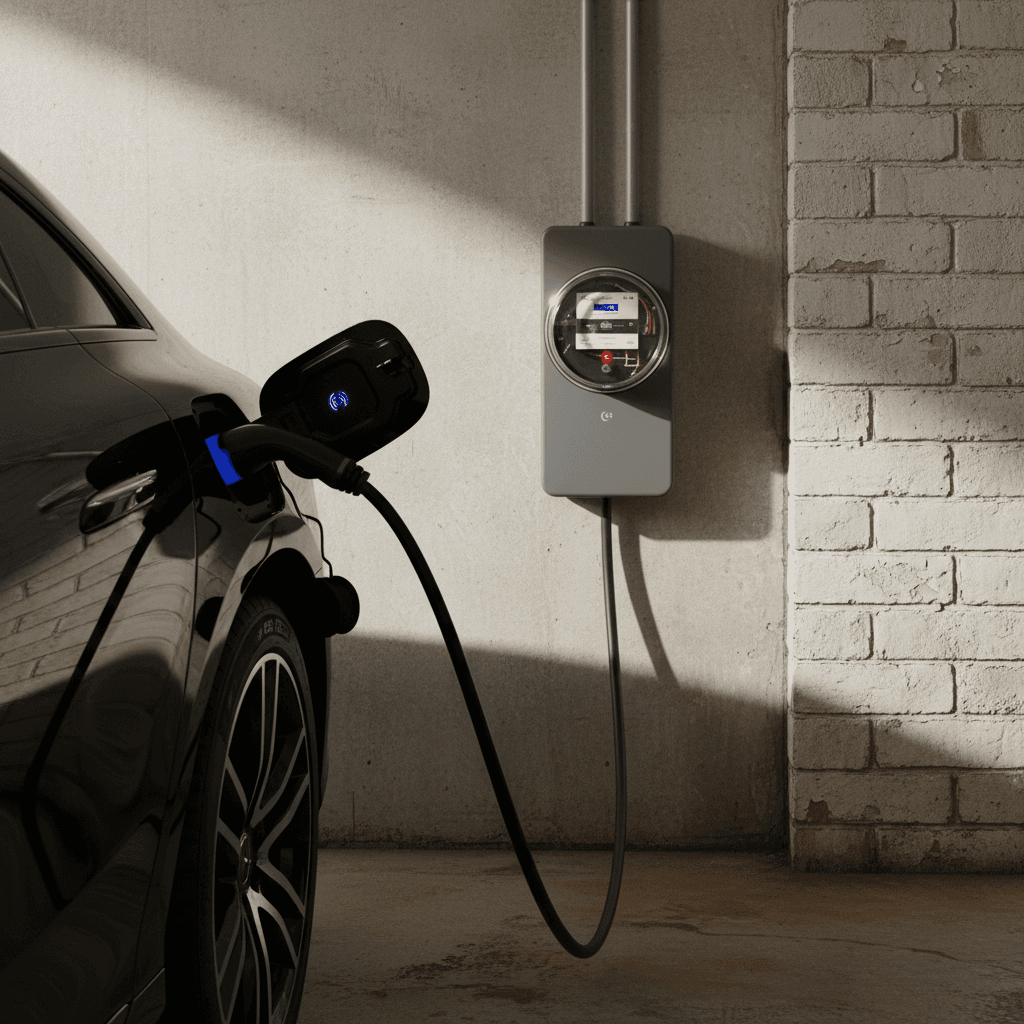
Three common EQS charging patterns, and what they mean for cost
1. Mostly home charging (best case)
You have a garage or driveway and a Level 2 charger. 80–90% of your miles are charged at home off your residential rate. This is where you see the <strong>biggest per‑mile savings</strong> versus a gas S‑Class.
2. Mixed home, workplace, and public
You charge at home, grab free or cheap workplace charging when available, and use DC fast chargers primarily on road trips. Your average cost per mile stays clearly below gasoline, but the gap narrows if fast charging becomes a weekly habit.
3. Mostly public fast charging (worst case)
Apartment living with limited home charging and frequent DC fast charging at $0.40–$0.60/kWh. In this scenario, the EQS can cost as much or even more per mile than the S‑Class while still carrying higher depreciation.
Bonus: Solar‑powered home
If you offset some or all home charging with rooftop solar, your effective energy cost per mile can drop dramatically, improving the EQS total cost picture far beyond what a gasoline S‑Class can match. "Free" fuel changes everything.
Don’t buy an EQS assuming cheap energy without a plan
Who comes out ahead: EQS vs gas S-Class?
When you put all the pieces on the table, energy, maintenance, depreciation, insurance, there isn’t a single universal winner. The better choice depends on how you use the car, how long you keep it, and whether you buy new or used.
When the EQS usually wins on total cost
- You drive 12,000+ miles per year and charge mostly at home.
- You plan to keep the car 7–10 years, spreading depreciation over a long period.
- Your local electricity is reasonably priced, and gasoline is above about $3/gal.
- You value quiet, instant‑torque driving enough that you’ll actually use the car often.
In this world, the EQS’s lower energy and maintenance costs have enough time and mileage to overcome its steeper early depreciation.
When the gas S‑Class can be cheaper overall
- You buy the car new and plan to sell or trade in within 3–5 years.
- You lack convenient home charging and rely heavily on DC fast chargers.
- You live in an area with expensive electricity and relatively cheap gasoline.
- You’re especially worried about long‑term EV technology/battery risk and prefer the “known quantity” of a gas flagship.
In those scenarios, the S‑Class’s somewhat steadier resale and simpler refueling can out‑weigh the EQS’s cheaper electrons.
How buying used with Recharged changes the equation
Here’s where the EQS becomes very interesting: the used market. Because new EQS models took such a big depreciation hit early, a 2–3‑year‑old car can sell for a fraction of its original price. If you’re stepping in at that point, you’re harvesting someone else’s depreciation while still getting the benefits of an ultra‑quiet luxury EV.
Why a used EQS through Recharged can undercut a gas S-Class
You keep the EV advantages while trimming the biggest EV disadvantage: new‑car depreciation.
Lower starting price
Verified battery health
EV‑specialist support & delivery
Ready to find your next EV?
Browse VehiclesThe sweet spot: 2–4-year-old EQS with good battery health
Checklist: deciding between a Mercedes EQS and gas S-Class
Key questions before you choose EQS or S-Class
1. Where will you park and charge most nights?
If you have a dedicated parking spot with access to a 240‑volt outlet or charger, the EQS gains a huge advantage. If the car lives on the street with no practical way to plug in, a gas S‑Class is likely less stressful.
2. How many miles do you really drive per year?
High‑mileage drivers (12,000–15,000+ miles per year) benefit most from the EQS’s lower per‑mile energy and maintenance costs. If the car is a low‑mileage toy, depreciation dominates the math.
3. Are you buying new or used?
New EQS vs new S‑Class is a close call because of depreciation. A <strong>used</strong> EQS with verified battery health can be a cost‑of‑ownership bargain compared with a similar‑age S‑Class.
4. How long do you keep cars?
Planning to sell or trade every 3–4 years? The S‑Class may be safer on resale. Keeping the car for 7–10 years? The EQS’s lower running costs have more time to pay off.
5. What do local energy prices look like?
Check your actual electric bill (cents per kWh) and local gas prices. If electricity is under about $0.20/kWh and gas runs above $3/gal, the EQS is in its element.
6. How comfortable are you with EV tech?
EVs add software, over‑the‑air updates, and a big battery to think about. If you’re excited by that and willing to learn, the EQS is rewarding. If it all feels like a chore, the S‑Class may fit your personality better, even if it costs more at the pump.
FAQ: Mercedes EQS total cost vs gas car
Frequently asked questions about EQS vs gas S-Class costs
Bottom line: should you choose an EQS over a gas S-Class?
Think of the EQS and S‑Class as two flavors of the same indulgence. The gasoline S‑Class offers familiarity and predictable resale on a known luxury template. The EQS trades those for near‑silent acceleration, lower day‑to‑day running costs, and the satisfaction of skipping gas stations, at the price of steeper early depreciation and a steeper learning curve on charging.
If you have solid home charging, drive a healthy number of miles each year, and you’re willing to buy lightly used instead of brand‑new, a well‑vetted EQS can undercut a comparable S‑Class on total cost while feeling even more futuristic and refined. That’s exactly where a platform like Recharged shines: verified battery health, transparent pricing, expert EV guidance, and financing and trade‑in support to make the numbers work for you.
Run your own math with your local fuel and electricity prices, then look at what a used EQS actually costs in today’s market. You may find that the luxury flagship with the plug is not just the cleaner choice, it may quietly be the cheaper one to live with as well.