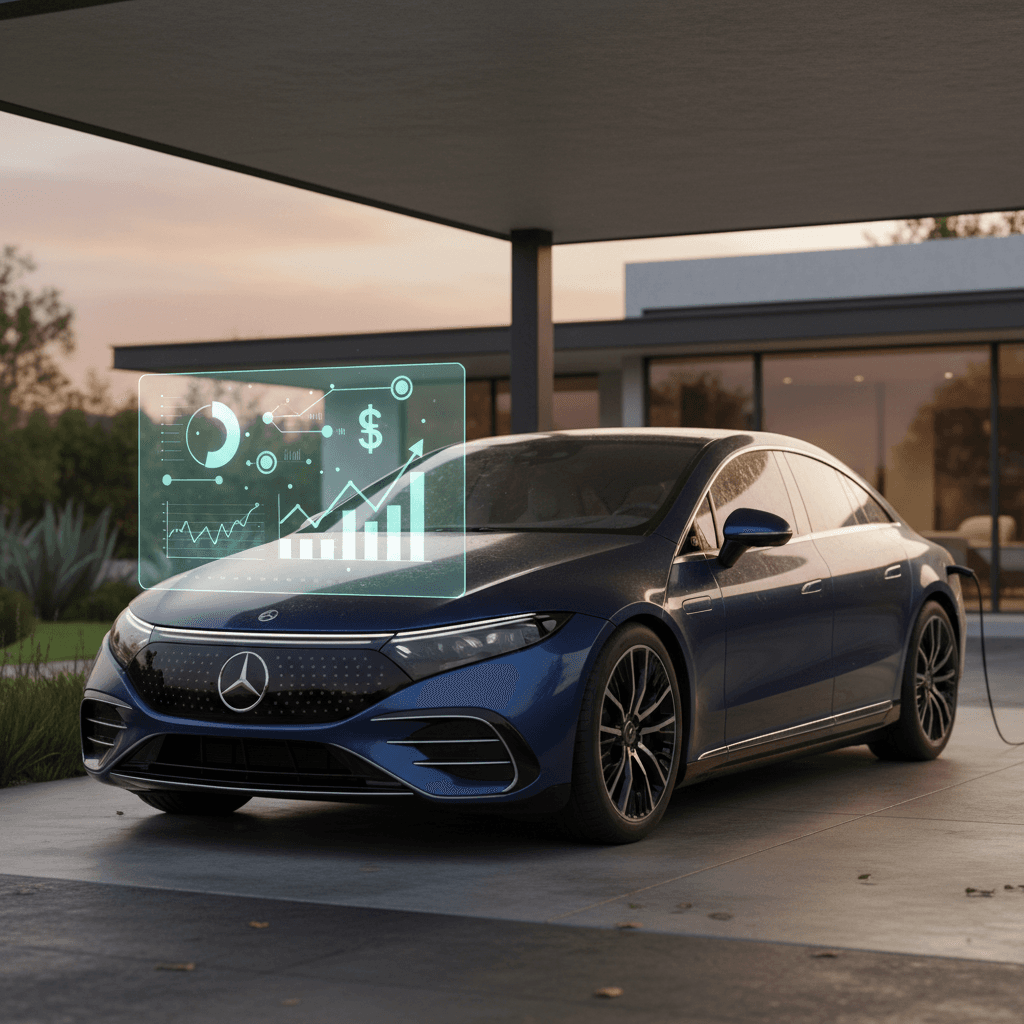
If you’re looking at a Mercedes EQS, you already know it’s a flagship luxury EV, with insurance premiums to match. Understanding the Mercedes EQS insurance cost per month before you sign a purchase or lease can keep your total payment from getting away from you.
Key point
Mercedes EQS insurance cost per month: quick overview
Mercedes EQS insurance at a glance (2025 U.S. averages)
Numbers like these are directional, not a quote. Insurers price your Mercedes EQS based on you, your driving record, ZIP code, annual miles, coverage limits, credit, and more. But they give you a realistic starting point before you start shopping rates.
How much does it cost to insure a Mercedes EQS per month?
Let’s start with hard data, then layer in what real EQS owners are seeing in the wild.
Typical Mercedes EQS insurance cost per month (full coverage)
Approximate monthly premiums for a Mercedes-Benz EQS in the U.S. for 2025, assuming 12,000–15,000 miles per year. These are directional examples, not quotes.
| Driver profile & situation | Estimated monthly premium | Notes |
|---|---|---|
| Major national average (all drivers, EQS all models) | ≈ $400/mo | Based on ~$4,839 per year average for full coverage on a Mercedes EQS. |
| Excellent driver, 40s–50s, suburban, EQS 450+ | $275–$375/mo | Clean record, good credit, higher deductibles, bundling home/auto. |
| Good driver, 30s–40s, EQS 580 sedan or SUV | $350–$500/mo | Higher vehicle value and more power push the rate up. |
| Performance model (EQS AMG 53), urban area | $450–$750+/mo | High MSRP, performance hardware, and traffic density drive premiums higher. |
| Liability‑only or reduced coverage on older CPO EQS | $150–$220/mo | Only realistic on lower‑value used EQS, but exposes you to more risk. |
Younger, high-risk drivers and AMG models will tend toward the top of each range; older, claim‑free drivers in low‑risk ZIP codes will trend toward the bottom.
These are not quotes
Why is Mercedes EQS insurance so high?
If you’re coming from a mainstream SUV or an older sedan, the first EQS quote you see can feel like cold water. There are good reasons why Mercedes EQS insurance cost per month typically lands well above the national average.
What drives EQS insurance premiums up?
It’s not just that it’s electric, it’s that it’s a flagship luxury EV.
Six‑figure MSRP when new
Complex EV hardware
Luxury brand risk history
Urban & commuter use
Liability exposure
Long repair times
EVs vs. gas cars on insurance
9 factors that change your EQS monthly insurance
You can’t change that the EQS is a six‑figure Mercedes, but you can influence much of what an underwriter looks at. Here’s what typically moves your Mercedes EQS insurance cost per month up or down.
- Driver age and experience – Younger drivers (especially under 25) pay sharply more on any luxury EV. Mature drivers with 10+ claim‑free years often get the best EQS rates.
- Driving record – At‑fault accidents, speeding tickets, or DUIs can add hundreds per month to an EQS policy or push some carriers to decline altogether.
- Location – Dense metro areas with more theft and collisions cost more than small towns. Coastal, flood‑prone, or hail‑prone regions also see higher comprehensive rates.
- Annual mileage – A 4,000‑mile‑per‑year EQS that’s mainly a weekend car is cheaper to insure than a 15,000‑mile daily highway commuter.
- Coverage limits – Full‑coverage policies with high liability limits and low deductibles (say $500) will cost much more than state minimum liability with $1,500 deductibles.
- Credit‑based insurance score (where allowed) – In many states, insurers use credit‑based scores. Strong credit can materially lower your monthly premium.
- Model and trim – An EQS 450+ is typically cheaper to insure than an EQS 580, which in turn is cheaper than an AMG EQS 53 with more power and performance hardware.
- New vs. used – Insurers care about repair and replacement cost, but moving from a fresh‑off‑the‑lot EQS to a few‑year‑old CPO example can still moderate premiums a bit.
- Safety and telematics – Advanced safety features, anti‑theft systems, and usage‑based driving apps can unlock discounts if you’re a consistently cautious driver.
Sample Mercedes EQS insurance scenarios
To make all this more concrete, here are simplified, hypothetical scenarios that illustrate how the same EQS can generate very different monthly premiums.
Scenario 1: Cost‑conscious commuter
Vehicle: 2022 EQS 450+ sedan, CPO purchase around $55,000
Driver: 45‑year‑old, clean record, suburban Midwest ZIP code, 10,000 miles/year
Coverage: Full coverage, $250k/$500k liability, $1,000 deductibles
Typical ballpark: $275–$350 per month.
Bundling auto with home, choosing higher deductibles, and avoiding rush‑hour commuting could drag this number toward the lower end of the range.
Scenario 2: Urban AMG enthusiast
Vehicle: 2024 Mercedes‑AMG EQS 53, MSRP well into six figures
Driver: 30‑year‑old, a couple of speeding tickets, large coastal city, 14,000 miles/year
Coverage: Full coverage, high liability limits, $500 deductibles
Typical ballpark: $550–$750+ per month.
The combination of performance hardware, higher‑risk city driving, and recent violations stacks multiple surcharges on top of an already pricey base rate.
Get quotes before you fall in love
How EQS insurance compares to other EVs and gas luxury sedans
Another way to sanity‑check your EQS quote is to compare it to both other EVs and the gas sedans it competes with.
Insurance cost comparison: Mercedes EQS vs. other vehicles
Very rough directional national averages for full‑coverage insurance in 2025. Your exact quote may differ substantially.
| Vehicle | Typical annual premium | Approx. monthly | Relative to EQS |
|---|---|---|---|
| Mercedes‑Benz EQS (all trims) | ≈ $4,800–$5,600+ | ≈ $400–$470+ | Baseline |
| Mainstream gas sedan (national average) | ≈ $2,600 | ≈ $215 | Often less than half of an EQS policy |
| Gas Mercedes E‑Class (luxury sedan) | ≈ $2,600–$3,000+ | ≈ $215–$250+ | Substantially cheaper than an EQS for many drivers |
| Other luxury EVs (e.g., large Tesla, Lucid, BMW i7) | ≈ $4,000–$5,000+ | ≈ $335–$420+ | Generally in the same ballpark as EQS |
These numbers are only for broad comparison. A cautious driver in a low‑risk ZIP code might see all of them come in lower; a high‑risk driver could see them all higher.
The EQS isn’t uniquely punished
9 ways to lower your Mercedes EQS insurance cost per month
You can’t turn an EQS into a Corolla in the insurer’s eyes, but you do have levers to pull. Here are realistic tactics I’d look at if I were trying to get an EQS payment package to pencil out.
Practical strategies to trim your EQS premium
Mix and match these depending on your risk tolerance and financial comfort level.
1. Shop widely, every year
2. Adjust deductibles thoughtfully
3. Bundle home, renters, or umbrella
4. Consider mileage‑based programs
5. Opt into telematics (if you drive gently)
6. Leverage professional & affinity discounts
7. Take a defensive‑driving course
8. Fine‑tune who’s listed on the policy
9. Don’t skimp on liability
How Recharged can help
Ready to find your next EV?
Browse VehiclesUsed Mercedes EQS: insurance and total cost of ownership
One of the quirks of the EQS market in 2024–2025 is how fast these cars have depreciated from their original sticker price. That creates an opportunity, but you have to view insurance as just one piece of the puzzle.
Why a used EQS often makes financial sense
- Lower purchase price: A lightly used EQS can sell for a fraction of its original MSRP, meaning a much smaller loan or lease payment.
- Similar insurance ballpark: Insurers care more about replacement and repair cost than your actual purchase price, so monthly premiums don’t fall as dramatically as the payment, but they can still soften.
- Slower depreciation curve: Buying after the steepest drop in value helps stabilize your total cost of ownership.
Where insurance still bites
- Even with a used EQS, you’re insuring a complex, high‑end EV, not a budget commuter.
- Collision and comprehensive coverage often remain expensive because parts, labor, and repair times are similar whether the car is new or three years old.
- Dropping to liability‑only to save money can leave you exposed if the vehicle is still worth a large chunk of cash.
Use total cost, not just the premium

Checklist before you get an EQS insurance quote
Pre‑quote prep: get your best possible EQS rate
1. Decide on your realistic coverage needs
Before you ever hit a quote form, decide on liability limits, whether you want collision and comprehensive, and how high a deductible you’d genuinely be comfortable paying.
2. Gather key details about the EQS
You’ll want the exact year, trim (450+, 580, AMG), body style (sedan vs. SUV), and ideally the VIN. The more precise the info, the more accurate your quote.
3. Pull your current declarations page
Your existing policy shows your current coverage levels, deductibles, and premium. Use it as an apples‑to‑apples comparison when you shop EQS quotes.
4. Estimate your annual mileage accurately
Don’t guess wildly. If your EQS will be a second car or short‑range commuter, say so. Lower, documented mileage can help nudge your rate down.
5. Ask about all available discounts
While quoting, explicitly ask each carrier about EV discounts, telematics, multi‑policy savings, good‑driver discounts, and any profession or alumni perks you might qualify for.
6. Compare total monthly car cost
Add your <strong>estimated EQS insurance cost per month</strong> to the projected payment, charging cost, and taxes. That full picture will tell you if an EQS truly fits your budget today.
FAQ: Mercedes EQS insurance cost per month
Frequently asked questions about Mercedes EQS insurance
Bottom line: what to budget for EQS insurance
For most U.S. drivers in 2025, a realistic Mercedes EQS insurance cost per month for full coverage lands around $350–$450, with some lower‑risk owners dipping under that and higher‑risk or AMG drivers climbing well above it. That’s a big step up from the national average, but it’s part of the price of admission for a flagship luxury EV.
If the EQS is on your short list, don’t guess, run real quotes based on your profile, and look at the whole picture: payment, insurance, energy, maintenance, and taxes. A carefully chosen used EQS with verified battery health can deliver a top‑tier driving experience for a surprisingly attainable total monthly cost, especially when you buy through a transparent marketplace like Recharged that’s built around the realities of EV ownership.