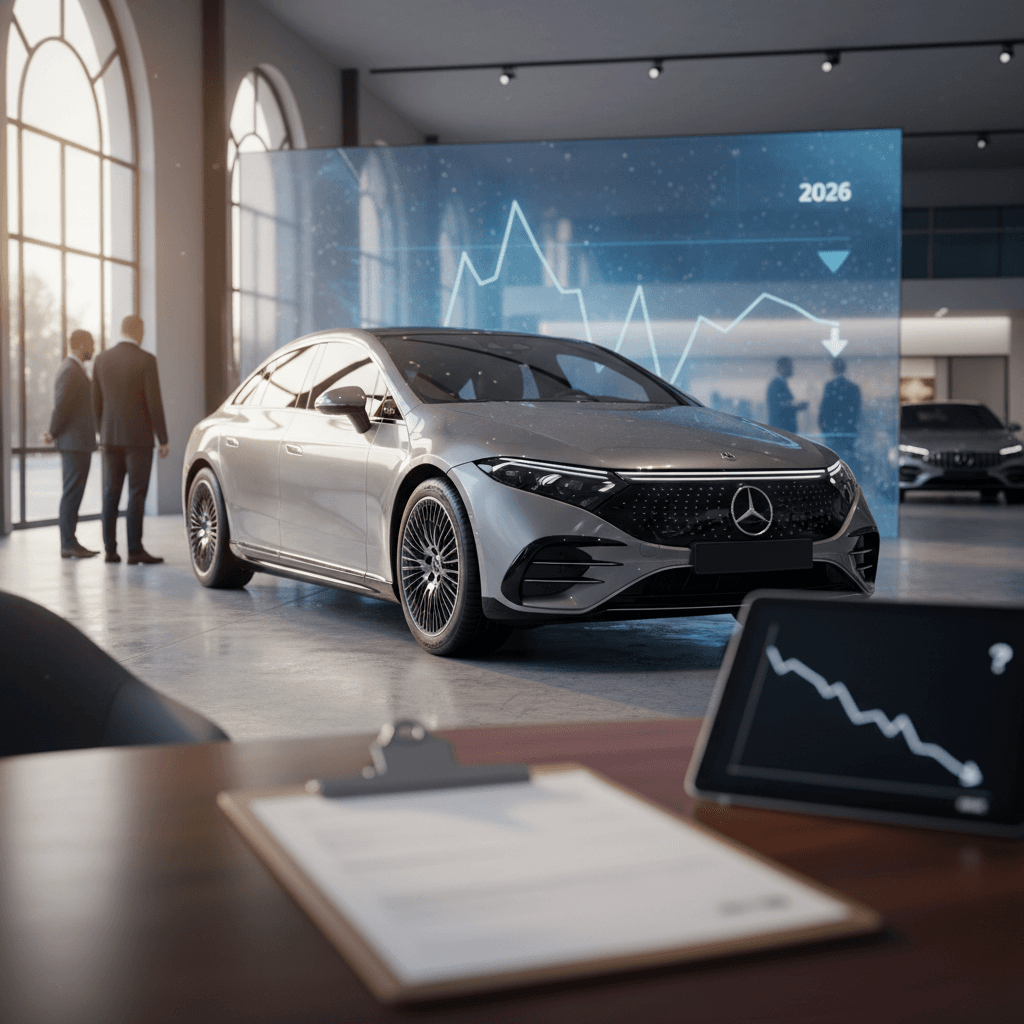
By 2026, the Mercedes EQE trade-in value has become a kind of black comedy. You paid E-Class money for your electric Mercedes, and now the local dealer is offering midsize-Camry numbers. The truth is, the EQE has been hit by a perfect storm of EV price cuts, soft demand, and fast-moving tech. The good news: if you understand how buyers price these cars, and you come prepared, you can still squeeze real money out of your EQE when you trade it in or sell it.
Context: 2026 and the EQE
Why Mercedes EQE trade-in values feel so weird in 2026
The EQE arrived as Mercedes’s electric E-Class equivalent: plush, quiet, techy, and priced accordingly. New-car MSRPs for sedans hovered in the mid‑$70,000s to mid‑$80,000s, with some AMG variants sailing past $100,000. Then reality bit. A softer EV market, aggressive discounting, and a glut of lease returns pushed used prices down hard. Many 2023–2024 EQE sedans that stickered around $76,000–$87,000 now transact in the mid‑to‑high $30,000s on the used market as of early 2026.
- Rapid EV price cuts: Mercedes slashed EQE and EQS prices to chase demand, dragging used values down with them.
- Luxury-brand depreciation: Mercedes already depreciates faster than Toyota or Lexus; combine that with EV uncertainty and you get double trouble.
- Technology turnover: Shoppers know that newer EVs charge faster and go farther, so they expect steep discounts on older tech.
- Sedan headwinds: In the U.S., SUVs are king. The EQE sedan takes a bigger hit than the EQE SUV, especially outside coastal EV hubs.
Double depreciation is real
What your Mercedes EQE is roughly worth in 2026
Let’s talk ballpark numbers. Exact values depend on mileage, options, condition, region, and timing, but by 2026 a pattern has emerged. Early EQEs have fallen off the cliff, and even 1–2‑year‑old cars are trading at a huge discount to original MSRP.
2026 value bands for common Mercedes EQE trims (U.S.)
Very rough retail value ranges for typical, clean-title examples with average mileage. Trade-in offers often land 10–20% under these figures.
| Model year & trim | Typical mileage in 2026 | Approx. retail price range | Typical dealer trade-in band |
|---|---|---|---|
| 2022–2023 EQE 350+ / 350 4MATIC sedan | 25,000–40,000 miles | $33,000–$40,000 | $26,000–$34,000 |
| 2022–2023 EQE 500 sedan / AMG sedan | 20,000–35,000 miles | $38,000–$48,000 | $30,000–$40,000 |
| 2023–2024 EQE 350+ / 350 4MATIC SUV | 15,000–30,000 miles | $40,000–$52,000 | $32,000–$44,000 |
| 2023–2024 EQE 500 SUV / AMG SUV | 15,000–30,000 miles | $47,000–$60,000 | $37,000–$50,000 |
These are directional, not quotes. Use them to sanity-check offers, not replace a professional appraisal.
How to use these numbers
Mercedes EQE depreciation snapshot by 2026
How dealers actually calculate Mercedes EQE trade-in value
When you roll your EQE into a traditional dealership, they’re not thinking about what you paid. They’re thinking about what they could sell it for next week at auction or on their front row, and how much risk they’re taking on a complex, first‑generation EV. Here’s the back-of-napkin math most stores use.
The dealer’s EQE trade-in playbook
What’s really happening behind the glass office door
1. Start with auction / wholesale data
Most dealers begin with auction reports and wholesale pricing tools, what similar EQEs are actually changing hands for between dealers. This can be well below the retail prices you see online.
2. Subtract recon and risk
Next they estimate reconditioning: tires, brakes, detailing, software updates, and any open recalls. EVs add uncertainty, especially around batteries, so the risk buffer tends to be larger than on a gas E-Class.
3. Adjust for trim, miles, and history
Premium audio, AMG styling, and driver-assist packages help, but not as much as you think. On the flip side, accidents, smokers, or high mileage can crater the number quickly.
4. Account for EV and brand volatility
With prices on EQE and EQS still softening, many dealers build in extra margin in case values dip again before they sell your car. That’s why your trade figure often feels a size too small.
Where EQE trades get ugly
Battery health: the silent EQE price killer
With a gas E-Class, you can read the odometer and skim the Carfax and feel mostly informed. With an EQE, the high‑voltage battery is the story. It’s a ~90‑kWh, six‑figure component that dictates both range and resale value. Two identical‑looking EQEs can be thousands apart in value if one has a strong battery and the other is already showing noticeable degradation.

- Dealers rarely pull deep battery data. Many stores just scan for fault codes and call it a day. That protects them legally, not necessarily your value.
- Range complaints stick to a VIN. If prior owners have documented poor range or frequent DC fast‑charging, savvy buyers will discount the car.
- Battery warranties are not a cure‑all. Mercedes’s 10‑year battery warranty helps, but only for failures that meet specific thresholds. Moderate degradation isn’t always covered, but still matters to the next buyer.
- Third‑party diagnostics are becoming critical. A quantified health score can turn hand‑wavy anxiety into real, defensible value when you negotiate.
Where Recharged’s battery data helps
Steps to maximize your Mercedes EQE trade-in offer
You can’t rewrite the market, but you can absolutely influence your side of the equation. Think like a buyer, document the car like an engineer, and make it hard for anyone to pretend your EQE is just another soft EV with mystery miles.
Pre‑trade EQE value-boost checklist
1. Document battery health and charging habits
If you can, pull a detailed battery health report or use an EV‑specific diagnostic. Note how often you DC fast‑charge vs. Level 2 at home. Buyers like to see evidence of gentle charging habits and consistent range.
2. Gather all service and recall records
Have digital or printed records ready: software updates, warranty work, tire rotations, brake service. A tidy history suggests a tidy car and helps justify a trade figure at the top of the range.
3. Fix visible, inexpensive flaws
Curb‑rashed wheels, cheap interior trim pieces, and minor paint scuffs give appraisers easy excuses to deduct value. Address the obvious items that cost you less than the hit you’ll take on trade.
4. Detail the car like you’re selling it yourself
A deep interior clean, fresh mats, and a proper exterior detail can move the perceived condition from "average" to "above average" in one afternoon. On a luxury EV, that difference is real money.
5. Get multiple numbers, don’t stop at one
Collect trade bids from a Mercedes dealer, an EV‑savvy independent dealer, and a digital buyer like Recharged. The spread on EQE offers can be thousands; you want that competition working for you.
6. Time your move around incentives and demand
If new EQE incentives spike or Mercedes drops prices again, used values can wobble. If you see aggressive new‑car discounts arriving in your area, try to <strong>trade before those cars hit the used market</strong> in volume.
Leverage your EQE as a deal lever
Trade-in vs. private sale for a Mercedes EQE
With the EQE, the gap between what a dealer will pay and what an informed retail buyer might pay can be eye‑watering. But that extra money comes at the cost of time, hassle, and sometimes risk. Here’s how the options stack up in 2026.
Trading your EQE in
- Pros: Fast, convenient, sales tax savings in most states, no strangers at your house, no managing payoff paperwork.
- Cons: Usually 10–20% less than a strong private‑party sale, especially on a sought‑after spec with good battery health.
- Best for: Busy owners, high‑mileage cars, or EQEs with blemished histories you don’t want to explain over and over.
Selling your EQE privately
- Pros: Potentially thousands more in your pocket, especially if you can prove battery health and recent maintenance.
- Cons: Requires marketing, screening buyers, arranging test drives and payment, and in some cases paying off a lien.
- Best for: Low‑mileage, well‑optioned EQEs in EV‑friendly markets, where buyers understand what they’re looking at.
Market matters
How Recharged helps you value and sell your EQE
Recharged exists for exactly this moment, the part where you realize your Mercedes EQE is too complicated and too misunderstood for the usual "What’s my car worth?" widgets. Rather than letting a generic algorithm guess, Recharged uses EV‑specific data and battery diagnostics to value the car like an EV, not just a fancy E-Class with a plug.
Selling or trading your EQE through Recharged
Options that treat your EQE like the sophisticated EV it is
Recharged Score battery health diagnostics
Every EQE gets a Recharged Score Report, including verified battery health, charging history insight, and range expectations. That transparency makes your EQE easier to price, and easier for buyers to trust.
Fair-market pricing for used EVs
Recharged benchmarks your EQE against real‑world used EV transactions, not just generic books. Soft EV prices are baked in, but so is any upside your particular car earns on condition and battery health.
Flexible selling paths
You can request an instant offer, list on consignment, or use your EQE as a trade‑in toward another used EV in Recharged’s nationwide marketplace, often with home delivery and fully digital paperwork.
Ready to find your next EV?
Browse VehiclesWhy this matters for EQE owners
FAQ: Mercedes EQE trade-in value in 2026
Frequently asked questions about Mercedes EQE trade-in value
Bottom line: Playing the EQE trade-in game in 2026
The Mercedes EQE is a deeply comfortable, quietly impressive electric sedan or SUV that just happened to debut in a brutal EV market cycle. In 2026, that means trade‑in values that look shockingly low next to the original window sticker, but also a chance to extract real value if you handle the sale thoughtfully. Know the true retail range for your trim, come armed with battery and service documentation, shop multiple offers, and don’t be afraid to separate your EQE from the generic “EV problem child” narrative.
If you’d rather not fight that battle alone, leaning on an EV‑focused platform like Recharged can help. With fair‑market pricing, verified battery health data, financing, trade‑in or consignment options, and nationwide delivery if you’re moving into another used EV, Recharged is built to make this messy corner of the market a lot more transparent, and to give your Mercedes EQE a fair shake when it’s time to move on.