If you’re considering a Mercedes EQE and you own a small camper, cargo trailer, or pair of jet skis, you’re probably wondering two things: what is the Mercedes EQE towing capacity and how much range loss will I see while towing? The answers depend on which EQE you drive, the hitch package it has, and how heavy and boxy your trailer is.
Quick takeaway
Can you tow with a Mercedes EQE?
The short answer: yes, some EQE models can tow, but it’s not as simple as just bolting on a hitch. You need to pay attention to model, market, and whether your specific vehicle has the factory towing package.
EQE body styles and towing basics
SUVs can tow; sedans usually can’t (in North America).
EQE SUV
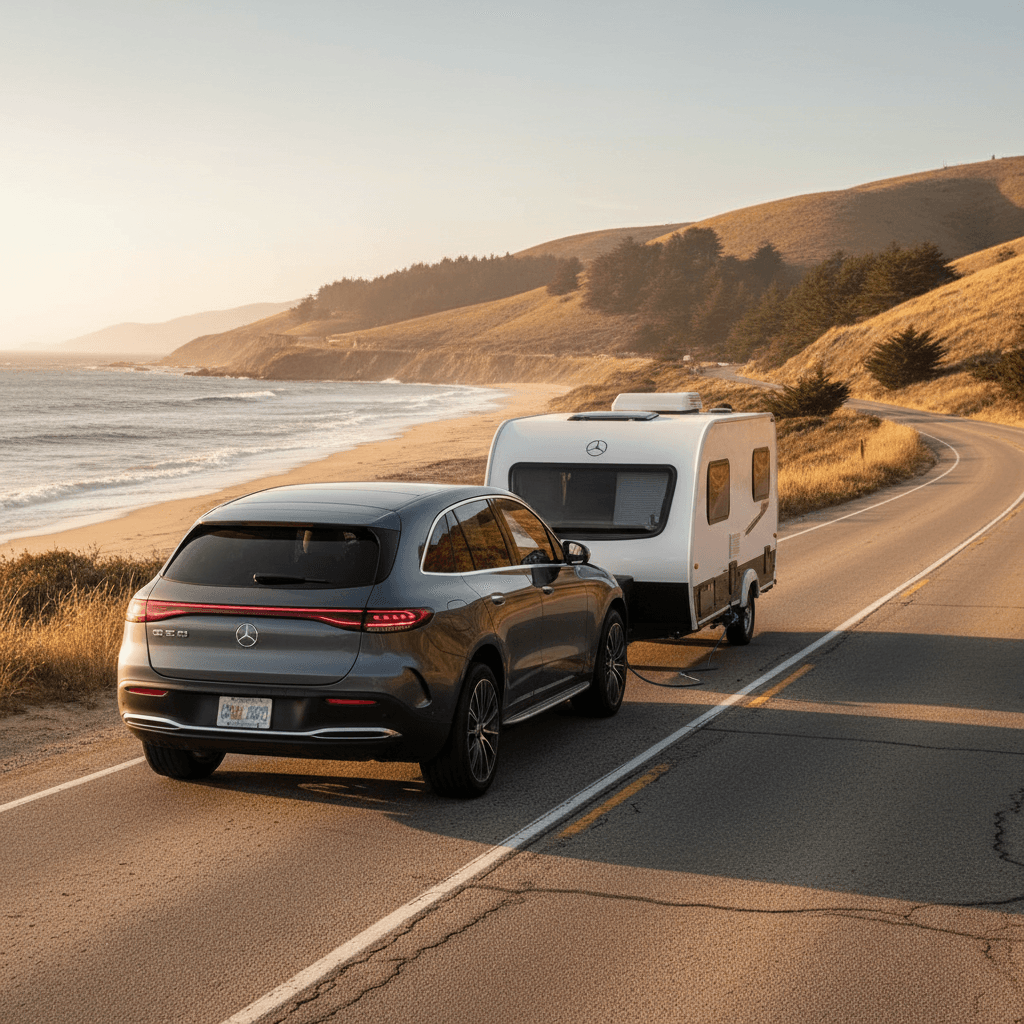
The EQE SUV (X294) is the model most commonly rated for towing. With the factory towing package and an electric folding towbar, European documentation lists braked towing up to around 1,600–1,800 kg (about 3,500–3,970 lbs), depending on variant.
In North America, ratings around 3,500 lbs are typical when equipped with the official towing package.
EQE sedan
The EQE sedan is an aerodynamic, long‑range cruiser. In many markets, especially the U.S., it is not factory‑approved for towing. Some European brochures list limited tow ratings, but U.S. owners should assume no towing unless clearly stated in the owner’s manual.
Even if aftermarket hitches exist, using them for towing on a non‑rated model can create warranty and liability issues.
Always check your specific car
Mercedes EQE towing capacity by model
Exact numbers vary slightly by year and market, but the EQE lineup follows some consistent patterns. Here’s a simplified view to help you understand where your vehicle likely falls.
Typical Mercedes EQE tow ratings (when factory‑equipped)
Approximate braked towing capacity for common EQE variants. Always verify for your specific VIN and market.
| Model | Drivetrain | Factory tow package available? | Typical braked towing capacity | Best use cases |
|---|---|---|---|---|
| EQE SUV 350+ | RWD | Yes in many markets | ~3,500 lbs (≈1,600 kg) | Small campers, utility trailers, toys |
| EQE SUV 350 4MATIC | AWD | Yes | ~3,500 lbs (≈1,600 kg), some brochures up to ~3,970 lbs | Similar to 350+; more traction for slippery boat ramps |
| EQE SUV 500 4MATIC | AWD | Yes | ~3,500–3,970 lbs depending on market | Heavier single‑axle campers within rating |
| AMG EQE SUV 43/53 | Performance AWD | Generally yes in Europe; check local specs | Often around ~3,500–3,970 lbs | Performance‑oriented towing within limits |
| EQE sedan 350+/500 | RWD/AWD | Often no in U.S.; limited in some EU markets | Commonly not rated in North America | Bike racks (hitch carrier) rather than towing |
| AMG EQE sedan | Performance AWD | Typically no towing | 0 lbs (no factory rating) | Not intended for towing |
Use this as guidance only; your owner’s manual is the final authority.
Don’t forget payload and tongue weight
How much range do you lose when towing with an EQE?
This is where expectations often need a reset. EVs like the EQE are very efficient on their own, but a trailer adds three range killers: weight, aerodynamic drag, and speed. That’s why you’ll see big differences between city and highway towing.
Typical EV range loss while towing
In simple terms, if your EQE SUV normally delivers a comfortable 230–260 miles of highway range, it’s reasonable to plan on about 110–160 miles per charge while towing a small camper at interstate speeds and leaving yourself a safety buffer.
Avoid planning off the EPA number
Real‑world towing examples and matching a trailer
Choosing the right trailer for your Mercedes EQE is less about maxing out the spec sheet and more about staying comfortably under it. Here are illustrative scenarios to frame your expectations.
1. Lightweight utility trailer
- Trailer: 5x8 utility trailer with lawn gear, ~1,200 lbs loaded
- EQE model: 350+ SUV with factory tow package
- Driving: Suburban speeds, 35–55 mph
What to expect: Mild range hit, maybe 15–25% loss. You might still see ~180–200+ usable miles per charge if you typically get 230–260 miles solo.
2. Aerodynamic teardrop camper
- Trailer: 1,800–2,200 lb teardrop or small travel trailer with rounded nose
- EQE model: EQE SUV 350 4MATIC rated ~3,500 lbs
- Driving: Highway speeds, 60–65 mph
What to expect: 30–40% range loss. If your solo highway range is ~240 miles, plan in the 140–165 mile range, and keep your charge window narrower (e.g., 10–80%).
3. Tall boxy camper near max weight
- Trailer: Square‑front camper at 3,000–3,500 lbs with bikes on the rear
- EQE model: 500 4MATIC or AMG SUV, properly rated
- Driving: Long freeway stints, 65–70 mph, some hills
What to expect: 40–50% range loss or more in wind or cold. That might mean practical legs of 110–140 miles before you want to stop for a charge.
Leave headroom in your tow rating
Tips to minimize range loss when towing an EQE
You can’t cheat physics, but you can make smart choices that help your EQE tow more efficiently and comfortably. Think of it as stretching the same battery pack further without white‑knuckling the state of charge.
Practical ways to save range while towing
1. Manage your speed
Aerodynamic drag climbs dramatically above 60 mph, and that’s amplified with a trailer hanging in the breeze. Keeping your EQE around <strong>55–65 mph</strong> instead of 70–75 mph is often the single biggest lever you have to reduce range loss.
2. Choose the most aerodynamic trailer
A <strong>rounded teardrop</strong> or low‑profile cargo trailer creates far less drag than a tall, square travel trailer. Even at the same weight, a sleeker shape can noticeably improve your miles per kWh.
3. Pack light and smart
Every extra cooler, generator, or toolbox eats into payload and towing margin. Store heavy items over the trailer axle, pack only what you need, and keep tongue weight within spec to maintain stable handling and efficiency.
4. Use the right drive mode
Many EQE SUVs offer driving modes that adjust throttle response and regenerative braking. For towing, a more relaxed mode with <strong>strong but predictable regen</strong> can smooth power use and reduce energy waste in stop‑and‑go traffic.
5. Watch real‑time consumption
Use the EQE’s energy display to monitor kWh/100 mi or mi/kWh while towing. If you see numbers spike due to headwinds or hills, consider lowering speed or adjusting your plan to hit a charger sooner.
6. Pre‑condition in cold weather
In winter, cabin and battery heating can significantly cut range. Pre‑condition the EQE while plugged in before departure and consider using seat and steering‑wheel heaters instead of blasting cabin heat whenever possible.
Good news for short‑haul towing
Charging strategy while towing your EQE
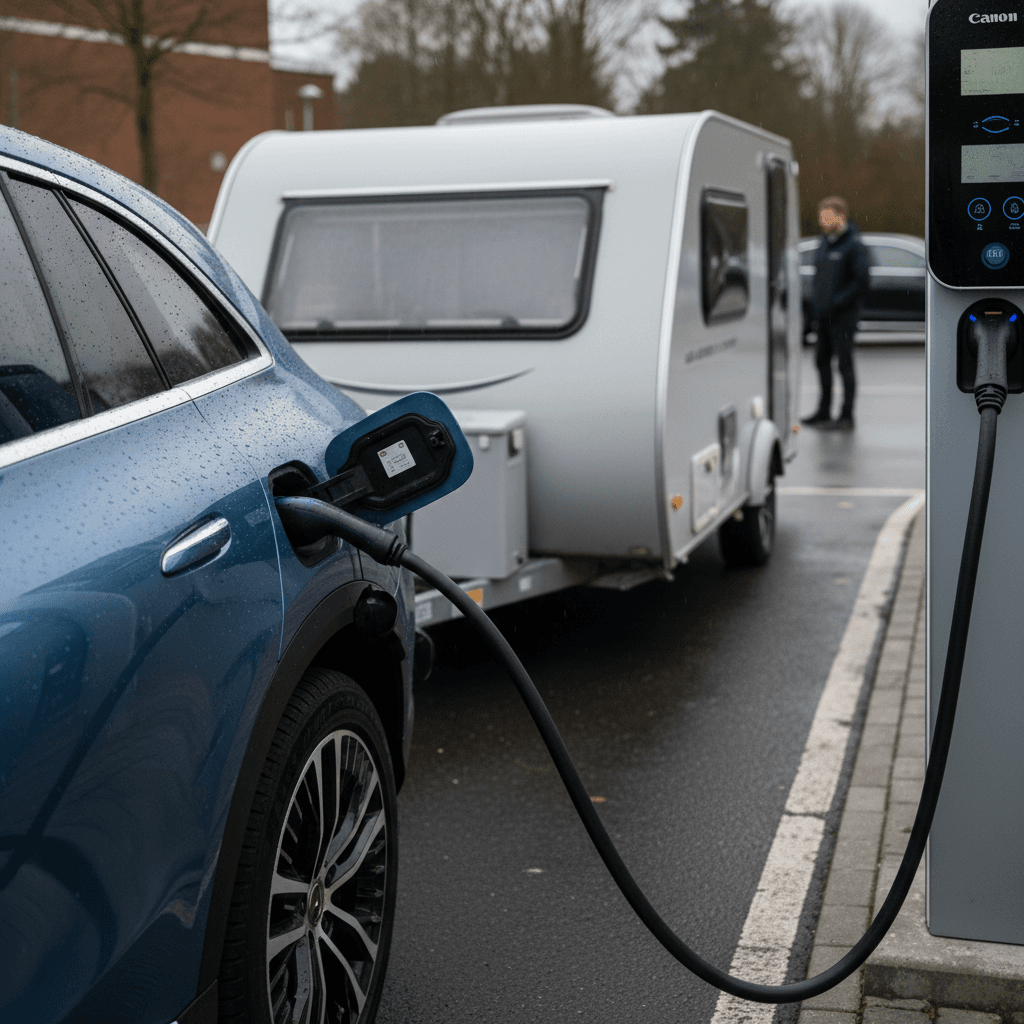
Towing doesn’t just change how far you can go; it changes how you plan stops. The Mercedes EQE can fast‑charge at DC stations and Level 2 chargers, but a trailer adds a few wrinkles to your charging game plan.
- Plan chargers that are easy to pull through or back into without unhitching, such as stations with pull‑through RV spots or chargers at the edge of a parking lot.
- Use apps (including Mercedes navigation, PlugShare, and major charging‑network apps) to scout satellite images of stations before you commit, especially important with a trailer.
- When you do need to unhitch, look for flat, well‑lit areas where the trailer can sit safely while you charge.
- Target charging from roughly 10–15% up to 70–80% when possible. Above ~80%, DC fast‑charge speeds taper significantly, especially under heavy battery load from towing.
- In hot or cold weather, expect slightly slower charging and leave buffer in your plan. The pack is working harder while towing and may throttle to protect long‑term health.
Mind your trailer plug and wiring
Towing and battery health on a used Mercedes EQE
If you’re shopping for a used Mercedes EQE SUV, towing history is one of those hidden details that can matter, but it’s not the whole story. Occasional towing within the rated limits is well within what the engineers had in mind. Problems tend to come from chronic overloading, heat, or aggressive fast‑charging behavior.
How towing can impact battery life
- Higher average loads: Towing pushes the powertrain harder, raising battery temperatures, especially on long grades.
- More frequent fast‑charging: Towing road trips often require more DC fast‑charge sessions, which adds some extra wear over time.
- Thermal management: The EQE’s liquid‑cooled pack is designed to manage heat, but repeated heavy use still shows up in long‑term health.
That’s why looking at real battery health data is so much better than guessing how a prior owner used the car.
How Recharged helps you buy confidently
Every used EV sold through Recharged comes with a Recharged Score Report that includes verified battery health diagnostics and fair market pricing. Our technicians look beyond mileage, using diagnostic tools and real‑world data to understand how the pack is aging.
If towing is part of your plan, our EV specialists can help you match the right EQE to your trailer expectations and walking you through tow‑package, payload, and charging considerations before you buy.
FAQ: Mercedes EQE towing capacity and range loss
Common questions about towing with the Mercedes EQE
Is the Mercedes EQE a good EV for towing?
If your plan is to pull a three‑axle toy hauler across several states, the Mercedes EQE isn’t the right tool. But if you’re looking to tow a small camper, utility trailer, or toys within a few hundred miles, a properly equipped EQE SUV can do the job comfortably, provided you respect its tow rating and adjust for range loss.
The keys are straightforward: pick a light, aerodynamic trailer, stay well inside your rated capacity, keep highway speeds reasonable, and build in extra charging stops. Do that, and you’ll discover that an EQE can be a remarkably refined tow vehicle for weekend adventures.
If you’re shopping the used market and want help finding an EQE that can tow, and has the battery health to support years of road trips, Recharged can help. Our Recharged Score Report, expert EV advisors, and financing and trade‑in options make it easier to choose the right EV for your towing plans, not just for your daily commute.