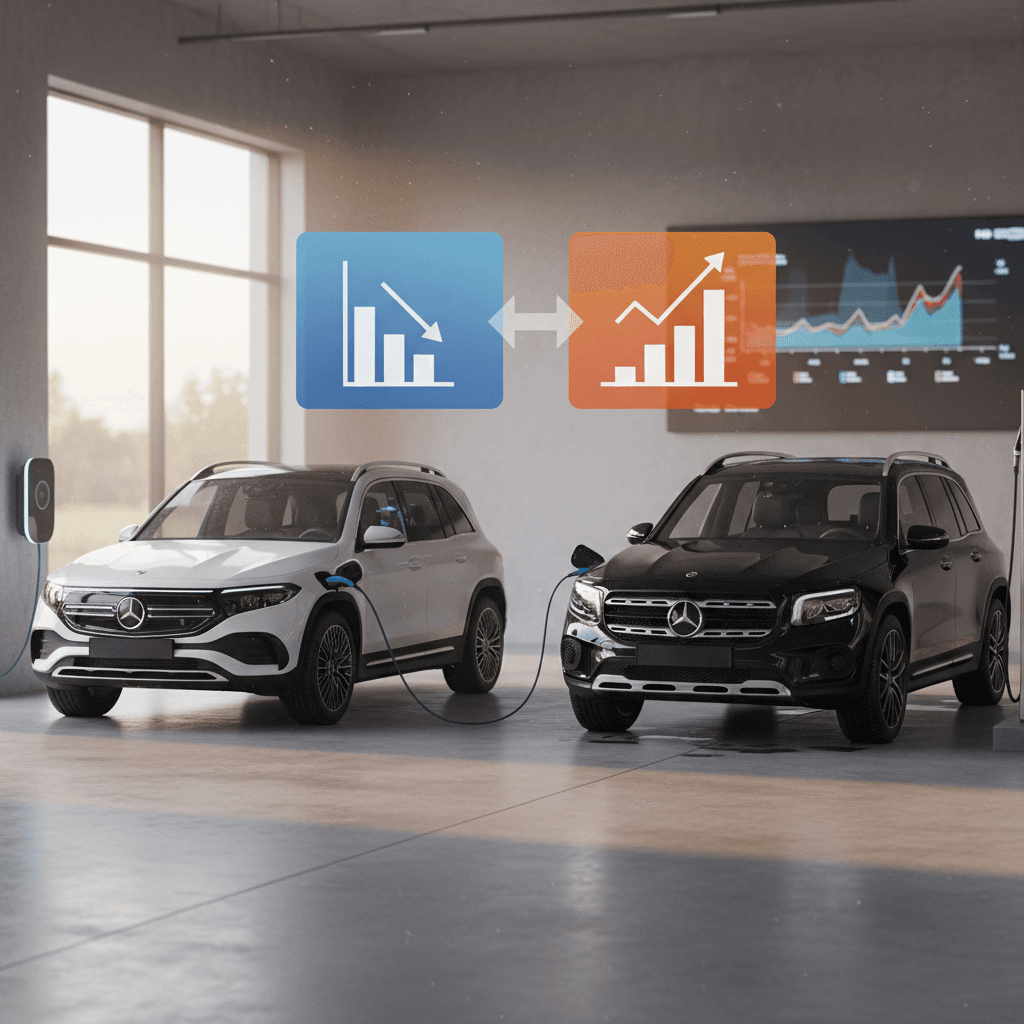
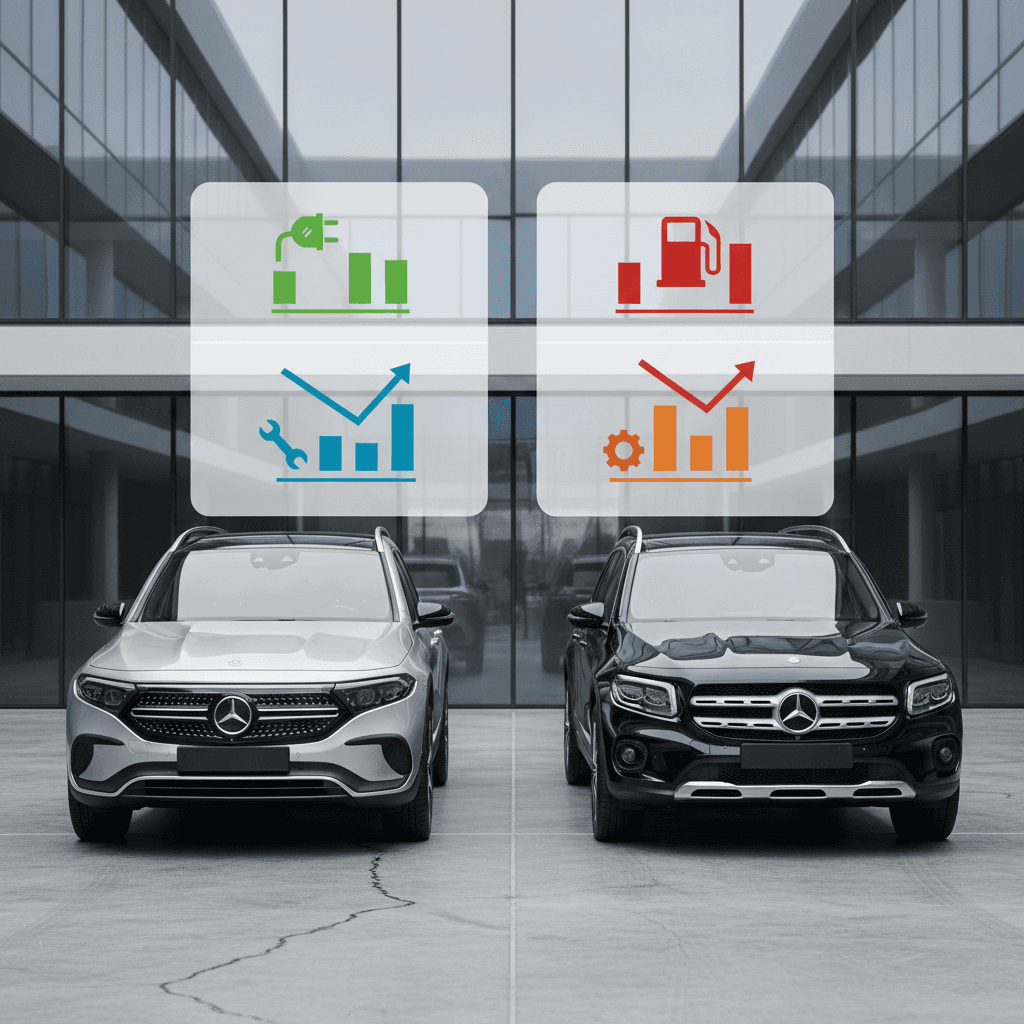
If you’re cross‑shopping the Mercedes EQB against a gas SUV, the obvious comparison is its sibling, the GLB 250. On paper the EQB often costs more to buy, but once you factor in fuel, maintenance, and resale, the picture changes fast. This guide walks through the Mercedes EQB’s total cost of ownership versus its gas car equivalent so you can see, in real dollars, what you’re likely to spend over five years.
Key takeaway in one sentence
Why compare the Mercedes EQB to a gas equivalent?
Mercedes didn’t design the EQB from a clean sheet; it’s an electric version of the compact GLB SUV. Same basic body shell, similar interior layout, and available third row, but with a battery and electric motors instead of a turbocharged gas engine. That makes the EQB vs. GLB match‑up one of the cleanest real‑world tests of EV vs gas total cost of ownership you’ll find.
- Nearly identical size and practicality
- Similar luxury features and tech packages
- Same brand, dealer network, and warranty experience
- Different powertrains and fueling costs
In other words, you’re not comparing apples to oranges. You’re asking a focused question: for essentially the same Mercedes compact SUV, is the electric EQB or the gas GLB 250 cheaper to live with over time?
The gas twin: Mercedes GLB 250 as EQB benchmark
For this analysis, we’ll use a front‑wheel‑drive or 4MATIC GLB 250 as the EQB’s gas benchmark because that’s how most shoppers are actually cross‑shopping. We’ll stay away from AMG variants and other outliers to keep things realistic.
Core specs: Mercedes EQB vs GLB 250
High‑level specs that matter for cost of ownership rather than performance bragging rights.
| Model | Powertrain | EPA efficiency / fuel economy* | EPA range | Battery / tank size |
|---|---|---|---|---|
| EQB 250+ (FWD) | Single‑motor electric | ~31 kWh/100 mi (about 3.2 mi/kWh) | Up to ~250 mi | 66.5 kWh gross (approx.) |
| EQB 300 / 350 4MATIC | Dual‑motor electric | ~39 kWh/100 mi | ~220–245 mi | 66.5 kWh gross (approx.) |
| GLB 250 (FWD/4MATIC) | 2.0L turbo gas | ~26–27 mpg combined | N/A | ~15.9 gal gas tank |
EPA and efficiency figures rounded; actual results vary with driving style, climate, and wheel choice.
Numbers are estimates, not promises
Energy costs: electricity vs gasoline
When you’re comparing the Mercedes EQB’s total cost vs a gas car equivalent, energy cost per mile is the first big lever. Here’s a simple framework using recent U.S. averages so you can adjust for your own utility bill and local gas prices.
Typical U.S. energy costs (late 2025–early 2026)
Step 1: Cost per mile for the EQB
Let’s assume a mid‑range U.S. electricity cost of $0.18/kWh. An EQB 250+ that uses about 31 kWh per 100 miles (0.31 kWh/mile) will cost roughly:
- 0.31 kWh × $0.18 ≈ $0.056 per mile
- That’s about $5.60 in electricity for 100 miles of driving at home.
Dual‑motor EQB 300/350 models are a bit less efficient. At roughly 39 kWh/100 mi, you’re closer to $0.07/mile at the same electric rate, but still far below gasoline on a per‑mile basis in most markets.
Step 2: Cost per mile for the GLB 250
Using a recent national average gas price of about $3.00/gal and a GLB 250 combined fuel economy around 26 mpg:
- $3.00 ÷ 26 mpg ≈ $0.115 per mile
- That’s about $11.50 for 100 miles of driving.
In simple terms, the GLB 250 typically costs about 2× per mile in fuel compared with an EQB you charge at home. That gap grows if your local gas prices are higher than the national average or if you can take advantage of off‑peak EV rates.
What about public fast charging?
5‑year total cost: Mercedes EQB vs GLB 250
Sticker price is only the opening bid. To see whether the Mercedes EQB or its gas twin is cheaper to live with, you have to look at total cost of ownership (TCO): purchase price, fuel, maintenance, insurance, taxes/fees, and resale value. Let’s walk through a simplified five‑year, 60,000‑mile example.
Baseline assumptions
- Annual mileage: 12,000 miles
- Ownership period: 5 years (60,000 miles total)
- Electricity: $0.18/kWh home charging
- Gasoline: $3.00/gal regular
- Financing: typical 60‑month loan with similar APR on both vehicles
EQB vs GLB price reality
New EVs like the EQB often carry a higher MSRP than their gas siblings, but incentives and discounts can narrow that gap. In the used market, where Recharged operates, late‑model EQBs can sometimes be priced very competitively against similar‑year GLBs, especially once you consider battery health and warranty coverage.
Illustrative 5‑year cost comparison (60,000 miles)
Rounded, ballpark numbers to show directionally how EQB vs GLB costs stack up. Use them as a framework, not a quote.
| Category (5 yrs) | EQB (typical) | GLB 250 (typical) | Comment |
|---|---|---|---|
| Fuel / Energy | ≈$3,400 | ≈$6,900 | EQB estimated at $0.056/mi, GLB at $0.115/mi. |
| Maintenance & Repairs | ≈$2,000 | ≈$3,200 | Fewer moving parts and no oil changes favor EQB. |
| Insurance | Slightly higher | Baseline | EVs can cost a bit more to insure in some markets. |
| Taxes & Fees | Similar | Similar | Depends on state EV incentives or registration fees. |
| Depreciation | Higher % but narrowing | More predictable | EV values are stabilizing; EQB resale is improving. |
| Charging Equipment | $800–$1,500 (one‑time) | $0 | Home Level 2 charger + possible electrician work. |
Assumes similar trim levels and financing. Taxes, fees, and insurance are averaged for a typical U.S. driver and will vary by location and driver profile.
What the rough math suggests
Maintenance and repairs: where EVs shine
Whether you’re a spreadsheet person or not, you’ll feel this difference in your checkbook. The EQB deletes a lot of the routine service items that keep a GLB 250 visiting the service bay.
Typical maintenance differences: EQB vs GLB 250
Assuming 5 years / 60,000 miles and a mix of dealer and independent shop visits.
Gas GLB 250
- Oil and filter changes 2–3 times per year
- Spark plugs, belts, and engine air filters
- Automatic transmission service
- More frequent brake pad/rotor work (no regen)
Over five years, it’s not unusual for a luxury gas SUV to rack up $3,000+ in routine maintenance, excluding major repairs.
Electric EQB
- No engine oil, spark plugs, or timing chains
- Single‑speed gearbox with minimal service
- Brake pads last longer thanks to regeneration
- Coolant and cabin filters still need periodic service
Most EQB owners mainly pay for tire rotations, brake fluid, and occasional inspections in the first 5 years.
Big‑ticket repairs still matter
Insurance, taxes, and fees
On the insurance side, the Mercedes EQB and GLB 250 live in the same neighborhood: compact luxury SUVs with lots of safety tech. EVs can carry slightly higher premiums in some regions because of repair complexity and parts costs, but driver profile, ZIP code, and driving history matter more than the fuel you burn.
- If your state offers EV incentives or reduced registration fees, the EQB can come out slightly ahead.
- If your state charges extra annual EV fees in lieu of gas taxes, that advantage may shrink or flip.
- Both models qualify for similar safety and comprehensive coverage options from major insurers.
In most real‑world quotes I’ve seen, insurance differences between these two are measured in tens of dollars per year, not hundreds, unless something in your personal profile drives a bigger swing.
Charging equipment and home setup costs
One cost the gas GLB 250 doesn’t have is a home charging setup. To make EQB ownership painless, most drivers invest in a Level 2 charger.
What to budget for home charging
1. Level 2 charger hardware
Expect about <strong>$400–$800</strong> for a quality 240‑volt home EVSE (wallbox or portable) from a reputable brand, depending on features and power rating.
2. Electrical work
If you already have a suitable 240‑V outlet near your parking spot, installation may be minimal. If you need a new circuit run from your panel, a licensed electrician might add <strong>$400–$700+</strong>, more if trenching or panel upgrades are required.
3. Permits and inspection
Some municipalities require a permit for a new 240‑V circuit. Fees are usually modest but worth factoring in when you compare EQB vs gas.
4. Smart charging features
App‑connected chargers can help you schedule off‑peak charging and track costs accurately, tightening up your total‑cost estimates over time.
Resale value and battery health
EV resale values went through a volatile stretch in the early‑to‑mid 2020s as incentives, interest rates, and new‑model launches whipsawed the market. The good news is that values are stabilizing, and compact luxury EVs like the EQB are finding their level relative to gas equivalents.
- The EQB may depreciate faster in percentage terms than a GLB 250, but often started from a higher MSRP.
- Used‑EV prices cooled, which is actually an opportunity if you’re buying now.
- Battery warranties (typically 8 years / 100,000 miles for components) backstop the biggest long‑term concern for many shoppers.
Why battery health transparency matters
How a used Mercedes EQB changes the math
Up to now we’ve talked in broad strokes that apply to new and used vehicles, but the real value story often appears in the used EQB market. Early depreciation is already baked into the price, yet you still enjoy most of the fuel and maintenance savings over the rest of the vehicle’s life.
Why total cost tilts even harder toward a used EQB
Especially when you’re shopping on a marketplace like Recharged.
Lower capital cost
Known battery health
Nationwide access
When you run the same five‑year, 60,000‑mile math on a late‑model used EQB vs a similar‑year GLB 250, the EV’s lower operating costs often push its total cost of ownership clearly below the gas SUV’s, without relying on any future fuel‑price spikes to bail you out.
Who should choose the EQB vs the gas GLB?
Choose the Mercedes EQB if…
- You drive 10,000–15,000 miles a year or more.
- You can install or already have home Level 2 charging.
- Your local electricity rates are reasonable relative to gasoline.
- You plan to keep the vehicle at least 4–5 years.
- You value quiet, smooth power and instant torque more than engine sound.
Stick with a GLB 250 if…
- You live in a home or apartment where charging access is uncertain.
- You drive mostly in areas with sparse public charging and can’t charge at home or work.
- Your annual mileage is very low, so fuel savings are minimal.
- You prefer to avoid EV learning curves and simply want to gas‑and‑go.
Think about your energy mix, not just pump prices
FAQ: Mercedes EQB total cost vs gas SUV
Frequently asked questions
Bottom line: is the Mercedes EQB cheaper to own?
Put simply, if you drive a normal amount, can charge at home, and plan to keep the vehicle at least several years, the Mercedes EQB is very likely to be cheaper to own than its gas twin, the GLB 250. Lower energy costs and reduced maintenance tend to outweigh a higher purchase price, especially in the used market where early depreciation is already baked in.
Your situation may differ, energy prices, charging access, and how long you keep your cars all matter. But if the EQB fits your daily driving pattern, it’s not just a greener choice; it’s often the more financially sensible one. And if you’re ready to run the numbers on real vehicles, exploring used EQBs on Recharged gives you verified battery health data, transparent pricing, expert EV guidance, and nationwide delivery, so you can choose the SUV that makes sense for your budget today and five years from now.