If you’re pricing out a Mercedes EQB brake pad replacement, you’ve probably already discovered the spread is wild, quotes from a few hundred dollars to north of a grand for what sounds like the same job. The truth lives in the middle. Because the EQB is an electric SUV with strong regenerative braking and a premium badge on the hood, its brake service profile looks a little different from your average compact crossover.
Quick answer: EQB brake pad replacement cost
Mercedes EQB brake pad replacement cost overview
Typical Mercedes EQB brake service costs (U.S. 2025)
National brake cost surveys show most vehicles land in the $150–$500 per axle range for pads and labor, with SUVs and luxury brands on the upper end. The EQB sits squarely in that luxury-SUV band. Parts are pricier than on a mass-market crossover, and dealership labor rates easily clear $150 per hour in many metro areas.
On the upside, the EQB’s electric drivetrain and regenerative braking mean you’ll likely replace pads less often than you would on a comparable gas GLB, GLC or rival compact SUV. Over a 5–7 year ownership window, total brake spend can still be very reasonable, especially if you’re smart about where you go and what parts you choose.
Why EQB brake pads often last longer than gas SUVs
Many EQB owners are surprised when their first brake quote shows up at 50,000 miles and the advisor says, “You’re fine for now.” That’s the quiet magic of regenerative braking at work. Every time you lift off the pedal, the EQB’s motors act as generators, slowing the car and feeding energy back to the battery. The friction brakes just finish the job.
How regenerative braking changes EQB brake wear
Same brake hardware idea, very different duty cycle.
1. Less heat, less wear
On an EV like the EQB, the front pads don’t live in a blast furnace every time you come down an off-ramp. Regen handles the bulk of everyday slowing, so the pads see fewer high-heat cycles and can easily last 40,000–70,000 miles in normal use.
2. Corrosion, not just mileage
The downside: when pads don’t work as hard, they can age out before they wear out. Light-footed drivers who rely heavily on regen can see pad faces and rotors build surface rust or glazing. Regular highway drives and firm braking now and then keep things clean and functional.
Driving style still matters. An EQB doing ride-share duty in hilly San Francisco traffic will need brakes sooner than a gently driven commuter in Nebraska. But broadly, expect your EQB to be kinder to its pads and rotors than a comparable gas Mercedes crossover, one of the subtle ways EVs pay you back.
Watch out for the EV “rust paradox”
Dealer vs independent shop: what you’ll actually pay
In the U.S., the same Mercedes EQB brake job will be priced three different ways depending on the sign over the door. Luxury-brand labor rates, electronic parking brakes and brake wear sensors all add time and cost, but how that’s marked up is very much a shop-by-shop affair.
Typical Mercedes EQB brake pad replacement pricing by shop type
Approximate 2025 U.S. pricing for a single axle (front or rear) on an EQB, pads-only vs pads + rotors.
| Shop type | What’s included | Expected cost per axle | Pros | Cons |
|---|---|---|---|---|
| Mercedes dealership | OEM pads, hardware, labor; sometimes resurfacing or new sensors | $325–$650 | Factory parts, brand-trained techs, loaner cars, warranty alignment | Highest hourly rates, more upsell pressure |
| Independent European specialist | OEM or high-quality aftermarket pads, hardware, labor | $250–$450 | Lower labor rates, still know Mercedes systems well, more flexible on parts | Waiting room may be less plush, you must vet the shop |
| General repair shop | Aftermarket pads, basic hardware, labor | $200–$350 | Lowest advertised prices, easy to find | May lack experience with Mercedes electronics and parking brake service modes |
Real quotes vary by region, but this table gives you a realistic lane for negotiation.
For a pads-only service on one axle, a fair U.S. target for an EQB is around $325–$450 out the door at a dealership and $250–$375 at a European specialist. Once rotors join the party, the job becomes a full brake service and the total per axle jumps into the $400–$600 range, sometimes higher in expensive cities.
A quick way to sanity-check a quote
Front vs rear brake pad costs on the EQB
On the EQB, front brake pads typically cost slightly more than rears, both in parts and labor. The calipers are larger, the hardware more robust, and the front axle still does the lion’s share of panic-stop work, even with regen helping out.
Front brake pads
- Dealer parts (pads + hardware): often $150–$260 per axle.
- Independent shop using OEM-equivalent pads: $90–$180.
- Installed with labor: most quotes land between $350–$600 per front axle.
If the fronts are badly grooved or the rotors are below spec, expect a combined pads-and-rotors price closer to $450–$750 per front axle at a dealership.
Rear brake pads
- Dealer parts (pads + hardware): usually $120–$220 per axle.
- Indie shop with quality aftermarket: $80–$160.
- Installed with labor: $300–$500 per rear axle is common.
The electronic parking brake can add a little labor time on the rear axle, your tech has to put the calipers into service mode and reset everything properly after.
It’s not unusual to see the fronts wear out first, with rears following 10,000–20,000 miles later. But if your driving is city-heavy with a lot of automated braking or stability control intervention, the rears can wear surprisingly fast too, so don’t assume they’re immortal.
When do Mercedes EQB brake pads need replacement?
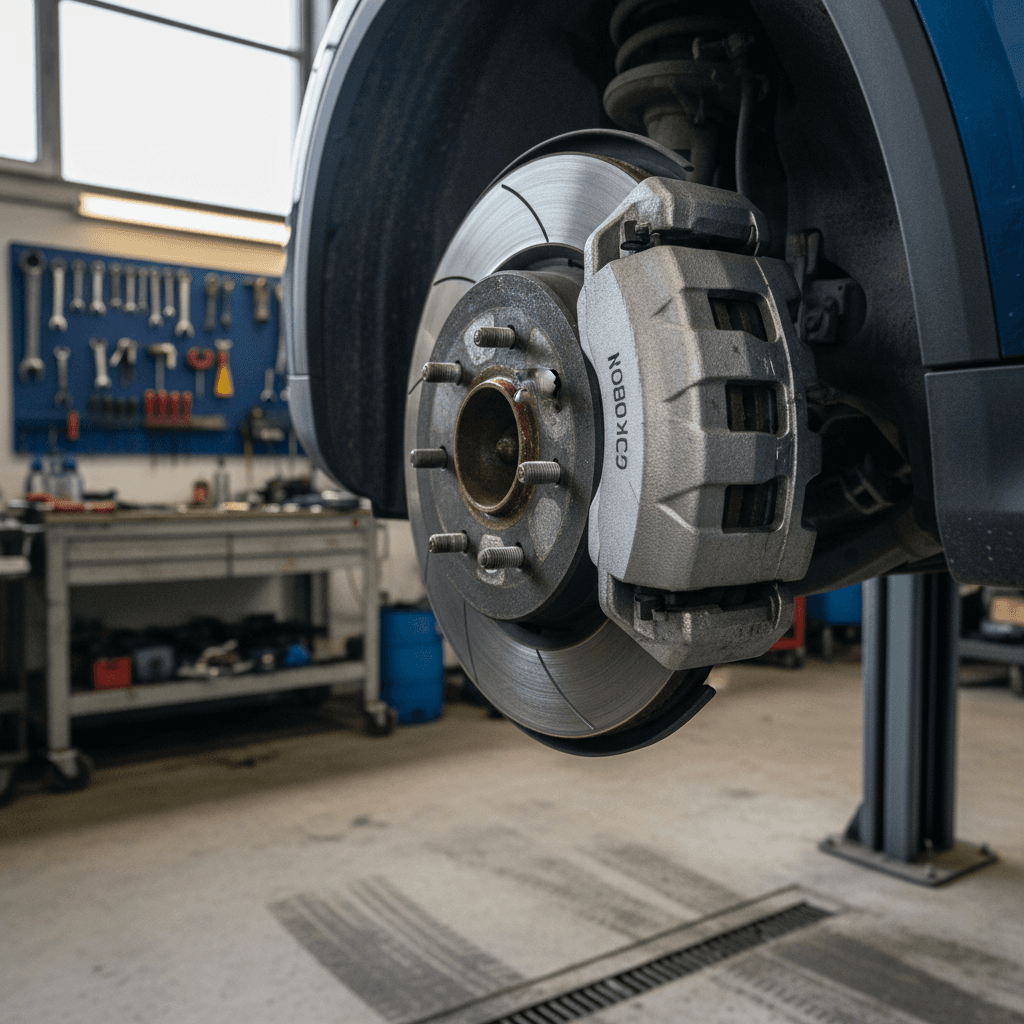
Mercedes builds wear monitoring into the EQB’s brake system. When the pads hit a certain minimum thickness, you’ll see warnings on the cluster or in the MBUX interface long before metal-on-metal contact. Still, it pays to know what you’re looking at so you’re not at the mercy of a vague service recommendation.
Key signs your EQB needs new pads
1. Dashboard brake wear warning
The most honest signal: when the EQB flashes a <strong>brake wear indicator</strong>, it’s telling you pad thickness has reached the engineered minimum. You don’t need to panic-stop at the next exit, but you shouldn’t wait months either.
2. Less than 3–4 mm of pad material
If you can see the pad through the wheel spokes, look for the friction material thickness. Anything near a <strong>1/8 inch (3 mm)</strong> or less means it’s time to book an appointment, especially before a road trip.
3. Squealing, grinding or pulsing
High-pitched squeals can be wear indicators doing their job. Grinding or a pulsing pedal under light braking usually means the pads have worn into the rotors or the rotors are warped, turning a cheap job into a pricier one.
4. Soft or long brake pedal
A pedal that feels softer or travels farther before biting can indicate pad wear, glazed pads, or other hydraulic issues. On an EV where regen hides minor friction-brake problems, this is a cue to get the car inspected soon.
5. Service advisor says “they’re at 5 mm”
Some dealers recommend pad replacement when you’re at <strong>5–6 mm</strong>, well above the absolute minimum. That’s not wrong, early replacement prevents rotor damage, but you’re allowed to ask for actual measurements and plan accordingly.
Do NOT ignore grinding on an EQB
What makes an EQB brake job more expensive?
If your neighbor just paid $280 for pads on a base Corolla, a $900 quote for your EQB can feel like assault. But once you pull apart the details, there are understandable, if not always lovable, reasons for the premium.
- Vehicle weight and performance: The EQB is a heavy, torque-rich SUV. Larger rotors and pads cost more to manufacture and ship, and they’re often specific to the model.
- OEM vs aftermarket pads: Genuine Mercedes pads command a premium, especially at the dealer counter. High-end low-dust ceramic options can also be pricey, but they tend to stay quieter and keep the wheels cleaner.
- Electronic parking brake setup: Rear brake jobs require putting the parking brake into service mode and resetting the system. That adds a bit of time versus a purely mechanical setup.
- Labor rate: It’s not unusual to see $150–$200/hour posted at U.S. Mercedes dealers in large cities. Even a simple 1.5–2 hour front brake job becomes expensive at those rates.
- Scope creep: If the shop adds new rotors, wear sensors, a brake fluid flush and a “courtesy” alignment on the same ticket, the total can balloon fast. Some of that may be legitimate; some may be wishful thinking on their part.
Pads-only vs a full brake job
How to save money on EQB brake pad replacement
The good news is you don’t have to pay “$1,800 because it says Mercedes” money for a basic EQB brake service. With a little homework and the right questions, you can keep costs in check without compromising safety.
Smart ways to trim EQB brake service costs
Spend where it matters, save where it doesn’t.
Compare at least 3 quotes
Call a dealer, a European specialist and a well-rated general shop. Give them your VIN, ask for pad brand, rotor brand (if included), parts cost and labor hours. That 10-minute exercise can easily save you a few hundred dollars.
Use OEM-equivalent parts
You don’t need gold-plated rotors. Many reputable brands build pads and rotors to Mercedes specs at a lower cost. Ask your shop for low-dust ceramic or OEM-equivalent parts from a known brand rather than the cheapest white-box option.
Bundle service strategically
If you’re due for an annual service and brakes within a few months of each other, ask whether doing everything at once reduces labor overlap. One visit, one loaner, often slightly lower total labor than two separate appointments.
Before you say yes to an EQB brake quote…
Confirm whether rotors truly need replacement
Have the shop <strong>measure rotor thickness</strong> and show you the numbers compared with the minimum spec. Light grooves alone don’t always justify new rotors; underspec thickness or heavy scoring usually does.
Ask for the pad brand and part number
You’re entitled to know whether you’re getting genuine Mercedes parts or an aftermarket set. With the part number, you can quickly check fair pricing online and decide whether you’re comfortable with the markup.
Clarify what’s included in the price
A tidy quote should spell out pads, rotors (if any), hardware, sensors, brake fluid flush, shop fees and tax. If the advisor only gives you a single number, politely ask them to itemize it.
Check warranty on parts and labor
Many shops offer <strong>12–24 months</strong> of coverage on brake work; some premium rotor and pad brands offer even longer. It’s worth a few extra dollars if you plan to keep the EQB.
Think about your ownership horizon
If you’re trading out of the EQB in a year, you may not need the most expensive lifetime-rotor package on the shelf. If you’re in for the long haul, investing in higher-quality components can pay off in quiet stops and longer intervals.
Where Recharged can help
Ready to find your next EV?
Browse VehiclesUsed EQB shoppers: brake system inspection checklist
On a test drive, the EQB’s brakes should be anonymous, in the best way. No squeaks, no shimmy, no drama. If you’re evaluating a used EQB at a dealer lot or from a private seller, a quick brake inspection can tell you whether the price is fair or whether you should be budgeting for an imminent service.
Brake checks before you buy a used EQB
1. Look at the pad thickness through the wheels
Turn the steering wheel full lock and peer between the caliper and rotor. You want to see a healthy chunk of friction material, not razor-thin slivers. Anything around <strong>3 mm or less</strong> means pads are due very soon.
2. Inspect rotor surfaces
Surface rust from overnight rain is normal and should clear with a short drive. Deep grooves, heavy pitting or a pronounced lip at the rotor edge suggest either hard use or deferred maintenance, and a likely pads-and-rotors bill coming up.
3. Test for noise and vibration
On a quiet road, do a series of gentle stops from 40–50 mph. Listen for squeals or grinding and feel for steering wheel shake or pedal pulsation. Any of these can indicate warped rotors, uneven pad deposits or worn components.
4. Check for warning lights or messages
Scroll through the instrument cluster menus and look for <strong>brake system</strong> or <strong>service required</strong> warnings. A recently cleared code can be a red flag; ask to see service records that match what the car is telling you.
5. Ask for the last brake service invoice
A seller who can prove pads and rotors were done 5,000 miles ago has a stronger case for their asking price. No paperwork? Assume you may be the one paying for the next brake job and negotiate accordingly.
6. Use a trusted third-party inspection
Before you wire money for any used luxury EV, a <strong>pre-purchase inspection</strong> by an independent Mercedes or EV specialist is cheap insurance. At Recharged, this kind of scrutiny is baked into the process so you don’t have to orchestrate it yourself.
Mercedes EQB brake pad cost FAQ
Frequently asked questions about EQB brake pad replacement
Bottom line: what to budget for EQB brakes
For a Mercedes EQB owner in the U.S., a realistic budget for brake work looks like this: $250–$450 per axle at a trusted independent shop when you’re just doing pads, and $700–$1,200 total when all four corners eventually need pads and rotors together. Thanks to regenerative braking, that moment should arrive later and less often than it would in a gas SUV of similar size.
If you’re shopping for a used EQB, brakes are a line item, not a landmine, as long as you know what you’re looking at. Ask for service records, listen closely on the test drive, and don’t be shy about getting an independent inspection. When you buy through Recharged, our Recharged Score Report and EV-specialist support make that calculus far more transparent, from battery life to humble brake pads. That way, the only surprises your EQB delivers are the good kind, smooth, silent torque and a driving experience that feels a class above your old gas crossover.