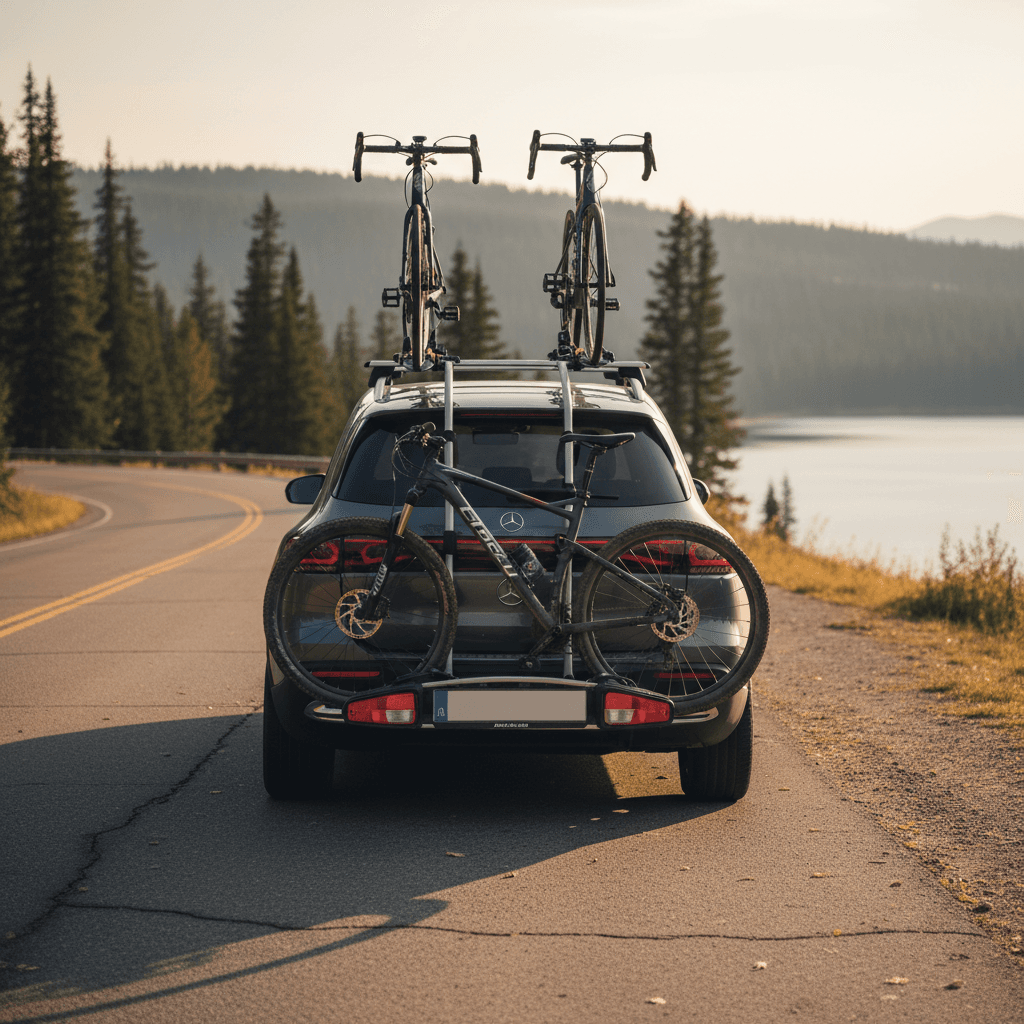
If you’ve got a Mercedes EQB and a couple of bikes, you’re probably wondering which Mercedes EQB bike rack options actually work, how much weight you can safely carry, and what it all does to your range. Because the EQB is an electric SUV with limited or no factory towing rating in some markets, you can’t just bolt on any hitch or strap rack and call it a day, you need a setup that respects the EV’s structure, software, and warranty limits.
Quick answer
Overview: EQB bike-carrying basics
The EQB is a compact electric SUV based on the GLB platform, with a battery pack under the floor and, depending on market, limited or no rated towing capacity. That has two big implications for hauling bikes:
- You must distinguish between towing (pulling a trailer) and supporting a bike rack on a towbar or hitch.
- Any rear-mounted solution has to respect the nose load (vertical load) or tongue-weight limit of the towbar or accessory hitch, not just the rack’s rating.
- All external racks, roof, hitch, or trunk, will increase drag and weight, which reduces your effective driving range, especially at highway speeds.
The good news is that there are now several EQB-specific towbar and hitch offerings marketed explicitly for bike carriers, plus off‑the‑shelf roof rack and crossbar systems that accept standard bike trays from Thule, Yakima, and others. The challenge is choosing the right route for your use case, and then matching bike rack capacity, weight, and geometry to the EQB’s limits.
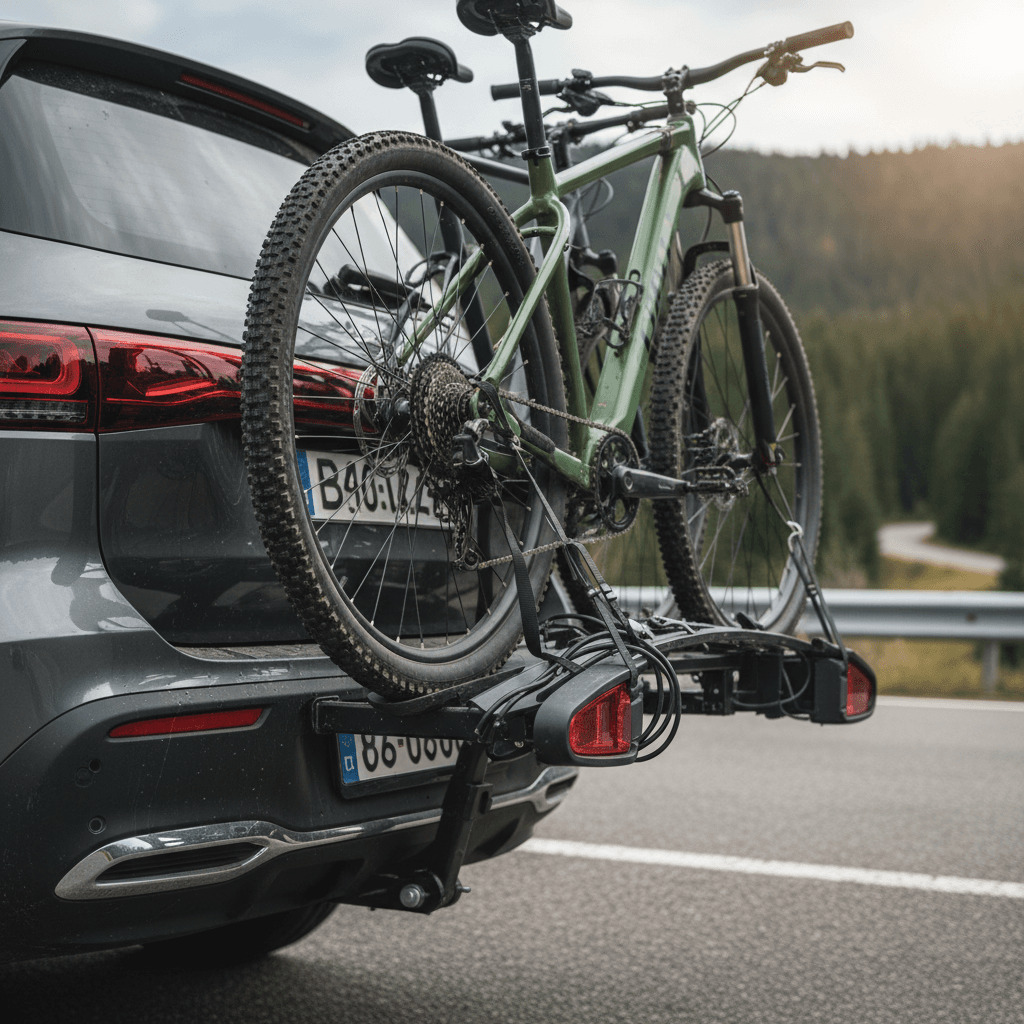
Where can you mount a bike rack on the EQB?
Broadly, there are four mounting locations for bikes on a Mercedes EQB:
Four ways to carry bikes on an EQB
Each mounting point has different pros, cons, and limitations.
1. Towbar / hitch mount
Uses a towbar or accessory hitch under the rear bumper. You attach a platform or hanging-style bike rack to a 1.25" or 2" receiver or a towball.
Best for heavier bikes and frequent use; easiest loading and best stability.
2. Roof crossbars
Uses raised rails and crossbars on the roof, then fork-mount or upright trays that clamp to the bars.
Good for lighter bikes and when you don’t want anything on the rear, but increases drag the most.
3. Trunk / hatch strap rack
Universal strap-on racks hook to the hatch edges. These are common on gas crossovers but tricky on EVs.
Risk of paint damage, sensor interference, and load path issues means they’re usually a last resort for EQB owners.
4. Interior / flat load floor
With the rear seats folded, the EQB can swallow one or two bikes with front wheels removed, using fork mounts or pads.
Zero aero penalty and safest for the car’s structure, but trades cargo and passenger space.
Check your specific EQB first
Hitch-based Mercedes EQB bike rack options
For most EQB owners who carry bikes regularly, especially heavier e‑bikes, a towbar or hitch-based setup is the most practical solution. But because the EQB is not a traditional body‑on‑frame SUV, you need a vehicle-specific kit designed for bike carriers, not a generic bolt‑on truck hitch.
Towbar and hidden hitch options for the EQB
In many markets, Mercedes does not rate the EQB for towing a trailer, but aftermarket suppliers have stepped into the gap with hardware rated specifically for bike carriers and light cargo.
Examples of EQB towbar / hitch hardware (bike-carrier use)
Representative hardware options marketed for the Mercedes EQB. Always verify fitment, ratings, and legality for your region before purchase.
| Product / Type | Mounting style | Use case | Max vertical load* | Towing rating |
|---|---|---|---|---|
| Invisible towbar (MBEQB-Bike, Europe) | Invisible towbar with detachable ball | Bike carriers only (no trailer) | ≈ 80 kg (176 lb) nose load | No towing, D-value 0 kN |
| Stealth / hidden hitch for EQB (US-style) | Hidden crossbar with removable receiver | Bike racks and cargo trays; optional towing in some kits | Typically 75–90 kg (165–200 lb) tongue weight | Some kits offer limited towing when combined with wiring |
| Factory-style towbar (market-dependent) | Integrated bar with towball or receiver | Official Mercedes-approved bike carrier mounting, sometimes with no trailer rating | Refer to manual (often 75–80 kg) | Often “accessory only,” no rated trailer weight |
Ratings shown are typical published figures as of 2025 and may vary by supplier and region. Your vehicle’s approved limits may be lower.
What the “bike only” towbar means
Choosing a hitch-style bike rack for your EQB
Once you’ve got a proper towbar or hidden hitch solution, almost any high‑quality hitch‑mount rack that fits the receiver size can work, but EVs like the EQB reward a little more selectivity. Here’s what to prioritize.
Checklist: Picking the right hitch rack for your EQB
1. Match rack capacity to nose load
Start with the EQB’s approved <strong>maximum nose load</strong> (often around 75–80 kg / 165–176 lb on EQB‑specific bike towbars). Subtract the rack’s own weight, then divide what’s left by your heaviest bike. Make sure you have margin; for example, 80 kg nose load minus a 20 kg rack leaves 60 kg for bikes, plenty for two 25 kg e‑bikes but not four heavy mountain bikes.
2. Prefer platform-style racks
A <strong>wheel- or tray‑mount platform rack</strong> holds bikes lower and farther apart, reducing sway and paint contact. That’s better for heavier e‑bikes and for the EQB’s relatively soft rear suspension. Hanging‑style rack arms are lighter and cheaper, but they’re less stable with mixed frame shapes and step‑through e‑bikes.
3. Look for tilt-away access
Choose a rack with a <strong>tilt-away mechanism</strong> so you can open the EQB’s tailgate with bikes loaded. Note that on some towbars, a long wheelbase or high handlebars can still hit the tailgate, so check user photos for similar SUVs or test in person if possible.
4. Consider integrated lights and plate mount
Some towball‑mount European carriers include <strong>integrated tail lights and a secondary license plate</strong> holder. That’s especially helpful if your bikes would otherwise block the EQB’s rear lights or plate, and is a legal requirement in some markets.
5. Don’t forget e-bike–specific features
If you’re hauling e‑bikes, prioritize <strong>higher weight ratings per bike</strong> (e.g., 30 kg+ each), wider wheel trays, and optional loading ramps so you’re not deadlifting 60+ lb bikes repeatedly.
Why hitch racks usually win for EQB owners
Don’t guess on weight
Roof bike racks for the Mercedes EQB
If your EQB isn’t equipped for a towbar or you prefer keeping the rear hatch free for a box or cargo tray, roof-mounted bike racks are the obvious alternative. The EQB’s raised roof rails make this relatively straightforward, but you still need the right combination of crossbars and bike trays.
Crossbars for the EQB’s raised rails
The EQB uses raised longitudinal rails, so you’ll be looking for rail‑mount crossbar systems from brands like Thule, Yakima, or OEM‑style bars from Mercedes dealers. These systems typically offer around 75 kg (165 lb) total dynamic load on the roof but always respect whichever is lower: the crossbar rating or the EQB’s roof load rating in your manual.
- Choose aero-profile bars (e.g., Thule WingBar-type designs) to minimize wind noise and drag.
- Confirm the bar spread (distance between front and rear bars) is compatible with your bike trays and any box you might add later.
- If you plan to haul multiple bikes and a box, verify the combined weight of all accessories and bikes stays under the dynamic roof limit.
Types of roof-mounted bike racks for the EQB
Common roof bike rack styles
Match the rack style to your bikes and lifting comfort.
Upright frame-clamp
Holds the bike by the frame and wheels. Easy to load, no wheel removal.
- Works with most hardtails and road bikes.
- Be careful with carbon frames; use torque-limited clamps.
Fork-mount
Front wheel comes off and the fork locks to a skewer or thru‑axle mount.
- Lower profile and more stable at speed.
- Great for road/gravel bikes; more fiddly for commuters.
Wheel-hook / tray e-bike racks
Some newer designs combine a tray and an over‑wheel hook for e‑bikes.
- Higher weight rating per bike.
- Lifting heavy e‑bikes to roof height is still challenging.
Mind the height and wind
Trunk, hatch, and interior alternatives
Some owners look at universal strap‑on trunk racks as an easy answer, especially if their EQB lacks a towbar and they don’t want crossbars. With EVs, that option is usually more compromise than it’s worth.
Why strap-on hatch racks are a poor fit for the EQB
- The EQB’s hatch and roof edges are designed for aerodynamics and sealing, not concentrated point loads from metal hooks.
- Modern EQs rely heavily on rear radar and camera sensors; a strap rack and bikes can block or confuse these systems.
- Load paths from a strap rack go through the glass and thin sheet metal in ways Mercedes did not engineer or test for.
When in doubt, skip the strap rack
Carrying bikes inside your EQB
For solo or two‑person trips, using the EQB’s interior is often the most EV‑friendly and aero‑efficient way to move bikes, especially high‑value road or mountain bikes.
Simple interior carry setup
1. Fold the rear seats flat
Drop the second (and third, if equipped) rows to create a flat load floor. Put down a <strong>protective mat or blanket</strong> to protect the upholstery and keep grit off the battery tunnel.
2. Remove at least the front wheel
Take off the front wheel and either use a <strong>portable fork mount</strong> bolted to a board or simply lay the bike gently on its side with drivetrain facing up to avoid bending the derailleur hanger.
3. Secure the frame
Use <strong>soft straps or Voile‑style ski straps</strong> around the frame and cargo tie‑downs so the bike can’t shift under braking. Avoid ratchet straps that can easily crush tubing if over‑tightened.
4. Plan around passengers
Interior carry is perfect when it’s just you or you plus one passenger. If you regularly travel with family or friends, a towbar or roof solution will be more practical.
Range, safety, and weight limits with bike racks
Whatever rack you choose, you’re not just decorating the EQB, you’re changing its aerodynamics and load distribution. That matters more on an EV than on a gas crossover because efficiency is so visible in your remaining range.
Range impact: what to expect
- Rear hitch racks usually add modest drag, often costing in the range of 5–10% more energy use at highway speeds, depending on your bikes and speed.
- Roof bike racks can add much more aero drag, 20%+ on some EVs with multiple bikes on top, because they put a messy shape directly in the airstream.
- At lower urban speeds, weight matters more than drag; at highway speeds, drag dominates. Plan your charging stops accordingly when heading to distant trails.
Weight and structural safety
- Respect the lowest-rated component in the chain: towbar nose load, hitch rating, rack rating, or roof load.
- Remember to include rack weight plus all bikes in your calculation, not just the bikes.
- If you’re ever close to the limit with multiple e‑bikes, consider transporting batteries inside the cabin (if allowed by the rack and bike maker) to reduce rear overhang weight.
Use your EQB’s systems to your advantage
How to choose the right EQB bike rack setup
Choosing the best Mercedes EQB bike rack option is less about the fanciest hardware and more about how you actually ride, what bikes you own, how often you travel, and who comes with you. Use this simple decision framework.
EQB bike rack paths by rider profile
E-bike owners & heavy trail riders
Prioritize a <strong>towbar or hidden hitch</strong> specifically rated for bike carriers.
Choose a <strong>two-bike platform rack</strong> with a high per‑bike rating (30 kg+ each).
Limit to two e‑bikes unless you’re well within nose load limits.
Plan for a modest but noticeable highway range penalty and extra rear overhang when parking.
Family riders with lighter bikes
If a towbar is available in your region, a <strong>three- or four-bike platform or hanging rack</strong> can work, just mind total weight.
If you can’t fit a towbar, consider <strong>roof crossbars plus two upright trays</strong>, and carry kids’ bikes inside when possible.
Keep speeds reasonable on long trips; aero drag grows quickly above 60–65 mph (100–105 km/h).
Urban riders & occasional trips
Skip the towbar investment and start with <strong>interior carry</strong> for one or two bikes plus a blanket and simple fork mounts.
Add <strong>roof bars and one upright tray</strong> only if you find yourself hauling bikes frequently.
Use public charging near trailheads and treat bike trips as a chance to <strong>top up while you ride</strong>.
Long-distance road-trippers
Plan around a <strong>rear platform rack</strong> if at all possible; it’s the best compromise between access, stability, and range.
Keep your bikes clean and well-secured; mud and loose straps cost aero efficiency and can damage paint.
Build your charging plan around <strong>slightly shorter legs</strong> than normal to leave margin for headwinds and profile drag.
Thinking about a used EQB?
FAQ: Mercedes EQB bike rack options
Frequently asked questions about EQB bike racks
Wrap-up: Bike racks, EQB ownership, and used EVs
The Mercedes EQB can be an excellent adventure partner, but it asks you to be a bit more thoughtful about bike racks than a body‑on‑frame SUV would. The right answer for most owners is a bike-rated towbar or hidden hitch plus a stable platform rack, with roof trays and interior carry as strong alternatives depending on your bikes, passengers, and storage situation.
Take the time to verify your specific EQB’s nose load and roof load limits, weigh your bikes and rack, and factor a modest range penalty into your route planning. Do that, and the EQB’s quiet, efficient drivetrain, compact footprint, and flexible interior layout make it a remarkably capable shuttle for everything from local trail rides to multi‑day road trips.
If you’re still in the shopping phase, a used EQB or other EV SUV from Recharged can be a smart way to get on the road with money left over for quality racks and bikes. Every vehicle comes with a Recharged Score battery health report, transparent pricing, and access to EV‑savvy specialists who can help you think through accessories, charging, and day‑to‑day ownership, so your next ride to the trailhead starts with confidence, not guesswork.