If you’re eyeing a new or used Mercedes EQB, the question lurking behind every test drive is simple: how much will this battery degrade per year? Range is the whole game in an EV, and EQB owners want to know whether the pack is going to age gracefully or fall off a cliff by year five.
Quick takeaway
Overview: What’s “normal” EQB battery degradation per year?
Mercedes doesn’t publish an official "per‑year" degradation figure for the EQB, and no serious manufacturer does. What we do have is a mix of warranty math, fleet‑level EV studies, and real‑world EQB examples that all cluster in the same ballpark.
EQB battery health at a glance
Put simply: the EQB’s chemistry and cooling system look conservative and durable. If you drive average mileage and don’t abuse fast charging, you’re more likely to see a slow, boring decline than any dramatic plunge.
How the Mercedes EQB battery is built
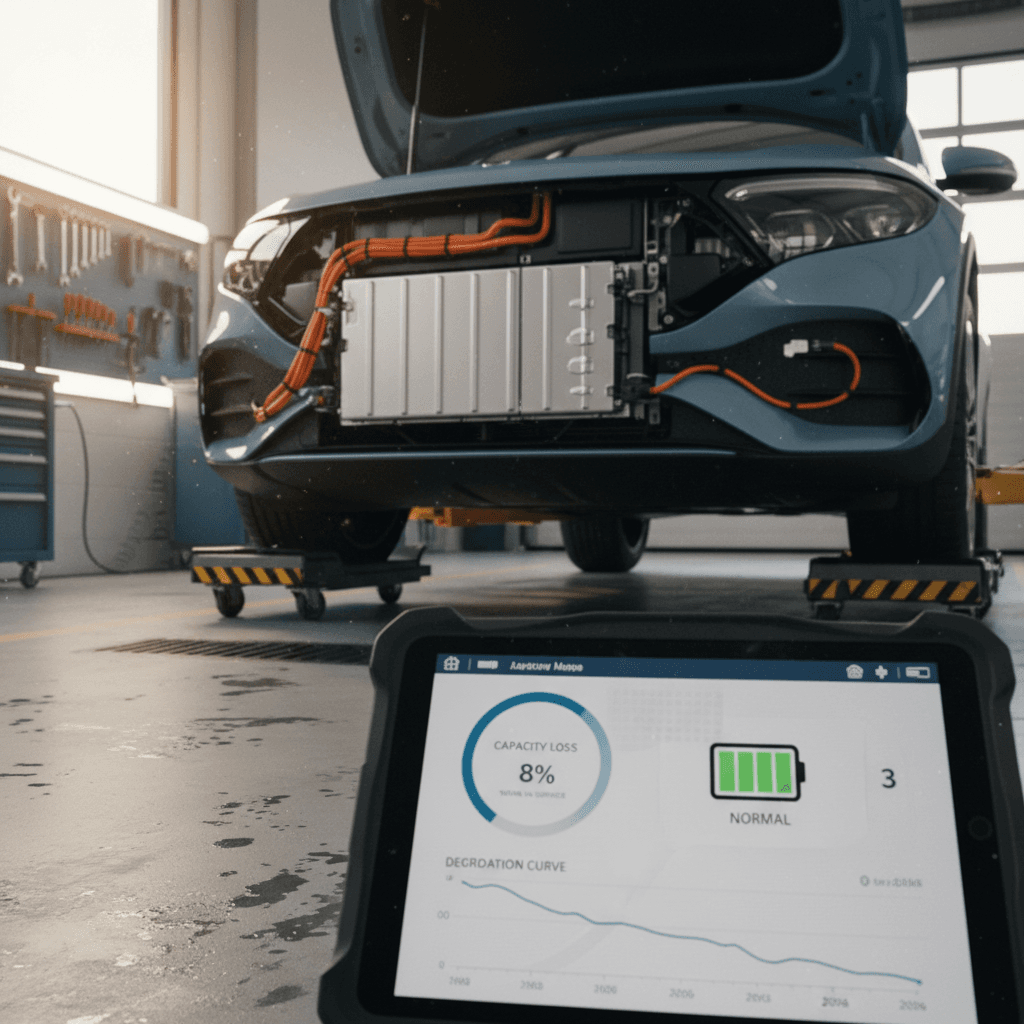
Understanding where degradation comes from starts with the hardware. The EQB is built on Mercedes’ MFA2 platform (shared with the gas GLB), but its pack is all‑EV thinking: a liquid‑cooled lithium‑ion pack mounted in the floor, with a conservative usable capacity window and cautious charge curves.
- EQB 250+ and 300/350 variants all use a pack in the ~70 kWh gross range, with usable capacity around the mid‑60s to low‑70s kWh depending on model year and software tuning.
- Mercedes intentionally keeps a buffer at both the top and bottom of the pack, so when you see 0–100% on the dash, you’re not truly cycling 0–100% of the cells.
- The pack is actively liquid‑cooled and heated, which helps keep cell temperatures in the sweet spot and slows chemical aging.
Why this matters for degradation
Warranty, 70% capacity, and what it implies per year
The way Mercedes writes the warranty tells you a lot about how confident they are in the EQB’s pack. In the U.S., recent EQB models typically come with an 8‑year / 100,000‑mile high‑voltage battery warranty. In some stricter emissions (CARB) states, coverage can stretch closer to 10 years and higher mileage caps for certain EQ models.
EQB battery warranty at a glance
Approximate coverage for recent Mercedes EQB models in the U.S. (always confirm details for your VIN and state).
| Item | Typical Value | What it means for degradation |
|---|---|---|
| Time limit | 8 years | Mercedes expects the pack to remain healthy for at least this long under normal use. |
| Mileage limit | 100,000 miles | Higher‑mileage drivers hit this sooner; degradation is more closely tied to energy throughput than just years. |
| Capacity threshold | ~70% usable | If the pack falls significantly below ~70% usable capacity within time/mileage limits, it may qualify for repair or replacement. |
| Goal degradation | ≤30% over term | Implied target is to keep loss under that ~30% band for most drivers. Average annual loss needs to be well under 4% to stay clear. |
The fine print may vary by model year and registration state, but most EQB owners are looking at around a decade of meaningful battery protection.
Do the math on that last line. To go from 100% to 70% usable capacity over 8 years, you’d be averaging about 3.75% loss per year. Yet industry‑wide data on modern EVs shows that well‑engineered packs are often doing almost half that in the real world. In other words, the warranty is the guardrail, not the expected outcome.
Real‑world data: what owners and tests show
Because the EQB is still a relatively young model (launched for 2022 in the U.S.), we don’t have 15‑year lab histories. What we do have are three strong signals: broader EV degradation studies, high‑mileage Mercedes EV anecdotes, and early EQB‑specific checks.
Three lenses on EQB battery degradation
Put together, they paint a reassuring picture.
Modern EV fleet data
Large, multi‑brand studies of electric vehicles built in the last decade show average degradation dropping from roughly 2–3% per year in early models to about 1.4% per year in newer designs with better cooling and software.
Mercedes EV case studies
Independent reports of earlier Mercedes EVs (like the EQC) show single‑digit percentage loss even past 200,000+ km, suggesting that Mercedes’ conservative approach to packs pays off with slow, steady degradation.
EQB health checks
Used‑car battery health reports have turned up early EQBs around 90–100k miles still reading mid‑90s state of health. That’s roughly in line with a 1–1.5% per‑year decline, even for heavy‑mileage drivers.
Don’t confuse software limits with degradation
Year‑by‑year: what to expect from an EQB battery
Every battery ages a little differently, but if you’re trying to sanity‑check a used EQB’s range, it helps to have a mental model. Below is a rough, ballpark progression for a normally used EQB 250+ (EPA rated around 245–250 miles) in a moderate climate with mostly Level 2 charging.
Illustrative EQB 250+ range and capacity over time
Approximate, not guaranteed, but useful for evaluating a used EQB against expectations.
| Vehicle age | Approx. capacity | Typical displayed range |
|---|---|---|
| New (Year 0) | 100% | ≈ 245–250 miles |
| Year 1 | 96–98% | ≈ 235–245 miles |
| Year 3 | 92–95% | ≈ 225–235 miles |
| Year 5 | 88–92% | ≈ 210–225 miles |
| Year 8 | 80–88% | ≈ 195–215 miles |
| Year 10 | 75–85% | ≈ 185–205 miles |
Numbers assume typical driving, mostly AC charging, and a temperate climate. Hard DC fast‑charging use or extreme heat can push you below these lines.
Expressed per year, that works out to roughly 1–2% annual degradation on average, with a slightly faster drop early on, flattening out as the pack settles. A used EQB that’s dramatically worse than this curve deserves a closer look; one that’s better than this is a pleasant surprise, not a red flag.
Factors that speed up or slow down EQB degradation
Battery chemistry doesn’t care what badge is on the grille. The same basic villains that age a Tesla or Hyundai pack will also age a Mercedes EQB pack, heat, high voltage stress, and heavy cycling. The twist is how Mercedes’ software chooses to protect the cells.
Big levers on EQB battery life
You can’t control everything, but you can control more than you think.
Things that accelerate degradation
- Frequent DC fast charging from low state‑of‑charge to near 100%, especially on hot days.
- Living in sustained high heat, especially if the car bakes outside on a full charge daily.
- Regularly charging to 100% and letting the car sit full for days at a time.
- High annual mileage with lots of deep cycles from near‑empty to near‑full.
Habits that slow degradation
- Daily charging to 70–80% instead of 100%, upping it only for road trips.
- Parking in a garage or shade to avoid baking the pack.
- Mostly Level 2 charging at home or work, with DC fast charging saved for trips.
- Updating software so the car has the latest thermal and charge‑management logic.
A note on EQB battery recalls
How to check battery health on a used EQB
Unlike some rivals, Mercedes doesn’t hand you a neat "battery health" percentage in a menu. That means evaluating EQB battery degradation per year is part detective work, part pattern‑matching against the curves we just walked through.
Used EQB battery health checklist
1. Start with the odometer and model year
A 2022 EQB with 70,000 miles has simply had more chances to cycle its pack than a 2024 with 18,000 miles. High mileage isn’t bad on its own, but it tightens the acceptable range window.
2. Compare displayed range to the EPA rating
With the pack at or near 100%, compare the predicted range in Comfort/Normal mode to the original EPA figure for that trim. If it’s more than ~15–20% lower with a clean driving history, you’re outside "normal" degradation territory.
3. Reset a trip and do a real‑world test
On a test drive, reset a trip meter and log miles driven vs. % battery used at steady speeds. If you drive 40 miles and use 20% of the pack, the car is effectively on pace for about 200 miles, compare that to the original rating.
4. Ask for service and recall history
Request documentation for any <strong>high‑voltage battery repairs, software updates, or recall work</strong>. A full battery replacement under recall is not necessarily a problem; it may mean you’re getting a younger pack than the odometer suggests.
5. Look for third‑party battery health reports
Some dealers and marketplaces, including Recharged, provide <strong>independent battery health diagnostics</strong>. On EQBs we’ve seen, it’s not unusual to find 90k‑mile cars still in the mid‑90% health range.
6. Use climate as a sanity check
An EQB that spent its life in Arizona or Nevada deserves more scrutiny than one from coastal Washington. Climate isn’t destiny, but it’s a meaningful clue when you’re interpreting range numbers.
How Recharged helps here
Ready to find your next EV?
Browse Vehicles
Shopping used: how much degradation is acceptable?
This is where the rubber meets the road. You’ve found a pre‑owned EQB, the price is right, but the range display isn’t what you saw in the brochure. How much loss is fine, and when should you walk?
Degradation that’s usually fine
- Up to ~10% loss by Year 3 for typical mileage.
- Up to ~15–20% loss by Year 5 on a higher‑mileage example.
- 20–25% loss by Year 8–10, especially for road‑trip‑heavy cars, is not necessarily alarming if the pack is stable.
In this band, the question is less "Is the battery dying?" and more "Does the remaining range fit my life?"
Degradation that deserves a hard look
- More than 20% loss within the first 3–4 years of normal mileage.
- A car still within the 8‑year warranty window that seems 30%+ down on range compared with its EPA rating and peers.
- Range that has dropped suddenly after a software update, with no clear explanation from the dealer.
Here you may be looking at an outlier pack, a history of heavy abuse, or a situation where a warranty conversation with Mercedes is justified.
Use the warranty as leverage, not a crutch
Protecting your EQB battery: daily habits that matter
Once the EQB is in your driveway, you actually have a lot of control over how fast that degradation curve unfolds. Think less like a hypermiler and more like a good battery custodian.
Daily practices to minimize EQB degradation per year
Keep daily charge limits around 70–80%
Use the EQB’s charge‑limit settings so that your normal overnight target is below 100%. Bump it up to full only when you actually need maximum range the next morning.
Avoid arriving at fast chargers with a full pack
DC fast charging when the battery is already warm and above ~70–80% state of charge is the worst of both worlds: lots of heat and lots of voltage stress. Start fast charges lower and unplug around 80–90% on road trips.
Park in shade or a garage when possible
You don’t have to baby it, but shield the car from all‑day, full‑sun baking when you can. High pack temperatures accelerate chemical aging over time.
Let the car manage its own thermal system
Don’t disable preconditioning or energy‑management features to "save" a few miles. The software is there to keep the pack in its comfort zone, which slows degradation in the long run.
Stay current on software and recall campaigns
Mercedes has already pushed out high‑voltage battery updates for the EQB line. Staying up to date keeps your car on the latest thermal and charging logic.
Drive it like a car, not a science experiment
Short of abuse, constant 100% charges, track‑day sprints on a hot battery, the EQB will handle spirited use just fine. Consistency and moderation matter more than the occasional hard pull.
FAQ: Mercedes EQB battery degradation per year
Frequently asked questions about EQB battery degradation
Bottom line: Is the Mercedes EQB battery a safe bet?
If you boil all the numbers and anecdotes down, the Mercedes EQB looks like what it is: a cautiously engineered family EV that trades a bit of sizzle for long‑term composure. Battery degradation per year is typically in the low single digits, not the horror‑story cliffs people imagine, and Mercedes backs that up with an 8‑year warranty and conservative software.
For you as a buyer, the smart play is simple: treat range as a wear item you can measure. Compare an individual EQB’s real‑world range and state of health to the curves in this guide, factor in how you actually drive, and let the warranty and diagnostics do the heavy lifting. If the numbers line up, a used EQB can be one of the calmer, more predictable battery bets in the segment.
And if you’d rather not do the detective work alone, that’s literally what Recharged was built for. From Recharged Score battery diagnostics to transparent pricing, financing, trade‑ins, and nationwide delivery, we make owning a used EQB, or any used EV, as straightforward as reading a fuel gauge. You tell us how far you need to go; we’ll help you find the battery that can get you there today and ten Aprils from now.