Planning your first EV road trip feels exciting, and a little intimidating. You’re not just throwing snacks in the car and filling the tank anymore. You’re thinking about charging speeds, apps, and whether that lonely fast charger on the map will actually work when you get there. This guide walks you step‑by‑step through how to plan an EV road trip for the first time so you can trade range anxiety for a confident, predictable drive.
Good news for first‑time EV road‑trippers
Why EV road trips feel different from gas trips
What stays the same
- You still plan around time, budget, and comfort, meals, bathrooms, scenery.
- You still want to avoid traffic, bad weather, and sketchy stops.
- You still need to prep the car: tires, washer fluid, wipers, snacks.
What changes with an EV
- You plan around charging locations and speeds, not just gas exits.
- Your “fuel tank” refills slower, so you combine charging with meals and breaks.
- Weather, speed, and hills affect range more noticeably than in a gas car.
Think in time, not just miles
Step 1: Set realistic range expectations
Your dashboard range number, often called the guess‑o‑meter, assumes mild weather and moderate speeds. On your first EV road trip, assume you’ll get about 65–75% of the rated EPA range at highway speeds, less in winter or heavy rain.
Reality check: How far can you actually go?
Use conservative estimates for your first few long trips.
EPA range vs. real world
If your car is rated for 300 miles, plan around 200–225 miles between full charges at 70–75 mph.
Cold or very hot weather
Heating or A/C plus battery conditioning can trim range by another 10–30%, especially on short hops.
Don’t plan 0–100%
Fast charging is quickest from about 10–60%. Plan most stops in that band instead of “topping off” every time.
Watch your buffer
Step 2: Pick the right route for your first EV trip
Not every road is equally friendly to EVs yet. For your first electric road trip, you want a route that hugs major highways with multiple fast‑charging options, not a remote shortcut with a single lonely station.
Better vs. worse route options for a first EV trip
When in doubt, prioritize redundancy and predictability over the absolute shortest distance.
| Option | Pros | Cons | Best for |
|---|---|---|---|
| Interstate with multiple DC fast chargers | Redundant chargers, amenities, easier detours | May add a few miles vs. back roads | First‑time EV road trips |
| Scenic highway with a few DC fast chargers | Great views, lower speeds help range | Limited backup if a charger is down | Second or third EV road trip |
| Remote shortcut with one DC fast charger | Shortest distance; can save time if all goes well | High risk if that single charger is busy or offline | Avoid for first long trip |
| Level 2 only small towns | Good for overnight hotel charging | Too slow for fast daytime hops | Road trips with flexible schedules |
Choose routes with more chargers, even if they add a bit of distance.
Plan around amenities, not just plugs
Step 3: Choose the best EV road trip planning apps
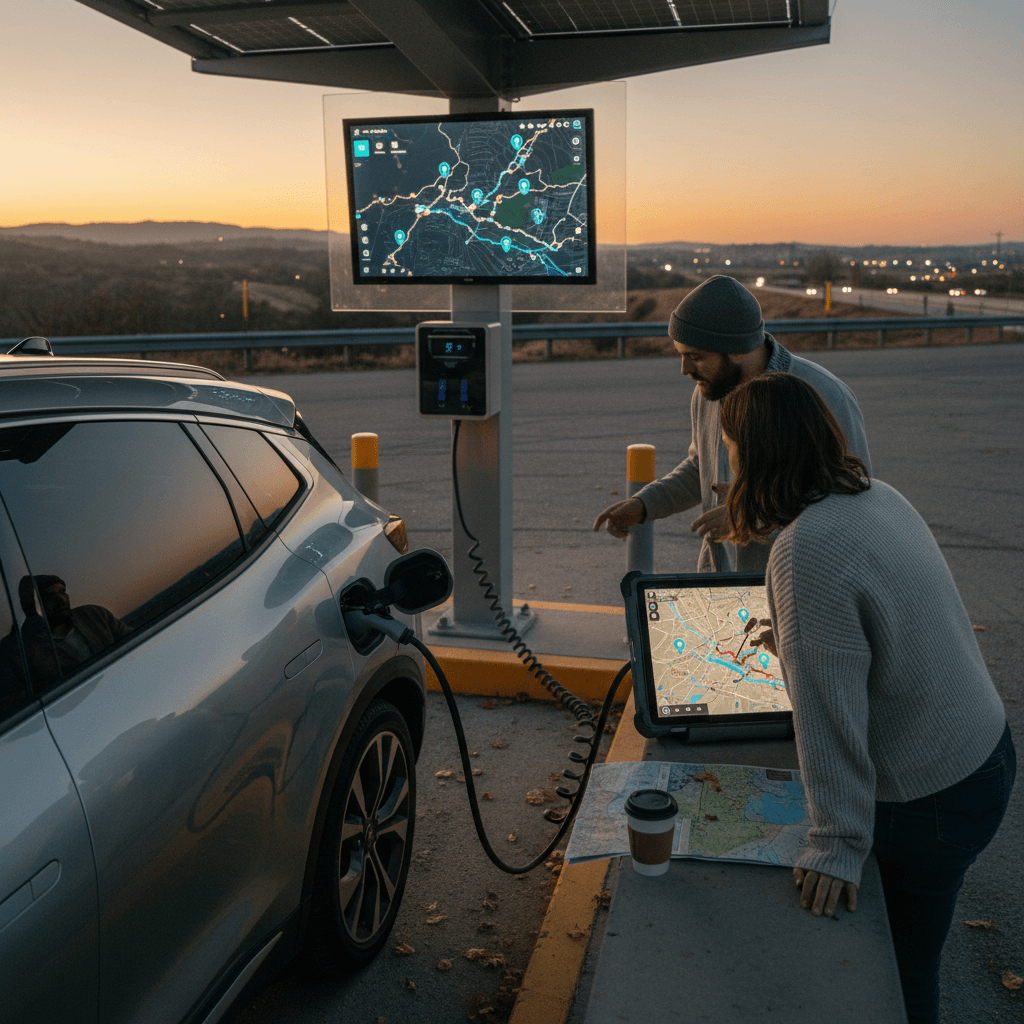
Your EV’s built‑in navigation is a strong starting point, but pairing it with one or two dedicated apps makes planning your first trip much easier. Think of it as using both Google Maps and Waze, you get more data and more backup options.
Core apps for planning your first EV road trip
You don’t need every app, pick one primary planner and one backup for charger info.
EV’s built‑in planner
Best for: Simple, plug‑and‑play routing.
Most modern EVs will automatically route you through fast‑charging stops based on state of charge and terrain.
A Better Routeplanner (ABRP)
Best for: Deep planning and “what‑if” scenarios.
Lets you model different speeds, weather, and state‑of‑charge targets, and can connect to many cars for live data.
PlugShare / Chargeway / network apps
Best for: Real‑world charger status.
See reviews, photos, uptime history, and pricing from networks like Electrify America, EVgo, Tesla, and others.
Download and log in before you leave
Step 4: Build your charging plan
Once you’ve chosen a route and apps, it’s time to turn your ideas into a concrete plan. Think of it as a flexible outline: you know your target stops and timing, but you’re free to adjust as conditions change.
EV road trip charging plan: a simple workflow
1. Set your daily distance goal
Decide how many hours you’re comfortable driving per day, say, 6–8 hours. At highway speeds, that’s often 350–500 miles in many EVs with two or three fast‑charging stops.
2. Choose anchor stops first
Use your planner to identify 1–2 main DC fast‑charging stops that pair with meals or major breaks (lunch, dinner, stretch). Then fill in shorter “top‑off” stops as needed.
3. Aim for 10–60% charging windows
Plan most fast‑charging sessions to start around 10–20% state of charge and end around 60–70%. Charging slows down above ~70–80%, so it’s often faster to drive to the next charger than to wait for 100%.
4. Add backups within 20–30 miles
For every planned DC fast charger, identify at least <strong>one backup station</strong> within ~20–30 miles, ideally on the same highway. Save them as favorites in your app.
5. Build in overnight Level 2
When possible, choose hotels or rentals with Level 2 charging. Waking up to a full battery can remove an entire fast‑charging stop from your next day’s plan.
6. Save an offline version
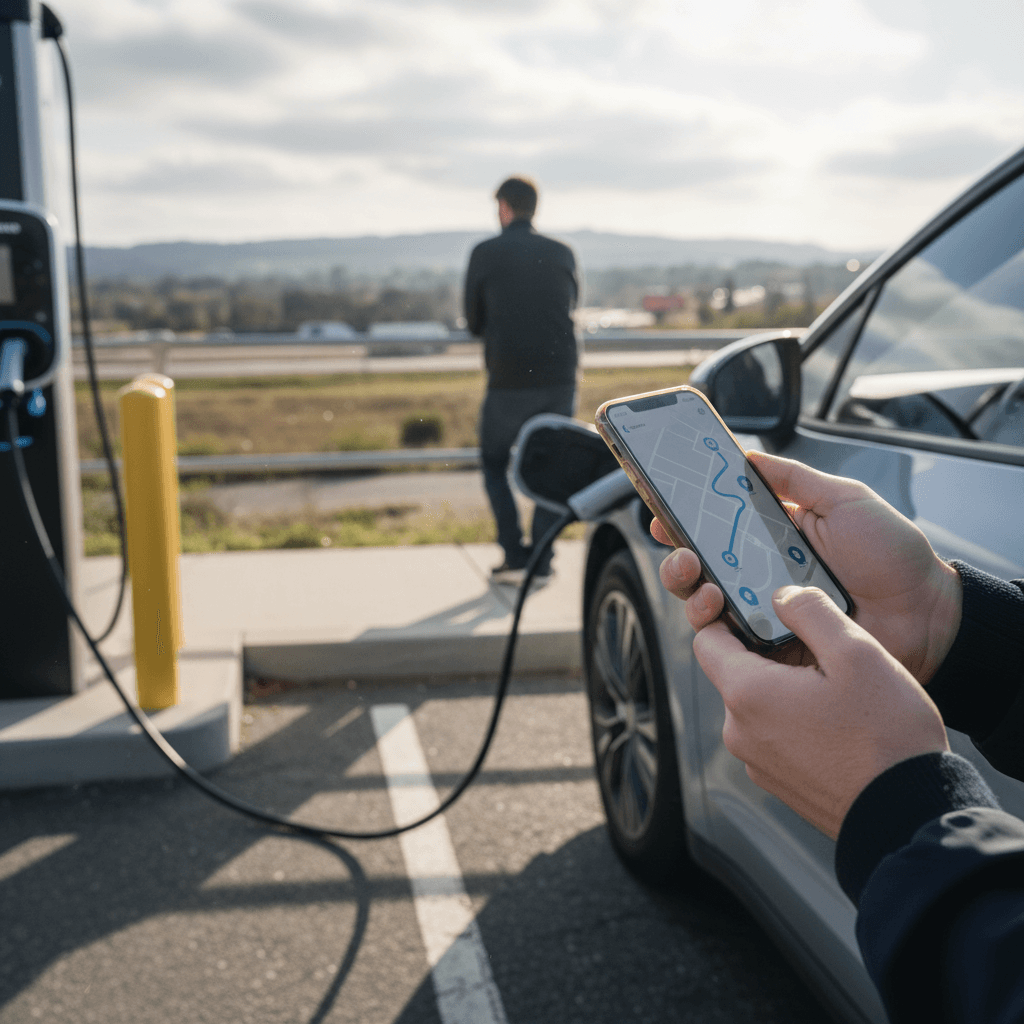
Screenshots your route and stop list or export it to a PDF. If your cell signal drops or an app misbehaves, you still know your next few planned chargers.
Step 5: Plan around weather, speed and terrain
Internal‑combustion drivers can mostly ignore hills and headwinds. EV drivers can’t, especially on their first long trip. The good news: with a bit of margin and smart planning, these factors become manageable instead of scary.
Weather
- Cold (below ~40°F / 4°C): Expect slower charging and higher energy use. Precondition the battery and cabin while plugged in before departure.
- Heat (above ~90°F / 32°C): A/C and thermal management add a load. Watch your projected arrival state of charge and keep a buffer.
Speed & terrain
- High speed: Jumping from 65 to 80 mph can noticeably cut range. Use cruise control and stay in the right lane if you’re worried about margin.
- Hills & mountains: Climbing burns energy; descending recovers some via regen but not all. Plan extra buffer before big climbs.
Use your car’s live estimate, not just the trip plan
Step 6: Pack an EV road trip kit
Packing for an EV trip isn’t dramatically different from any other road trip, but a compact charging kit can turn a minor hiccup into a non‑event. You don’t need to fill the trunk with gear; you just need the right few items.
Essential EV road trip kit
Charging cables and adapters
Bring your portable Level 1 or Level 2 cable if you have one, plus any adapters your car uses (J1772, NACS/CCS adapters, or regional plugs). Store them where you can reach them without unpacking luggage.
Backup payment options
Have at least one major credit card in addition to app‑based payment. Some stations still rely on card readers or RFID cards from the network.
Comfort gear for longer charges
Think folding chairs, warm layers, a small umbrella, and snacks, especially if you’re traveling with kids or pets and expect 30–45 minute sessions.
Paper list of key chargers
Write down or print the addresses of your main and backup chargers for each day. If your phone dies or a map app glitches, you’re not guessing names in the dark.
Basic car care items
Tire pressure gauge, portable inflator, windshield washer fluid, microfiber cloths, and a basic emergency kit matter just as much in an EV as in a gas car.
Entertainment and downtime plan
Download podcasts, playlists, kids’ shows, or offline maps over Wi‑Fi before leaving. That way you’re not burning limited cell data at the charger.
Charging etiquette and station strategy
A smooth first EV road trip isn’t just about finding chargers, it’s also about using them in a way that keeps your day moving and keeps other drivers from silently cursing you on PlugShare.
- Move your car once you’ve reached your target charge (often 60–80%), especially at busy sites.
- Avoid parking in a charging stall if you’re not going to plug in, even “just for a minute.”
- If multiple stalls are available, avoid parking right next to another car when you can; some stations share power between paired units.
- Use the charger’s own app or support number if something doesn’t start. Many problems are fixable remotely.
- Don’t unplug another car unless you’re absolutely sure the session is finished and local etiquette supports it, when in doubt, don’t.
Beware idle fees
Do a test run before the big trip
The best way to calm first‑trip nerves is to take a short practice run. Treat it like a dress rehearsal: you’ll work out app logins, cable quirks, and charging behavior on a day when the stakes are low.
Practice runs that build confidence
Same‑day practice (2–4 hours total)
Pick a DC fast charger 40–80 miles away and plan a round trip.
Use your chosen planner app to route there and back.
Arrive around 20% battery, charge to ~70%, and watch how speed changes above 60–70%.
Test at least one backup charger nearby, even if just for a quick top‑off.
Weekend shakedown trip
Plan a 150–250‑mile weekend getaway with at least one fast‑charging stop each way.
Book lodging with Level 2 charging so you wake up full.
Experiment with different driving speeds and climate settings to see how they affect arrival state of charge.
Note any apps or adapters you wish you’d had, and add them to your kit before the longer trip.
Common first‑time EV road trip mistakes
Where first‑time EV road‑trippers usually stumble
How to avoid the classic first‑trip mistakes
Keep a healthy buffer
Plan stops so you arrive with 10–25% state of charge, not 1–2%. In bad weather or unfamiliar territory, err on the higher side.
Always have at least one backup
Never rely on a single charger to be working. For each leg, save one or two alternatives into your nav or app.
Favor larger sites and major brands
Bigger sites built by national networks or automakers tend to have more stalls, better lighting, and higher uptime than a lone unit behind a building.
Watch live status and reviews
Before committing to a stop, check recent user comments and uptime in your charging apps. If the last five check‑ins say “broken,” choose your backup instead.
Don’t chase 100%
Use the fast middle of the charge curve and move on. Often, <strong>two shorter stops</strong> are faster than one very long one.
When to bail out early
First EV road trip FAQs
Frequently asked questions about planning your first EV road trip
How Recharged can help you road‑trip with confidence
A well‑planned first EV road trip doesn’t have to be complicated. If you set realistic range expectations, stick to charger‑rich routes, use a good planning app, and give yourself backups, you’ll discover that fast‑charging breaks can feel like natural pauses instead of stressful delays.
If you’re still shopping for an EV, or wondering whether your current one has the road‑trip legs you need, Recharged can help. Every vehicle we list includes a Recharged Score Report with verified battery health and charging details, so you know what kind of real‑world range to plan around before you ever hit the highway. With nationwide delivery, financing options, and EV‑specialist support, you can choose a used EV that fits your daily life and your next adventure, and then plan your first electric road trip with confidence.