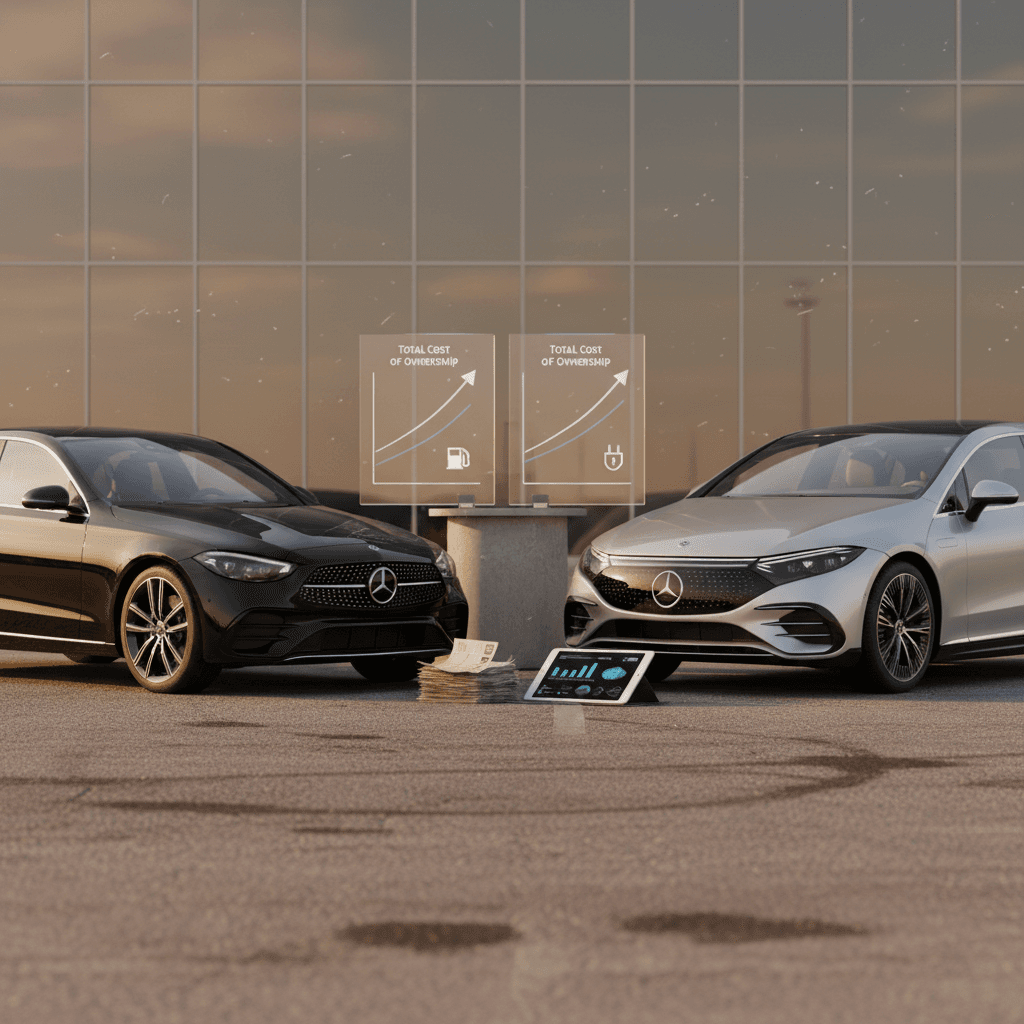
If you're cross-shopping a **Mercedes C-Class** against the all-electric **Mercedes EQE**, you're not just choosing between gas and electrons. You're deciding what your life looks like for the next five to ten years, monthly payments, fuel stops, maintenance appointments, and resale value. This is where **total cost of ownership (TCO)** matters more than the window sticker.
Gas vs Electric, Same Luxury Badge
Why Compare Mercedes C-Class vs EQE Total Cost of Ownership?
The C-Class is Mercedes’ long-time **compact luxury sedan benchmark**, refined, comfortable, and still proudly burning gasoline. The EQE is its younger, battery‑driven cousin: quieter, heavier, and shaped like a bar of soap designed by a wind tunnel. Comparing their **total cost of ownership** lets you answer a deceptively simple question: Is the EV premium actually worth it?
- You care about long-term costs, not just monthly payments.
- You’re wondering if EVs really save money once you add insurance, tires, and charging hardware.
- You’re debating between buying a newer used C-Class or taking the plunge on a used EQE.
Think in Years, Not Months
Quick Take: Which One Is Cheaper to Own?
C-Class vs EQE: 5-Year Cost Snapshot (Typical U.S. Driver)
Under most realistic scenarios, especially at U.S. gas prices from 2024–2026, the **EQE usually wins the total cost of ownership battle**, particularly if you buy it used and you have a reasonable home charging setup. The C-Class only starts to look cheaper if you drive very little, pay unusually high electricity rates, or plan to keep the car for a short time and are nervous about EV resale.
Baseline Vehicles and Key Assumptions
Mercedes changes trims and badges every few years, but for a clean, apples‑to‑apples comparison we’ll make a few reasonable assumptions. Adjust the numbers up or down for your exact model, but the directional story will look similar.
Baseline Models and Ownership Assumptions
These are typical, not worst‑case or best‑case numbers. Think of them as a realistic starting point for a U.S. driver in 2026.
| Category | Mercedes C-Class (Gas) | Mercedes EQE (EV) |
|---|---|---|
| Representative model | C 300 4MATIC sedan | EQE 350+ sedan (RWD) |
| Purchase type | Lightly used, ~3 years old | Lightly used, ~3 years old |
| Annual mileage | 15,000 miles | 15,000 miles |
| Time horizon | 5 years | 5 years |
| Gas price | $4.00 per gallon | , |
| Electricity price (home) | , | $0.15 per kWh off-peak |
| Fuel economy / efficiency | 28 mpg combined (real world) | 2.7 mi/kWh combined (real world) |
| Charging mix | , | 80% home, 20% public DC fast charging |
You can plug in your own gas price, electricity rate, and annual mileage to personalize this comparison.
These Are Estimates, Not Absolutes
Fuel vs Electricity Costs: Where the EQE Pulls Ahead
Fuel is where the EV vs gas story turns from theory into a monthly reality. A C-Class sips respectfully, but it still burns gasoline. The EQE, meanwhile, turns cheap off‑peak electrons into stealthy forward motion.
C-Class: Respectable, But Still Thirsty
- Real-world fuel economy: ~28 mpg combined is achievable if you’re not driving like an AMG brochure.
- Annual miles: 15,000 miles / 28 mpg ≈ 535 gallons per year.
- At $4.00/gal: That’s about $2,140 per year in fuel, or roughly $10,700 over 5 years (before any price swings).
EQE: Your Power Company Becomes Your Gas Station
- Efficiency: Around 2.7 miles per kWh in mixed real-world driving.
- Annual energy use: 15,000 miles / 2.7 mi/kWh ≈ 5,555 kWh per year.
- Home charging (80%): 4,444 kWh × $0.15 ≈ $667/year.
- Fast charging (20%): 1,111 kWh × ~$0.35 ≈ $389/year.
- Total electricity cost: about $1,050 per year, or roughly $5,250 over 5 years.
Fuel Savings in One Line
Maintenance and Repairs: Fewer Moving Parts, Fewer Headaches
Mercedes makes beautiful engines. They also make **beautiful service invoices**. Even if you’re religious about independent shops, a gas C-Class will inevitably ask for oil, filters, belts, exhaust pieces, spark plugs, and transmission service. The EQE simply doesn’t have most of those parts.
Where the EQE Dodges Maintenance Costs
You still have to maintain an EQE, but there’s a lot less to break.
No Oil Changes
Simpler Drivetrain
Less Exhaust Hardware
On the flip side, both cars will still chew through tires, brake pads, cabin filters, and alignment. The EQE’s extra weight and instant torque can wear tires more quickly if you drive it like a YouTube thumbnail, but regenerative braking can substantially extend brake life compared with a gas car.
Rough 5-Year Maintenance Picture
Depreciation and Resale: How Each Benz Loses Value
Depreciation is the giant, invisible line item in any luxury car’s budget. Historically, gas C-Class models have **depreciated steadily but predictably**, and in some years, surprisingly gently, thanks to pandemic-era used car weirdness. The EQE, like many newer EVs, has seen steeper early depreciation as incentives, tech turnover, and range expectations move quickly.
C-Class Depreciation
- New C-Class sedans typically lose a large chunk of value in the first 3 years, then **settle into a slower decline**.
- By years 4–8, depreciation is more about mileage, service history, and accident records than model-year glamour.
- Well-kept C-Class examples can be relatively easy to resell because the market understands them.
EQE Depreciation
- The EQE has taken a **steeper early hit**, which is rough if you bought new, but a gift if you’re buying used.
- Future values will depend on range competitiveness, battery health, and charging speed versus newer EVs.
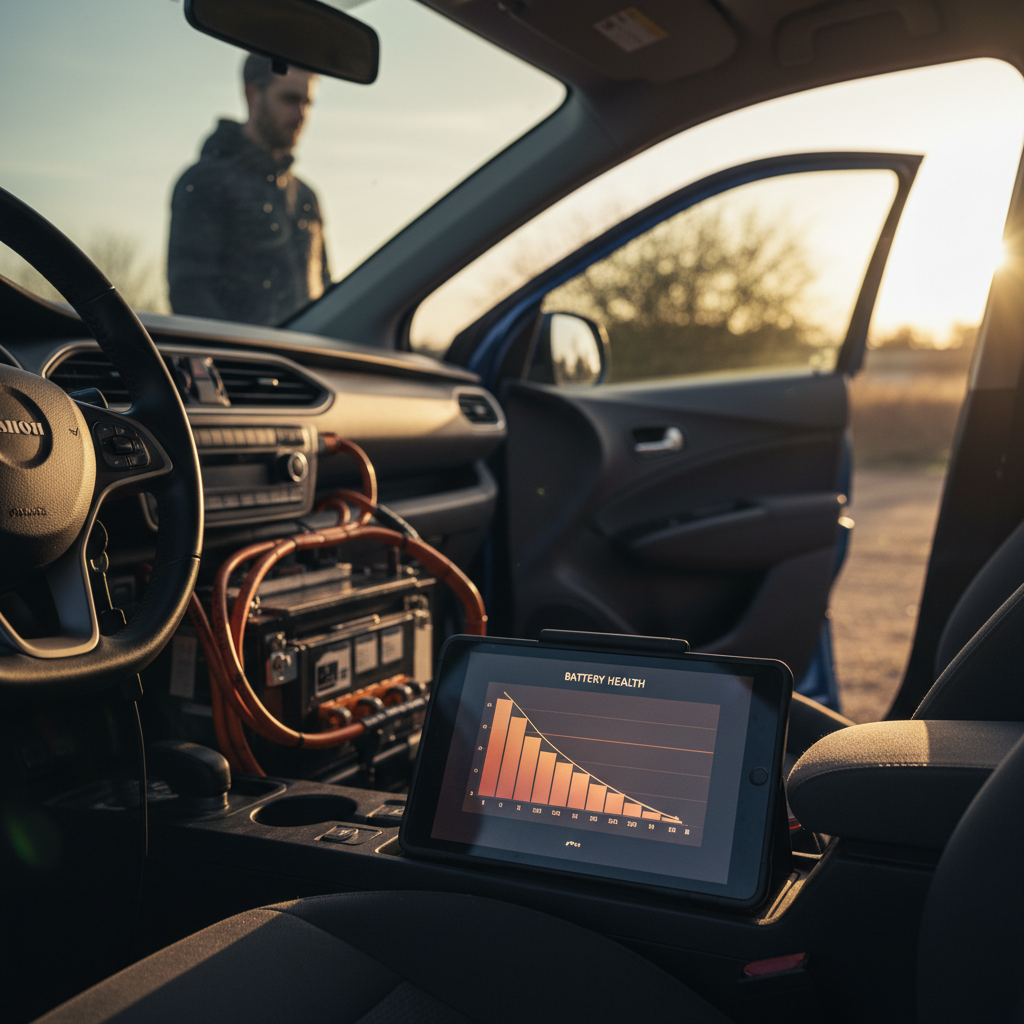
- Battery health documentation, like a Recharged Score report, can make your used EQE significantly easier to resell.
Use Early EV Depreciation to Your Advantage
Insurance, Taxes, and Fees: The Often-Ignored Line Items
Insurance companies rate vehicles on repair costs, driver profiles, safety tech, and theft risk. In practice, **a comparably priced C-Class and EQE often land in the same ballpark**, but there are a few wrinkles.
- The EQE’s higher original MSRP can nudge premiums up, but advanced driver assistance and crash protection can pull them back down.
- Some insurers still treat EVs cautiously on repair cost, especially for collision; shop quotes for your exact VINs instead of guessing.
- State and local tax policy can favor EVs with rebates, credits, or reduced registration fees, or add EV-specific road-use fees.
Don’t Guess on Insurance, Quote Both
Charging Convenience and Hidden Costs
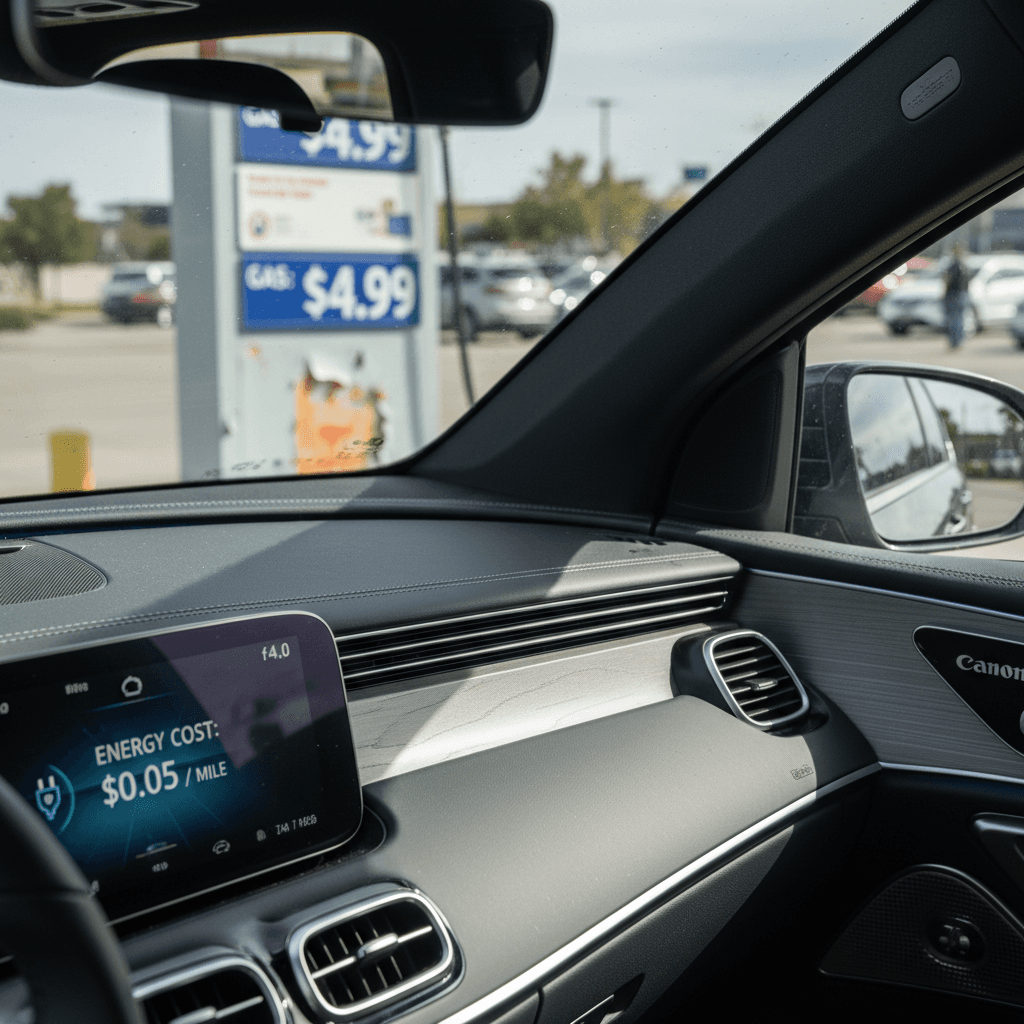
The C-Class hides its infrastructure in plain sight: **gas stations are everywhere**, and your “install cost” is whatever the gas pump asks today. With an EQE, you have a little homework: home charging, public networks, and how often you really road-trip.
Apartment Dwellers: Run the Numbers Twice
5‑Year Mercedes C-Class vs EQE Cost Comparison
Let’s combine the major ingredients, fuel/energy, routine maintenance, and a rough sense of depreciation, into a simplified 5‑year snapshot. These are directional examples, not guarantees, but they’ll give you a useful mental model.
Illustrative 5‑Year Total Cost of Ownership
Assumes both vehicles are bought lightly used (around 3 years old) and kept for 5 additional years, driving 15,000 miles annually.
| Cost Category (5 Years) | Mercedes C-Class (Gas) | Mercedes EQE (EV) | Comment |
|---|---|---|---|
| Fuel / Electricity | ~$10,700 | ~$5,250 | EQE ahead by roughly $5,000+ in typical U.S. conditions. |
| Routine maintenance & minor repairs | ~$6,000–$8,000 | ~$3,500–$5,000 | Gas car needs oil, transmission service, exhaust parts, etc. |
| Depreciation (used purchase) | ~$15,000 | ~$16,000–$18,000 | EQE may still depreciate a bit faster, but gap is narrowing. |
| Insurance, taxes, and fees | Similar order of magnitude | Similar or slightly higher | Depends heavily on your location and insurer. |
| Estimated 5‑year running costs (excluding purchase price) | ~$31,700–$33,700 | ~$29,750–$33,250 | In many realistic cases, the EQE edges ahead or ends up roughly equal. |
Depreciation numbers are rough but representative; real-world results will vary by purchase price, condition, and market swings.
What This Table Really Says
Why a Used EQE Often Makes the Math Silly-Good
New EVs, including the EQE, took a depreciation punch in the early years as incentives, fast‑moving tech, and interest rates collided. For a used buyer in 2026, that’s an opportunity: you’re skipping the nastiest part of the curve while keeping most of the range and all of the comfort.
Key Advantages of a Used Mercedes EQE
1. Early Depreciation Is Already Paid
You’re buying after the EQE has done its biggest drop, so each additional year you own it often costs you less in depreciation than a newer C-Class.
2. High-End Tech at Mid-Tier Prices
You get the EQE’s quiet cabin, strong acceleration, and advanced driver aids for roughly the money of a modestly equipped newer gas C-Class.
3. Fuel Savings Start Immediately
From the day you plug in, you’re typically spending less per mile on energy than you would at a gas pump, especially if you can charge at home on off‑peak rates.
4. Lower Mechanical Complexity
No turbocharged engine, fewer hot moving parts, and no complicated transmission mean fewer places for age-related failure as the car climbs into higher mileages.
5. Potential Incentives on Used EVs
Depending on when and where you buy, you may qualify for used EV tax credits or state incentives that simply don’t exist for a used gas C-Class.
Battery Health Is the Make-or-Break Variable
How Recharged Helps You Shop the EQE (and Other Used EVs) Smart
Buying a used EV isn’t the same as buying a used gas sedan. You’re not just kicking tires; you’re effectively buying a **giant, very expensive battery pack** on wheels. That’s exactly the problem Recharged is built to solve.
What Recharged Brings to a Used EQE Purchase
We try to turn "EV anxiety" into practical, transparent information.
Recharged Score Battery Health Report
Expert EV Guidance, Not Just Sales Talk
Nationwide Delivery & Experience Center
Financing, Trade‑In & Consignment
Ready to find your next EV?
Browse VehiclesIf you’re on the fence between a newer C-Class and a used EQE, this is where talking to someone who lives in this data every day can save you thousands. A brief conversation with an EV specialist plus a **Recharged Score report** often makes the decision obvious.
FAQ: Mercedes C-Class vs Mercedes EQE Total Cost of Ownership
Frequently Asked Questions
Bottom Line: Which Mercedes Makes More Financial Sense?
If you strip away the badge loyalty and spec-sheet bravado, the **Mercedes EQE increasingly makes more financial sense than a C-Class** for many drivers, especially when you buy it used, charge mostly at home, and plan to keep it for at least 5 years. You’re trading away fuel bills, much of the maintenance burden, and a decade of gas-station coffee for a car that feels like the future of the brand.
The C-Class still has its case: simpler road trips, a familiar fueling routine, and a depreciation curve the market understands. If you barely drive, or you absolutely can’t make home charging work, it may remain the rational choice.
But if you can plug in at home and you’re willing to think in years, not months, a well‑chosen EQE, backed by transparent battery health data and EV‑savvy guidance, often delivers the lower total cost of ownership and the better daily experience. That’s the equation Recharged is built to help you solve: not just which Mercedes you want to drive, but which one you’ll be glad you paid for.