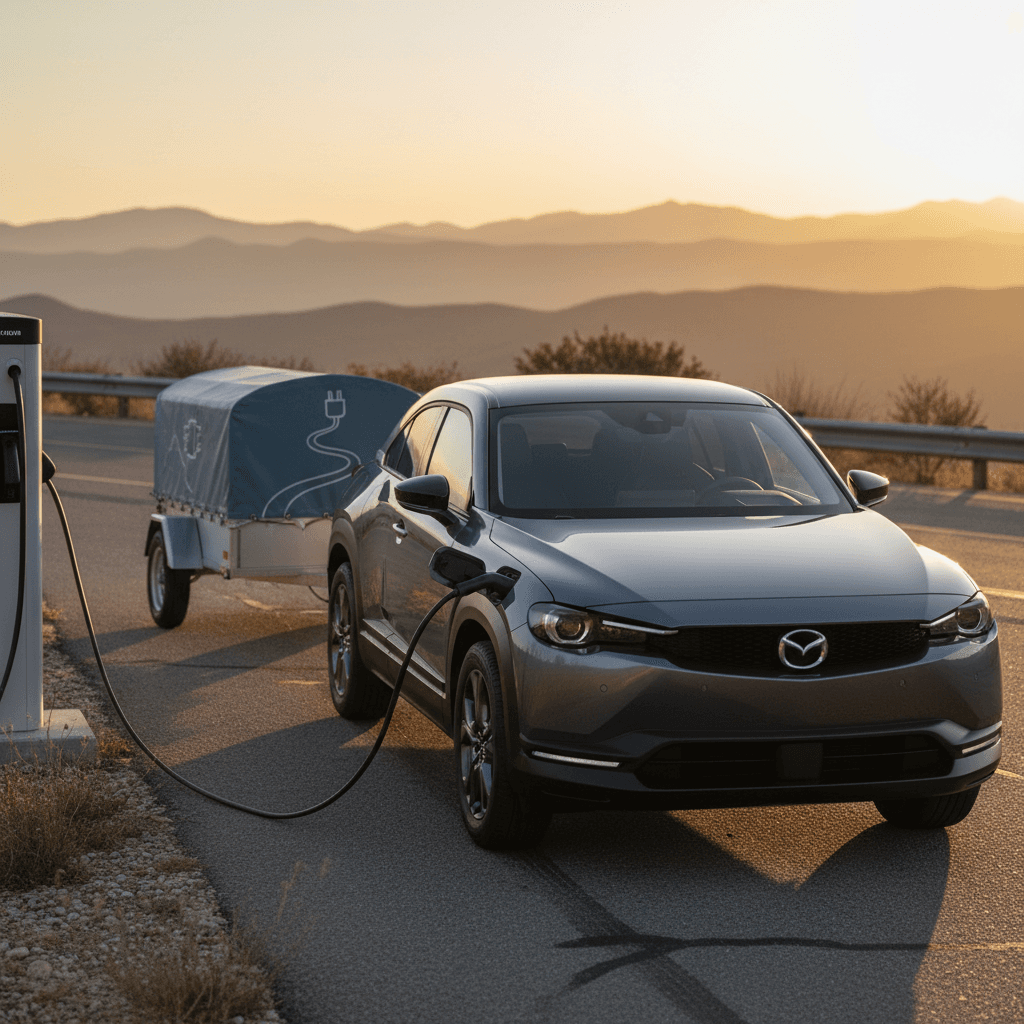
If you’re looking at a Mazda MX-30, or already own one, the two big questions are simple: **how far can it go, and can it tow anything at all?** The Mazda MX-30’s towing capacity and range story is unusual in today’s EV market, and understanding those limits is critical if you’re considering this quirky electric crossover as a daily driver or a used EV value play.
MX-30 at a glance
Mazda MX-30 towing capacity and range overview
Let’s start with the headline: **the Mazda MX-30 is not rated to tow in the U.S. market**, and its range is on the very short end of the EV spectrum. Officially, the MX-30’s EPA-rated range is about **100 miles** on a full charge, backed by a relatively small battery pack and modest efficiency numbers. That makes it a pure **urban and suburban runabout**, not a tow vehicle or road-trip workhorse.
Core Mazda MX-30 EV range stats
Short-range specialist
Does the Mazda MX-30 have any towing capacity?
From Mazda’s perspective, the MX-30 is **not a tow vehicle**. In U.S. documentation and owner information, Mazda does **not list an official towing capacity** for the MX-30 EV, and there is no factory tow package offered. That’s your first and most important data point: if you want to tow, this isn’t the right tool for the job.
- No published U.S. tow rating (no pounds/kg figure in Mazda documents).
- No OEM tow package or hitch option for the U.S. EV.
- Compact FWD platform with modest 143 hp motor and small brakes.
- Tight range headroom, towing would quickly eat into 100 miles of EPA range.
Aftermarket hitches: proceed with caution
Practically, you can think of the MX-30 as being in the same camp as many small hatchbacks and early compliance EVs: fine for carrying people and gear inside the cabin, but **not designed or certified to pull a trailer**. If you need to tow a small camper, utility trailer, or jet skis, you’ll be far better served by an EV with a rated tow capacity, think Hyundai Ioniq 5, Kia EV6, or one of the newer PHEV and EV SUVs.
Battery size, efficiency and official range specs
The MX-30’s range story starts with its **battery and efficiency choices**. Mazda deliberately chose a small pack to keep weight and embedded CO₂ down, at the cost of usable range.
Mazda MX-30 EV key range and charging specs
Core technical specs that shape the MX-30’s towing limitations and driving range.
| Spec | Value | Why it matters |
|---|---|---|
| Battery capacity | 35.5 kWh (gross) | Small pack means limited energy to spend on speed, HVAC, or towing. |
| Official EPA range | ≈100 miles | Defines realistic maximum in mild conditions; expect less in winter or at high speed. |
| EPA efficiency | 92 MPGe (37 kWh/100 mi) | On the thirsty side for such a small battery, so you don’t get as many miles per kWh as the best EVs. |
| On-board charger | 6.6 kW AC Level 2 | Roughly 5 hours from empty to full on a typical 240V home charger. |
| DC fast charge | Up to ~50 kW | 20–80% in about 30–40 minutes under ideal conditions, fine for a short‑range pack. |
| Drivetrain | 143 hp FWD, single‑speed | Adequate for city driving, but not a strong tow platform. |
Figures shown are for the U.S.-spec 2022–2023 Mazda MX-30 EV.
Why efficiency matters more with a small pack
Real-world MX-30 range: what you can actually expect
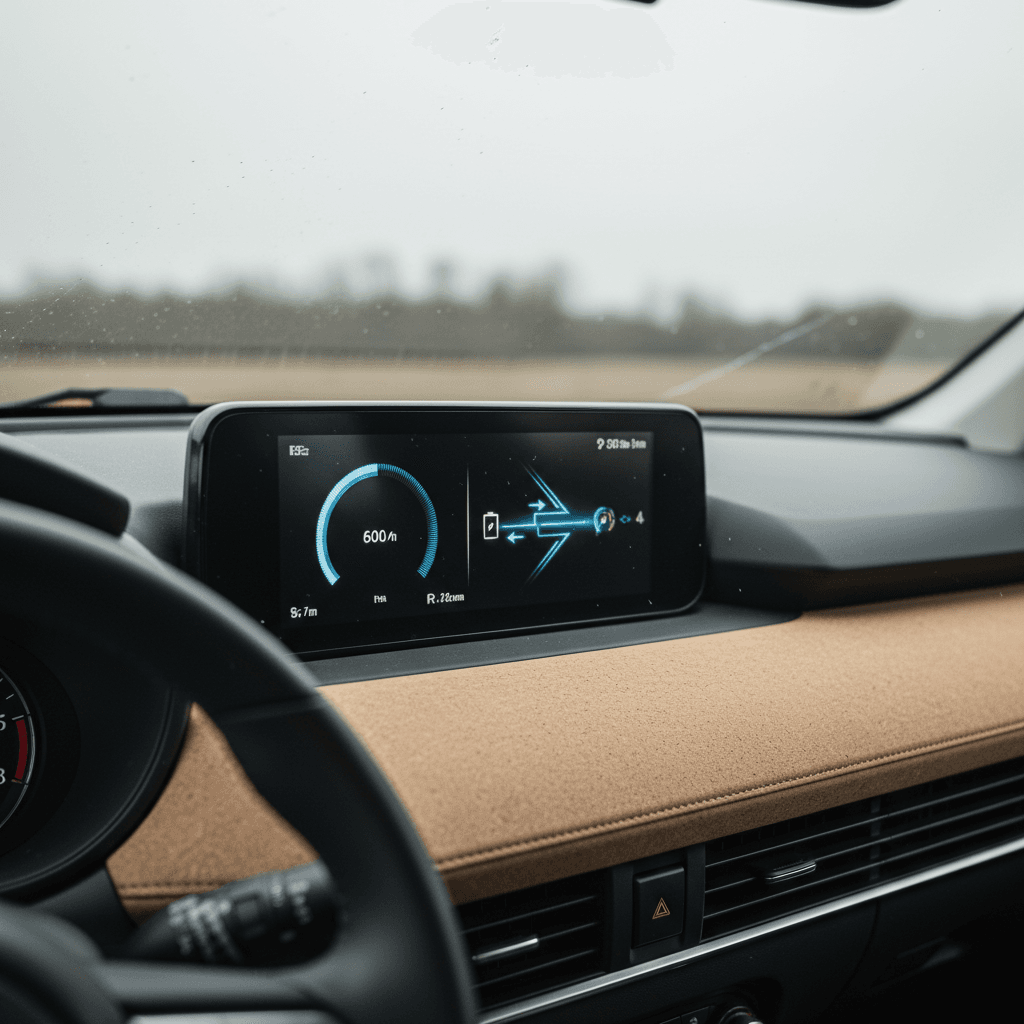
EPA numbers are useful, but your **real-world Mazda MX-30 range** will move around based on how and where you drive. Because the starting point is only about 100 miles, conditions that chip away at range have an outsized impact.
Factors that impact Mazda MX-30 range
Why a 100‑mile EV feels very different from a 250‑mile EV
Cold or hot weather
Climate control is a big energy user when the pack is small. In winter, the MX‑30 can easily lose **20–30% of its displayed range** due to cabin heating and battery conditioning. Very hot days with max A/C can have a similar effect.
Highway speeds
The MX‑30’s aero and gearing are tuned more for city than freeway. At **70–75 mph**, expect noticeably worse efficiency than around town. A realistic highway range might be **60–80 miles** with a buffer.
Payload and roof racks
Passengers, cargo, and aero drag from boxes or racks all cost energy. With only 35.5 kWh on tap, filling the cargo area and adding a roof box can shave another **10–15 miles** off a charge.
In practice, most MX-30 owners treat it like a **70–80 mile comfortable-use vehicle**, preserving a safety margin at the bottom of the pack. That’s plenty for many daily commutes, school runs, and errands, especially if you can plug in at home or work, but it’s not forgiving if plans change mid‑day.
Use 70–80 miles as your planning number
How MX-30 range compares to other small EVs
Range only makes sense in context. The MX-30’s 100‑mile EPA figure was marginal even when it launched, and by 2026 it’s in a different universe from mainstream EVs. If you’re cross-shopping used EVs, this comparison should be front of mind.
MX-30 range vs. other popular compact EVs
Approximate EPA ranges for common small EVs you might cross‑shop with a used MX-30.
| Model (battery) | EPA range | Battery size (approx.) | Quick takeaway |
|---|---|---|---|
| Mazda MX-30 (35.5 kWh) | ≈100 miles | 35.5 kWh | Stylish, but strictly a short‑range, city‑focused EV. |
| Chevrolet Bolt EV (65 kWh) | 247 miles | 65 kWh | More than 2x the range and similar footprint. |
| Hyundai Kona Electric (64 kWh) | 258 miles | 64 kWh | Compact crossover with 2.5x the usable range. |
| Nissan Leaf 40 kWh | 149 miles | 40 kWh | Older tech, but still ~50% more range than MX‑30. |
| Hyundai Ioniq Electric (38.3 kWh) | 170 miles | 38.3 kWh | Efficiency star; shows what a similar-size pack can do. |
Ranges are representative U.S. EPA ratings; individual trims and wheel sizes may vary slightly.
Compliance car legacy
Can you road-trip or haul gear with an MX-30?
You *can* take an MX-30 on longer journeys, but you’ll need a different mindset from a 250‑mile EV, or any gasoline crossover. And without a tow rating, “hauling gear” really means **using the interior cargo space**, not pulling a trailer.
Road-trip realities
- Frequent stops: With 60–80 miles of real freeway range, you’ll be stopping often, even in DC fast‑charger dense regions.
- Tight routing: You’ll need to plan around Level 3 chargers every 40–60 miles, favoring corridors with multiple backup options.
- Time cost: Each 20–80% fast charge may take 30–40 minutes. Over a full day, that’s hours of charging time.
- Weather-sensitive: In winter, you may find parts of the map effectively off‑limits without heroic planning.
Carrying gear instead of towing
- Cargo volume: Around 21 cubic feet behind the rear seats, expandable with the second row folded.
- Roof racks: An aftermarket or dealer‑installed rack can handle bikes or boxes, but will hit efficiency.
- Hitch for accessories: A light‑duty, non‑OEM hitch might work for a 2–4 bike rack, but treat this as accessory mounting, not towing.
- Weight discipline: Heavier loads inside the cabin still eat into range; pack thoughtfully for weekend getaways.
Best use case: local adventures
Ownership tips to get the most range from an MX-30
If the MX-30 fits your lifestyle, you can make its limited range feel less, well, limiting. With a small pack, smart charging and driving habits go a long way.
Practical ways to stretch Mazda MX-30 range
1. Start every day near full
Because the pack is small, it’s reasonable to charge to **90–100% for daily use**, especially if you’re not fast‑charging repeatedly. A simple Level 2 home charger will typically refill the battery overnight from low state‑of‑charge.
2. Precondition while plugged in
Use the MX-30’s climate controls to warm or cool the cabin while the car is still charging. That way, initial HVAC load comes from the grid instead of your limited battery, preserving range for driving.
3. Favor 55–65 mph on highways
Aerodynamic drag rises quickly with speed. On a small battery, dropping from 75 to 65 mph can save a surprising number of miles. If traffic allows, cruise in the **right lane at moderate speeds** and watch your range estimate stabilize.
4. Pack light and clean up the aero
Avoid leaving roof racks, boxes, or heavy junk in the cargo area if you don’t need them. Less mass and cleaner airflow mean more miles from each kWh, critical when you only have 35.5 kWh to work with.
5. Use regen smartly, not obsessively
Regen helps, but the big wins come from **smooth driving**, looking ahead, and avoiding harsh accelerations. Driving as if you have no brakes at all will do more for range than fiddling with regen levels at every stop.
6. Watch your energy and trip readouts
Keep an eye on the MX-30’s consumption screens. Over a few weeks you’ll learn what energy use (in kWh/100 mi or mi/kWh) corresponds to your routes, and you can plan buffer accordingly.
Battery longevity silver lining
Ready to find your next EV?
Browse VehiclesBuying a used Mazda MX-30 in 2026: what to know
Mazda discontinued the MX-30 EV in the U.S. after the 2023 model year, and global production has now wound down. That leaves the MX-30 as a niche used‑EV option, especially in California, where almost all U.S. cars were sold. The upside: **limited demand plus quirky specs can mean attractive prices** if its constraints match your needs.
Is a used Mazda MX-30 right for you?
Key advantages and tradeoffs to weigh before you buy
What works in its favor
- Often cheaper than long‑range rivals with similar mileage, because many shoppers want 200+ miles of range.
- Great for short commutes, urban errands, and second‑car duty where 40–60 miles per day is plenty.
- Pleasant Mazda driving dynamics and a distinctive interior with eco‑material touches.
- Smaller battery can be easier on tires and brakes than heavy long‑range EVs.
Where it falls short
- No towing capacity, OEM hitch, or factory support for trailer use.
- Very limited public fast‑charge flexibility due to short highway legs and sensitivity to weather.
- Discontinued model with small U.S. fleet size, which can affect long‑term parts availability and aftermarket support.
- Only practical in specific use cases, dense metro areas or tightly bounded daily patterns.
How Recharged can de-risk an MX-30 purchase
If you’re trading out of a longer‑range EV or a gas SUV into an MX-30, it’s worth talking to an EV‑focused retailer before you commit. At Recharged, EV specialists can help you map your actual driving patterns against the MX-30’s constraints, or steer you toward a used Kona Electric, Bolt, or other model that better fits your range and towing needs. You can also use Recharged’s **trade‑in and consignment options** to move out of a poorly matched vehicle without becoming your own salesperson.
Mazda MX-30 towing capacity and range FAQ
Common questions about Mazda MX-30 range and towing
Key takeaways on Mazda MX-30 towing and range
The Mazda MX-30 is a textbook example of how **towing capacity and range are inseparable** on an EV. With no official tow rating, a compact FWD platform, and a 35.5 kWh battery that delivers only about 100 miles of EPA range, it’s simply not built to pull trailers or chew through long highway stretches. Treated instead as a nimble, city‑centric EV for short commutes and errands, it can be a charming, low‑stress choice, especially if you value Mazda’s driving feel and design.
If you’re evaluating a used MX-30 today, start by mapping your **actual daily and weekly mileage**, and assume a comfortable range window of **70–80 miles** per charge. If that covers your life with room to spare, and you have no towing needs, it could be a smart, inexpensive entry into EV ownership. If not, a longer‑range used EV with a real tow rating will serve you better. Either way, working with an EV‑focused retailer like Recharged, and insisting on a transparent battery health report, will give you far more confidence in whichever path you choose.