Among modern EVs, the Mazda MX-30 is an oddball: gorgeous interior, tiny battery, and charging specs that look fine on paper but feel very different in the real world. If you’re researching a Mazda MX-30 charging speed test before buying one used, or trying to figure out if you can live with the one you have, this guide walks through how it actually charges, not just the brochure numbers.
Quick take
Why the Mazda MX-30’s charging speed matters so much
With big-battery EVs, charging speed is important but not existential. In the MX-30, it’s the whole ballgame. Mazda gave the car a 35.5 kWh pack (about 30 kWh usable), which delivers roughly 100 miles of EPA range in U.S. trim and around 170 km in real-world European tests. That’s half of what many newer EVs manage. The upside is that a small battery is quick to refill, if the car will actually accept full power for more than a hot minute.
Many owners discover in practice that the MX-30 behaves more like an early-generation EV: modest DC power, a conservative charging curve, and a strong preference for being used as a local commuter rather than a long-haul cruiser. Understanding those limits before you buy, or before you head off on a 300‑mile weekend, is the difference between a relaxed trip and a map dotted with emergency coffee stops.
Mazda MX-30 charging facts (factory & real-world
Mazda MX-30 battery and charging specs at a glance
Mazda MX-30 battery & charging specs
Key figures that shape how the MX-30 charges in the real world.
| Item | Spec | What it means |
|---|---|---|
| Battery capacity (gross) | 35.5 kWh | Total pack size before buffers. |
| Battery capacity (usable) | ≈30 kWh | Energy Mazda actually lets you use. |
| Official range | ≈100 mi EPA / 200 km WLTP | City-biased range, drops quickly at highway speeds. |
| On-board AC charger | 6.6–11 kW (market dependent) | At U.S. 240 V Level 2, assume ~6.6 kW. |
| Max DC fast charge power | 50–54 kW | Best-case power on a 50 kW+ CCS station. |
| Quoted DC time 20–80% | ≈30–40 minutes | Real-world tests cluster around the 35–40 minute mark. |
| AC home charge 0–100% | ≈6–7 hours at 7 kW | Overnight top‑ups are easy, even on modest Level 2. |
| Charging standard | CCS (Type 2 in EU, CCS1 in NA) | No NACS port from factory; will need an adapter once CCS sites convert. |
Specs shown are for the full-electric MX-30, not the rotary range‑extender.
Note on model years and markets
Real-world Mazda MX-30 charging speed test (DC fast)
On paper, Mazda says the MX-30 can charge from about 20% to 80% in roughly 30–40 minutes on a 40–50 kW DC fast charger. Independent tests and owner logs tend to land at the slower end of that range, particularly in cooler weather. To make this concrete, let’s walk through what a typical Mazda MX-30 charging speed test looks like on a modern 50 kW public charger.
- Start with the battery at 20% state of charge after a short highway stint.
- Plug into a 50 kW CCS fast charger at a station that can deliver at least 125 A at the MX-30’s pack voltage.
- Watch initial power ramp up into the high 40s or low 50s kW once the battery and charger have negotiated.
- Hold roughly 45–50 kW through the 40–50% range if the battery is warm; colder packs will ramp more slowly.
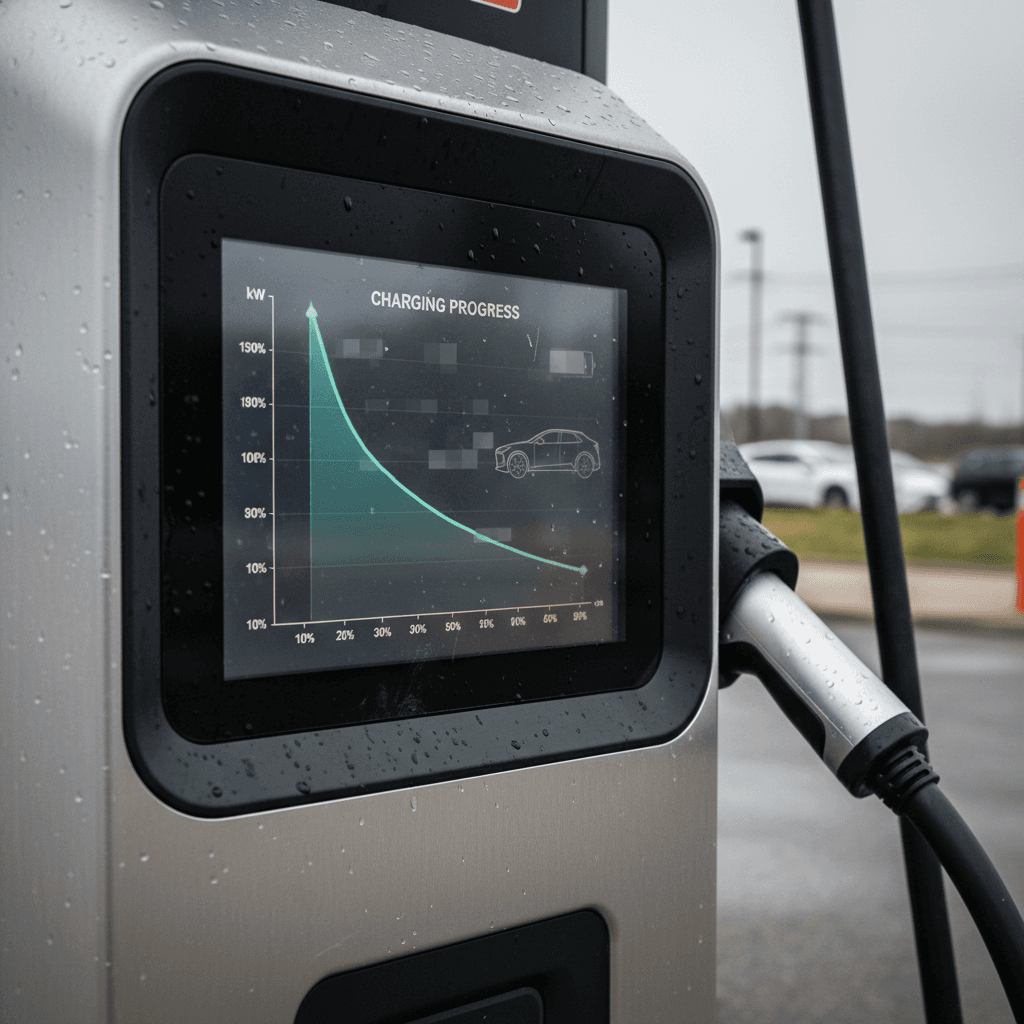
- See power begin to taper, often into the 30s by the time you hit 70–75%, and further down as 80% approaches.
- Unplug around 80% with about 60–70 miles of realistic mixed-use range added back into the pack.
In time terms, that 20–80% window works out to about 35–40 minutes on a healthy, warm pack. Because the battery is so small, each minute of charging buys fewer miles than you might expect, roughly 1.5–2.0 miles of real‑world range per minute at good DC rates, compared with 3–5 miles per minute in bigger, faster‑charging EVs.
Pro tip: Warm the battery before testing
How long to charge a Mazda MX-30 in common scenarios
Specs and one-off tests are helpful, but what you really care about is how long you’ll be sitting at the charger in day-to-day life. Here’s what to expect in the most common scenarios, assuming a healthy battery and mild weather.
Mazda MX-30 charging scenarios
Approximate times based on real-world reports and published specs.
Overnight at home (Level 2)
Charger: 240 V Level 2 (~6.6–7 kW)
- 20–80%: about 2 hours
- 0–100%: about 6–7 hours
Plug in when you get home and you’ll almost always wake up near 100%.
Quick top-up in town
Charger: 50 kW DC fast
- 20–60%: ~20–25 minutes
- Range added: ≈40–50 miles
Good for turning a school run EV into an impromptu evening errand car.
Highway pit stop
Charger: 50 kW DC fast
- 10–80%: ~45–50 minutes
- 80–90%: another 15–20 minutes (not worth it unless you must)
Best strategy is to stop more often and stay in the 10–80% band.
Don’t chase 100% on DC
Understanding the MX-30’s quirky charging curve
Every EV has a distinct “charging curve”, how many kW it accepts at different states of charge. The MX-30’s curve is conservative, in keeping with Mazda’s generally risk‑averse engineering.
1. Small pack, modest amps
The MX-30 uses a relatively small, low‑energy pack compared with most modern crossovers. That puts a natural cap on how far Mazda wants to push charging power, high current on a small pack creates more heat stress.
So while peak DC power around 50–54 kW doesn’t sound terrible, the total energy going in is modest because there simply isn’t much battery to fill.
2. Early tapering for longevity
Owners and testers report a noticeable taper starting around 55–65% state of charge, with power dropping into the 30s kW, then low 20s as 80% approaches.
This feels slow in the moment, but it’s Mazda’s way of protecting the battery from rapid aging, especially important on a small pack where every kilowatt‑hour of capacity matters.
Feels slower than it is
Level 2 AC: Home and workplace charging for the MX-30
If DC fast charging is the MX-30’s weak side, AC charging is where it quietly makes sense. A 30 kWh usable pack is tiny by modern standards, but it’s almost designed for overnight top‑offs. Even a modest 32‑amp Level 2 wallbox in a garage will refill the car from nearly empty in a standard night’s sleep.
Mazda MX-30 AC charging times
Approximate 0–100% times on different AC sources.
| Charging method | Power | 0–100% time | Use case |
|---|---|---|---|
| 120 V wall outlet (Level 1) | 1.4 kW | ≈18–20 hours | Emergency only; fine for very low daily mileage. |
| 240 V / 16 A (small Level 2) | 3.3 kW | ≈10–11 hours | Apartment or older home wiring; overnight from low SOC. |
| 240 V / 32 A (typical Level 2) | 6.6 kW | ≈6–7 hours | Standard home charger; plug in nightly and forget about it. |
| 11 kW workplace AC (EU spec) | ≈11 kW | ≈3–3.5 hours | Lunch + afternoon and you’re full again. |
Actual times vary with temperature and voltage; think of these as ballpark planning numbers.
Where the MX-30 shines
Can you road-trip in a Mazda MX-30? Yes, but…
You can road-trip in almost anything. People have done cross‑country hauls in air‑cooled Volkswagens and Citroën 2CVs. The question with the MX-30 is whether you can live with its rhythm: short legs, frequent stops, and a hard ceiling on DC speed. For some drivers, that’s tolerable; for others, it’s a non‑starter.
Road-tripping realities in an MX-30
What a 300–350 mile day actually looks like.
Stop more, drive slower
- Expect to drive roughly 60–80 miles between DC fast charges.
- Plan on 3–4 stops for a 300–350 mile day.
- High speeds (75–80 mph) chew through range; 65 mph is your friend.
Lean into the café lifestyle
- Each 20–80% stop: ~35–40 minutes, perfect for food, coffee, or a short walk.
- You’re traveling on EV time, not airline time. If that sounds relaxing, you’re the target audience.
Routing around CCS changes
Charging best practices to protect your MX-30’s battery
Small batteries age faster if abused. The MX-30 doesn’t have much excess capacity to lose, so good charging habits matter more here than in a 77 kWh crossover that starts with range to burn. The goal is to keep the pack living in its comfort zone: moderate state of charge, moderate temperature, and no chronic fast‑charging abuse.
Battery-friendly charging habits for MX-30 owners
1. Live between 20–80% most days
Don’t treat 100% as your default. For daily commuting, aim to leave home at 70–80% and return around 30–40%. Save full charges for days when you truly need maximum range.
2. Prefer Level 2 over repeated DC
DC fast charging is fine for trips, but living on DC, especially from low states of charge to 100%, heats and stresses the pack. Make Level 2 at home or work your primary fueling method.
3. Avoid sitting at 100%
If you must charge to 100% for an early-morning trip, time the charge so it finishes close to departure. Parking at 100% for days in hot weather is a recipe for faster degradation.
4. Don’t panic about occasional abuse
One or two badly timed fast charges won’t kill the battery. What matters is the pattern over months and years. Aim for good habits 80–90% of the time.
5. Watch temperature extremes
If your MX-30 lives in a very hot or very cold climate, expect some range loss and slower fast-charging. Whenever possible, park in shade or a garage and precondition the cabin while plugged in.
Buying a used Mazda MX-30? Charging checklist
Because Mazda has already discontinued the MX-30 in the U.S. and is winding it down in other markets, most examples you’ll find now are used. That actually plays to its strengths: low-mileage city cars with gentle use can be excellent values, if the battery and charging behavior check out.
Used Mazda MX-30 charging & battery checklist
1. Test DC from ~20–70%
On a healthy MX-30 and a good 50 kW charger, you should see power ramp into the 40–50 kW range and hold there through at least 50–60% before tapering. An unusually flat 20–25 kW plateau may indicate pack or thermal issues.
2. Compare displayed range to spec
At 100% charge in mild weather, you should see something in the ballpark of 90–110 miles projected, depending on recent driving. A car showing 60–70 miles at full might have a tired battery, or just a very heavy‑footed previous driver; reset trip data and recheck.
3. Listen for charging noises
Fans and coolant pumps during DC fast charging are normal. Loud, cycling noises accompanied by frequent charge interruptions are not. If the session keeps faulting, have the car inspected.
4. Verify home charging setup
Factor the cost of installing a proper Level 2 charger into your budget if the car doesn’t come with one and you don’t already have suitable infrastructure. A car this range‑limited really needs easy, reliable overnight charging.
5. Get objective battery data
A professional battery health report, like the <strong>Recharged Score</strong> that comes with every EV we list, can quantify remaining capacity and flag abnormal degradation before you sign anything.
How Recharged can help
FAQ: Mazda MX-30 charging speed and real-world use
Frequently asked questions about MX-30 charging
Bottom line: Who the MX-30’s charging works for
Viewed through the lens of 300‑mile crossovers and 250 kW charging, the Mazda MX-30 looks hopelessly outgunned. But that’s the wrong comparison. Treated as what it really is, a handsome, well‑made city EV with a scooter’s sense of range, it starts to make sense. The charging speed test verdict is simple: the MX-30 charges quickly enough for the size of its battery, but the battery is so small that you’ll be watching the trip planner more than the scenery on longer drives.
If your life is built around short commutes, reliable Level 2 at home, and the occasional carefully planned weekend away, the MX-30’s charging quirks are manageable, even charming. If you’re chasing spontaneous 400‑mile days, they’re a deal‑breaker. In either case, going in with clear expectations, and, ideally, a verified battery health report from a partner like Recharged, will tell you whether this beautifully odd little Mazda fits your electric life.